
How to Turn Website Visitors Into Actual Shipping Enquiries
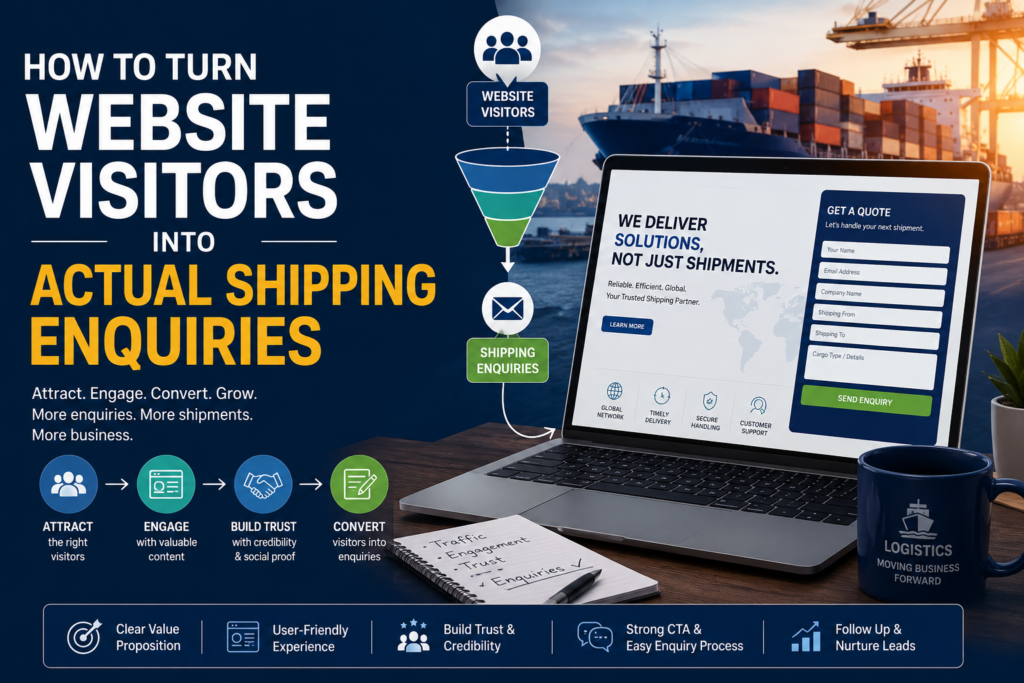
How to Turn Website Visitors Into Actual Shipping Enquiries
Most freight forwarders in India don't have a traffic problem. They have a trust problem.
Your website gets visits. Someone searches for a forwarder handling exports out of Nhava Sheva, lands on your homepage, scrolls for eleven seconds, and leaves without filling a single form. That's not a marketing budget issue — that's a signal issue. Google Analytics will tell you people showed up. It won't tell you why they didn't trust you enough to ask for a quote.
This is exactly what Google's own quality framework — E-E-A-T (Experience, Expertise, Authoritativeness, Trustworthiness) — was built to measure. It was designed to help Google rank pages. But the uncomfortable truth for most freight forwarding websites is that the same signals that convince Google to rank you are the same signals that convince a shipper to actually click "Request a Quote."
A shipper doesn't fill out your enquiry form because your website looks nice. They fill it out because, in the ten seconds they spent on your page, something told them: these people actually move cargo, they know what they're doing, other companies trust them, and my shipment is safe in their hands. That's E-E-A-T, translated out of Google's algorithm and into your bottom line.
This applies whether your enquiries are coming from exporters near JNPT (Nhava Sheva) and Mundra, importers routing through Chennai and Kolkata/Haldia, or businesses working the Cochin, Vizag (Visakhapatnam), Tuticorin, Kandla, and Krishnapatnam corridors. The port doesn't change the psychology. The buyer on the other side is always asking the same silent question: can I trust this forwarder with my cargo and my deadline?
Why most freight forwarding websites fail on E-E-A-T without realizing it
Walk through ten Indian freight forwarding websites and you'll see the same pattern repeat: a generic hero banner with a container ship stock photo, a services list copied almost word-for-word from a competitor, an "About Us" paragraph that says "we have years of experience" without naming a single year, route, or client, and a contact form that asks for eight fields before it lets someone send a message.
None of that is dishonest. But none of it is evidence either. And evidence is what E-E-A-T actually rewards — both in Google's eyes and in a shipper's eyes.
Experience
Proof you've actually handled cargo like theirs — specific ports, specific commodities, specific problems solved.
Expertise
Depth of knowledge that shows in your content and team — not just claims, but demonstrated understanding.
Authoritativeness
Third-party signals — associations, certifications, reviews, mentions — that confirm you are who you say you are.
Trustworthiness
Transparency in how you operate — pricing logic, response times, real contact details, real people.
Here's how each one converts a passive visitor into an actual enquiry — with specific fixes you can make this week.
Experience: show the shipment, not the slogan
"Years of experience in freight forwarding" is the single most repeated, least believed sentence on Indian logistics websites. It carries zero information. A shipper reading it learns nothing about whether you can handle their specific cargo, route, or deadline.
Replace claims with cases. Every forwarder has stories sitting in WhatsApp threads and email chains that never make it onto the website — a container that made a tight vessel cutoff out of Mundra, a temperature-sensitive shipment coordinated through Cochin, a customs hold at Chennai that got resolved in a day instead of a week. These are exactly the details that build experience signals.
What to actually do
- Add a "Recent Shipments" or "Cases We've Handled" section with 4–6 short, specific write-ups — commodity, origin/destination, port used, and what you solved. No client names needed if confidentiality is a concern; the specificity is what matters, not the name.
- Name the ports you operate through explicitly on your homepage and service pages, instead of a vague "Pan-India" claim. A shipper near Vizag searching for a forwarder wants to see Vizag mentioned, not inferred.
- Use real photos from your operations — even phone photos of a container being stuffed or a truck at a CFS — over stock imagery. Real, unpolished photos consistently outperform stock photos for enquiry conversion because they read as evidence, not decoration.
Expertise: content that proves you know the job, not just the industry
There's a difference between a page that says "we offer FCL and LCL services" and a page that explains, in plain language, when a business should choose FCL over LCL out of a specific Indian port, what the cost trade-off actually looks like, and what mistakes cost first-time exporters money. The second version is what search engines and shippers both recognize as expertise.
Many forwarders write blog content aimed at exporters and importers — HS code lookups, IEC registration steps, documentation checklists. That content brings traffic, but it rarely converts, because the person searching "how to get IEC code" is doing their own paperwork, not hiring a forwarder yet. Content that converts speaks to the business owner deciding who to trust with their shipment — not the person still figuring out compliance basics.
What to actually do
- Publish content answering the questions a shipper asks right before choosing a forwarder: "What determines freight forwarding costs from Nhava Sheva to the Middle East," "How to compare freight quotes without getting burned by hidden charges," "What causes shipment delays at Chennai port and how forwarders prevent them."
- Put a named, credentialed person behind the content — your ops manager, your customs specialist — with a short bio. Anonymous, unsigned advice reads as generic; a name attached to real experience reads as expertise.
- Keep compliance content (IEC, HS codes, documentation) on the site if you want it for broader traffic, but don't rely on it to drive enquiries — pair it with a next step aimed at forwarder-selection intent.
Authoritativeness: let other sources vouch for you
Authoritativeness is the one E-E-A-T pillar you can't build entirely on your own website — it depends on the rest of the internet backing up what you claim about yourself. For a freight forwarder, that means the signals a shipper (and Google) can verify independently.
What to actually do
- Display verifiable credentials prominently — customs broker license, FIATA/IATA affiliation, MSME registration, ISO certification if held — with the certificate numbers visible, not just the logos.
- Actively collect Google Business Profile reviews after successful shipments. A forwarder with 40 reviews at 4.7 stars converts enquiries at a completely different rate than one with three reviews or none.
- Get listed on the directories that matter for logistics — port authority vendor lists, trade association member directories, Clutch and GoodFirms if you offer broader supply-chain services. Each one is a third party confirming you're real.
- If a client, chamber of commerce, or trade publication has ever mentioned your company, link to it. A single credible external mention does more for trust than another paragraph about yourself.
Trustworthiness: remove every reason to hesitate before enquiring
This is where most of the lost enquiries actually happen — not because the visitor didn't trust the company overall, but because something small on the page created hesitation at the exact moment they were about to act.
What to actually do
- Shorten your enquiry form. Cargo type, origin, destination, and a contact method is enough to start a conversation. Every extra required field is a reason to abandon the form.
- Add a WhatsApp enquiry option alongside the form. Many Indian shippers will message on WhatsApp before they'll fill out a web form — meet them where they already are.
- State your response time. "We respond to quote requests within 4 business hours" removes the biggest unspoken fear: submitting a form and hearing nothing back.
- Show real people. A team page with actual photos and roles — not stock headshots — tells a visitor there are real humans handling their cargo, not a faceless intermediary.
- Be upfront about how pricing works, even without exact numbers. A short explainer on what drives freight cost (weight, volume, route, season) sets honest expectations and prevents shippers from bouncing to a competitor who "seems more transparent."
Port-specific pages convert better than one generic "services" page
Most freight forwarding websites have a single "Services" page trying to speak to every shipper, on every route, out of every port, at once. It's efficient to build and almost impossible to convert well, because a business owner searching for a forwarder near Mundra and a business owner searching near Cochin are asking subtly different questions — different transit times, different congestion patterns, different customs realities at that specific port.
A dedicated page for each major port you serve — even a few hundred words — lets you speak directly to that shipper's situation instead of forcing them to guess whether you actually operate where they need you to.
What a strong port page includes
- The port name in the H1 and opening line — "Freight Forwarding Services at JNPT (Nhava Sheva)" reads as relevant in a way "Freight Forwarding Services" doesn't.
- Typical transit times and common trade lanes you handle from that port.
- A note on anything shippers commonly worry about at that specific port — congestion at JNPT during peak season, weather-related delays at Kolkata/Haldia during monsoon, capacity constraints at Mundra.
- A port-specific enquiry form or WhatsApp link, so the visitor doesn't have to hunt for a generic contact page.
This also compounds your E-E-A-T signals: each port page becomes another piece of evidence that you have genuine, granular experience with that location — not a copy-pasted claim of "pan-India coverage."
Conversion killers that undo good E-E-A-T work
You can get every trust signal right and still lose the enquiry if the mechanics of the page work against you. These are the quiet conversion killers that show up again and again on freight forwarding websites.
Slow-loading pages on mobile
A large share of Indian B2B search traffic — including shippers researching forwarders — happens on mobile, often on a mid-range connection. A homepage loaded with unoptimized stock photography can take 6–8 seconds to load, and a meaningful share of visitors won't wait that long. Every second of load time past roughly three seconds measurably reduces the odds of a visitor sticking around to trust you, let alone enquire.
The enquiry form buried below the fold
If someone has to scroll through your entire "About Us" story before they find a way to contact you, you're relying on patience you haven't earned yet. A visible, persistent way to enquire — a sticky WhatsApp button, a "Get a Quote" button in the header — should be reachable from the first screen they see, on every page, not just the homepage.
No confirmation after submission
A form that submits with no visible confirmation — no "we've received your enquiry, here's what happens next" message — leaves the visitor uncertain whether it worked at all. Some will simply try a competitor's site instead of waiting to find out. A clear confirmation, paired with an automatic acknowledgement email or WhatsApp message, closes that gap immediately.
Generic thank-you pages that end the relationship
Most freight forwarders treat the thank-you page as the finish line. It's actually a second opportunity: a short line on what happens next ("Our team will call you within 4 hours") paired with a WhatsApp link for anyone who wants to add details immediately, rather than wait for a callback, captures shippers who are ready to move faster than your response time.
What happens after the enquiry matters just as much
E-E-A-T doesn't stop working the moment someone submits a form — the follow-up is where trust either gets confirmed or quietly destroyed. A shipper who filled out a form because your website looked credible will re-evaluate that credibility the moment they see how you actually respond.
What to actually do
- Respond faster than you promised, not slower. If your website says "within 4 hours," a reply in 45 minutes reinforces every trust signal the page already built. A reply in 24 hours undoes it.
- Send a real quote, not a form response. An auto-generated PDF with no context reads as impersonal. A short, specific reply — referencing their actual cargo, route, and timeline — signals that a real person with real expertise looked at their enquiry.
- Follow up once, not five times. A single, well-timed follow-up a few days later ("checking if you had questions on the quote") reads as attentive. Repeated follow-ups read as desperate and undo trust rather than build it.
Google increasingly treats engagement and reputation signals — reviews mentioning responsiveness, repeat business, complaint patterns — as part of trustworthiness. The follow-up process isn't just good customer service; over time, it's also what generates the reviews and referrals that feed back into your website's authority signals.
A quick self-check: is your website actually enquiry-ready?
Before publishing new content or running paid traffic to your site, it's worth checking whether the site itself is ready to convert what it already gets. Ask honestly:
- Does your homepage name specific ports and trade lanes, or only vague claims like "pan-India" and "global network"?
- Can a visitor find at least one specific, real shipment example within 15 seconds of landing on the site?
- Is there a named person — with a photo — behind at least one piece of content or the team page?
- Are your certifications and association memberships visible, with verifiable numbers, not just logos?
- Can someone enquire in under 4 form fields, or via WhatsApp, from the very first screen?
- Does your site state a response time anywhere?
- Do you have more than a handful of visible, recent Google reviews?
Most Indian freight forwarding websites will honestly answer "no" to at least four of these. Each "no" is a specific, fixable gap — not a sign that you need a full redesign, just a sign of where the next hour of work should go.
Bringing it together: the enquiry-ready freight forwarder homepage
If you rebuilt your homepage around E-E-A-T tomorrow, it would include, in order: a headline naming the specific ports and trade lanes you serve, 3–4 real shipment examples, visible credentials and review scores, a named team, a short and honest pricing explainer, and a two-field enquiry form with a WhatsApp alternative. Nothing on that list requires a redesign budget — it requires replacing generic claims with specific, verifiable ones.
The forwarders currently winning enquiries out of Mundra, JNPT, Chennai, and every other major Indian port aren't necessarily the biggest operations. They're the ones whose websites answer the shipper's unspoken question — can I trust you — before the shipper even has to ask it.
Frequently asked questions
Is E-E-A-T only a Google ranking factor, or does it actually affect conversions?
Both. E-E-A-T started as guidance for Google's human quality raters, but the same evidence that signals quality to a rater — specific experience, verifiable credentials, transparent operations — is what a shipper is unconsciously scanning for before they trust you with their cargo. Improving it tends to lift both rankings and enquiry rates, often at the same time.
How long does it take to see more enquiries after making these changes?
Conversion-focused changes — shorter forms, WhatsApp buttons, visible response times, real shipment examples — can lift enquiry rates from existing traffic within days, since they don't depend on new visitors, only on converting the visitors already arriving. Authority-building changes — reviews, directory listings, backlinks — compound more slowly, typically over a few months.
Do I need port-specific pages for every port, or just the major ones?
Start with the two or three ports that generate the most of your current business, build those pages properly, and expand from there. A handful of strong, specific port pages will outperform a dozen thin ones every time.
What if I don't have many client reviews yet?
Start asking after every successful shipment, not just the large ones. A short WhatsApp message with a direct Google review link, sent while the shipment is still fresh in the client's mind, converts far better than a generic request sent weeks later.
Want your website audited against these four signals?
RouteRush works exclusively with freight forwarders and logistics companies on marketing that turns port-specific traffic into real quote requests.
Get a Free Website AuditRelated reading
Why Most Freight Forwarding Companies Don't Show Up on Google
Freight Forwarding Services — RouteRush
How Freight Forwarders Can Generate Leads Without Cold Calling
Anshul Kuntewar
Founder & CEO, RouteRush Digital — helping freight forwarders grow across India, GCC, UK, Australia, and South Africa
[…] ownership and record the conversation in the same customer record as email and forms. Our guide to turning website visits into shipping enquiries explores the conversion step in more detail. For UAE campaigns, carry the gateway and onward […]