
How to Build a Freight Forwarding Sales Pipeline That Doesn’t Rely on Relationships
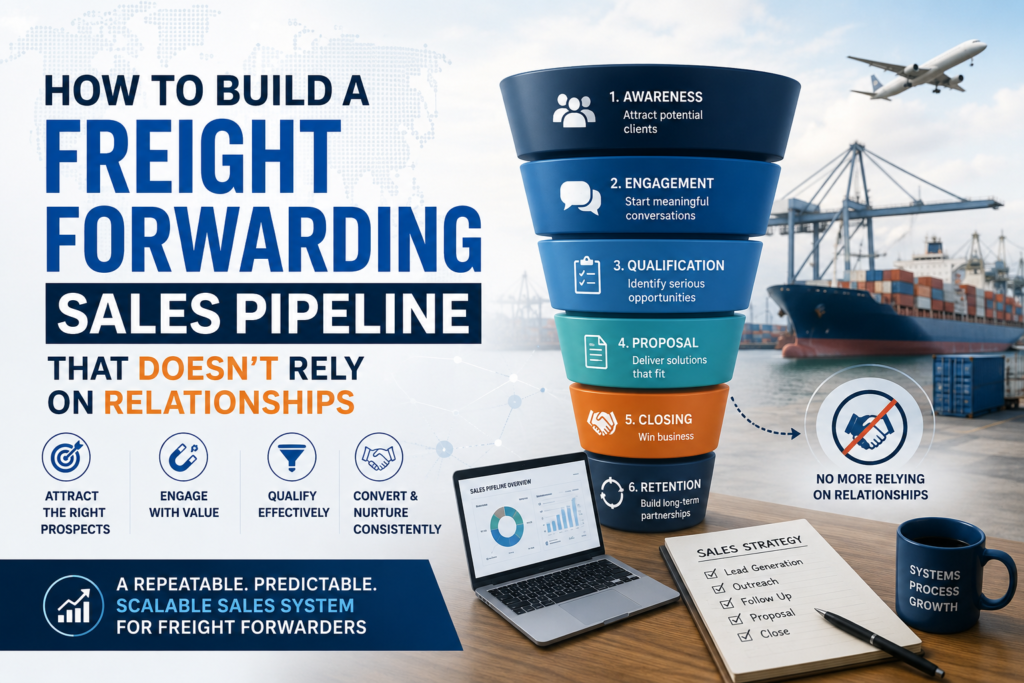
How to Build a Freight Forwarding Sales Pipeline That Doesn't Rely on Relationships
Ask most freight forwarders in India how they get new clients, and the honest answer is usually some version of "referrals" or "people I know from the industry." That's not a criticism — relationships genuinely built this business for decades. But it's also, quietly, the reason so many forwarders hit a growth ceiling they can't explain.
A relationship-only sales model has a hard limit built into it: it can only grow as fast as the owner's or the sales team's personal network grows. It's also fragile in ways that only become visible at the worst possible time — when a key relationship manager leaves, when a long-standing contact retires or switches companies, or when a major client simply gets acquired by a competitor with its own logistics arrangement. The pipeline doesn't just slow down. It can go to zero, almost overnight, because there was never really a pipeline — just a set of personal connections dressed up as one.
A real sales pipeline is something a business owns, not something that lives in one person's contact list. And building one, for a freight forwarder, comes back to the same foundation as everything else in growth: E-E-A-T — Experience, Expertise, Authoritativeness, Trustworthiness. Relationships get a prospect to trust you because they know you personally. A pipeline has to earn that same trust from a stranger, systematically, before a relationship ever exists.
A relationship-dependent business has clients because of who the owner knows. A pipeline-dependent business has clients because a stranger, searching for a forwarder out of Chennai or Mundra or Kandla, found enough evidence on the way in to trust the company before ever meeting a person from it.
This holds regardless of which Indian port anchors your business — whether your strongest lanes run out of JNPT (Nhava Sheva), Mundra, Chennai, Kolkata/Haldia, Cochin, Vizag, Tuticorin, Kandla, or Krishnapatnam. The pipeline mechanics are identical. Only the specific trade lanes and seasonal patterns change.
Why the relationship-only model quietly caps your growth
Relationship-based sales feels efficient because it converts well — a warm introduction closes faster than a cold enquiry almost every time. The problem isn't the conversion rate. It's the volume ceiling underneath it. A single owner or sales lead can only maintain so many genuine relationships at once, and every new relationship takes months or years to build to the point where it produces business.
That ceiling shows up as a specific, familiar pattern: growth that plateaus right around the size of the founder's or senior team's personal network, no matter how good the service is. Revenue tracks relationships, not capability — and capability is usually the thing that's actually ready to scale first.
Experience
Documented and published, so a stranger can see it — not just known by the people you've personally worked with.
Expertise
Demonstrated in content and conversation, so a prospect can evaluate it without needing an existing relationship to vouch for it.
Authoritativeness
Confirmed by third parties — reviews, associations, certifications — that a relationship would otherwise have provided informally.
Trustworthiness
Built into how the business operates and communicates, replacing the personal trust a relationship used to carry.
A pipeline, at its core, is what replaces each of these with a repeatable, ownable system — one that keeps working whether or not any single person is in the room.
Stage 1: Build the evidence before you need it
Every pipeline starts with awareness, but awareness without evidence just produces traffic that doesn't convert — the same problem covered in turning website visitors into actual enquiries. Before any outbound activity, the foundation needs to already be in place: a website and LinkedIn presence that show real experience, named ports, real shipment examples, visible credentials, and reviews. This is the work that used to happen invisibly, over years, through relationships. A pipeline does it deliberately, in public, upfront.
What this looks like in practice
- Port-specific pages and content that let a stranger self-qualify — "yes, they operate where I need them to" — without ever speaking to your team.
- A steady drumbeat of specific, useful content (not generic industry posts) that builds expertise signals over months, not a one-time push before a sales campaign.
- Reviews and credentials collected continuously, from every shipment, not scrambled together right before a big pitch.
Stage 2: Replace "who you know" with structured outbound
Once the evidence exists, outbound activity — LinkedIn outreach, cold email, directory presence — can actually convert, because a stranger receiving a message can verify the claims in it. This is the stage most forwarders try to run first, without the groundwork in place, which is why cold outreach so often produces disappointing results: the message is fine, but there's nothing behind the sender's name to make a stranger trust it.
A structured outbound system means defined, repeatable steps — not a founder personally messaging contacts when there's a lull in business. It should run whether or not the owner has time that week, using the same identity + specific finding + implication + soft CTA structure that makes cold outreach work in 2026, applied consistently rather than in occasional bursts.
Stage 3: Capture and qualify enquiries the same way every time
A relationship-based pipeline often has no real qualification process — a contact calls, and the deal either happens or doesn't, based on the relationship alone. A structured pipeline needs a consistent way to capture every enquiry (web form, WhatsApp, LinkedIn reply, referral) into one place, and a simple, repeatable way to qualify it: cargo type, route, volume, and timeline, gathered the same way regardless of which channel it came in through or who on the team received it.
Without a consistent capture process, enquiries live scattered across someone's WhatsApp, another person's inbox, and a notebook by the phone. Nothing gets tracked, nothing gets a reliable follow-up, and the business has no real visibility into how many opportunities it's actually generating — or losing.
What to actually do
- Use even a simple CRM or shared spreadsheet — the tool matters far less than the discipline of using it for every single enquiry, not just the promising ones.
- Define what "qualified" means for your business (a minimum volume, a served route, a realistic timeline) so time isn't spent chasing enquiries that were never going to convert.
- Assign ownership for every enquiry immediately, so nothing sits waiting for whoever happens to be free.
Stage 4: Follow-up that doesn't depend on memory
In a relationship-driven business, follow-up happens because the owner remembers to call their contact. In a pipeline-driven business, follow-up happens on a schedule, regardless of who remembers what. This is usually the single biggest gap between forwarders who convert enquiries well and those who don't — not the quality of the initial quote, but whether anyone reliably follows up on it.
A realistic follow-up cadence
- Same day or next morning: Quote sent, referencing the specific enquiry details — not a generic template.
- 3–4 days later: A short, low-pressure check-in — "wanted to see if you had any questions on the quote."
- 10–14 days later: A final, easy follow-up, with an offer to revisit if timing wasn't right — closing the loop without repeated pestering.
- Ongoing: Anyone who didn't convert gets added to a periodic, low-frequency nurture list — a useful update every month or two, not a sales pitch.
None of this requires the owner's personal involvement once it's set up. That's the entire point — it's a system the business runs, not a habit one person has to remember.
Stage 5: Systemize referrals instead of hoping for them
Referrals aren't the problem with relationship-based selling — leaving them entirely to chance is. A pipeline treats referrals as a stage to manage deliberately, not a lucky accident.
What to actually do
- Ask for a referral at a specific, repeatable moment — right after a shipment closes successfully, when satisfaction is highest — rather than occasionally, whenever it crosses someone's mind.
- Make it easy: a simple message a satisfied client can forward, rather than asking them to write something from scratch.
- Track referral sources the same way you track any other pipeline stage, so you know which relationships and which clients are actually generating new business — and can invest more deliberately in those.
What a port-anchored pipeline looks like end to end
Put together, a pipeline for, say, a forwarder specializing in the Mundra–Gulf lane looks like this: port-specific content and a credible LinkedIn presence generate inbound awareness; structured outbound messages reference specific, verifiable details about each prospect's shipments into the Gulf; every enquiry — whether from the website, WhatsApp, or a LinkedIn reply — lands in the same tracking system; follow-up runs on a fixed schedule regardless of who's available that week; and every closed shipment triggers a referral ask and a review request. No single stage depends on one person's memory, network, or availability — which means the pipeline keeps producing enquiries even through a slow season, a team change, or a founder's vacation.
Common mistakes when building this out
- Building outbound before the evidence exists. Sending polished outreach from a thin website or empty LinkedIn profile undercuts the message before it's even read.
- Treating the CRM as optional. A pipeline that only gets logged "when there's time" isn't a pipeline — it's the same ad hoc system with extra steps.
- Following up inconsistently. A single missed follow-up on a promising enquiry often costs more revenue than an entire month of outbound effort.
- Asking for referrals only from your biggest clients. Smaller, happy clients refer just as often — and are usually easier to ask.
Bringing it together
A relationship-only sales model isn't wrong — it's incomplete. The forwarders growing steadily out of JNPT, Mundra, Chennai, and every other major Indian port in 2026 aren't the ones with the biggest personal networks. They're the ones who've turned trust into something the business itself produces — through evidence, systems, and consistency — so growth no longer depends on any one person's contact list.
Frequently asked questions
Does building a pipeline mean I should stop relying on relationships?
No — existing relationships remain valuable and often convert fastest. The goal is to stop being dependent on them as the only source of new business, so growth isn't capped by how many personal contacts one person can maintain.
How long does it take to see results from a structured pipeline?
The mechanical stages — capture, qualification, follow-up — can improve conversion from existing enquiries almost immediately. The evidence-building stages — content, reviews, credentials — typically take a few months to compound into a meaningfully different inbound flow.
Do I need a full CRM system to do this properly?
No. A well-maintained spreadsheet used consistently for every enquiry outperforms an expensive CRM that's used inconsistently. The discipline matters far more than the tool.
What's the very first step if I'm starting from a purely relationship-based business today?
Start with capture and follow-up — put every current and new enquiry into one tracked place and put a fixed follow-up schedule in place. It's the fastest-to-implement stage and often reveals how much business was previously being lost to inconsistent follow-up alone.
Want a pipeline built around your actual ports and lanes?
RouteRush helps freight forwarders build the evidence, outbound, and follow-up systems that turn strangers into clients — without relying on any one person's contact list.
Talk to Us About Your PipelineRelated reading
How to Turn Website Visitors Into Actual Shipping Enquiries
LinkedIn Outreach for Freight Forwarders: What Actually Works in 2026
How Much Should a Freight Forwarder Spend on Digital Marketing in India? (2026)
Anshul Kuntewar
Founder & CEO, RouteRush — helping freight forwarders grow across India, GCC, UK, Australia, and South Africa