
NDIS Provider Website Checklist: SEO & Trust Guide
NDIS Marketing · Website Strategy
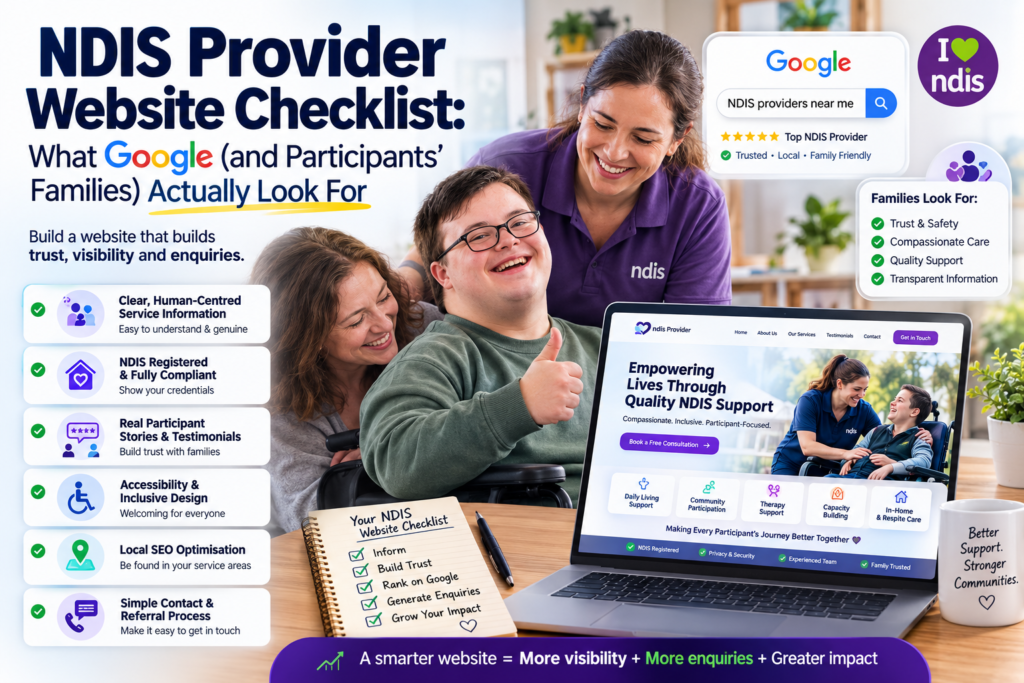
NDIS Provider Website Checklist: What Google (and Participants' Families) Actually Look For
A quick gut check before you read on: could a stranger land on your homepage right now and tell, in five seconds, that you're registered, where you operate, and that real families trust you? If not, this checklist is for you.
If you run an NDIS business, your website isn't a brochure. It's usually the first place a participant's parent, carer, or support coordinator lands before they ever pick up the phone — and in a sector built on trust, that first impression decides whether they call you or the provider three tabs over.
Right now, more than 774,000 Australians are benefiting from the NDIS, supported by a provider market that's grown to well over 21,000 registered organisations — up sharply year on year as demand for disability support continues to climb. That growth is good news for the sector, but it also means families have more choice than ever, and providers have more competition for the same searches. With mandatory registration rules for SIL and platform providers coming into effect from 1 July 2026, the providers who look credible and easy to verify online are the ones who'll keep winning that first click.
So what actually makes an NDIS provider website work — for Google's ranking algorithm and for the anxious parent scrolling through search results at 11pm? Here's the checklist.
1Lead with trust signals, above the fold
Families choosing disability support aren't browsing casually — they're making a decision that affects someone they love. Your homepage needs to answer "can I trust this provider?" before it answers anything else.
Include, visible without scrolling:
- Your NDIS registration status (registered, or NDIS-friendly non-registered — say which, clearly)
- The service categories you're funded/qualified to deliver (e.g. Core Supports, Capacity Building, SIL, SDA)
- Your service area — named suburbs and cities, not just "Australia-wide"
- A real phone number and a way to make contact without filling a 12-field form
2Build city and region pages, not just one generic "Services" page
NDIS support is inherently local — a family in Parramatta isn't going to drive across Sydney for in-home care, and a provider in regional Queensland needs to show up when someone searches "NDIS provider Toowoomba," not just "NDIS provider Australia."
If you operate across multiple areas, build a dedicated page for each major city and region you serve:
- Sydney
- Parramatta
- Newcastle
- Melbourne
- Geelong
- Ballarat
- Brisbane
- Gold Coast
- Sunshine Coast
- Townsville
- Perth
- Adelaide
- Canberra
- Hobart
- Darwin
Each page should mention the specific suburbs you cover, any local staff or on-the-ground team, and services available in that area. This is one of the highest-leverage SEO moves for an NDIS business — 98% of people now search online for nearby businesses, and Google needs those location signals to know when to show you.
3Make your reviews impossible to miss
Reviews are doing more work in a family's decision than almost anything else on your site. Providers with 50+ genuine Google reviews generate dramatically more enquiries than those with only a handful, and the large majority of people read reviews before choosing a provider at all.
- Actively ask satisfied participants, families, and support coordinators for Google reviews
- Embed a review widget or testimonial section on your homepage and service pages
- Respond to every review, positive or negative — responsiveness itself builds trust
- Keep your Google Business Profile fully filled out (photos, hours, services, service area)
4Answer the questions families are actually typing into Google
Search behaviour for NDIS services is driven by real, specific questions. Your site should answer them directly — not bury them in generic "about us" copy. A dedicated FAQ section (with structured/schema markup) also gives Google clean, quotable answers to surface directly in search results.
How do I choose an NDIS provider I can trust?
Check their registration status with the NDIS Quality and Safeguards Commission, read recent reviews, and confirm they clearly list the specific supports they're qualified to deliver in your area.
Does an NDIS provider need to be registered to support me?
Not always — it depends on how your plan is managed (self-managed, plan-managed, or NDIA-managed) and the type of support. From 1 July 2026, registration becomes mandatory for SIL and platform providers specifically, so this is worth stating clearly on your site if it affects you.
What's the difference between Core Supports, Capacity Building, and Capital Supports?
A short, plain-language explainer here does double duty — it helps confused first-time visitors and is exactly the kind of content Google rewards with featured snippets.
How do I switch NDIS providers if I'm not happy?
Families search this constantly. Providers who answer it honestly, rather than avoiding the topic, come across as more trustworthy, not less.
Can I use an NDIS provider outside my local area?
Answer this per your actual service radius — and link straight to your city/region pages.
5Show real experience, not just claims
"We're passionate about care" tells Google and families nothing. What builds credibility:
- Staff bios with qualifications (Certificate III/IV in Disability, relevant allied health credentials, years of experience)
- Case studies or outcome stories (with consent) — e.g. a participant's progress toward a goal
- Photos of your actual team and facilities, not stock imagery
- Any accreditations, partnerships, or sector affiliations clearly listed
6Fix the basics Google penalises silently
- Mobile-first: the large majority of local, high-intent searches happen on a phone. If your site is slow or hard to tap through on mobile, you're losing the exact moment someone was ready to call.
- Page speed: every extra second of load time increases the chance someone bounces back to search results.
- Clear calls-to-action: "Enquire Now," "Check Availability," "Call Us" — repeated at the top, middle, and bottom of every page.
- Accessibility: alt text, readable fonts, good colour contrast, and screen-reader compatibility aren't optional for a disability services website — they're a credibility signal in themselves.
Why this matters more in 2026
| Metric | Why it matters for your website |
|---|---|
| 774,456+ Australians currently benefiting from the NDIS | The addressable market is large and still growing — but so is competition for visibility |
| 21,000+ registered NDIS providers nationally, growing year on year | Generic, unclear websites get lost in a crowded field |
| Mandatory registration for SIL/platform providers from 1 July 2026 | Registration status becomes an even bigger trust and compliance signal to display clearly |
| 98% of consumers search online before choosing a local business | Your website is doing the work a phone book used to do — it needs to be found |
| Providers with 50+ reviews earn significantly more leads than those with under 10 | Review volume is now a direct revenue lever, not a vanity metric |
| Complete business profiles see notably higher visit and enquiry rates | Filling out every field (services, hours, area, photos) isn't busywork — it converts |
The bottom line
Google and a worried parent are, surprisingly, looking for the same thing: proof that you are who you say you are, that you serve their area, and that other people trust you. A website that leads with registration status, local service pages, real reviews, and honest answers to the questions families are actually asking will consistently outperform a polished-but-generic site — both in search rankings and in the enquiries that actually convert to intake calls.
Want your NDIS website audited against this checklist?
RouteRush helps NDIS providers across Australia turn website visits into intake calls.
Get a Free Website ReviewThis checklist reflects NDIS provider market data current as of mid-2026. Registration requirements are subject to change — always confirm current rules with the NDIS Quality and Safeguards Commission before publishing compliance claims on your website.