
LinkedIn Outreach for Freight Forwarders in Qatar (2026)
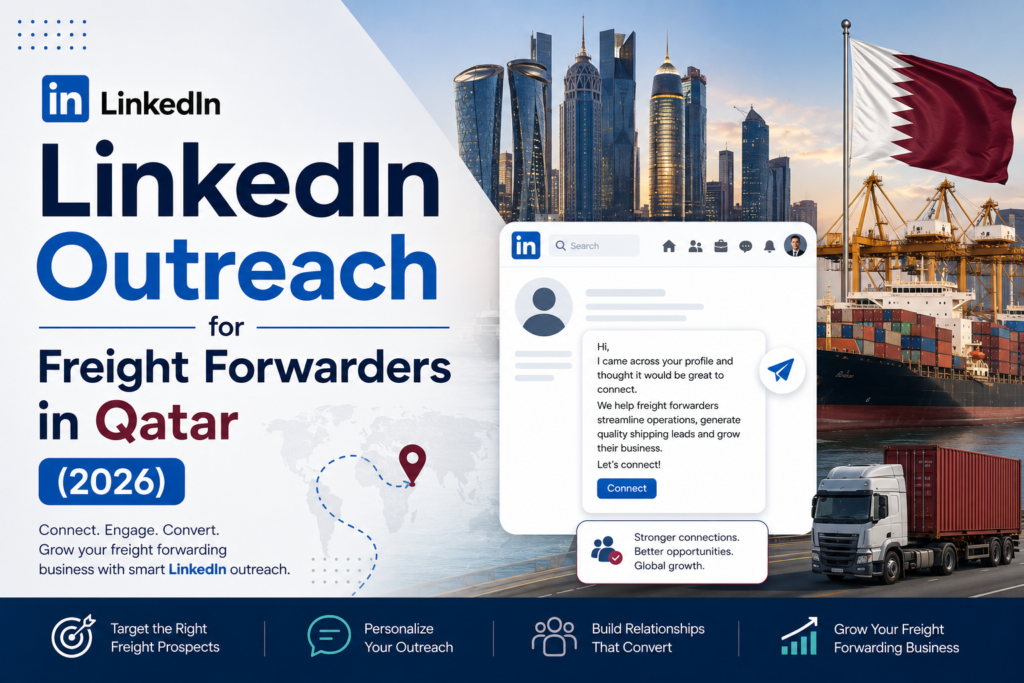
Freight Forwarding Marketing · LinkedIn Outreach
LinkedIn Outreach for Freight Forwarders in Qatar: What Actually Works in 2026
89% of prospects on LinkedIn now get 15+ connection requests a week. Generic outreach is drowning in noise — but the freight forwarders sending fewer, sharper messages are still booking meetings.
What's Covered In This Guide
- Why LinkedIn Outreach Matters for Qatar Freight Forwarders Right Now
- 7 Things That Actually Work on LinkedIn in 2026
- What's Quietly Killing Your Response Rate
- Where to Focus Outreach, Port by Port
- A Practical Weekly Roadmap
- Frequently Asked Questions
Why LinkedIn Outreach Matters for Qatar Freight Forwarders Right Now
Qatar's freight and logistics market is worth an estimated $10.7 billion in 2026 and is projected to reach $13.98 billion by 2031, growing at roughly 5.5% annually. Growth is being driven by capacity upgrades at Hamad Port and Hamad International Airport, free-zone incentives at Ras Bufontas and Umm Alhoul, and sustained government investment under National Vision 2030 — with the North Field LNG expansion alone pushing production toward 142 million tonnes annually by 2030. Hamad Port handled 7.5 million TEU in 2024 and continues expanding, positioning Doha as an increasingly high-efficiency hub within the wider Gulf supply chain. That's a compact but fast-growing market — and LinkedIn is where most Qatari logistics decision-makers, from procurement leads to supply chain directors, actually spend their professional attention.
But LinkedIn outreach in 2026 looks nothing like it did even two years ago. Nearly 90% of prospects now receive more than 15 connection requests a week, and connection-request reply rates have dropped 37% year-over-year as inboxes get noisier. The freight forwarders still generating real pipeline from LinkedIn aren't sending more messages — they're sending fewer, better-targeted ones.
7 Things That Actually Work on LinkedIn in 2026
A personalized note on every connection request. This is the single highest-leverage habit in outreach right now. Personalized connection requests convert at roughly 45-48%, compared to 15-26% for blank requests — nearly double, sometimes triple. For a freight forwarder, "personalized" doesn't need to be elaborate: referencing the prospect's specific trade lane, industry, or a recent company announcement is enough.
Warm-first sequencing, not cold blasts. Visiting a prospect's profile or engaging with a recent post before sending a request measurably improves acceptance. Sequences that combine a profile visit with a direct message have pushed reply rates as high as 11.87% in recent benchmarking, well above cold outreach alone.
Short messages over long pitches. Well-structured campaigns with tight targeting and short first messages regularly hit 14-17% reply rates — nearly double the platform average. A three-line message asking one clear question consistently outperforms a paragraph explaining your entire service offering.
Trigger-based outreach. Reaching out around a relevant event — a job change, a company expansion announcement, a post about a shipping delay or new trade lane — boosts response rates by roughly 32% compared to outreach with no clear reason for the timing.
Connection requests before InMail, not instead of it. InMail open rates are strong (52-57%), but cost-per-reply runs around $47 versus close to nothing for an organic connection sequence. InMail earns its cost specifically when you're targeting a prospect with zero shared connections and a historically low acceptance rate — for most Qatar freight prospecting, a well-built connection sequence will outperform InMail on both cost and conversation quality.
Follow-ups spaced 2-5 business days apart. A single message rarely does the work. Sequenced, spaced follow-ups consistently outperform one-and-done outreach, without crossing into the kind of daily-ping behavior that gets flagged as spam.
Messaging built around the specific port, lane, or cargo type the prospect actually cares about. A generic "we help freight forwarders grow" message reads as one of dozens a decision-maker received that week. A message referencing their specific corridor — Hamad Port container imports, Ras Laffan LNG logistics, Mesaieed petrochemical exports — reads as researched, not templated.
What's Quietly Killing Your Response Rate
- Generic templates. Roughly 72% of all LinkedIn outreach messages are still generic beyond the recipient's first name — and LinkedIn's spam-detection has gotten materially better at identifying and suppressing them.
- Over-volume. Sending too many requests too fast is the single fastest way to trigger LinkedIn's adaptive restriction algorithm — sustained acceptance rates below 25-30% can trigger automatic throttling on your account.
- Pitching in the first message. Asking for a call or pushing your services before any real exchange has happened is the most common reason a warm connection goes cold immediately after accepting.
- Ignoring day-of-week patterns. Response activity is measurably higher earlier in the week (Sunday through Wednesday in the Gulf working calendar) and drops sharply toward the weekend — sending your best messages on a Friday wastes your strongest content on your quietest audience.
Where to Focus Outreach, Port by Port
Qatar's freight and maritime activity concentrates around a small number of ports, each tied to distinct cargo profiles and buyer behavior. Outreach that references the right one lands very differently than generic Qatar-wide messaging.
Hamad Port, Umm Al Houl
Qatar's primary seaport and one of the world's largest greenfield port developments, handling 7.5 million TEU annually alongside livestock, vehicles, grains, and cereals, with capacity continuing to expand under National Vision 2030. The highest concentration of freight forwarders and logistics decision-makers in the country operates here — outreach referencing container capacity, free-zone integration at Ras Bufontas or Umm Alhoul, or specific import categories lands stronger than generic pitches.
Doha Port
Qatar's original commercial port, now handling a smaller share of cargo following Hamad Port's development but still processing specific imports and maritime tourism traffic. Forwarders and buyers still connected to this port often have longer institutional histories in Qatar's logistics sector — outreach acknowledging that legacy tends to resonate more than a pure volume-focused pitch.
Mesaieed Port (Umm Said)
A major industrial port roughly 45km south of Doha, handling around 48 million tonnes of cargo and 59,000 TEU annually, centered on crude oil, refined products, petrochemicals, and industrial imports like iron ore pellets and cement. Buyers here are heavily industrial and petrochemical-focused — outreach mentioning bulk, project cargo, or industrial logistics performs far better than generic container messaging.
Ras Laffan Port
The world's largest LNG exporting facility and a cornerstone of Qatar's North Field expansion, operated by Qatar Petroleum with six LNG handling facilities and a dedicated sulphur terminal. An extremely narrow, technical buyer segment tied directly to energy logistics — outreach volume here should be low and highly targeted, prioritizing precision over reach.
Al Ruwais Port
Located on Qatar's northern end, handling more than 240 vessels monthly and serving as a maritime gateway for fresh and refrigerated food imports from neighboring countries, alongside conventional cargo. A smaller, regionally focused buyer base — outreach referencing perishable goods logistics or regional trade connectivity tends to land well.
Al Rayyan Marine Oil Terminal
An offshore oil terminal roughly 35 nautical miles off Qatar's northern shore. A highly specialized, technical buyer segment tied to the oil and gas sector — generic freight messaging is unlikely to resonate with this narrow audience.
Halul Island
A dedicated offshore oil storage and export terminal. Similar to Al Rayyan and Ras Laffan, this is an extremely niche, technical buyer segment where a small, precisely targeted outreach list will substantially outperform any broad campaign.
A Practical Weekly Roadmap
| Timeframe | Action |
|---|---|
| Week 1 | Build a tight ICP list segmented by port and cargo specialization, not just job title |
| Week 1 | Write 3-4 short message variants (under 4 lines) referencing specific lanes or ports |
| Week 2 | Start warm-first sequencing: profile visit or post engagement before connecting |
| Week 2 | Send personalized connection notes only — no blank requests |
| Weeks 3-4 | Layer in trigger-based outreach (job changes, expansions, relevant posts) |
| Weeks 3-4 | Add spaced follow-ups (2-5 business days) for non-responders |
| Month 2 | Review acceptance and reply rates by port segment; double down on what's converting |
Frequently Asked Questions
Is LinkedIn outreach still worth it for freight forwarders in Qatar, given declining reply rates?
Yes, directionally — platform-wide averages have compressed, but well-targeted, personalized campaigns are still hitting reply rates of 25-35%, multiple times the platform average. Qatar's small, concentrated buyer base makes precise, personalized outreach even more important relative to broad campaigns than in larger markets.
Should we use InMail or regular connection requests?
For most Qatar freight prospecting, connection requests first. InMail's higher open rate comes at a real cost (roughly $47 per reply versus near-zero for organic sequences) and is best reserved for high-value, technical-buyer segments like LNG or offshore energy logistics where the total addressable list is very small.
How many connection requests can we safely send per week?
Most accounts can safely send 80-100 requests per week. Accounts with strong acceptance rates and Social Selling Index scores can push higher, but sustained acceptance rates below 25-30% risk automatic throttling — quality of targeting matters more than raw volume, especially given Qatar's small total buyer pool.
What should the first message actually say?
Keep it short — three or four lines, referencing something specific to the prospect (their port, cargo type, recent company news) and ending with a low-friction question, not a pitch or a meeting request. Save the service pitch for after a real exchange has started.
How long before LinkedIn outreach starts producing real pipeline?
Most well-structured campaigns show measurable pipeline signal within 4-6 weeks, though the strongest results typically come from segment-by-segment refinement over 2-3 months as you learn which ports and cargo types respond best to which messaging.
Get Started
Ready to Build LinkedIn Outreach That Actually Converts?
We'll build your ICP list by port and cargo specialization, write outreach sequences that reference real trade lanes instead of generic pitches, and track acceptance and reply rates so you know exactly what's working.
Request Your Free LinkedIn Outreach AuditRelated reading
- LinkedIn Outreach for Freight Forwarders in UAE: What Actually Works in 2026
- LinkedIn Outreach for Freight Forwarders in Oman: What Actually Works in 2026
- LinkedIn Outreach for Freight Forwarders in Australia: What Actually Works in 2026
Anshul Kuntewar
Founder, RouteRush Digital Marketing Agency — a freight forwarding marketing agency specialising in LinkedIn outreach, SEO, and lead generation for freight and logistics companies across Qatar, the UAE, Oman, South Africa, India, Australia, and the UK. Connect on LinkedIn →
This guide reflects LinkedIn outreach benchmark and Qatar freight market data current as of mid-2026. Platform algorithms and response patterns change frequently — treat these figures as directional benchmarks, not guarantees.