
Small Freight Forwarders in Thailand vs. DHL & Kerry Logistics
Freight Forwarding Marketing · Thailand
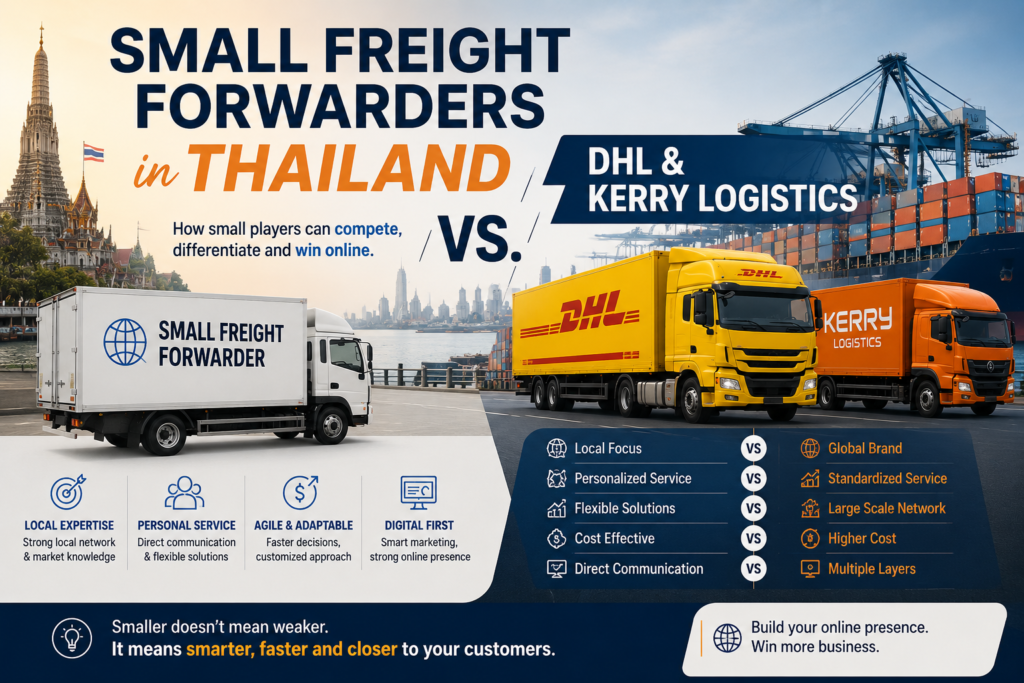
How Small Freight Forwarders in Thailand Can Compete With DHL and Kerry Logistics
On this page
Why This Matters in Thailand Real Pain Points Where Small Forwarders Win Step-by-Step Process Examples in Practice Ports & Corridors Tools Checklist FAQsKerry Logistics Network didn't arrive in Thailand as an outside giant — it built its ASEAN business here from 2002 onward, developed a logistics centre inside Laem Chabang port itself by 2003, and now runs Kerry Siam Seaport as a joint-venture terminal operator alongside its freight forwarding and express arms. Kerry Express alone moves over 1.1 million parcels a day through more than 5,500 service points nationwide.
Why This Matters in Thailand Specifically
DHL operates as one of the two or three largest global integrators in air and ocean freight forwarding worldwide. Between DHL and Kerry, these two names dominate a huge share of what a Thai shipper sees first when they search online. But Thailand's freight market has a structural feature that works in a small forwarder's favor: the country isn't just a seaport economy, it's a land-bridge economy.
A huge and rapidly growing share of trade is now moving by rail and road across Thailand's northern and eastern borders — the China-Laos Railway alone carried over 155,000 tons of Thai durian by the end of last August, up more than 90% year-on-year, and total cross-border freight on that line grew nearly 95% in a single year. That kind of growth, in a corridor most large integrators are still building out capacity for, is exactly where a smaller, more specialized Thai forwarder has room to move faster than either DHL or Kerry.
Real Pain Points Thai Freight Forwarders Actually Deal With
This isn't a generic "small vs. big" problem. These are the specific frictions that show up in day-to-day operations for Thai forwarders, and they're also the openings a large integrator's broad, standardized process often can't address well.
Thai-registered trucks generally can't simply cross into Laos, Cambodia, Myanmar, or Vietnam — cross-border road freight requires country-specific permits, and the rules differ at every crossing.
Documentation standards, inspection timing, and rules-of-origin verification vary between Nong Khai, Mae Sot, Chiang Saen, and the southern crossings into Malaysia.
With over 90% of Thai durian exports bound for China and rail volumes still climbing, exporters need forwarders who understand temperature-controlled logistics and pre-declaration customs specifically.
Ongoing Phase 3 construction periodically affects yard capacity and berth scheduling — communication about this matters more than most forwarders realize.
As RCEP integration deepens, Thai SME forwarders increasingly compete with vertically integrated Chinese platforms moving goods directly.
Documentation for China-bound rail freight increasingly needs to satisfy both Thai and Chinese customs standards — a genuinely scarce skill set.
Where Small Thai Forwarders Actually Win
A forwarder who has fully mapped one specific border crossing offers something neither DHL's global standardization nor Kerry's domestic network is built to replicate at that level of local depth.
Large integrators are built around high-volume enterprise shippers. A first-time durian exporter is exactly the account a small forwarder can serve well and retain long-term.
Thai-Chinese or Thai-Burmese language capability is a real differentiator when a shipper navigates two customs regimes at once.
Personal relationships with customs officials and cross-docking operators at a specific checkpoint can meaningfully reduce dwell time and disputes.
A Practical Process to Compete Online
"China-Laos Railway durian and cold-chain export specialist" tells a visitor exactly what you're built for — far more useful than "comprehensive logistics solutions."
A visitor searching for Chiang Saen river-port logistics should land on a page written specifically for that route.
LINE Official Account is the default business communication tool for most Thai buyers — a forwarder without one is invisible to a huge share of the market.
Checkable facts that build trust with a shipper who has been burned by an unlicensed operator before.
Guides explaining pre-declaration timelines or bilateral permits answer exactly what an exporter is searching for.
A short, regularly updated note on likely delays builds more trust than silence.
Thailand's dominant digital ad channels for SME-to-SME commerce, often outperforming Google Ads for this audience.
Signals credibility to domestic and cross-border shippers evaluating you side-by-side with international competitors.
Tells you where to double down your content and ad spend next season.
What This Looks Like in Practice
The following are illustrative scenarios based on common patterns in the Thai logistics sector, not verified case studies of specific named companies.
A small forwarder specializing in durian and cold-chain rail export. The homepage leads with "Cold-Chain Durian & Perishables Export via China-Laos Railway — Laem Chabang to Kunming," includes a page explaining pre-declaration customs timing, and offers a LINE Official Account for fast first contact during export season.
A CLMV road freight specialist focused on the Nong Khai crossing. Instead of claiming broad Southeast Asian coverage, the company builds one deeply detailed page on Thai-Laos bilateral trucking permits and typical crossing times, becoming the most relevant result for that exact search.
A Chiang Saen river-port forwarder building bilingual trust signals. With Thai and Chinese-language site versions, DBD registration displayed prominently, and a LINE-first contact strategy, the company captures enquiries from both Thai exporters and Chinese buyers sourcing through the northern river route.
Ports & Corridors: What Your Positioning Should Actually Say
| Port / Corridor | Example positioning line |
|---|---|
| Laem Chabang, Chonburi | "LCL and FCL consolidation through Laem Chabang, with live updates during Phase 3 capacity works" |
| Bangkok Port (Khlong Toei) | "Bangkok Port clearance and Chao Phraya river logistics for Greater Bangkok importers" |
| Map Ta Phut, Rayong | "Petrochemical and industrial bulk cargo handling for the Eastern Economic Corridor" |
| Si Racha | "Industrial estate logistics support adjacent to Laem Chabang for EEC manufacturers" |
| Sattahip | "Naval and commercial cargo coordination for Eastern Seaboard exporters" |
| Songkhla | "Southern Thailand container and bulk cargo, with Malaysia border coordination" |
| Ranong | "Andaman Sea freight and Myanmar border trade support" |
| Chiang Saen (Mekong river port) | "Northern Thailand river-border logistics for China and Laos-bound agricultural exports" |
Tools That Help Level the Playing Field
LINE Official Account — the primary channel Thai B2B and B2C buyers expect
DBD e-Registration lookup, so shippers can verify your business status directly
Genuine e-Customs system fluency, communicated clearly on your site
Facebook Ads & LINE Ads — often outperforming Google Ads for Thai SME shippers
Google Search Console and a basic SEO tool to find corridor-specific searches
A simple bilingual CMS supporting Thai and English or Thai and Chinese content
Even a shared spreadsheet, to track enquiries by corridor and season
The Competing-Online Checklist
- Homepage names a specific corridor, port, or commodity — not "nationwide logistics solutions"
- Dedicated pages exist for each port and border crossing you genuinely work
- LINE Official Account is active, monitored, and visible on every page
- DBD registration and any customs broker licensing are displayed near your contact point
- At least one guide exists explaining a specific cross-border process
- Congestion or delay updates are communicated proactively, not left for shippers to discover
- Facebook or LINE Ads are running for your specific niche, not generic brand awareness
- Reviews are collected and displayed in both Thai and English
- Enquiries are tracked by corridor and season to guide where you focus next
Frequently Asked Questions
Can a small Thai forwarder really compete with Kerry Logistics or DHL online?
Yes, particularly for corridor- and commodity-specific searches — China-Laos Railway durian export, Nong Khai trucking permits, Chiang Saen river logistics — where neither company's broad, standardized web presence goes into the same operational depth a specialized local forwarder can offer.
Is the China-Laos Railway durian boom actually a realistic opportunity for a small forwarder?
Yes — durian volumes on that corridor grew nearly 90% year-on-year recently, and the rail model is specifically well-suited to smaller, more flexible consolidated shipments, which favors SME forwarders who understand the process, not just large integrators optimized for bulk volume.
Why does LINE matter more than a website contact form for Thai freight forwarders?
LINE is the default business communication channel for most Thai SMEs and consumers. A forwarder relying only on email or a web form is invisible to buyers who expect to message a business the same way they message anyone else.
How do we compete against Chinese cross-border e-commerce logistics platforms specifically?
Depth and relationship, not scale — genuine local knowledge of Thai customs, border-specific permit processes, and bilingual service for Thai-Chinese trade are advantages a vertically integrated platform typically can't replicate at the individual shipper level.
Should a small forwarder try to cover every Thai port and border crossing?
No — pick the two or three corridors or ports where you have genuine operational depth, build content and positioning specifically around them, and treat the rest as secondary.
How long does it take to see results from a corridor-specific strategy like this?
Most forwarders see early movement in corridor-specific search visibility within 2-3 months, with content and reputation-building compounding over 6-12 months, though seasonal corridors like durian export may see faster, more concentrated results during peak windows.
Want a full audit of where your positioning currently stands?
We'll identify your highest-leverage corridor or commodity opportunity and build a prioritized plan around it.
Request Your Free Website & SEO AuditAnshul Kuntewar
Founder, RouteRush Digital Marketing Agency — specialising in SEO, website strategy, and lead generation for freight and logistics companies across Asia, the Middle East, Africa, and Australia, working directly with freight forwarders and CHAs to compete effectively against much larger competitors online.
This guide reflects Thai freight forwarding, port, and cross-border trade data current as of mid-2026, sourced from Kerry Logistics Network public materials, the Port Authority of Thailand, and reporting on the China-Laos Railway from Xinhua, People's Daily, and Global Times. Company figures for DHL and Kerry Logistics are cited for market context only and are drawn from publicly available reporting.