
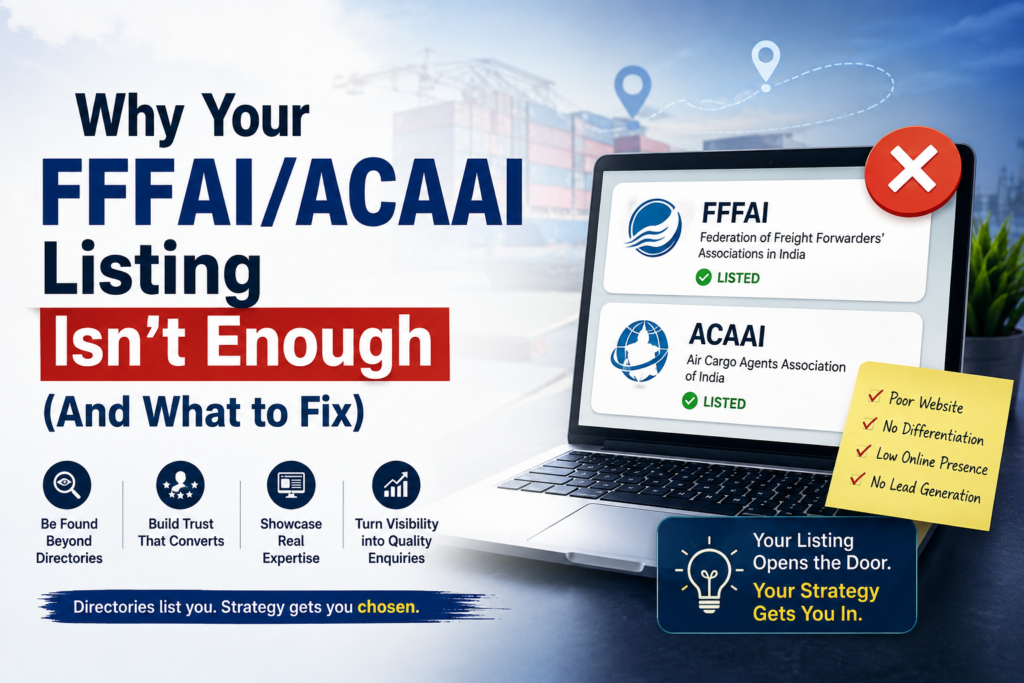
Why Your FFFAI/ACAAI Listing Isn’t Enough (And What to Fix)
Freight Forwarding Marketing · India
Why Your FFFAI/ACAAI Listing Isn't Enough (And What to Fix)
On this page
Why This Misconception Is So Common What Membership Actually Does What It Doesn't Do 9 Things to Fix Tools Examples in Practice Ports Checklist FAQsA shipper searching "freight forwarder Nhava Sheva to Jebel Ali" on Google is not browsing the FFFAI or ACAAI member directory. They're typing a query into a search engine that has never heard of your association membership unless your own website tells it to care.
Why This Misconception Is So Common
FFFAI — the Federation of Freight Forwarders' Associations in India — is the apex body and sole representative of 30 member associations across the country, representing roughly 6,500 customs brokers who together employ over 110,000 people. ACAAI, the Air Cargo Agents Association of India, has grown from 16 founding members in 1970 to nearly 600 members today, with a head office in Mumbai and eight regional offices across the country. Both are genuinely significant, credible institutions in Indian freight forwarding — which is exactly why so many forwarders assume that being listed is the same thing as being found.
It isn't. Membership is real, valuable credibility — but credibility that only industry insiders see doesn't convert a shipper who's never heard of either organisation and never will. This confusion tends to run deep, and it's understandable why. For decades, being part of a recognized trade body was one of the primary ways a freight forwarding business signaled legitimacy to the rest of the industry — before websites, before Google, before online reviews existed as a concept. That instinct hasn't fully caught up to how a modern shipper, especially a younger procurement manager or a first-time exporter, actually searches for and evaluates a logistics partner today.
It's also worth being precise about what "listing" actually means here. Being a member of FFFAI or ACAAI is not the same as appearing in Google's local search results, and it's not the same as having a complete, optimized website. A member directory entry typically lives on the association's own website, is formatted identically for every member, and exists primarily to serve other members and industry stakeholders searching for a company they already know to look for — not to attract new business from people who don't yet know your company exists.
What FFFAI and ACAAI Membership Actually Does
ACAAI works closely with government ministries, airlines, airport operators, and international bodies like IATA and FIATA on behalf of its members.
FFFAI's own membership materials describe real reference value for developing national and international networks.
Membership eligibility criteria mean not just anyone can join — being listed says something real to anyone who already knows to check.
What It Doesn't Do — And Why That Matters
Association directories are not built or optimized to rank for the commercial searches your actual customers type.
A directory entry is a name, an address, and a phone number — it says nothing about your specific ports, lanes, or response time.
Today's shippers expect to see reviews and specific service descriptions before making contact — none of which a directory listing provides.
A first-time exporter or overseas buyer has no reason to know FFFAI or ACAAI exist before searching Google directly.
The most costly effect: forwarders deprioritize the website and SEO work that would actually generate enquiries.
AI-generated overviews draw from well-structured, content-rich websites — not static directories with a name and phone number.
A growing share of B2B research happens on LinkedIn, where an association listing does nothing to build your presence.
9 Things to Fix Once You Realize Your Listing Isn't Enough
It's genuine credibility — but it should support a real website, not substitute for one.
A page targeting "JNPT to Dubai LCL consolidation" will rank for that search. Your association listing never will.
Client counts, shipment volumes, years in operation, and specific service descriptions.
Specific, detailed reviews build first-contact trust more than any association listing.
Google actively uses this to rank you for the exact queries your customers type.
This same well-structured content is exactly what AI-generated search summaries increasingly draw from.
A short, accurate guide builds more real authority than a page targeting a phrase without answering the question behind it.
A complete company page and active staff profiles give you visibility where buyers increasingly research directly.
Once you measure this, the gap between perceived and actual visibility usually becomes obvious fast.
Tools That Help Close the Gap
Google Business Profile — the single highest-leverage free tool for local and map-based search
Google Search Console, to see which searches already find you and which port pages are missing
A simple review-collection habit — asking satisfied clients directly after a completed shipment
LinkedIn Company Page and active personal profiles for key staff
A basic content calendar — even one new port page or FAQ article a month compounds over a year
A simple CRM or shared spreadsheet to track where enquiries actually come from
Examples in Practice
The following are illustrative scenarios based on common patterns in the industry, not verified case studies of specific named companies.
A forwarder discovering its FFFAI listing generates almost no direct enquiries. After tracking enquiry sources for a full quarter, a mid-sized forwarder finds its association membership produced zero direct shipper enquiries — while a handful of new, port-specific website pages generated dozens.
A forwarder using ACAAI membership as one trust signal among several. Building it into a trust bar alongside years in operation, shipment volume, and Google reviews gives a cold search visitor multiple, complementary reasons to trust the business.
A forwarder finally building the port-specific content its listing never provided. Realizing its ACAAI entry said nothing about its actual air cargo specialization, the company builds a dedicated page targeting exactly that search.
A forwarder comparing its association listing's traffic to its own website's, honestly. Checking analytics reveals the company's own website — despite being rarely updated — still drives more enquiries in a month than the association listing has generated in a year.
Ports: Where the Gap Shows Up Most
Association membership is national and general by design — it says nothing about which specific ports or routes you actually specialize in. This is exactly the gap dedicated port pages are built to close.
| Port | What your own website needs to say that your association listing never will |
|---|---|
| Mumbai & JNPT (Nhava Sheva), Maharashtra | Your specific FCL/LCL capacity and typical routes through India's busiest container port |
| Mundra Port, Gujarat | Your experience with agri-export and PLI-scheme manufacturing exporters shipping through Mundra |
| Deendayal Port (Kandla), Gujarat | Your specific bulk and chemical cargo clearance experience |
| Chennai Port, Tamil Nadu | Your specific automotive and electronics component export documentation experience |
| V.O. Chidambaranar Port (Tuticorin), Tamil Nadu | Your LCL consolidation experience for South Tamil Nadu textile and garment exporters |
| Kolkata & Haldia (Syama Prasad Mookerjee Port), West Bengal | Your cross-border documentation expertise for Bangladesh and Nepal-bound trade |
| Cochin Port, Kerala | Your specific reefer and perishables experience for spice, seafood, and coir exporters |
| Visakhapatnam Port, Andhra Pradesh | Your bulk mineral and steel cargo handling experience |
The Fix-It Checklist
- Association membership is displayed on your website as one trust signal among several, not your only credibility claim
- Dedicated pages exist for the specific ports and routes you actually serve
- Google Business Profile is complete, accurate, and actively maintained
- Real client counts, shipment volumes, and specific service descriptions are visible
- Google reviews are actively collected and displayed
- Content exists answering the specific questions your customers actually search
- A LinkedIn company page and active staff profiles support your website presence
- Enquiry sources are tracked, including whether your association listing generates any direct contact at all
- You've compared your website's actual traffic and enquiries against your association listing's, honestly
Frequently Asked Questions
Should we let our FFFAI or ACAAI membership lapse if it's not generating enquiries directly?
No — the value isn't primarily about direct shipper enquiries. Industry standing, regulatory relationships, and peer credibility are real, ongoing benefits. The fix isn't dropping membership; it's not relying on it as your only visibility strategy.
Is it worth optimizing our actual association directory listing itself?
It's worth keeping accurate and current, but the effort is better spent on your own website and Google Business Profile — those are the assets that actually compete for the searches your customers run.
How do shippers who don't know about FFFAI or ACAAI actually find a forwarder?
Overwhelmingly through Google search, referrals, and increasingly LinkedIn — which is exactly why a forwarder's own website, local SEO, and visible trust signals matter more for lead generation than association directory presence.
We're a small forwarder — is this fix realistic without a big budget?
Yes — a handful of well-written port-specific pages, a complete Google Business Profile, and a habit of asking satisfied clients for reviews cost time and consistency far more than money.
How long does it take to see results after fixing this?
Most forwarders see measurable movement in search visibility for port-specific pages within 2-3 months, with reviews and content compounding trust and conversion over 6-12 months.
Does FIATA affiliation through FFFAI carry more weight internationally than domestic association membership?
It can, for international-facing credibility specifically — but the same principle applies: this credibility needs to be visible on your own website to help you, since an overseas buyer researching online isn't checking FIATA's member directory either.
Should we be worried competitors also being FFFAI or ACAAI members means we can't differentiate?
Not worried, but it should reframe your strategy — since most credible competitors carry the same membership, it was never going to be your differentiator. Route-specific expertise, response speed, and visible client trust are what actually separate you.
What's the very first thing we should check to see if this problem applies to us?
Search Google for the exact phrase a customer would type — your primary port plus your primary trade lane — and see whether your own website appears at all. If your association listing is the only place your company name shows up online, this guide describes your situation directly.
Want a full audit of how your online presence compares to what shippers are searching for?
We'll identify your highest-leverage gaps and build a prioritized plan to close them.
Request Your Free Website & SEO AuditAnshul Kuntewar
Founder, RouteRush Digital Marketing Agency — specialising in SEO, website strategy, and lead generation for freight and logistics companies across India, the UAE, Oman, South Africa, Qatar, and Australia, working directly with freight forwarders and CHAs to turn credibility into visibility.
This guide reflects FFFAI and ACAAI membership data current as of mid-2026, sourced from each organisation's own public materials.