
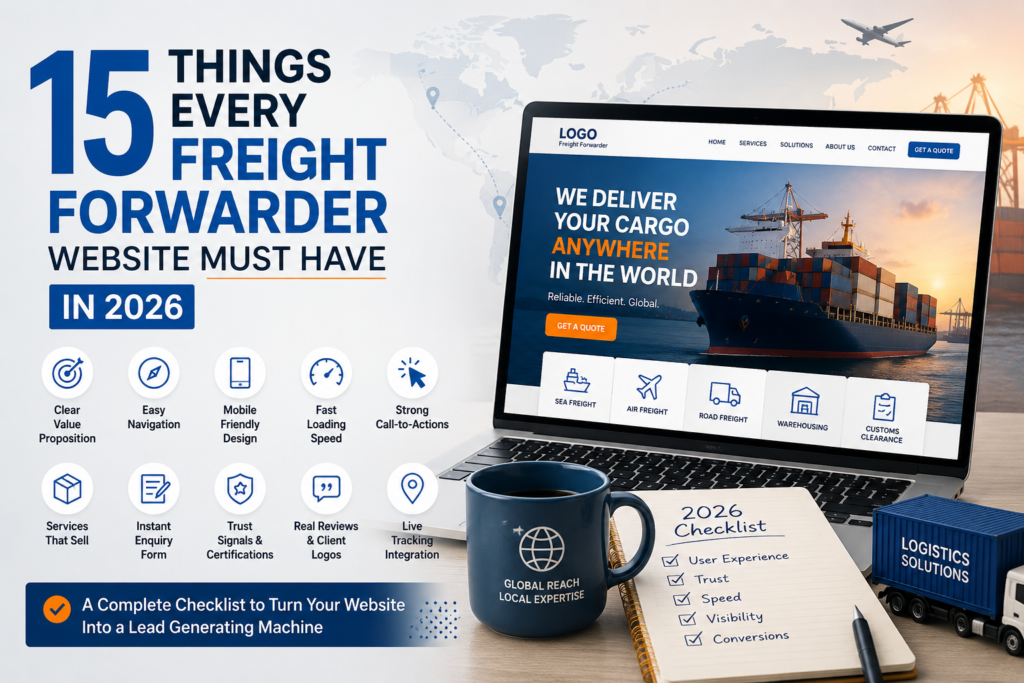
15 Things Every Freight Forwarder Website Must Have in 2026
Freight Forwarding Marketing · Website Strategy
15 Things Every Freight Forwarder Website Must Have in 2026
A freight forwarder's website used to just need to exist. In 2026, it needs to load fast, work on a phone, prove trust in seconds, and be readable by the AI systems increasingly standing between your site and the shipper searching for you.
Why This List Matters Now
Only 33% of websites currently pass all three Core Web Vitals, and for B2B specifically, a site that loads in one second converts at three times the rate of a five-second site, and five times the rate of a ten-second one. Every one of these 15 items exists because it's a documented, current reason shippers leave a freight forwarder's website without converting — not a theoretical best practice.
The list below is deliberately not sorted by difficulty or cost. Some items — rewriting your headline, tightening your enquiry form — take an afternoon. Others, like implementing schema markup correctly across every page, take genuine technical effort. What they share is that each one addresses a specific, measurable point of friction between a visitor arriving on your site and that visitor actually submitting an enquiry. Skipping any single item rarely sinks a website on its own; skipping several of them at once, which is the far more common pattern, compounds into a site that looks fine on a quick glance but quietly underperforms at every stage of the visitor's decision.
The 15 Things
1. A headline that names your service and route, not your company philosophy. "Reliable Global Logistics Solutions" says nothing a shipper can act on. "FCL & LCL Ocean Freight from [Port] to [Destination] — Quoted in Under 2 Hours" answers the only question a visitor actually has in the first five seconds: is this relevant to me? Every competitor's homepage claims to be reliable and experienced; almost none of them name their actual specialization in the first sentence, which is exactly why doing so stands out.
2. Dedicated pages for your specific ports and trade lanes. A single generic "Services" page can't rank for "freight forwarder [port] to [destination]" the way a page built specifically for that search can. This is one of the highest-leverage, most commonly skipped items on this entire list. A forwarder handling three or four core routes well is usually better served by four detailed, specific pages than by one page trying to describe everything at once.
3. Visible trust signals placed near your quote button, not buried on an About page. IATA/FIATA/AEO registration, years in operation, and shipment volume need to sit where the decision happens. Unverifiable adjectives like "trusted" and "experienced" get discounted almost automatically by a skeptical reader; specific, checkable facts don't.
4. A page that loads in under 2-3 seconds. 53% of mobile users abandon a page that takes longer than three seconds to load, and a two-second delay increases bounce rate by over 100%. Unoptimized images remain the single most common cause of slow load times, and are usually the fastest, cheapest fix on this entire list.
5. A design that actually works on mobile, not just technically renders there. B2B mobile traffic share runs lower than consumer sectors (roughly 42-54%), but that's still a large minority of your audience — and even visitors who ultimately convert on desktop form their first impression of your credibility on a phone.
6. One consistent call to action, repeated, not five competing options. "Get a Quote," "Contact Us," "Learn More," and "Download Brochure" all fighting for attention forces a visitor to choose between vaguely different actions. Pick one primary action and repeat it at the top, middle, and bottom of every page.
7. Real, specific client reviews, not just a star rating. A handful of detailed reviews that speak to actual service experience builds more first-contact trust with a skeptical visitor than any amount of homepage copy claiming reliability.
8. A short quote or enquiry form, not a long intake questionnaire. Every additional required field is a reason for a busy shipper to abandon the form. Ask for what you genuinely need to give a first response, and gather the rest in the follow-up conversation.
9. A WhatsApp or live chat option for fast first contact. Many shippers, especially in markets where WhatsApp Business is standard practice, expect a low-friction way to ask an initial question before committing to a full enquiry form.
10. Schema markup (structured data) on every key page. This is the item most freight forwarder websites are missing entirely in 2026. Content with proper schema markup has up to a 2.5x higher chance of appearing in AI-generated answers, and sites with complete schema see up to 40% more AI Overview appearances. Organization, FAQPage, and LocalBusiness schema are the highest-priority types. Use JSON-LD specifically — it's the format AI engines and Google's own guidance consistently prefer.
11. An llms.txt file at your site root. This emerging standard gives AI systems like ChatGPT and Perplexity a clear, high-level summary of what your business does and where to find detailed information — a genuinely new requirement in 2026 that almost no freight forwarder websites currently have, meaning early adopters have real, uncontested advantage in how AI search tools describe and cite them.
12. Consistent, accurate facts across your visible content and your structured data. AI systems specifically check for mismatches between what a schema tag claims and what the page actually displays — an inconsistency here can get your page ignored or deprioritized by exactly the systems you're trying to be found by.
13. Basic accessibility: readable fonts, sufficient contrast, and alt text on images. Beyond being the right thing to do, accessible sites are easier for search engines and AI crawlers to parse correctly, and poor accessibility increasingly correlates with worse technical SEO performance generally.
14. Regularly published content that answers real, specific questions. Customs documentation guides, typical transit times, and route-specific FAQs generate ongoing search and AI-citation visibility that a static homepage alone cannot.
15. Analytics that actually tell you where enquiries come from. Without tracking which page, channel, or piece of content generated a given enquiry, you can't tell which of the other 14 items on this list are actually working for your specific business.
What Happens When You Skip These
Most freight forwarder websites don't fail on one dramatic mistake — they lose ground gradually across several of these items at once. A slow-loading site with no schema markup and a single generic services page isn't just missing traditional search rankings; in 2026 it's also functionally invisible to the growing share of buyer research now happening through AI answer engines rather than a traditional search results page. The compounding effect is real: a visitor who has to wait, then can't quickly verify you're legitimate, then can't find a page relevant to their specific route, is a lost enquiry at three separate points, not just one.
Examples in Practice
The following are illustrative scenarios based on common patterns across freight forwarder websites, not verified case studies of specific named companies.
A forwarder discovering their biggest gap was page speed, not content. After investing heavily in new port pages and content, one forwarder saw only modest improvement in enquiries — until an audit revealed unoptimized images were pushing mobile load time past six seconds. Compressing images and switching hosting alone produced a measurable jump in form completions within weeks.
A forwarder becoming an early, visible source for AI-generated answers. After implementing schema and a well-structured llms.txt file, a mid-sized forwarder began noticing their name appearing accurately when prospects asked AI tools about forwarders serving a specific route — visibility their larger, slower-moving competitors hadn't yet captured.
A forwarder cutting form abandonment by shortening their enquiry form. Cutting a 12-field intake form down to five essential fields, with a promise of fast follow-up, raised completion rates noticeably with no drop in lead quality.
The 15-Point Checklist
- Headline names your specific service and route, not vague company language
- Dedicated pages exist for your core ports and trade lanes
- Trust signals (credentials, years in business, volume) sit near your quote button
- Core pages load in under 2-3 seconds
- Mobile experience is genuinely usable, not just technically responsive
- One consistent call to action repeats across the page
- Real, specific client reviews are visible
- Your enquiry form asks only for what's needed for a first response
- WhatsApp or live chat is available for fast first contact
- Schema markup (Organization, FAQPage, LocalBusiness) is implemented on key pages
- An llms.txt file exists at your site root
- Visible content and structured data match exactly, with no inconsistencies
- Basic accessibility (contrast, alt text, readable fonts) is in place
- Content is published regularly answering real customer questions
- Analytics track enquiries by source page and channel
Frequently Asked Questions
Do we really need all 15 of these, or can we prioritize a few?
If you can only tackle a few first, start with port-specific pages, visible trust signals, and page speed — these three alone address the most common and highest-impact gaps. Schema markup and llms.txt are the next priority, since so few competitors have implemented them yet.
Is llms.txt actually necessary, or is it too early to bother?
It's genuinely early, which is exactly the opportunity — very few freight forwarder websites have implemented it yet, meaning the ones that do gain real, uncontested advantage in how AI systems currently describe and cite them. It's a small, one-time technical addition, not an ongoing burden.
How much does page speed actually matter compared to content quality?
Both matter, but they're not substitutes for each other. Excellent content on a slow site loses visitors before they read it; excellent speed on a thin, generic site has nothing to convert them once they arrive. The two need to be addressed together.
We already have a website — do we need a full redesign to fix this list?
Rarely. Most of these 15 items are additions or adjustments to an existing site — new pages, schema markup, a faster hosting setup, a shorter form — rather than a ground-up rebuild.
How do we know if our schema markup is actually working?
Google's Rich Results Test and Search Console's Enhancements reports show whether structured data is implemented correctly and being read. Testing whether tools like ChatGPT or Perplexity can accurately summarize your business is a practical, direct check for AI visibility specifically.
How long does it take to see results after implementing this checklist?
Page speed and mobile fixes can show measurable bounce rate improvement within days. Port-specific pages and content typically show search visibility movement within 2-3 months. Schema and llms.txt benefits compound over a longer, less predictable timeline as AI search usage grows.
Which of these 15 items do most freight forwarder websites already have?
Trust signals and a basic quote form are the two most commonly present already. Port-specific pages, schema markup, llms.txt, and analytics that track enquiry source are the four most commonly missing entirely — which is exactly why they tend to offer the most room for improvement.
Do smaller freight forwarders really need to worry about AI search visibility yet?
Genuinely, yes, and arguably more than larger competitors — because so few forwarders of any size have implemented schema markup or llms.txt yet, a smaller forwarder who does so now can capture AI search visibility a larger, slower-moving competitor hasn't claimed.
Want a full audit of your website against every item on this checklist?
We'll identify exactly which of the 15 you're missing and build a prioritized plan to fix them.
Request Your Free Website AuditAnshul Kuntewar
Founder, RouteRush Digital Marketing Agency — specialising in SEO, website strategy, and lead generation for freight and logistics companies across India, the UAE, Oman, South Africa, Qatar, and Australia.
This guide reflects web performance, SEO, and AI search visibility research current as of mid-2026, sourced from Akamai, HTTP Archive, Site Builder Report, Searchlab, Walker Sands, Crispy Content, and Stackmatix. Individual results vary based on starting technical foundation and market.