
How Indian Freight Forwarders Can Generate Qualified Leads From LinkedIn in 2026
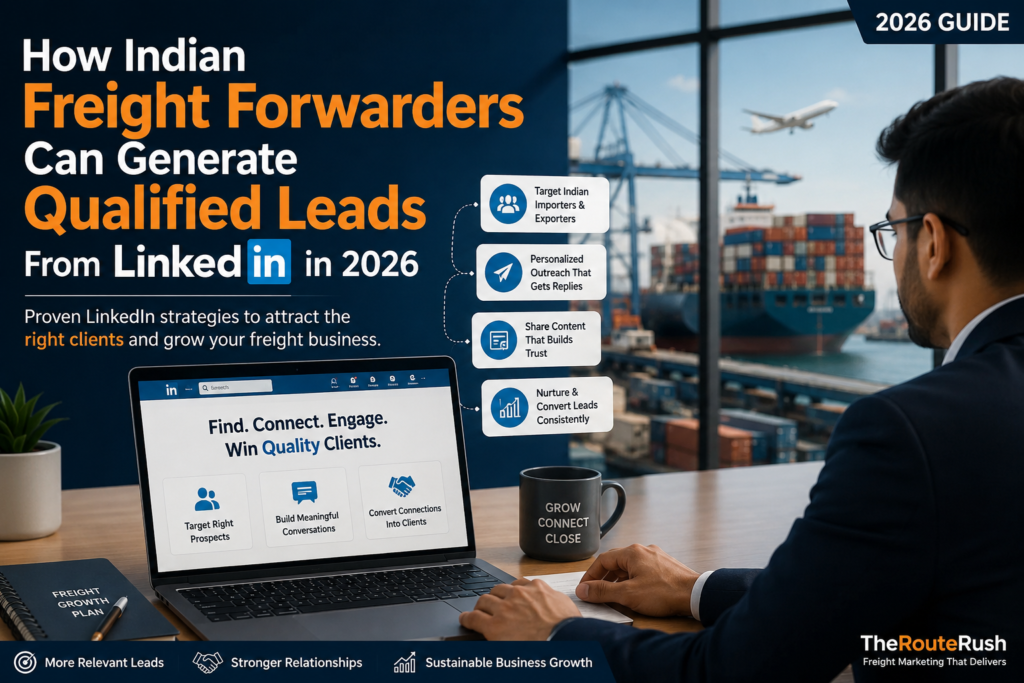
Freight Forwarding Marketing · India
How Indian Freight Forwarders Can Generate Qualified Leads From LinkedIn in 2026
On this page
Why This Matters Now The Core Mistake Personal Profiles Content Formats Employee Advocacy Sales Navigator & PLI The WhatsApp Handoff LinkedIn Ads Compliance Content Examples in Practice Ports Checklist FAQsIndia is now LinkedIn's second-largest market globally, adding roughly 30 million new members in a single year — a 25% year-over-year increase. That growth is happening at exactly the moment PLI-scheme manufacturing is creating a wave of genuinely new, LinkedIn-native exporters with no existing forwarder relationships.
Why LinkedIn Matters More for Indian Forwarders Than Most Realize
India is now LinkedIn's second-largest market globally, with an estimated 130-160 million users, and it's the fastest-growing major market on the platform. LinkedIn as a whole hosts 63 million decision-makers and 10 million C-level executives worldwide, and platform-wide, LinkedIn generates leads at a rate 277% higher than Facebook, with a visitor-to-lead conversion rate of 2.74% against Facebook's 0.77%.
This growth trajectory matters specifically because of who's driving it. LinkedIn's own demographic data shows the 25-34 age bracket as the platform's largest user group globally, a cohort of mid-career professionals and early-stage directors — and India's own workforce skews young relative to most major economies, meaning a large share of the country's rising LinkedIn user base sits precisely in the age range most actively making or influencing procurement and logistics decisions. A forwarder building a LinkedIn presence today isn't reaching a niche audience; they're reaching the demographic that will be making these decisions for the next two decades.
For an Indian freight forwarder, this growth isn't abstract. It's happening at exactly the moment India's logistics sector is professionalizing fast — logistics cost as a share of GDP has fallen below 8%, PM GatiShakti has grown into a full geospatial planning platform, and PLI-scheme-driven manufacturing is creating a wave of genuinely new exporters in electronics, pharmaceuticals, and textiles. Many of these new exporters are younger, LinkedIn-native decision-makers navigating export logistics for the first time — precisely the audience a well-run LinkedIn strategy reaches before a cold call or a generic Google ad ever could.
The Core Mistake Most Indian Forwarders Make
Ask most Indian freight forwarders what their LinkedIn strategy is, and the answer is almost always the same: sending connection requests to procurement managers, sometimes with a templated pitch attached. That's one piece of a much larger system, and it's also the piece most affected by market saturation — nearly 90% of professionals on LinkedIn now receive more than 15 connection requests a week, and connection-request reply rates have dropped 37% year-over-year as inboxes get noisier.
The bigger opportunity sits in the parts of LinkedIn most Indian forwarders never touch: personal profile content, employee advocacy, precision targeting through Sales Navigator, and — critically for the Indian market specifically — the handoff from LinkedIn to WhatsApp, which is where a huge share of Indian B2B relationships actually convert from interest into a real conversation.
1. Personal Profiles Outperform Company Pages by a Wide Margin
Posts from individual LinkedIn profiles consistently receive several times the engagement of identical content posted from a company page. This matters even more in India's relationship-driven B2B culture, where a named, visible individual builds trust faster than a corporate account ever will. A post from "Rahul, Founder" about a shipment challenge solved at JNPT reads as credible and specific in a way a company page announcement rarely does.
2. Post Consistently, and Lead With Formats That Actually Perform
Native document posts (PDFs uploaded directly and displayed as swipeable carousels) are currently the highest-performing content format on LinkedIn. For a freight forwarder, this format is a natural fit: a short carousel walking through a specific customs documentation requirement, a step-by-step guide to shipping under a new PLI-linked compliance rule, or a simple explainer on FCL versus LCL for a first-time exporter.
Consistency matters more than frequency for a resource-constrained team — three posts a week, done consistently, will outperform an ambitious daily schedule that collapses after two weeks.
3. Build a Small, Genuine Employee Advocacy Habit
For an Indian forwarder with even 10-15 staff, identifying five or six people willing to share and add a short, genuine comment to company posts weekly creates a distribution channel that reaches far more of the right people than the company page alone. This is particularly effective in India's operations-heavy forwarder teams, where staff often have real, specific stories that make for more credible content than anything a marketing team could write from scratch.
4. Use Sales Navigator to Target PLI-Scheme Exporters Specifically
Given the specific opportunity around PLI-scheme-driven new exporters in electronics, pharmaceuticals, and textiles, Sales Navigator's filtering by industry, company size, and job function lets a forwarder build a genuinely targeted list of exactly this segment — companies and individuals who are, by definition, newer to export logistics and have no existing forwarder relationship to overcome.
5. Treat WhatsApp as the Natural Next Step, Not a Separate Channel
This is the single most India-specific adjustment to make to any generic LinkedIn strategy: a LinkedIn connection or comment is frequently just the first step in an Indian B2B relationship, with the real conversation moving to WhatsApp almost immediately once genuine interest is established. A forwarder whose LinkedIn messages don't offer a fast, natural path to WhatsApp is adding unnecessary friction at exactly the point a prospect is ready to engage.
A practical sequence that works well: a short, personalized LinkedIn connection request referencing the prospect's specific industry or shipping need, a brief follow-up message once connected, and — once there's a real signal of interest — a direct, low-pressure offer to continue over WhatsApp for faster back-and-forth.
6. LinkedIn Ads Work, But Target Narrowly Given India's Scale
Given how large and varied India's exporter base is, a broad "logistics decision-makers in India" audience wastes budget on low-intent clicks. A narrow campaign — targeting, for instance, supply chain managers specifically at mid-sized electronics manufacturers in a state with strong PLI-scheme activity — will produce a meaningfully lower cost-per-qualified-lead than a broad national campaign.
7. Publish Content Addressing India-Specific Compliance Changes
Being the clear, accurate, fast source explaining a new GST e-way bill requirement, a ULIP integration update, or a PLI-scheme documentation change builds real authority — and this is exactly the kind of specific, practical content that performs well as a LinkedIn document post while also serving as evergreen website content afterward.
What This Looks Like in Practice
The following are illustrative scenarios based on common patterns in the industry, not verified case studies of specific named companies.
A forwarder building a Sales Navigator list around PLI-scheme electronics exporters. Filtering for supply chain and export roles at mid-sized electronics manufacturers in known PLI hubs reaches a segment with no existing forwarder relationship and genuinely urgent first-time export needs.
A forwarder moving qualified LinkedIn conversations to WhatsApp quickly. Offering a direct WhatsApp handoff once genuine interest was clear noticeably improved conversion from initial contact to a real conversation.
A forwarder publishing a carousel on a new customs requirement. A well-designed document post explaining a GST e-way bill change gets saved and shared by exactly the export managers navigating it, at effectively no media cost.
A forwarder building a small, consistent employee advocacy habit. Five operations and sales staff sharing and personalizing one post a week began meaningfully outperforming the company page's own organic reach within a couple of months.
Where This Matters Most, Port by Port
| Port / region | LinkedIn targeting angle worth building |
|---|---|
| Mumbai & JNPT, Maharashtra | The most competitive LinkedIn audience — differentiate with specific, credible content, not volume |
| Mundra Port, Gujarat | PLI-scheme textile and agri-processing exporters, many new to export logistics |
| Deendayal Port (Kandla), Gujarat | Established bulk and chemical exporters — content depth matters more than volume here |
| Chennai Port, Tamil Nadu | PLI-driven electronics and automotive component manufacturers |
| Kamarajar Port (Ennore), Tamil Nadu | Newer manufacturing exporters with limited existing forwarder relationships |
| Kolkata & Haldia, West Bengal | Cross-border trade decision-makers for Bangladesh and Nepal-bound shipments |
| Cochin Port, Kerala | Established spice, seafood, and coir exporters diversifying into new cargo categories |
| Visakhapatnam Port, Andhra Pradesh | Bulk commodity exporters exploring diversification and new forwarder relationships |
The LinkedIn Lead Generation Checklist for Indian Forwarders
- Founder or senior team members post from personal profiles, not just the company page
- Posting cadence is realistic and consistent — 3 times a week sustained beats 5 times a week that collapses
- Document/carousel posts are used for compliance and customs-related content specifically
- A small group of team members actively share and personalize company content weekly
- Sales Navigator targets PLI-scheme exporters and other new-to-export segments specifically
- LinkedIn conversations offer a clear, natural path to WhatsApp once genuine interest is shown
- Any LinkedIn ad campaign uses narrow, specific targeting rather than broad national reach
- Content addressing India-specific compliance changes is published regularly
Frequently Asked Questions
Is LinkedIn actually worth the effort compared to WhatsApp-first outreach for Indian forwarders?
They're not competing channels — LinkedIn is where credibility and initial trust get built with a decision-maker who doesn't know you yet, while WhatsApp is where the relationship actually moves once that trust exists. Skipping LinkedIn means missing the discovery and credibility-building stage entirely.
How is targeting PLI-scheme exporters on LinkedIn different from general logistics prospecting?
PLI-scheme manufacturers are frequently new to exporting altogether, meaning they have no existing forwarder loyalty to overcome — Sales Navigator's filtering lets you build a list specifically of this segment, rather than competing for attention with every established exporter's existing forwarder relationships.
Should content be in English, Hindi, or a regional language?
This depends entirely on your specific client base and region — a forwarder serving exporters concentrated in one state may see real engagement value from occasional regional-language content, while English remains the default for pan-India or cross-border-facing content.
How quickly should we move a LinkedIn conversation to WhatsApp?
Once there's a genuine signal of interest — a specific question, a request for a quote, real engagement beyond a passive connection — offering a WhatsApp handoff removes friction rather than creating it. Moving too early can feel presumptuous; waiting too long risks losing momentum.
How long does it take to see real results from this approach?
Organic content and profile activity can show engagement movement within weeks. Sales Navigator-driven outreach targeting PLI-scheme exporters can produce qualified conversations within 4-8 weeks. Broader pipeline results typically take 3-6 months to assess honestly.
Does India's LinkedIn growth mean the platform will get as saturated as it currently is in the US?
Likely over time, yes, which is exactly why building a genuine presence now — while India's market is still growing and connection-request fatigue hasn't reached the levels seen in more mature markets — has real, time-limited advantage.
Is it worth running LinkedIn ads at all given how much cheaper other channels are in India?
It depends on the specific goal. For broad awareness, cheaper channels often make more sense. But for reaching a precisely defined decision-maker segment, LinkedIn's targeting precision can justify the higher cost-per-click, provided the campaign stays narrow.
Want help building a LinkedIn lead generation system built specifically for the Indian market?
We'll audit your current presence and build a plan across content, Sales Navigator targeting, and the WhatsApp handoff that actually converts.
Request Your Free LinkedIn Strategy SessionAnshul Kuntewar
Founder, RouteRush Digital Marketing Agency — specialising in SEO, LinkedIn strategy, and lead generation for freight and logistics companies across India, the UAE, Oman, South Africa, Qatar, and Australia.
This guide reflects LinkedIn market and India logistics data current as of mid-2026, sourced from Expandi, Axis Intelligence, Cognism, and India's Economic Survey 2026. Platform algorithms and benchmarks change frequently — treat these figures as directional, not guaranteed.