
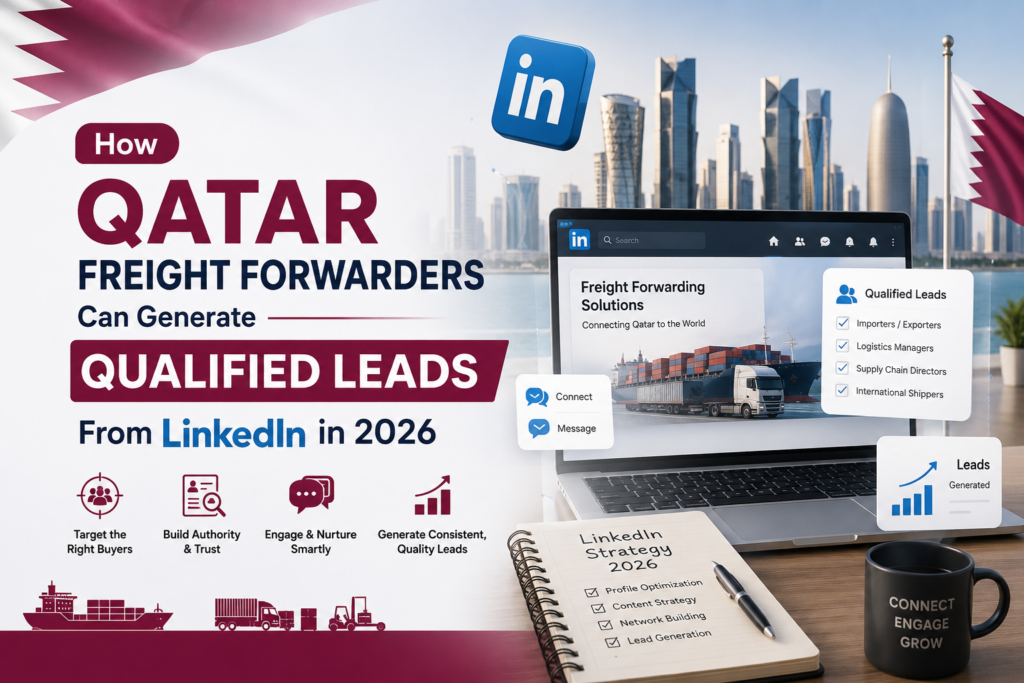
How Qatar Freight Forwarders Can Generate Qualified Leads From LinkedIn in 2026
Freight Forwarding Marketing · Qatar
How Qatar Freight Forwarders Can Generate Qualified Leads From LinkedIn in 2026
On this page
Why LinkedIn Is Different in Qatar The 360Brew Shift Personal Profiles Content Built for Saves Free Zone Targeting Employee Advocacy Sales Navigator Arabic Content LinkedIn Ads Examples in Practice Ports Checklist FAQsLinkedIn's advertising reach data put Qatar's platform audience at 1.80 million members in late 2025 — equivalent to roughly 57.5% of the country's entire population. That's an extraordinarily high concentration for any social platform anywhere in the world.
Why LinkedIn Is Different in Qatar Than Almost Anywhere Else
Qatar's internet penetration sits at 99%, social media usage covers 94.3% of the population, and the country's international, highly professional workforce treats LinkedIn less as one channel among many and more as the default professional ecosystem.
Compare this to the region's larger markets: the UAE has roughly 9.5 million LinkedIn users and Saudi Arabia nearly 11 million — over 20 million combined. Qatar's absolute numbers are far smaller, but its penetration rate relative to population is what makes the market genuinely distinctive. A far higher proportion of Qatar's total working population is reachable on LinkedIn than in almost any other country, which means a forwarder's LinkedIn presence isn't reaching a subset of the market the way it might elsewhere — it's reaching something close to the entire professional population at once.
Across the GCC generally, LinkedIn functions differently than it does in more mature Western markets. Executive search firms operating across the UAE, Saudi Arabia, and Qatar use LinkedIn as their default sourcing tool, and in a professional culture that places enormous weight on reputation, visibility, and trusted networks, a forwarder's LinkedIn presence isn't a marketing nice-to-have — it's read as a direct signal of legitimacy by exactly the kind of internationally-minded decision-makers Qatar's economy is built around.
The Algorithm Shift Every Qatari Forwarder Needs to Understand
LinkedIn replaced its legacy content ranking system in early 2025 with 360Brew, an AI foundation model that fundamentally changed how content gets distributed — and the practical effects of that shift have become clear through 2026. Average organic reach for standard posts has reset to a meaningfully lower baseline, with independent studies putting the year-over-year drop somewhere between a third and a half. Company pages, already structurally disadvantaged because the platform is built to surface individual professional voices over corporate broadcasts, are feeling this gap acutely across the GCC.
There's also a specific, actionable engagement shift worth knowing: saves and bookmarks now carry far more algorithmic weight than likes, with some analyses suggesting a single save drives several times more distribution than a like and roughly double what a comment produces. For a Qatari forwarder, this changes what "good content" actually means in 2026 — a post someone saves for later reference (a customs checklist, a documented process, a reference guide) now outperforms a post that just gets a quick like and scroll-past.
1. Personal Profiles Matter More in Qatar Than the Global Average Suggests
The shift away from company page reach that's happening globally is landing harder in Qatar and the GCC specifically, because Gulf businesses have historically relied more heavily on their company page as the primary content hub than businesses in more organically-diversified markets. A forwarder whose entire LinkedIn presence still routes through the company page is losing visibility faster than the global average right now.
The fix is the same one working everywhere, just more urgent here: the founder's or a senior team member's personal profile needs to become the primary content channel, with the company page serving as a credibility-verification destination rather than the main distribution point. In Qatar's relationship-driven, reputation-conscious business culture, a named individual with a visible, consistent LinkedIn presence builds trust faster than a corporate account regardless of algorithm changes — the 360Brew shift just makes this even more consequential now.
This doesn't mean abandoning the company page. A prospect who engages with a personal post will very often click through to the company page next, to confirm the business behind the individual is real, registered, and credible before responding to any direct message. The company page's job in 2026 is verification, not primary distribution — a subtle but important shift in how the two assets should be used together.
2. Build Content Around Saves, Not Just Likes
Given that saves now drive meaningfully more distribution than likes or comments, the highest-value content for a Qatari forwarder is genuinely reference-worthy material someone would want to return to — not a quick take on industry news, but something concrete enough to bookmark. A clear breakdown of Qatar's pre-arrival customs declaration requirements, a comparison of current Hamad Port congestion or berth scheduling conditions, or a step-by-step explainer on navigating the new free-zone incentive programme are all exactly the kind of content someone genuinely saves rather than scrolls past. The practical test worth applying to any planned post is simple: would a busy supply chain manager actually want to find this again in three weeks, or is it only interesting for the ten seconds it takes to scroll past.
Native document posts — PDFs uploaded directly and displayed as swipeable carousels — remain a particularly strong format for this kind of content, since the format itself invites a save-for-reference behavior that a standard text post doesn't.
3. Use LinkedIn to Reach International Operators Researching Qatar's Free Zones
With Qatar's recent $1 billion incentive programme and reduced free-zone land rents actively attracting international logistics operators to Ras Bufontas and Umm Alhoul, a meaningful and growing share of relevant LinkedIn activity in Qatar right now comes from decision-makers outside the country who are actively researching local partners. This is a genuinely time-sensitive opportunity: a forwarder building visible, specific content about supporting free-zone entrants — not generic "we serve Qatar" messaging — is positioned to be found by exactly this audience while most local competitors haven't yet updated their own LinkedIn presence to reflect the incentive programme.
4. Build a Small, Consistent Employee Advocacy Habit
Given how heavily Qatar's business culture already relies on personal and professional networks, employee advocacy carries even more weight here than the global average would suggest. A small group of team members — five or six people at even a modest-sized forwarder — sharing and genuinely personalizing company content weekly extends reach through real, trusted personal networks in a market where personal recommendation and reputation already drive a large share of business decisions offline.
5. Use Sales Navigator for Precision in a Small, Concentrated Market
Qatar's freight forwarding market is small and concentrated enough that broad, high-volume outreach quickly exhausts the realistic pool of relevant decision-makers. Sales Navigator's filtering by industry, company size, and job function is particularly valuable here — rather than broad prospecting, a Qatari forwarder should build a precisely targeted list of the specific decision-makers at companies genuinely relevant to their ports, cargo types, or the free-zone segment specifically, since the total addressable market for any given niche is small enough that quality of targeting matters more than volume of outreach.
6. Consider Arabic-Language Content Where It Genuinely Fits Your Audience
Arabic search activity is outpacing English at more than double the rate across the GCC in 2026, reflecting a genuine shift in how the region's professional audience searches for and engages with content. This doesn't mean every post needs an Arabic version, but for a forwarder whose client base includes a meaningful share of Arabic-first decision-makers, occasional Arabic-language posts — particularly for compliance or documentation content where precision matters — can reach an audience that English-only content structurally misses.
7. LinkedIn Ads: Precision Targeting Justifies the Cost in a Small Market
LinkedIn advertising costs more per click than most alternatives, but in a market as small and specific as Qatar's, the ability to target a precise job function within a precise industry is genuinely valuable rather than a nice-to-have. A narrow campaign — targeting supply chain or logistics roles specifically at companies newly established or expanding within Qatar's free zones, for instance — will produce a far more efficient cost-per-qualified-lead than a broad "Qatar logistics decision-makers" campaign competing for a much less relevant, much larger audience.
What This Looks Like in Practice
The following are illustrative scenarios based on common patterns in the Qatari logistics sector, not verified case studies of specific named companies.
A forwarder shifting primary content distribution to a personal profile after noticing company page reach collapse. After observing organic reach on the company page drop sharply through 2026, the team began posting the same insights from the founder's personal profile instead, recovering and then exceeding previous engagement levels within weeks.
A forwarder building a save-worthy reference guide to the free-zone incentive programme. A genuinely useful, detailed carousel explaining how the programme works and what an international operator needs to know is specifically designed to be saved and referenced, not just liked in passing.
A forwarder using Sales Navigator to build a precise list of free-zone entrants. Filtering specifically for companies newly registering activity in Ras Bufontas or Umm Alhoul reaches exactly the segment most likely to need a local forwarding partner right now.
A forwarder building light Arabic-language content alongside its English posts. After noticing a meaningful share of engagement from Arabic-first profiles, the team began publishing occasional Arabic versions of its most reference-worthy compliance content, reaching a segment that had been engaging less consistently with English-only posts.
Where This Matters Most, Port by Port
| Port / zone | LinkedIn content and targeting angle worth building |
|---|---|
| Hamad Port, Umm Al Houl | Save-worthy content on berth conditions and integrated free-zone services |
| Ras Bufontas & Umm Alhoul Free Zones | Direct targeting of international operators researching the new incentive programme |
| Doha Port | Legacy institutional relationships — content depth matters more than broad reach here |
| Mesaieed Port (Umm Said) | Technical, industrial audience — precise Sales Navigator targeting over broad content |
| Ras Laffan Port | An extremely narrow, technical LNG audience better reached through direct targeting than organic content |
| Al Ruwais Port | Smaller, regionally focused audience with limited existing LinkedIn competition |
| Abu Samra / Salwa (land border) | An underserved content niche — few competitors publish anything about this corridor at all |
The LinkedIn Lead Generation Checklist for Qatari Forwarders
- Primary content distribution has shifted to a personal profile, not just the company page
- Content is built to be saved and referenced, not just liked — checklists, guides, comparisons
- At least some content specifically targets international operators researching Qatar's free zones
- A small group of team members actively share and personalize company content weekly
- Sales Navigator targets specific, precise segments given Qatar's small total addressable market
- Arabic-language content is used where it genuinely fits your actual client base
- Any LinkedIn ad campaign uses narrow, specific targeting rather than broad market-wide reach
Frequently Asked Questions
Is Qatar's LinkedIn audience really that different from other GCC markets?
In scale, no — Qatar's total LinkedIn user base is far smaller than the UAE's or Saudi Arabia's. In penetration relative to population, yes — Qatar's LinkedIn audience represents an unusually high share of the total population, reflecting the country's highly professional, internationally-minded workforce.
How much does the 360Brew algorithm change actually affect a small forwarder's strategy?
Significantly — with organic reach for standard posts down a third to a half year-over-year and company pages hit particularly hard, a forwarder who hasn't already shifted primary content distribution to a personal profile is losing visibility faster than they may realize.
Is the free-zone incentive programme really worth building specific LinkedIn content around?
Yes, particularly right now — it's recent enough that most local competitors haven't updated their LinkedIn presence to address it directly, meaning a forwarder who does creates real, current visibility with an audience actively searching for exactly this information.
Should we prioritize Arabic or English content for our LinkedIn presence?
This depends on your actual client base rather than a blanket rule — but given that Arabic search activity is growing faster than English across the GCC, it's worth testing occasional Arabic content, particularly for compliance or documentation topics.
How long does it take to see results from this approach in Qatar's market specifically?
Given how concentrated and relationship-driven Qatar's business community is, a genuinely strong personal-profile presence combined with precise Sales Navigator targeting can produce visible engagement and qualified conversations within 4-6 weeks, though broader pipeline results still typically take 3-6 months to assess honestly.
Does Qatar's small market size limit how much LinkedIn can realistically generate?
It shapes the strategy rather than limiting it outright. Precisely because the market is small and concentrated, a forwarder who builds genuine, save-worthy authority and precise targeting can capture a meaningful share of a smaller total audience more effectively than in a larger, noisier market.
Should we worry about the 360Brew changes if we're only just starting our LinkedIn presence?
Actually, less than an established competitor might — a forwarder building their presence now can design content around save-worthy, personal-profile-first principles from day one, rather than needing to unlearn habits built around an older algorithm.
Want to see where your current LinkedIn presence and website stand?
Get your free Freight Growth Score — a fast, specific audit of your online presence against exactly the factors covered in this guide.
Get Your Free Freight Growth ScoreAnshul Kuntewar
Founder, RouteRush Digital Marketing Agency — specialising in SEO, LinkedIn strategy, and lead generation for freight and logistics companies across Qatar, the UAE, Oman, India, South Africa, and Australia.
This guide reflects LinkedIn market and algorithm data current as of mid-2026, sourced from DataReportal, NapoleonCat, and 23HubLab. Platform algorithms and benchmarks change frequently — treat these figures as directional, not guaranteed.