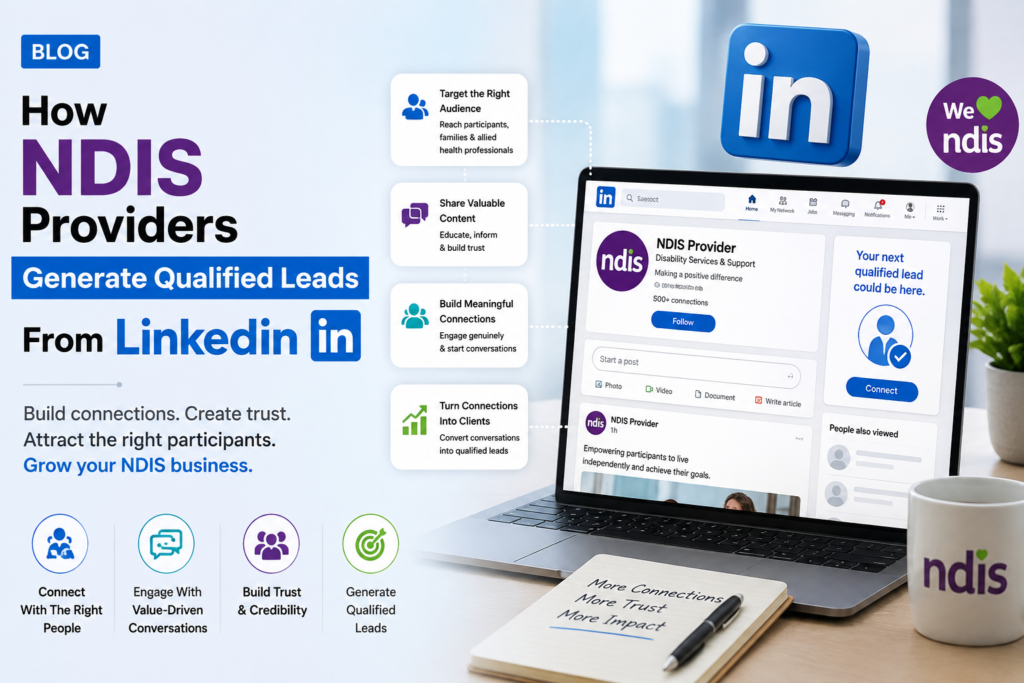
How NDIS Providers Generate Qualified Leads From LinkedIn (2026)
NDIS Marketing · LinkedIn Strategy
How NDIS Providers Generate Qualified Leads From LinkedIn
Most NDIS providers treat LinkedIn the same way they treat every other social platform — post a photo on World Disability Day, share a feel-good story about a participant's milestone, update their profile picture every two years. Then they wonder why LinkedIn isn't generating referrals. The providers quietly building a consistent pipeline of support coordinator referrals and plan manager relationships from LinkedIn are doing something fundamentally different. This is what it looks like.
LinkedIn is not a social media platform in the conventional sense. LinkedIn surpassed 1.3 billion registered members in December 2025 and generates 80% of all B2B leads from social media — more than Facebook, Instagram, and X combined. In Australia specifically, over 17 million professionals are active on the platform, representing more than 61% of the working population. The 25–44 age bracket — the primary decision-makers and budget holders — dominate Australian LinkedIn usage.
For NDIS providers, that last point is particularly relevant. Support coordinators, Local Area Coordinators, plan managers, allied health professionals, and hospital discharge planners — the people whose referrals can fill your participant intake for months — are all on LinkedIn. They use it regularly. They read content published there. And almost no NDIS provider is publishing content designed specifically to reach them.
The opportunity gap is real. The NDIS sector has 21,734 registered providers competing for 761,442 active participants — no single provider holds more than 5% market share, which means the sector is fragmented and relationship-dependent. Support coordinators are the key intermediaries, and support coordinators live on LinkedIn. The providers who understand how to build genuine relationships with coordinators and allied health professionals on that platform are building a referral pipeline that works independently of cold outreach, directory listings, and word of mouth.
Here's the complete playbook for how it's done.
Why LinkedIn Works Differently for NDIS Providers
The professional network your referral sources are already using
Before getting into tactics, it's worth understanding why LinkedIn specifically — rather than Facebook or Instagram — is the right platform for B2B referral generation in the NDIS sector.
The NDIS referral ecosystem is fundamentally B2B, not B2C. A support coordinator deciding which provider to recommend to a participant is making a professional decision — one that affects their relationship with that participant and their professional reputation. They are not browsing casually. They are actively looking for providers they can trust, have a relationship with, and feel confident recommending. That mindset maps exactly to how people use LinkedIn, and is completely different to how they use Facebook or Instagram.
Personal profiles on LinkedIn generate 8x more engagement than company pages for identical content. This has a direct implication for NDIS providers: the most effective LinkedIn strategy is built around the personal profile of the provider's founder, director, or support coordination lead — not the company page. Coordinators want to know and trust a person, not follow a brand.
Post occasionally from the company page. Share NDIS news and feel-good stories. Connect with other providers. Send no messages. Receive no referrals.
Publish consistent content from personal profiles. Connect with support coordinators and allied health professionals directly. Build genuine relationships before asking for anything. Let referrals arrive as a natural result.
LinkedIn lead generation costs 28% less per qualified lead than Google Ads for B2B campaigns — because LinkedIn's professional targeting means fewer wasted impressions and higher intent from the audience that sees your content. For NDIS providers whose referral sources are a definable professional group, this precision is particularly valuable.
Step 1: Build a Profile That Works as a Referral Page
Your LinkedIn profile is the first thing a support coordinator checks after hearing about you
A support coordinator who hears your name mentioned at a networking event, or sees you comment on a post they follow, will check your LinkedIn profile within minutes. What they find there either builds trust or undermines it. Most NDIS provider LinkedIn profiles do neither — they read like a CV from 2019, with a generic job title, a description about being passionate about disability support, and no real information about who you serve, where you operate, or what makes you the right choice for a coordinator's participant.
Rewrite your headline to speak directly to coordinators
Your LinkedIn headline is the one line visible in every search result, every comment, every connection request. Most provider directors use their job title — "Director at Sunrise Support Services." That tells a coordinator nothing they need to know to make a referral decision.
A headline written for referral generation answers the question a coordinator is silently asking: what do you actually do, for whom, and where?
"Director at Sunrise Support Services | Passionate about disability support"
"NDIS Support Coordination & SIL Provider · Western Sydney · Currently accepting new participants · Founder, Sunrise Support Services"
Rewrite your About section as a referral pitch, not a biography
The About section is where most coordinators go after your headline catches their attention. Most provider About sections read like an About Us page from a 2015 website — warm, vague, and full of phrases like "dedicated to empowering participants to live their best lives" that could describe any provider in the country.
A coordinator reading your About section wants to know: what registration groups you hold, which participant cohorts you specialise in, which suburbs or regions you cover, whether you're currently accepting referrals, and how to reach you right now. Give them exactly that — in plain language, in the first three lines, before LinkedIn collapses the text behind "see more."
"I'm passionate about making a real difference in the lives of people with disability. Our team at Sunrise Support Services believes in person-centred care and empowering participants to achieve their goals. We've been operating for seven years and are committed to providing high-quality supports across Sydney."
"Registered NDIS provider delivering Support Coordination and SIL across Western Sydney — Parramatta, Blacktown, Penrith, and surrounds. Currently accepting new participants across all age groups and disability types."
"If you're a support coordinator or LAC looking for a provider with genuine availability and a consistent team (we don't rotate support workers), I'd welcome a conversation. Best reached via message here or at [phone number]."
The second version answers the three questions a coordinator is actually asking — what do you do, where do you cover, and how do I refer — in the time they'd spend reading one paragraph of the first version.
Step 2: Connect With the Right People Systematically
Build your referral network before you need it
The most common LinkedIn mistake NDIS providers make is waiting until they need referrals to start building relationships. By that point, a cold connection request with an immediate pitch is exactly what it looks like — and coordinators receive enough of those to recognise and ignore them instantly.
The providers generating consistent LinkedIn referrals built those relationships three to six months before they needed them. They connected with support coordinators, LACs, plan managers, hospital social workers, and allied health professionals gradually — not as a campaign, but as a consistent professional habit. When a coordinator in their network has a participant who needs exactly the support they offer, they're the provider that comes to mind.
| Who to connect with | What they need from you | How to find them on LinkedIn |
|---|---|---|
| Support Coordinators | Reliable providers with genuine availability and consistent staffing | Search "Support Coordinator NDIS [City]" — filter by People |
| Local Area Coordinators | Registered providers who can take on new participants quickly | Search "Local Area Coordinator NDIS" — filter by your state |
| Plan Managers | Providers who invoice correctly and respond to queries fast | Search "NDIS Plan Manager [City]" — connect with individuals not companies |
| Hospital Social Workers | Providers who can receive hospital discharge referrals and respond urgently | Search "Social Worker [Hospital Name] [City]" |
| Allied Health Professionals | Providers whose services complement their clinical work | Search "Occupational Therapist NDIS [City]", "Physiotherapist NDIS [State]" |
| Disability Employment Consultants | Providers with community participation and employment support | Search "Disability Employment NDIS [State]" |
When sending a connection request, always include a brief personal note — not a pitch. Something that acknowledges what they do and why you're reaching out as a peer, not a vendor. Connection requests with a note are accepted at roughly twice the rate of blank requests.
"Hi, I'd like to connect. We provide NDIS support coordination and SIL across Sydney. Happy to discuss any referrals you might have."
"Hi [Name] — saw you're a support coordinator in Parramatta. We run a SIL and daily living provider in the area. Would be good to have you in my network even if there's no immediate fit."
Step 3: Publish Content That Earns Coordinator Trust Over Time
The single most underused referral-building tool in the NDIS sector
This is where most NDIS providers completely miss the opportunity. They connect with coordinators and allied health professionals, and then post nothing useful — or post only promotional content about their own services. Neither builds trust. Neither generates referrals.
The providers who build the strongest referral relationships on LinkedIn do so by consistently publishing content that is genuinely useful to the coordinators in their network. Not promotional. Not vague inspiration. Genuinely useful — the kind of content that makes a coordinator think "I'm glad I followed this person" and forward a post to a colleague.
LinkedIn newsletters have an average open rate of 42% — more than double the average email newsletter open rate of 21%. Content that stays in a professional's feed performs well. Content that earns a subscription performs significantly better.
Publish content in four categories — rotate between them weekly
The goal is to appear in a coordinator's feed regularly enough that they think of you when a referral need arises — without appearing so frequently that you become noise. Two to three posts per week from a personal profile, rotating between these four types, is the format that sustains attention without exhausting it.
| Content type | Example | Why it works for referrals |
|---|---|---|
| NDIS system updates | "The NDIS price guide changed yesterday. Here's what it means for Support Coordination billing in 2026." | Establishes you as someone who understands the sector — coordinators share this with colleagues |
| Practical coordinator tips | "Three things that make a referral to a new provider go smoothly — from a provider's perspective." | Shows you understand how coordinators work and that you're easy to work with |
| Availability updates | "We have two SIL vacancies opening in Blacktown next month. Happy to discuss if you have participants in the pipeline." | Direct, practical, immediately actionable for coordinators actively looking for placements |
| Honest sector observations | "The most common reason participants disengage from support coordination — and what I've seen fix it." | Builds trust by showing you think critically about quality, not just service delivery |
External links reduce LinkedIn reach by 40–50% compared to native content. Always post your content natively on LinkedIn first. If you want to link to a blog post, put the link in the first comment — not in the post itself. This single habit can double your content reach without changing anything else.
Step 4: Use Direct Messages to Convert Connections Into Relationships
The message that doesn't feel like a sales pitch
Connecting with a coordinator and then immediately sending a message about your services is the LinkedIn equivalent of handing someone your business card and then immediately asking for their clients. It is the most common mistake NDIS providers make on the platform, and it actively damages the relationship it was meant to start.
The message that converts a new LinkedIn connection into a real referral relationship does one of two things: it acknowledges something specific about their work, or it offers something genuinely useful with no ask attached. That's it. No pitch. No "happy to discuss any referrals." No "we have capacity for new participants if you're looking for placements."
"Hi [Name], thanks for connecting. We provide NDIS support coordination and SIL across Western Sydney and currently have capacity for new participants. Would love to discuss any referrals you might have — feel free to reach out."
"Hi [Name] — thanks for connecting. Noticed you're based in Parramatta. We've been running SIL and daily living support in the area for a few years now. If it's ever useful to know what we look like from a coordinator's perspective — capacity, how we handle transitions, participant feedback — happy to share. No ask, just good to have the context if there's ever a fit."
The second message does something the first doesn't: it anticipates what a coordinator would actually want to know before making a referral, and offers it proactively without demanding anything in return. That small shift in framing is the difference between a message that gets ignored and one that gets a response.
Step 5: Build a LinkedIn Newsletter for Long-Term Referral Authority
The 42% open rate channel most NDIS providers have never used
A LinkedIn newsletter is one of the most underused tools available to NDIS providers and one of the highest-performing. LinkedIn newsletters average a 42% open rate — compared to 21% for email newsletters — because subscribers have actively opted in to receive your content in a professional context.
For an NDIS provider, a monthly newsletter published directly on LinkedIn and sent to every coordinator, LAC, and allied health professional in your network creates a consistent touchpoint that requires no cold outreach, no email list building, and no advertising spend. The topic doesn't need to be complicated — it just needs to be genuinely useful to the coordinators reading it.
"Sunrise Support Services — Monthly Update" covering team news, participant milestones, and service announcements
"NDIS Coordinator Briefing" — one practical update, one sector insight, one thing worth knowing about finding placements in [your area] this month
Name the newsletter for your audience, not for your organisation. "The NDIS Coordinator Briefing" will attract more subscribers from the people you want to reach than "Sunrise Support Services Monthly Update" — because the first tells a coordinator immediately what they'll get from subscribing, and the second tells them only who it's from.
What This Looks Like in Practice — A Full Week
The actual rhythm of a LinkedIn lead generation strategy for an NDIS provider
Most providers who read about LinkedIn strategy understand it conceptually but don't know what it looks like as a weekly practice. Here's what a week of consistent LinkedIn activity looks like for a provider director who generates regular coordinator referrals from the platform — total time commitment: approximately 45 minutes across the week.
| Day | Activity | Time |
|---|---|---|
| Monday | Send 5–10 personalised connection requests to support coordinators or allied health professionals in your service area | 10 minutes |
| Tuesday | Publish a practical post — NDIS system update, availability announcement, or sector observation — from personal profile | 10 minutes |
| Wednesday | Reply to comments on Tuesday's post. Comment meaningfully on 3–4 posts from coordinators or LACs in your network | 10 minutes |
| Thursday | Send a follow-up message to 2–3 recent connections — acknowledge something specific about their work, offer something useful | 10 minutes |
| Friday | Publish second post of the week — participant story (with consent), team update with real photos, or honest sector reflection | 10 minutes |
That's it. 45 minutes a week, sustained consistently for three to six months, builds the kind of referral network that operates independently of cold outreach. The coordinators in your network start thinking of you when they have a participant who needs what you offer — not because you pitched them, but because you've been showing up in their professional feed regularly with content they find useful.
The Mistake That Kills Every NDIS LinkedIn Strategy
The single most common reason NDIS providers don't generate leads from LinkedIn isn't that LinkedIn doesn't work for the sector. It's that they stop too early.
LinkedIn referral relationships take time. A coordinator who connects with you today may not have a relevant referral for four months. A plan manager who reads your content consistently for six months may eventually message you about a participant who needs exactly the support you provide. The providers who stop posting after four weeks because "nothing happened" never reach the point where the compounding effect kicks in.
The providers generating consistent referrals from LinkedIn treat it as infrastructure — something they maintain consistently, not a campaign they run until they lose interest. Two posts a week, ten connection requests a week, and occasional genuine engagement with the coordinators in their network. That's the whole strategy. The results are not immediate. They are, however, durable in a way that any form of paid advertising is not.
Want a LinkedIn strategy built specifically for your NDIS organisation?
We work with NDIS providers across Australia on LinkedIn profile optimisation, content strategy, and coordinator outreach — starting with a free audit of your current digital presence.
Get your free NDIS digital auditQuick Answers
Should the LinkedIn activity come from the company page or a personal profile?
Personal profile, primarily. Personal profiles generate 8x more engagement than company pages for identical content on LinkedIn. The company page matters for search and credibility, but the relationship-building — which is where NDIS referrals actually come from — happens through personal profiles. The founder, director, or support coordination lead is the right person to be active on LinkedIn, not the brand account.
How many connection requests should we send per week?
Five to fifteen personalised requests per week is sustainable without triggering LinkedIn's spam filters or exhausting your outreach capacity. Quality matters more than volume here — a targeted request to a support coordinator in your specific service area, with a brief genuine note, outperforms fifty generic requests to anyone with "NDIS" in their profile.
What if we don't have anything interesting to post about?
You have more useful content than you think. Every week there's something in the NDIS sector worth a coordinator knowing about — a price guide change, a Commission update, a common challenge you've seen in referrals, something a participant taught you about what good support actually looks like. The posts that perform best on LinkedIn are rarely polished or complex. They're specific, honest, and written by someone who clearly knows what they're talking about.
How long before LinkedIn starts generating referrals?
Realistically, three to six months of consistent activity before you see referrals that can be directly attributed to LinkedIn relationships. Some providers see connections turn into conversations within weeks. What takes longer is the trust that makes a coordinator comfortable recommending you to a participant — and that trust is built through repeated exposure to your content and your professional presence over time, not a single post or message.
Is LinkedIn Sales Navigator worth it for NDIS providers?
For providers who want to build a large coordinator network quickly — particularly across multiple states — Sales Navigator's advanced search and InMail capabilities can accelerate the prospecting stage significantly. For most single-state providers, the free version of LinkedIn combined with consistent posting and targeted connection requests is sufficient to build a meaningful referral network. Start with the free version and assess after six months whether the additional targeting capabilities justify the cost.
Anshul Kuntewar, Founder, RouteRush Digital Marketing Agency — working with NDIS providers across Australia on LinkedIn strategy, website SEO, and referral-growth systems. Statistics sourced from HubSpot LinkedIn Lead Generation Data 2026, Digital Applied LinkedIn Statistics 2026, Search Scope Australian LinkedIn Statistics 2026, SearchLab LinkedIn Statistics 2026, and Martal LinkedIn Benchmarks 2026.