
In-House vs Agency Marketing for Oman Freight Forwarders
Freight Forwarding Growth Strategy · Omani Logistics Leadership
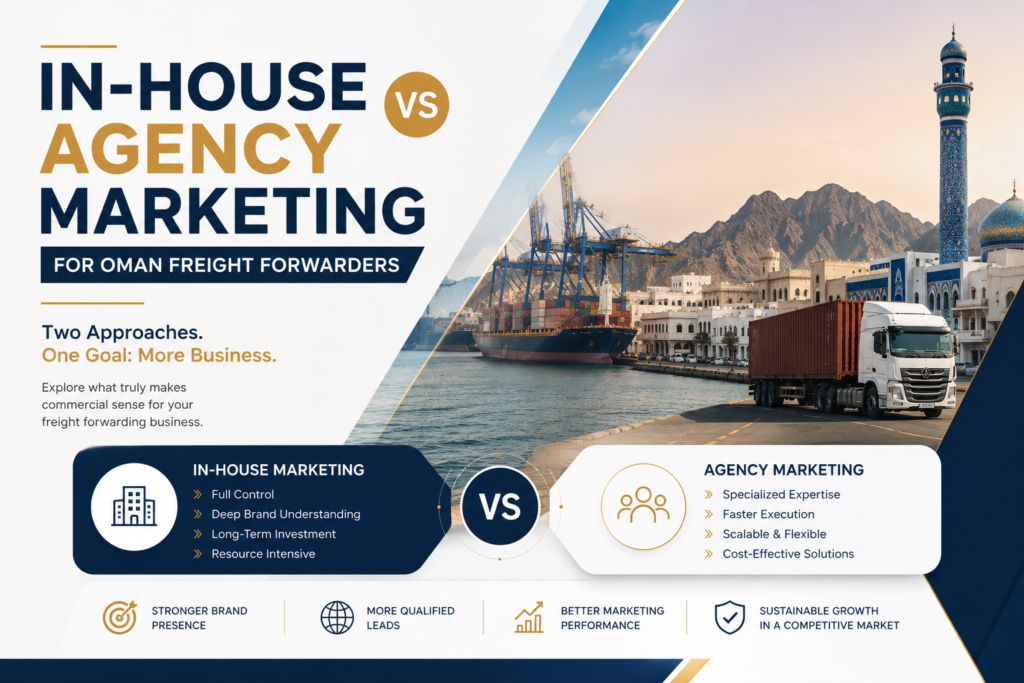
In-House vs. Agency Marketing for Oman Freight Forwarders: What Makes Commercial Sense?
On this page: Executive Navigation
The direct executive answer The changing commercial landscape in Oman Why freight marketing in Oman is unique Search-intent: pricing, trust & services The real financial math (OMR TCO) Four operational paths compared In-house route: strengths & pitfalls The generalist agency trap The specialized freight agency advantage The hybrid engine for scaling forwarders Decision matrix by annual turnover 6 commercial KPIs executives must track Marketing capability readiness checklist Costly leadership mistakes to avoid 90-day marketing transition roadmap Frequently asked questionsIf your Oman-based freight forwarding business generates under OMR 4.5 Million in annual turnover (or under OMR 500,000 in gross freight margin), partnering with a specialized logistics marketing agency yields 3x to 5x higher commercial ROI than hiring a solo in-house marketer.
Customer acquisition in Oman's expanding transport sector demands six specialized technical disciplines: commercial search architecture, trade lane SEO, technical B2B conversion copywriting, search advertising with aggressive negative keyword containment, CRM pipeline automation, and instant WhatsApp lead routing. In the Omani employment market, a single mid-level marketing hire (commanding a base salary of OMR 1,000 to OMR 1,500 per month plus Omanization quota management, visa fees, health insurance, annual flight allowances, and end-of-service gratuity) rarely masters more than one or two skills. Furthermore, generalist marketers have zero working knowledge of Directorate General of Customs (ROP Customs) Bayan Single Window clearance, SOHAR Port and Freezone gate passes, Port of Salalah transshipment protocols, Khazaen Dry Port bond movements, or Incoterms 2020. You end up spending over OMR 24,000 in true Total Cost of Ownership (TCO) for basic social media flyers while your commercial pricing desk receives zero qualified container inquiries.
For established forwarders turning over OMR 4.5 Million to OMR 18 Million with offices in Muscat, Sohar, and Salalah, the optimal structure is an agile hybrid model: an internal marketing or sales enablement coordinator capturing operational proof points from pricing and operations desks, paired with an external specialized freight agency executing technical Freight-Forwarder SEO, targeted Oman Freight-Forwarder Marketing, and high-intent commercial acquisition.
| Annual Revenue (OMR) | Recommended Operating Model | Primary Strategic Focus |
|---|---|---|
| Boutique / Specialist (OMR 500k – OMR 2.5M) | Specialized Agency Only | Rapid commercial RFQs, niche trade lane authority, zero payroll overhead |
| Established Mid-Tier (OMR 2.5M – OMR 7M) | Specialized Agency + Sales Liaison | Scale Google Ads, Bayan customs SEO, automated WhatsApp/CRM quote tracking |
| Multi-Facility Operator (OMR 7M – OMR 18M) | Agile Hybrid Model | Internal sales enablement lead + specialized technical agency partner |
| National Logistics Enterprise (OMR 18M+) | Internal Dept + Specialist Partners | Corporate brand/PR team backed by corridor-specific performance agencies |
The Changing Commercial Landscape of Omani Freight
For decades, freight forwarders and customs clearance brokers in Oman expanded through three traditional avenues:
- Field sales & personal networks: BDMs visiting industrial estates in Rusayl, Sohar Industrial City (Madayn), Raysut Industrial City in Salalah, and corporate trading offices in Ruwi and Al Khuwair.
- Customs clearing reciprocity: Direct relationships between local clearance brokers, line agents, and bonded transport hauliers at Port Sultan Qaboos, Sohar, and Salalah.
- International forwarding networks: Inbound nominated routings through WCA World, JCtrans, or FIATA partner directories.
While commercial relationships remain vital, the procurement behavior of Omani cargo owners—energy contractors, petrochemical manufacturers, mining conglomerates in Duqm, food security importers, and cross-border distributors—has shifted decisively toward digital verification.
The Rise of the Digitally Fluent Commercial Procurement Head
Today, supply chain decisions across Oman Vision 2040 industrial projects, Green Hydrogen developments in Duqm, and ASYAD-connected logistics parks are directed by tech-savvy supply chain directors, CFOs, and procurement heads. When an oilfield engineering contractor in Nimr needs urgent dangerous goods (DG) air charter out of Muscat International Airport (MCT) or a manufacturing plant in Sohar requires 50 TEUs cleared under customs bond through the Bayan system, they search Google and LinkedIn directly: "licensed customs clearing agent Sohar Port Bayan," "project cargo freight forwarder Duqm breakbulk," or "AEO certified logistics company Oman."
If your digital presence consists of an outdated template with generic stock imagery, broken quote forms, and no verifiable compliance credentials (such as Oman Chamber of Commerce and Industry (OCCI) registration, ROP Customs Bayan accreditation, or ASYAD Group port facility access), that procurement executive exits within fifteen seconds. You are silently excluded from high-margin freight tenders before your sales reps even know an opportunity was open.
Why Freight Marketing in Oman Is Uniquely Challenging
Many Omani logistics founders believe "digital marketing is a waste of capital" because a previous generic agency squandered their budget on broad ads that generated hundreds of calls from consumers tracking personal retail parcels or seeking cheap courier rates.
Marketing commercial logistics in Oman is uniquely complex due to four distinct operational dynamics:
1. Massive Consumer Search Noise & Negative Intent
Search engines across Oman are saturated with retail consumers searching for parcel tracking, Oman Post branches, Asyad Express drop-offs, Aramex tracking, DHL Express rates, and personal luggage shipping. Running broad search campaigns on terms like "shipping to India" or "cargo company Muscat" burns 85% to 90% of ad spend on expats asking how to send a single carton of personal effects or electronics home. Overcoming this requires building an aggressive negative keyword fortress (excluding thousands of retail courier, personal cargo, and tracking terms) while targeting strict B2B commercial intent triggers (such as FCL container shipping, ocean bill of lading, reefer consolidation, Sohar Port customs clearance, bonded warehouse Khazaen, and overland road freight Empty Quarter).
2. Strategic Geography Outside the Strait of Hormuz
Oman occupies a distinct strategic position on the global maritime map. With major deepwater facilities at Salalah and Duqm situated directly on the Arabian Sea and Indian Ocean, Omani ports offer shipping lines and cargo owners direct access without entering the Strait of Hormuz, avoiding war risk insurance surcharges and regional chokepoint delays.
B2B cargo owners moving high-value consignments evaluate forwarders on tangible operational capabilities: Bayan single-window clearance speed, Free Zone vs. Mainland customs execution (Sohar Freezone, SFZ Salalah, SEZAD Duqm), bonded trucking connectivity via Khazaen Dry Port, OCCI attestation, and direct carrier allocation power.
| Generic Marketing (Fails to Win Shippers) | Specialized Logistics Marketing (Wins Profitable Accounts) |
|---|---|
| "Your trusted global freight and logistics partner in Muscat" | "Direct weekly FCL consolidation Nhava Sheva to Sohar Port with in-house Bayan customs clearance & 2-hour quote turnaround" |
| "Fast and reliable shipping across GCC and Middle East" | "Heavy-lift breakbulk transport from Duqm Port to interior oilfields with full route surveys, police escorts & customs bond clearance" |
| "Contact us today for the best freight rates" | "Download our 2026 Importer’s Guide to Sohar Port Demurrage Mitigation & Bayan Tariff Concessions" |
3. Lengthy Corporate Tenders & WhatsApp Quote Velocity
Corporate freight agreements in Oman involve structured evaluation cycles with commercial tender boards, engineering leads, and financial directors. Concurrently, when spot cargo or emergency plant shutdowns arise, speed is decisive. In Oman's relationship-driven business culture, procurement managers expect quotation turnaround within 30 to 60 minutes. If an inbound commercial RFQ submits through your website form and sits unanswered for 24 hours, the shipper has already booked with another forwarder via WhatsApp. Digital growth architecture in Oman must instantly filter, validate, and route corporate inquiries to sales desks with automated WhatsApp and CRM alerts.
Search-Intent Breakdown: Pricing, Services, Trust & Documentation
To convert commercial Omani cargo owners, your digital presence must align with the exact search intents that procurement managers research during the decision-making cycle:
- Commercial Pricing Intent: Importers and exporters seek landed cost transparency, bunker adjustment factors (BAF), currency adjustment factors (CAF), terminal handling charges (THC), and container detention free-time terms. Providing downloadable landed-cost calculators or clear rate cards captures high-intent shippers actively budgeting quarterly import allocations.
- Specific Logistics Services Intent: Rather than generic "transport solutions," industrial buyers search for defined capabilities: FCL sea freight from Shanghai to Sohar Port, transshipment container handling at Port of Salalah, breakbulk energy equipment transport to Duqm, or bonded air freight out of Muscat International Airport (MCT). Each service requires a dedicated, technical landing page with lane-specific specifications.
- Institutional Trust & Accreditation Intent: Corporate procurement policies in Oman prioritize licensed and accredited partners. Shippers search specifically to verify Oman Chamber registration, FIATA affiliation, ROP Customs Bayan accreditation, and ASYAD dry port connectivity.
- Regulatory Documentation & Customs Intent: Importers actively search for guidance on navigating ROP Customs Bayan single-window declarations, Free Zone to mainland bill of entry filing, GCC Wajajah and Empty Quarter customs transit rules, and Incoterms 2020 commercial risk allocation.
- High-Velocity Lead Generation Intent: Shippers facing urgent supply chain bottlenecks or requesting quotes for upcoming project tenders demand streamlined quote forms with instant WhatsApp and CRM sales desk follow-up (under 30 minutes).
Executing these five search-intent pillars requires coordinated Trade-Lane Marketing and technical search positioning that turns your website into an active commercial pipeline engine, as demonstrated in our Oman Freight Forwarder Case Study.
The Real Financial Math: In-House Cost vs. Specialized Agency (OMR)
When evaluating marketing resourcing, Omani freight executives frequently make a misleading financial comparison: they pit a specialized agency's monthly retainer (e.g., OMR 700 to OMR 1,200/month) against a junior marketing employee's base salary (e.g., OMR 1,000/month), completely overlooking visa sponsorship, Omanization quotas, mandatory health insurance, software licensing costs, and executive management overhead required to sustain an internal marketing function.
Let us examine the true Total Cost of Ownership (TCO) in the Omani marketplace:
| Cost Element | Solo In-House Marketer (Oman) | Specialized Freight Marketing Agency |
|---|---|---|
| Base Salary | OMR 12,000 – OMR 19,200 (OMR 1,000 – OMR 1,600/mo for 3–5 yrs experience) |
OMR 0 (All personnel costs included in retainer) |
| Statutory On-Costs & Benefits (Visa, Resident Card, Health Insurance, Gratuity, Flights) |
OMR 2,400 – OMR 4,200 (Standard Oman employment on-costs and provisions) |
OMR 0 (Zero statutory liabilities or visa costs) |
| Recruitment & Sourcing Fees (Specialist recruiter placement fee or LinkedIn/Bayt) |
OMR 1,500 – OMR 3,000 (Typical 12%–15% recruiter placement fee)* |
OMR 0 (Zero recruitment overhead; immediate start) |
| Professional Tool & Data Stack (Semrush, Apollo/ZoomInfo, CRM, Email, Canva Pro) |
OMR 1,800 – OMR 3,600 (Enterprise software licenses at OMR 150–OMR 300/mo) |
OMR 0 (Agency provides its own enterprise analytics & data stack) |
| External Technical Specialists (WordPress dev, video production, technical SEO audits) |
OMR 1,500 – OMR 3,000 (Freelance contract support for specialized technical tasks) |
OMR 0 (Full multidisciplinary team included in retainer) |
| Executive Management Time (12+ hrs/month of MD or Commercial Director oversight) |
OMR 2,400 – OMR 4,500 (Opportunity cost of senior executive directing marketing) |
OMR 360 – OMR 600 (2 hours/month for strategic review and pipeline sync) |
| TOTAL ANNUAL INVESTMENT | OMR 21,600 – OMR 37,500 | OMR 8,400 – OMR 16,800 (OMR 700 – OMR 1,400 / month flat retainer) |
| Active Delivery Capacity | 1 Person (Constrained to 1–2 individual skills) | Cross-Functional Team (SEO, PPC, Copy, Dev, CRM) |
In Oman, employing a single in-house marketer costs more than double the annual investment of a dedicated freight marketing consultancy, while delivering only a fraction of the cross-disciplinary execution required to generate commercial pipeline.
Four Operational Paths: A Side-by-Side Comparison
To establish an objective strategic roadmap, let us compare the four primary marketing operating models available to Omani freight forwarding companies:
1. Solo In-House Marketer
- Domain Fluency: Moderate (Learns internal operations, lacks market-wide data).
- Skill Breadth: Narrow (Typically graphic design or social media; weak in PPC/SEO).
- Ramp-Up Speed: 90 to 120 Days (Recruiting, visa processing, onboarding, tech setup).
- Turnover Risk: Severe (If the employee resigns, all marketing halts).
- Executive Time: 15 to 20 Hours / Month (Hands-on management needed).
- Attribution: Rarely connected directly to booked freight margins.
2. Generalist Digital Agency
- Domain Fluency: Very Low (Requires extensive client education on basic freight terms).
- Skill Breadth: Broad, but optimized for retail B2C and e-commerce.
- Ramp-Up Speed: 60 to 90 Days (Steep industry learning curve).
- Turnover Risk: Low (Agency handles internal employee turnover).
- Executive Time: 10 to 15 Hours / Month (Correcting technical freight errors).
- Attribution: Vanity metrics (Ad impressions, social reach, page views).
3. Specialized Freight Agency
- Domain Fluency: High (Immediate fluency in Incoterms, Bayan, Sohar/Salalah rules, and GCC transit).
- Skill Breadth: Complete B2B commercial logistics growth stack.
- Ramp-Up Speed: 7 to 14 Days (Pre-built search and negative keyword assets).
- Turnover Risk: Zero (Contractual service continuity and team depth).
- Executive Time: 2 to 3 Hours / Month (High-level commercial steering).
- Attribution: Commercial Inbound RFQs, Cost per Lead, Win Rate.
4. Agile Hybrid Model
- Domain Fluency: High (Combines real-time operational stories with external market expertise).
- Skill Breadth: Comprehensive end-to-end commercial pipeline execution.
- Ramp-Up Speed: 14 to 21 Days (Rapid operational alignment).
- Turnover Risk: Low (Multi-tiered structure ensures operational resilience).
- Executive Time: 3 to 4 Hours / Month (Commercial alignment and pipeline review).
- Attribution: End-to-end pipeline tracking from inquiry to repeat booking.
The In-House Route: Operational Strengths and Critical Pitfalls
Employing an internal marketing coordinator located within your offices in Muscat, Sohar Freezone, or Salalah offers direct access to daily operations. However, management must weigh the practical benefits against predictable operational failure modes.
• Direct Physical Proximity: An internal employee can visit your warehouse or container freight station in Sohar or Khazaen Dry Port, photograph heavy machinery being loaded onto flat-racks, and document real-time de-stuffing operations.
• Immediate Sales Collateral Support: When your Muscat or Sohar sales team needs a customized capability deck or a specialized trade lane flyer for a major oilfield or industrial presentation tomorrow morning, an in-house person can produce it immediately.
• Dedicated Focus: 100% of their working hours are committed exclusively to your brand and company culture.
1. The "Unicorn Marketer" Trap: Logistics executives often assume one individual can write high-converting trade lane landing pages, manage complex Google Search ad accounts, design corporate collateral, build CRM automation workflows, and execute technical SEO. In practice, no single professional excels across all these domains. Inevitably, the marketer defaults to comfortable, low-impact tasks—like creating social media holiday posts—while technical pipeline generation stalls.
2. Professional Isolation & Stagnation: A lone marketer in a freight forwarding office has no senior marketing mentor to review keyword architecture, analyze conversion funnels, or audit tracking data. Working in isolation without specialized direction, their strategies become stagnant, resulting in frustration and eventual resignation.
3. Absence of Cross-Market Benchmark Data: An internal hire only has visibility into your internal conversion rates. They cannot tell whether an OMR 22 Cost Per Qualified Inbound Inquiry on Far East ocean freight is exceptional or inefficient. A specialized freight agency, managing campaigns across multiple shipping corridors, knows exactly where your acquisition benchmarks should sit.
The Generalist Agency Trap: Why 85% of Generic Campaigns Fail
Many Omani freight executives who have formed a negative opinion of digital marketing previously engaged a standard digital marketing agency that primarily serves hospitality brands, luxury automotive dealers, or local retail chains. When applied to B2B international shipping, their standard operating procedures fail systematically:
- They Waste Budgets on Retail Consumer Searches: Generic PPC managers set up broad search campaigns for terms like "cargo to London" or "movers in Muscat," bleeding your marketing budget on retail consumers looking for personal package tracking or sending excess holiday luggage.
- They Produce Superficial, Buzzword-Laden Copy: Lacking freight knowledge, generic copywriters rely on empty slogans like "Tailored end-to-end supply chain solutions" or "Seamless global logistics excellence," which fail to engage professional supply chain managers.
- They Report Irrelevant Vanity Metrics: Generic agencies provide monthly reports highlighting impressions, click-through rates, and social media likes. In commercial freight forwarding, 20,000 impressions are meaningless compared to three qualified RFQs from an industrial manufacturer moving 40 TEUs per quarter.
- They Overlook Critical Regulatory Credibility Factors: They produce service pages that completely omit Free Zone to mainland clearance, Bayan compliance, OCCI attestation, and Incoterm clarity—the exact proof points that corporate logistics buyers require to validate a forwarder.
When you hire a generalist agency, you spend six months teaching their account managers the fundamental differences between LCL and FCL, why an Air Waybill is not an Ocean Bill of Lading, and what a bonded customs warehouse entails. You are effectively paying them to learn your industry on your budget.
The Specialized Freight Agency Advantage
A specialized freight forwarding marketing consultancy operates with pre-existing logistics fluency. From day one, they understand how forwarders generate profit, which corridors carry attractive margins, and how to position an independent Omani forwarder against global integrators like Kuehne+Nagel, DHL Global Forwarding, and DSV.
- High-Intent Commercial Search Architecture: Targeting exact commercial search queries (e.g., "FCL sea freight Shanghai to Sohar Port," "customs clearing agent Salalah," "overland transport Oman to Riyadh") while aggressively filtering consumer parcel searches.
- Inspectable Digital Trust Infrastructure: Structuring your website as an interactive due diligence portal showcasing corporate registrations, licensed customs brokers, approved depot facilities, and verified industry memberships (OCCI, FIATA).
- Lane-Specific Decision Assets: Developing actionable resources—such as Oman import duty estimators, GCC road transit compliance checklists, and Sohar port demurrage guides—that capture verified contact details from active cargo owners through dedicated Trade-Lane Marketing.
- Direct CRM & Sales Desk Integration: Routing qualified web inquiries directly into your sales CRM (HubSpot, Zoho, Salesforce, or CargoWise) with structured shipment details (commodity, volume, weight, Incoterm, origin, and destination ports).
- Cross-Market Performance Intelligence: Utilizing campaign data across national and international trade corridors to continually refine your cost-per-inquiry and quote conversion rates, as detailed in our Oman Freight-Forwarder Marketing Solutions.
The Hybrid Engine: The Gold Standard for Scaling Omani Forwarders
For established Omani freight forwarding firms generating OMR 4.5 Million to OMR 18 Million in annual turnover, the most efficient and profitable operational structure is an agile hybrid model.
The Hybrid Division of Responsibilities
• Internal Coordinator (Sales Enablement & Marketing Lead): Embedded within your Oman office, collaborating directly with branch managers, sales reps, and pricing desks in Muscat, Sohar, and Salalah. They capture on-site project cargo photography, document customer case studies, coordinate local industry sponsorships, and ensure sales reps follow up on digital inbound leads within 30 minutes.
• External Partner (Specialized Freight Marketing Agency): Formulates high-level growth strategy, builds technical Freight-Forwarder SEO architecture, designs conversion-focused landing pages, manages Google Search and LinkedIn advertising, oversees CRM lead attribution, and authors regulatory-grounded industry thought leadership.
This collaborative model leverages the natural strengths of each party: the internal coordinator ensures seamless operational alignment and rapid lead follow-up, while the external agency delivers the technical depth, strategic insight, and creative production that no single internal employee could match.
Decision Matrix: Matching Growth Strategy to Annual Turnover
Use this practical, revenue-aligned framework to select the right marketing structure based on your company's turnover, branch footprint, and commercial objectives:
| Company Profile & Annual Turnover (OMR) | Recommended Operating Model | Resource Allocation & Commercial Focus |
|---|---|---|
| Boutique Forwarder / Clearing Broker (OMR 500k – OMR 2.5M Turnover / OMR 50k – OMR 250k Margin) |
Specialized Agency Only | Establish a modern digital trust portal, capture high-intent commercial search traffic across 2–3 core trade corridors, and generate qualified inbound RFQs without taking on internal payroll overhead. |
| Established Mid-Tier Operator (OMR 2.5M – OMR 7M Turnover / OMR 250k – OMR 700k Margin) |
Specialized Agency + Sales Liaison | Scale targeted Google Ads campaigns, build authoritative customs and port guide content hubs, implement automated CRM pipeline tracking, and designate a senior sales manager as the agency point of contact. |
| Scaling Multi-Facility Group (OMR 7M – OMR 18M Turnover / OMR 700k – OMR 1.8M Margin) |
Agile Hybrid Model (In-House Coordinator + Specialized Agency) |
Hire an internal Sales Enablement Coordinator to capture branch case studies and maintain quotation velocity, while partnering with a specialized agency for technical SEO, paid search, and digital positioning. |
| Major National Logistics Conglomerate (OMR 18M+ Turnover / OMR 1.8M+ Margin) |
Internal Department + Specialist Agency Partners | Maintain an in-house marketing team managing corporate communications, brand assets, and PR, supported by specialist performance marketing agencies executing high-intent acquisition and account-based marketing. |
6 Commercial KPIs Omani Freight Executives Must Track
Regardless of whether you hire internally or partner with an agency, marketing must be evaluated strictly on commercial revenue and pipeline velocity. Never judge marketing effectiveness by superficial metrics like website pageviews or social media impressions. Track these six commercial indicators:
- Qualified Commercial Inbound RFQs (MQLs): The number of quotation requests submitted by verified commercial cargo owners specifying container counts, commodity types, weight/volume, and Incoterms (excluding retail courier inquiries).
- Cost Per Qualified Freight Inquiry (CPQI): Total monthly marketing expenditure (retainer/salary + ad spend) divided by the number of validated commercial quotation requests.
- Quote-to-Booking Win Rate (%): The percentage of inbound commercial quotation requests that convert into booked, operational shipments. If this metric is low, evaluate pricing competitiveness or sales response speed.
- Customer Acquisition Cost (CAC) per Active Account:** The total marketing and commercial sales investment required to onboard a new trading client that completes at least one billable shipment.
- Client Lifetime Value to CAC Ratio (LTV:CAC): In freight forwarding, a profitable commercial account trades repeatedly for 24 to 36 months. A robust commercial acquisition engine should generate an LTV:CAC ratio of at least 5:1.
- Sales Desk Lead Response Velocity (Minutes): The average elapsed time between an inbound website inquiry landing and a sales representative making first contact. Industry leaders maintain an SLA of under 30 minutes during business hours.
Marketing Capability Readiness Checklist
Before committing capital to an internal recruitment search or an agency engagement, assess your internal operational readiness across these foundational prerequisites:
- Defined Core Trade Lane Strengths: Have you identified 3 to 5 primary trade corridors where your carrier allocations, overseas agent partnerships, and destination handling provide a genuine competitive advantage?
- Standardized Quotation SLA: Does your pricing desk guarantee turnaround of standard FCL, LCL, and air freight quotations within 2 to 4 business hours of receiving an inquiry?
- Centralized Commercial CRM: Are all sales leads, rate proposals, and client communications tracked centrally in a modern CRM (HubSpot, Zoho, Salesforce, or CargoWise) rather than managed in individual reps' email accounts?
- Documented Compliance & Accreditations: Are your OCCI membership certificate, ROP Customs Bayan broker licenses, approved Free Zone registrations, and industry memberships organized and accessible for digital display?
- Dedicated Management Sponsor: Is there an executive leader (Managing Director or Commercial Head) committed to dedicating 2 hours per month to review pipeline data and provide strategic direction?
Costly Leadership Mistakes to Avoid
Executive teams frequently encounter predictable pitfalls when modernizing their commercial marketing. Avoid these four common missteps:
Hiring a marketing coordinator and directing them to make 60 cold outbound calls per day is an expensive failure. Marketing and outbound sales require entirely different skill sets. Marketing builds inbound credibility, creates high-intent visibility, and captures active buyer demand; sales reps close deals and manage relationships.
Never enter into an agency agreement that lacks concrete, monthly deliverables: published technical pillar guides, verified search campaign structures, CRM pipeline integrations, and conversion audit milestones.
Marketing cannot succeed in a vacuum. Whether internal or outsourced, your marketing team requires regular access to your operations personnel to extract real-world operational stories about port terminal congestion workarounds, Bayan clearance wins, and carrier updates.
Switching marketing tactics every 90 days destroys momentum. High-intent SEO assets, organic trade lane rankings, and digital trust authority compound over time, steadily driving down customer acquisition costs year after year.
The 90-Day Marketing Transition Roadmap for Omani Forwarders
Whether you choose an internal hire, a specialized agency, or a hybrid model, execute your marketing transition using this structured quarterly roadmap:
Identify top 3 high-margin trade corridors, audit existing website conversion bottlenecks, configure CRM pipeline stages, and establish quotation turnaround SLAs with the commercial pricing desk.
Overhaul the website Homepage, About Us, and Compliance Verification pages with transparent licensing details, named operations staff, and clearly defined trade lane capabilities.
Deploy dedicated service landing pages for primary Omani maritime and air gateways (Sohar, Salalah, Duqm, Muscat MCT), complete with downloadable compliance checklists and customs FAQs.
Launch targeted B2B Google Search campaigns with strict negative keyword containment to capture high-intent commercial shippers while eliminating retail courier traffic.
Conduct a comprehensive pipeline audit with the sales team, analyze quote-to-booking win rates, calculate initial Cost Per Qualified Inquiry (CPQI), and refine conversion pathways.
Frequently Asked Questions (FAQs)
Can an Omani freight forwarder succeed without any digital marketing?
While established forwarders can operate on existing client relationships and agent nomination networks for a period, relying solely on traditional methods leaves the enterprise vulnerable to natural client attrition. Modern procurement managers and supply chain directors routinely research and verify every logistics provider online before awarding contracts. Without a credible digital trust presence, your business stagnates while competitors capture high-intent market demand.
How long does it take for freight forwarding marketing to generate qualified quotes in Oman?
Well-structured commercial search advertising (Google Ads) with rigorous negative keyword filtering can generate qualified B2B quotation inquiries within 14 to 30 days. High-intent organic search engine optimization (SEO) and technical content assets typically build momentum over 3 to 6 months, establishing permanent digital assets that deliver consistent commercial leads at near-zero marginal cost.
Why shouldn't our freight forwarding sales reps just handle marketing?
Sales representatives are trained to build interpersonal relationships, negotiate complex rates, and close active shipments. Requiring them to master SEO, web development, copywriting, and advertising tracking distracts them from billable selling activities. High-performing logistics companies allow sales reps to focus on closing, while marketing fills their pipeline with pre-qualified quotation opportunities.
What should we look for when interviewing a marketing agency for freight in Oman?
Ask the agency to explain the difference between FOB and CIF under Incoterms 2020, how Bayan single window customs clearance works for Free Zone vs. Mainland shipments, and how they prevent consumer courier tracking searches from wasting Google Ads budget. If they cannot answer these questions fluently without hesitation, they lack the domain fluency required to market an Omani freight forwarding business.
How much should an Omani freight forwarder budget for digital marketing?
As an industry benchmark, growing B2B freight forwarders in Oman typically invest between 2% and 5% of their net revenue (gross freight margin) into commercial marketing. For an independent forwarder generating OMR 300,000 to OMR 1,000,000 in gross margin, this represents an annual investment of OMR 6,000 to OMR 20,000 across agency retainers, advertising expenditure, and digital asset development.
What is the primary risk of hiring a solo in-house marketer?
The primary risk is single-person skill limitation. A solo hire often excels at graphic design or social media management but lacks the technical expertise required for high-intent search architecture, B2B conversion copywriting, and CRM workflow automation, resulting in substantial overhead costs with minimal commercial pipeline generation.
Is your Omani freight marketing generating qualified commercial shipping accounts?
Evaluate your digital acquisition engine, eliminate consumer click waste, and benchmark your commercial pipeline against industry leaders across Muscat, Sohar, Salalah, and Duqm.
Calculate Your In-House vs. Agency TCO & Claim Your Free Growth AuditAnshul Kuntewar
Founder of RouteRush, a specialized digital growth and search positioning consultancy dedicated exclusively to independent freight forwarders, licensed customs brokers, and logistics companies across the Sultanate of Oman, the GCC region, and global shipping corridors. Specializing in high-intent search engine positioning, conversion-focused website architecture, B2B LinkedIn strategy, and qualified lead generation.
Editorial & Industry References: Strategic frameworks referenced from the Directorate General of Customs (ROP Customs Oman) - Bayan System, SOHAR Port and Freezone, Port of Salalah - APM Terminals, ASYAD Group - Oman National Logistics Champion, Oman Chamber of Commerce and Industry (OCCI), International Federation of Freight Forwarders Associations (FIATA), International Chamber of Commerce (ICC) Incoterms 2020 Rules, and Google Search Central EEAT Guidelines. Commercial marketing advice provided for executive evaluation; specific returns vary based on trade lane competitiveness, sales closing capabilities, and pricing competitiveness.