
How Freight Forwarders Turn Industry Updates Into Leads
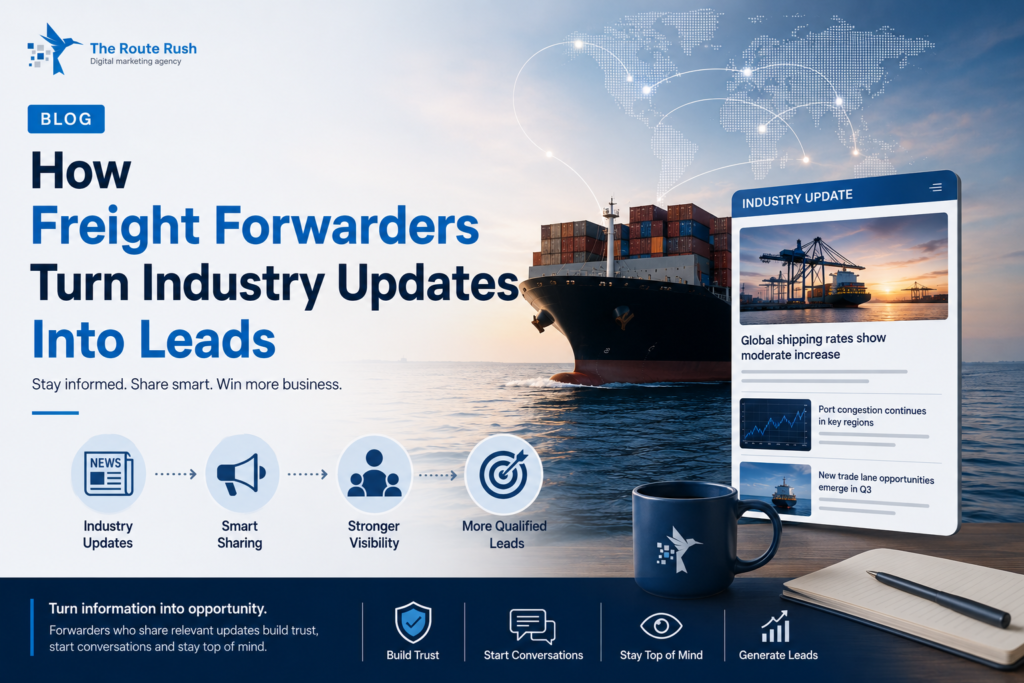
How Freight Forwarders Can Turn Industry Updates Into Leads: A Digital Marketing Playbook
Executive Context: Global supply chains never experience a quiet week. Between Red Sea vessel diversions, Panama Canal transit restrictions, unexpected port labor disputes (from US East Coast ILA negotiations to European terminal walkouts), seasonal biosecurity mandates (such as Australia’s BMSB measures), customs single-window upgrades (like India's ICEGATE, UAE's Mirsal II, and Oman's Bayan), and sudden General Rate Increases (GRIs), disruption is the normal state of commerce. Most freight forwarders view these events merely as customer service headaches. Elite commercial forwarders, however, view them as the single highest-converting inbound lead generation trigger in B2B logistics.
Industry updates generate commercial freight leads only when you immediately translate macro disruption into shipper financial and landed-cost impact, followed by a concrete operational alternative and a low-friction quotation mechanism.
When a shipping line announces a $1,500/FEU General Rate Increase (GRI) or a major port faces a 7-day berth congestion queue, cargo owners—importers, exporters, and procurement heads—do not need a passive news summary. They urgently need answers to three commercial questions: (1) How much will this add to my landed cost per unit? (2) Will my container miss our quarterly retail or manufacturing deadline? (3) What alternative routing, air-sea bypass, or bonded transshipment corridor can deliver my goods on time?
Forwarders who position themselves as the immediate operational solution capture high-intent shippers during their moment of peak supply chain vulnerability. By connecting breaking trade updates to dedicated Trade-Lane Marketing, reactive Freight-Forwarder SEO, and rapid-response sales workflows, independent logistics operators regularly achieve 300% to 500% higher lead-to-opportunity conversion rates than generic outbound sales prospecting.
Why Most Forwarder "Newsletters" and Market Updates Fail
Almost every medium-to-large freight forwarder sends some form of monthly "Market Update" PDF or publishes an occasional LinkedIn post about global shipping rates. Yet, 95% of these efforts generate zero inbound Request for Quotes (RFQs). Why?
They commit four fatal marketing mistakes:
The Passive Reporter Trap
They copy-paste generic articles from maritime news portals stating: "Bunker fuel prices rose 4% this week and Cape of Good Hope transits increased." Shippers already read trade news; they do not need forwarders to be journalists. They need an operational diagnosis.
The "No Clear Operational Solution" Void
They report severe port congestion at transshipment hubs without providing an alternate routing. Reporting a crisis without presenting your allocated capacity or bypass service leaves the shipper anxious, causing them to search Google for another forwarder who has space.
The Generic "Contact Us" Call to Action
Ending a complex advisory on new European Union Emissions Trading System (EU ETS) maritime surcharges with "For more information, email info@company.com" kills conversion. Shippers require targeted decision assets: a Landed Cost Calculator or a Transit-Time Comparison Matrix.
Sluggish Multi-Day Publishing Delays
When a carrier announces blank sailings or customs rolls out a mandatory new electronic filing (like India's ICEGATE changes or Australia's BMSB update), procurement managers search for solutions within the first 24 to 48 hours. Releasing a PDF two weeks later misses the entire buying window.
The Shipper Search-Intent Trigger Matrix
To turn breaking industry news into booked cargo bookings, forwarders must map specific industry events to the underlying search intent of corporate supply chain buyers across five core dimensions:
| Industry Disruption / Update | Shipper Panic & Search Intent | High-Converting Lead Offer (Lead Magnet) | Commercial Service Monetization |
|---|---|---|---|
| Ocean Carrier General Rate Increase (GRI) | "How to avoid $1,200/TEU rate spike on Transpacific / Far East-Europe lanes." | Q4 Landed-Cost Budget Lock-In Guide + Spot vs. Contract Rate Comparison Sheet. | Quarterly volume contract commitments & premium FCL space bookings. |
| Major Transshipment Congestion / Port Strike | "Alternative routes to bypass 10-day vessel berth delays at primary gateway." | Emergency Air-Sea Bypass Itinerary + Guaranteed Transit-Time Calculator. | Expedited Air Charter, Sea-Air via Dubai/Singapore, or overland bonded feeder trucking. |
| Regulatory / Biosecurity Mandate Change (e.g. BMSB, ICS, Bayan) | "How to prevent customs holds, quarantine fines, and port demurrage penalties." | Customs Compliance & Offshore Treatment Audit Checklist (PDF / Interactive tool). | Licensed customs brokerage, origin fumigation management, and bonded warehousing. |
| New Free Trade Agreement (e.g., India-UAE CEPA, AfCFTA, RCEP) | "How to claim 0% preferential customs tariff on manufactured imports." | HS Code Tariff Optimization Matrix + Rules of Origin Documentation Template. | Customs consulting, Certificate of Origin legalisation, and DDP end-to-end freight. |
| Seasonal Extreme Weather / Canal Restrictions | "Mitigating supply chain stockouts before peak holiday or production season." | Peak Season Inventory Buffering Model + Secondary Port Routing Guide. | 3PL contract warehousing, regional buffer storage, and multi-modal rail freight. |
The 4-Hour Breaking News Lead Funnel
When a major logistics disruption occurs, your agency or internal team should execute this standardized 4-hour commercial mobilization sequence to capture active market demand:
Interview your commercial pricing desk or operational heads. Determine the exact financial impact: Which trade lanes are impacted? What is the expected delay in days? What will be the surcharge per TEU/kg? What alternative routing can your company provide right now?
Draft a concise, 800-word tactical advisory on your website. Avoid fluff. Lead with: "The Problem," "The Landed Cost Impact," and "Our 3 Available Routing Solutions." Embed a dedicated quotation form titled: "Check Available Alternative Space & Landed Rate."
Distribute the advisory simultaneously across three high-impact channels: (1) LinkedIn post from company leadership with an inspectable route graphic; (2) Targeted email broadcast to existing and past quote requesters; (3) WhatsApp Business alert broadcast to active cargo owners and procurement managers.
Launch targeted, short-term Google Search ad campaigns targeting exact emergency search queries (e.g., "urgent air charter Shanghai to Frankfurt," "bypass Red Sea shipping rates," "customs clearing broker Nhava Sheva DDP") directing traffic directly to your new advisory landing page.
High-Converting Regulatory & Trade Lead Magnets
A generic "Contact Us" form on a logistics website converts at less than 1.5%. However, when a shipper faces regulatory confusion or sudden cost increases, offering a practical decision asset in exchange for their name, corporate email, monthly container volume, and primary trade lane converts at 8% to 15%.
3 Proven Lead Magnet Frameworks for Freight Forwarders
- 1. The Landed-Cost Surcharge Impact Calculator: An Excel or web-based calculator where importers enter their container counts and receive an automated projection of carrier surcharges, bunker adjustments (BAF), and port detention thresholds under the new rate cycle.
- 2. The Customs Regulatory & Biosecurity Audit Checklist: A 2-page operational checklist outlining mandatory filing deadlines on systems like ICEGATE (India), ABF Integrated Cargo System (Australia), or ROP Bayan (Oman) to avoid customs inspection holds and terminal demurrage.
- 3. The Peak Season Trade-Lane Transit Benchmark: A monthly comparison chart showing actual vessel transit times, container dwell hours, and rail transit reliability across competing ports (e.g., JNPT vs. Mundra, Port Botany vs. Melbourne, Jebel Ali vs. Khalifa Port).
LinkedIn Authority & Trade Alert Framework for Logistics Leaders
B2B supply chain managers and CFOs spend significant time on LinkedIn researching industry perspectives. When your Managing Director or Commercial Head shares authoritative, grounded breakdowns of industry updates, your company builds unshakeable institutional trust.
🚨 CRITICAL TRADE ADVISORY: [Disruption Event / Surcharge Announcement] If you are importing [Commodity / General Cargo] from [Origin Region] to [Destination Port], here is what today’s announcement means for your landed supply chain costs: 1️⃣ The Reality: [Carrier/Port] has announced [Specific Surcharge or Delay], effective [Date]. This will add approximately $[Amount] per FEU on standard contracts. 2️⃣ The Bottleneck: Expect vessel dwell times at [Port Name] to increase from [X days] to [Y days], creating severe container chassis shortages. 3️⃣ Our Operational Solution: We have secured allocated block space via [Alternative Route / Multi-Modal Corridor], providing a [Z-day] transit with guaranteed equipment release. Don't wait for your containers to roll. Download our [Trade Lane Landed-Cost Breakdown & Alternate Routing Guide] here: [Link] Or message our commercial desk directly on WhatsApp at [Link] for spot rate validations. #FreightForwarding #SupplyChain #LogisticsManagement #TradeCompliance #[TradeLane]
Notice that this post does not sound like a corporate press release. It reads like a trusted operational briefing from an industry expert. It identifies the exact pain point, quantifies the financial risk, and provides a tangible path forward.
High-Intent Reactive Search (SEO & Ads)
When sudden disruptions occur, search volume on Google for specific transactional phrases surges overnight. A forwarder with a pre-configured, high-velocity search architecture captures this surge while competitors are still debating what to do in internal meetings.
1. Reactive Search Engine Optimization (SEO)
Create evergreen "Gateway & Trade Lane Hubs" (e.g., "Ningbo to Port of Melbourne FCL Freight Rates & Transit Guide" or "Customs Clearance Broker Jebel Ali Mirsal II Guide"). When a disruption happens, update this live pillar page within 2 hours. Google prioritizes frequently updated, comprehensive resources, allowing your page to rank at the top of search results within hours of a breaking update.
2. The Negative Keyword Fortress
To prevent ad budget waste when running Google Search ads around breaking industry news, you must exclude retail consumer search noise. Add the following negative keyword categories immediately:
- Exclude Personal & Courier Terms: "parcel tracking", "post office", "luggage shipping", "excess baggage", "courier rates", "send 1 box", "personal courier".
- Exclude Retail Delivery Brands: "Amazon delivery", "FedEx tracking", "DHL Express tracking", "Aramex drop off", "Australia Post", "Oman Post".
- Exclude Job & Training Searches: "freight forwarder jobs", "customs broker salary", "logistics internship", "freight forwarding course", "certification exam".
- Require B2B Commercial Intent Modifiers: Ensure your positive keywords always require terms like "FCL", "commercial export", "customs clearance broker", "air charter", "bonded warehouse", or "TEU container rate".
The Dormant Shipper WhatsApp & Email Sequence
Your existing database contains hundreds of past clients and inactive quote requesters who have not booked freight with you in 6 to 12 months. Breaking industry news provides the perfect, non-intrusive excuse to reactivate these accounts without sounding like a desperate salesperson.
Hi [First Name], We noticed that shipping lines just announced a $[Amount]/FEU rate increase on the [Origin] to [Destination] corridor starting [Date]. Because your team previously moved [Commodity/Cargo Type] on this lane, we wanted to share our latest Landed-Cost Mitigation Sheet before the new rates take effect. We currently have pre-allocated block space at $[Locked Rate] valid for bookings confirmed before [Day of Week]. Would you like me to send over the updated rate schedule and transit options for your upcoming shipments? Best regards, [Your Name] | Commercial Desk, [Company Name]
Never send generic broadcast messages that look like mass spam. Customize the template with the shipper's specific commodity type and historical trade lane. A targeted message sent to 50 relevant past shippers will generate 10x more RFQs than a generic blast sent to 5,000 random contacts.
Speed-to-Quote CRM Routing Architecture
Capturing inbound interest from industry updates is only half the battle. If an importer downloads your advisory or requests a spot quote, but your sales team takes 24 hours to respond, your conversion rate drops by over 80%.
High-converting forwarders configure their digital infrastructure as follows:
- Instant Pre-Qualification Form: Capture essential shipment parameters (Commodity, Incoterm, Origin/Destination Port, Weight/Volume, Expected Ready Date) directly on the landing page.
- Automated WhatsApp Webhook Notification: The moment a form submits, trigger an instant WhatsApp notification to the regional pricing manager's mobile device with complete cargo details.
- Enforce a 30-Minute Speed-to-Quote SLA: During business hours, your commercial pricing desk must reach out to the shipper within 30 minutes with either a firm quote or an acknowledgment that rates are being negotiated with the carrier.
- Automated 3-Stage CRM Follow-Up: If the quote is sent but not accepted, trigger automated email and WhatsApp check-ins at 24 hours, 72 hours, and 7 days offering market updates on space availability.
5 Commercial Metrics to Measure Campaign ROI
Do not judge the success of your industry update marketing by vanity metrics like social impressions or website clicks. Measure these five commercial revenue indicators:
| Commercial Metric | Definition & Calculation | High-Performance Benchmark |
|---|---|---|
| 1. Qualified Commercial Inbound RFQs | Total volume of verified B2B quote inquiries generated directly from trade alert landing pages and campaigns. | 15 to 35 qualified RFQs per major trade disruption campaign. |
| 2. Speed-to-First-Contact (Minutes) | Average time elapsed between an inbound trade alert inquiry submitting and sales reps initiating direct contact. | < 30 minutes during standard commercial business hours. |
| 3. Quote-to-Booking Conversion Rate | Percentage of quotes generated from industry advisories that result in billable, active shipments. | 22% to 35% (significantly higher than cold outbound prospecting). |
| 4. Cost Per Qualified Freight Lead (CPQL) | Total marketing and ad spend allocated to the advisory campaign divided by verified commercial quotation requests. | $45 to $110 (or local equivalent in AED, OMR, ZAR, INR). |
| 5. Dormant Shipper Reactivation Rate | Percentage of previously inactive accounts in your CRM who book a shipment following a targeted disruption alert. | 8% to 14% reactivation across targeted email/WhatsApp outreach. |
Execution Readiness Checklist for Forwarder Leadership
Before launching your first trade-update lead generation campaign, ensure your organization has established these foundational building blocks:
- Dedicated Rapid-Response Content Lead: Do you have an internal marketer or specialized agency partner capable of writing and publishing a technical trade advisory within 4 hours of a major announcement?
- Direct Operations & Pricing Alignment: Is your operational pricing desk committed to providing real-time rate differentials, alternate routing options, and space allocations immediately upon request?
- Clean CRM Segmentation: Is your shipper database tagged by primary trade lane (e.g., Transpacific, Europe-Asia, India-Gulf, US-Australia) and commodity type (e.g., Automotive, Chemicals, Retail, Perishables) so advisories reach relevant buyers?
- Pre-Built Negative Keyword Lists: Have you configured search ad accounts with comprehensive negative keyword lists to prevent consumer parcel clicks from draining ad capital?
- Verified Speed-to-Quote Workflow: Does your CRM automatically alert sales managers via SMS/WhatsApp the instant a corporate shipper submits a quote request?
Frequently Asked Questions (FAQs)
How quickly do we need to publish after an industry update occurs?
What if our freight rates are higher than competitors during a disruption?
How do we prevent retail consumers from overwhelming our sales desk when news breaks?
Can smaller, independent freight forwarders compete with global integrators using this strategy?
What tools do we need to execute this marketing playbook effectively?
Anshul Kuntewar
Founder of RouteRush, a specialized digital growth and marketing consultancy dedicated exclusively to independent freight forwarders, licensed customs brokers, and multi-modal logistics companies worldwide. Specializing in high-intent search positioning, trade-lane acquisition architecture, B2B LinkedIn authority, and CRM conversion workflows that help logistics leaders turn complex industry developments into profitable, long-term commercial shipping accounts.