
How Australian Freight Forwarders Turn Trade Updates Into Leads
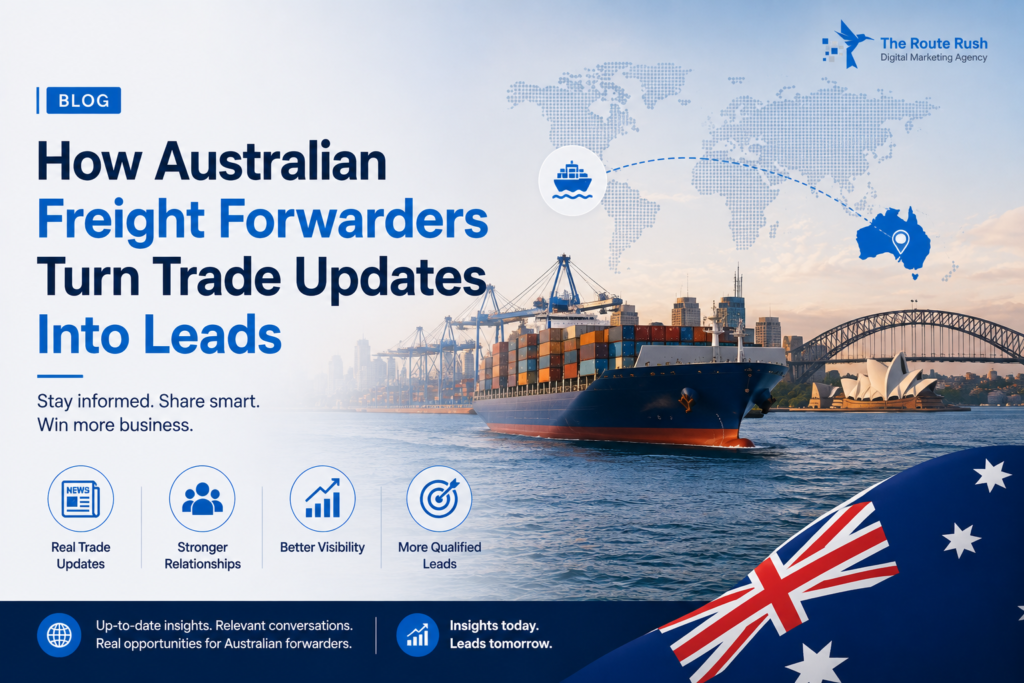
How Australian Freight Forwarders Can Turn Industry Updates Into Leads: A Digital Marketing Playbook
Executive Context: The Australian international trade environment is shaped by distinct regulatory rigor and geographic isolation. Between the annual seasonal surge of Department of Agriculture, Fisheries and Forestry (DAFF) Brown Marmorated Stink Bug (BMSB) offshore treatment rules, stevedore Terminal Access Charge (TAC) hikes at DP World and Patrick terminals, vessel delays and blank sailings on the North Asia–Australia corridor, Cape of Good Hope re-routing impacts on European imports, and ongoing Australian Border Force (ABF) Integrated Cargo System (ICS) compliance audits, Australian cargo owners face constant operational exposure. While average forwarders treat these developments as routine customer service friction, leading Australian logistics providers use them as their highest-converting commercial customer acquisition engine.
Australian freight forwarders convert industry updates into profitable container bookings when they immediately translate stevedore surcharges, DAFF biosecurity mandates, or ocean carrier GRI announcements into landed-cost Australian Dollar (AUD $) impacts, present an executable alternative solution, and provide a frictionless quotation mechanism within 4 hours.
When a shipping line announces a US$1,200/TEU rate increase from Shanghai to Sydney or DAFF places a targeted biosecurity hold on containerized machinery at Port of Melbourne, Australian supply chain managers in Western Sydney, Dandenong, Fisherman Islands, or Welshpool do not want a passive newsletter. They urgently need answers to three commercial questions: (1) How will this impact our landed cost per pallet or container in AUD? (2) How do we avoid catastrophic container detention and wharf storage penalties exceeding A$450 per day? (3) Which licensed customs broker and approved depot facility has immediate capacity to clear and de-stuff our cargo right now?
Forwarders who step into this information void as trusted operational advisors capture high-value commercial accounts at the moment of peak purchasing urgency. By linking breaking trade events to dedicated Trade-Lane Marketing, localized Freight-Forwarder SEO, and rapid-response sales workflows, independent Australian forwarders generate 3x to 5x higher commercial conversion rates than cold tele-calling, as demonstrated across our Australia Freight-Forwarder Marketing Solutions.
Why Australian Trade Updates Are High-Converting Lead Triggers
Most Australian forwarders handle market news passively. When stevedores announce Terminal Access Charge (TAC) increases or DAFF publishes seasonal biosecurity notices, forwarders simply forward PDF circulars from the Freight & Trade Alliance (FTA) or send mass email updates. These passive notices generate zero new commercial leads.
In contrast, the Australian import-export environment possesses four structural characteristics that make reactive, advisory marketing exceptionally profitable for forwarders who act decisively:
Severe Financial Penalties for Wharf Demurrage
Container detention from shipping lines and storage fees from terminal operators (Patrick, DP World, VICT) escalate rapidly after just 3 to 5 free days, often exceeding A$450 to A$600 per container per day. When terminal congestion or biosecurity holds threaten cargo releases, Australian importers urgently search Google and LinkedIn for forwarders with direct Section 77G bonded depots and fast-track clearance capabilities.
Rigorous DAFF Biosecurity Mandates (BMSB)
Between September and April each year, Australia enforces strict seasonal Brown Marmorated Stink Bug (BMSB) measures across target risk countries. Missing origin treatment certificates or incorrect declaration filing on the Integrated Cargo System (ICS) leads to mandatory onshore treatment holds or container re-exportation. Forwarders who clarify these rules instantly win enterprise manufacturing accounts.
Landed-Cost Sensitivity to Stevedore Ancillaries
With stevedores steadily increasing landside Terminal Access Charges, Vehicle Booking System (VBS) fees, and infrastructure surcharges, Australian wholesalers operate on tightening distribution margins. A forwarder who accurately breaks down landed costs and offers consolidated wharf cartage solutions captures immediate commercial attention.
Australian Trusted Trader (ATT) Due Diligence
Corporate procurement teams in Australia increasingly require forwarders to demonstrate Australian Trusted Trader accreditation, licensed in-house customs brokers, and approved biosecurity arrangements. Highlighting these credentials in response to trade disruptions establishes immediate institutional trust.
The Australian Shipper Search-Intent Matrix
To convert industry updates into commercial container bookings, forwarders must map specific Australian logistics events to the underlying search intent of corporate supply chain buyers:
| Disruption / Industry Event | Shipper Search Intent & Pain Point | High-Converting Lead Offer (Lead Magnet) | Commercial Service Monetization |
|---|---|---|---|
| Seasonal DAFF Biosecurity Measures (BMSB Window) | "How to avoid container quarantine holds, offshore treatment penalties, and wharf storage." | Australian Importer’s BMSB Compliance & Offshore Treatment Audit Checklist (PDF / Interactive SOP). | Licensed customs brokerage, approved arrangement (AA) depot storage, and origin treatment coordination. |
| Ocean Carrier General Rate Increase (GRI) | "How to calculate landed container costs and lock in pre-GRI ocean freight rates." | Q4 Ocean Freight Landed Cost & GRI Impact Sheet (AUD $ per TEU/FEU breakdown). | Quarterly volume contract commitments & dedicated ocean freight allocations. |
| Port Congestion / Stevedore Landside Disputes | "Alternative routes to bypass vessel delays and berth congestion at Port Botany / Melbourne." | Australian Port Congestion & Container Dwell Index + Coastal Rail Bypass Guide. | Wharf cartage transport, coastal feeder redirection, and air charter out of Sydney (SYD) / Melbourne (MEL). |
| ABF Customs Valuation / Tariff Concession (TCO) Revisions | "How to claim 0% customs duty via TCOs and ensure compliance on Integrated Cargo System (ICS)." | TCO Tariff Optimization Guide & Duty Refund Matrix. | Customs tariff consulting, retro-active duty refund claims, and trade compliance audits. |
| Red Sea Diversion Impact on Europe-Australia Lanes | "How to avoid 12-day transit delays on European machinery and consumer goods imports." | Europe-Australia Sea-Air Bypass Schedule (via Singapore / Dubai) + Landed Cost Comparison. | High-margin Sea-Air multi-modal transport and dedicated express air freight services. |
The 4-Hour Rapid Response Funnel for Australian Forwarders
When a major logistics bottleneck occurs, the forwarder who reaches the market first wins the business. Execute this standardized 4-hour commercial mobilization sequence:
Consult your commercial pricing and customs brokerage desk at key ports (Port Botany, Melbourne, Brisbane, Fremantle). Determine the exact parameters: Which shipping lines are affected? What is the expected delay in days? What is the surcharge in USD/AUD? What alternative routing, depot capacity, or space allocation can your company provide right now?
Publish a clean, 700-word advisory on your website. Avoid corporate jargon. Structure it with three clear headers: "The Disruption Explained," "Financial & Landed-Cost Impact on Australian Importers," and "Our 3 Executable Solutions." Embed a high-visibility quotation form: "Check Available Allocation & Lock-In Rates."
Distribute the advisory simultaneously: (1) Post an authoritative summary on LinkedIn from the Managing Director's profile with an actionable trade graphic; (2) Send a segmented email broadcast to your database of Australian importers; (3) Send an executive update directly to active and dormant cargo owners.
Deploy targeted, short-term Google Search ads targeting high-intent commercial keywords (e.g., "Shanghai to Port Botany FCL freight rates," "customs clearance broker Melbourne Airport," "BMSB treatment depot Sydney") directing traffic straight to your new advisory landing page.
High-Converting Australian Logistics Lead Magnets
A generic "Request a Quote" form on a logistics website converts at less than 1.5%. However, when Australian cargo owners face biosecurity holds or sudden freight rate spikes, offering a practical decision tool in exchange for their name, corporate email, monthly TEU volume, and primary commodity converts at 8% to 15%.
3 High-Converting Lead Magnet Assets for Australian Forwarders
- 1. The AUD Landed-Cost & Surcharge Estimator: An Excel or web calculator where Australian importers enter container quantities and receive an automated projection of carrier surcharges, Terminal Access Charges (TAC), and detention free-time thresholds across Australian ports.
- 2. The DAFF Biosecurity & BMSB Seasonal Compliance Guide: A 2-page operational guide detailing mandatory offshore treatment requirements, target high-risk goods lists, and documentation standards to avoid customs holds.
- 3. The Capital Port Dwell-Time & Wharf Cartage Benchmark: A monthly dwell-time benchmark comparing container turnaround and rail terminal efficiency across Port Botany, Port of Melbourne, and Port of Brisbane.
LinkedIn Authority Framework for Australian Logistics Leaders
Managing directors, supply chain managers, and procurement leads across Australian wholesale, retail, and manufacturing enterprises spend significant time on LinkedIn reviewing industry intelligence. When the leadership of an independent forwarder publishes authoritative, grounded analysis of trade disruptions, it builds immediate institutional trust.
🚨 CRITICAL SUPPLY CHAIN ADVISORY: [Port Disruption / Biosecurity / GRI Announcement] If your business is importing [Commodity / Machinery / Retail / Building Materials] through [Port Botany / Port of Melbourne / Brisbane / Fremantle], here is the operational impact on your shipments this month: 1️⃣ The Disruption: [Shipping Line / Terminal Operator / DAFF] has implemented a $[Amount]/TEU [GRI / Terminal Surcharge / Biosecurity Measure] effective [Date]. 2️⃣ The Operational Bottleneck: Container dwell times at [Port Name] are currently averaging [X days], creating severe wharf demurrage exposure exceeding A$450/day. 3️⃣ Our Actionable Solution: We have secured allocated block space and priority cartage via [Alternate Route / Approved Depot, e.g. Direct Section 77G Bonded Transit / Sea-Air via Singapore] with guaranteed equipment release and fast-track customs clearance. Do not let supply chain delays erode your landed margins. Download our complete [Landed-Cost Impact Matrix & Alternate Routing Schedule] here: [Link] Or message our commercial pricing desk directly at [Link] for instant spot rate confirmations. #AustralianLogistics #FreightForwarding #SupplyChainAustralia #PortBotany #PortOfMelbourne #[TradeLane]
This post avoids generic marketing fluff. It delivers direct, actionable intelligence from a knowledgeable logistics professional. It quantifies the financial risk in Australian Dollars, addresses the operational bottleneck, and provides an immediate, executable solution.
Reactive Google Ads & Negative Keyword Fortress
When global trade disruptions occur, transactional search queries on Google surge dramatically. However, advertising in Australia without strict negative keyword containment will exhaust your budget on retail consumers searching for consumer parcel tracking.
1. High-Intent Commercial Keyword Selection
Target specific commercial phrases with high buying intent: "FCL freight rates Shanghai to Port Botany," "licensed customs broker Melbourne wharf," "emergency air cargo Sydney to Singapore," "heavy haulage transport Fremantle breakbulk."
2. The Negative Keyword Fortress
You must rigorously exclude consumer parcel tracking and personal luggage searches by adding the following negative keywords across your campaigns:
- Exclude Retail Courier & Parcel Terms: "parcel tracking", "post office", "Australia Post tracking", "Sendle tracking", "StarTrack tracking", "courier rates", "send 1 box", "excess baggage", "luggage transport", "furniture removalists".
- Exclude Consumer Delivery Brands: "Amazon delivery", "FedEx tracking", "DHL Express tracking", "CouriersPlease tracking", "TNT express tracking", "Aramex tracking".
- Exclude Job & Training Searches: "freight forwarder jobs in Sydney", "customs broker salary Melbourne", "logistics internship", "freight forwarding course", "customs broker licence exam".
- Enforce B2B Intent Modifiers: Ensure your positive search keywords always require commercial terms such as "FCL", "commercial export", "TEU container", "licensed customs broker", "bonded depot", or "wharf cartage".
The Dormant Importer Reactivation Engine
Every Australian freight forwarder has a database of hundreds of past clients and inactive quote requesters who have not booked shipments in 6 to 12 months. Breaking industry news provides a compelling, value-driven reason to re-engage them without sounding like a pushy sales rep.
Hi [First Name], We noticed that shipping lines have just announced an emergency US$[Amount]/TEU rate increase on the [Origin Port] to [Port Botany / Melbourne] trade lane starting [Date]. Since your team regularly imports [Commodity / Product Type] on this corridor, we wanted to share our latest Landed-Cost Mitigation Sheet before the new tariff takes effect. We currently have pre-allocated space at $[Locked Rate] for bookings confirmed before [Day of Week]. Would you like me to share the updated rate schedule and transit options for your upcoming shipments? Best regards, [Your Name] | Commercial Desk, [Company Name]
Never send generic broadcast messages that look like mass spam. Personalize each communication with the importer's specific commodity and historical trade lane. A targeted message sent to 40 relevant past shippers will generate 10x more bookings than an unsegmented message sent to 5,000 random contacts.
30-Minute Speed-to-Quote CRM Architecture
Generating inbound quote requests from industry updates is only half the battle. In Australia's competitive logistics market, if an importer requests a rate and your pricing desk takes 24 hours to respond, your conversion rate drops by over 80% because the shipper has already booked elsewhere.
Configure your commercial digital infrastructure for maximum response velocity:
- Pre-Qualification Landing Page Forms: Capture essential operational parameters (Commodity, Incoterm, Origin/Destination, Gross Weight/CBM, Container Type, Target Dispatch Date) directly on the form.
- Instant Mobile & CRM Notifications: The moment a form submits, trigger an instant notification to the commercial pricing manager's phone with complete shipment parameters.
- Enforce a 30-Minute Speed-to-Quote SLA: During business hours, your commercial pricing desk must reach out to the importer within 30 minutes with either a firm quote or confirmation that carrier allocations are being finalized.
- Automated 3-Stage CRM Nurture: If the quote is submitted but not confirmed, trigger automated follow-ups via email at 24 hours, 72 hours, and 6 days providing updated market space availability.
5 Commercial Metrics to Measure Campaign ROI
Do not evaluate your digital marketing on vanity metrics like page views or social media likes. Track these five commercial revenue indicators:
| Commercial Metric | Definition & Calculation | High-Performance Benchmark |
|---|---|---|
| 1. Qualified Commercial Inbound RFQs | Total volume of verified B2B quote inquiries generated directly from trade alert landing pages and campaigns. | 15 to 40 qualified RFQs per major disruption campaign. |
| 2. Speed-to-First-Contact (Minutes) | Average time elapsed between an inbound trade alert inquiry submitting and sales reps initiating direct contact. | < 30 minutes during standard commercial business hours. |
| 3. Quote-to-Booking Conversion Rate | Percentage of quotes generated from industry advisories that result in billable, active shipments. | 25% to 38% (significantly higher than cold tele-calling). |
| 4. Cost Per Qualified Freight Lead (CPQL) | Total marketing and ad spend allocated to the advisory campaign divided by verified commercial quotation requests. | A$120 to A$280 per verified commercial cargo inquiry. |
| 5. Dormant Shipper Reactivation Rate | Percentage of previously inactive accounts in your CRM who book a shipment following a targeted disruption alert. | 10% to 16% reactivation across targeted direct outreach. |
Execution Readiness Checklist for Australian Forwarders
Before launching your first trade-update lead generation campaign, ensure your organization has established these foundational operational building blocks:
- Dedicated Rapid-Response Content Partner: Do you have an internal marketer or specialized agency partner capable of writing and publishing a technical trade advisory within 4 hours of a major announcement?
- Direct Operations & Pricing Alignment: Is your operational pricing desk committed to providing real-time rate differentials, alternate routing options, and space allocations immediately upon request?
- Clean CRM Segmentation: Is your shipper database tagged by primary trade lane (e.g., North Asia-Australia, Europe-Australia, Trans-Tasman, US-Australia) and commodity type (e.g., Machinery, Building Materials, Agriculture, Retail) so advisories reach relevant buyers?
- Pre-Built Negative Keyword Lists: Have you configured Google Search ad accounts with comprehensive negative keyword lists to prevent consumer courier clicks from draining ad capital?
- Verified Speed-to-Quote Workflow: Does your CRM automatically alert sales managers via email/SMS the instant a corporate shipper submits a quote request?
Frequently Asked Questions (FAQs)
How quickly must an Australian forwarder publish after an industry update?
What if our freight rates are higher than competitors during a disruption?
How do we prevent retail consumers from wasting our ad budget when news breaks?
Can independent Australian freight forwarders outcompete multinational integrators using this strategy?
What software stack is needed to execute this playbook effectively?
Anshul Kuntewar
Founder of RouteRush, a specialized digital growth and marketing consultancy dedicated exclusively to independent freight forwarders, licensed customs brokers, and multi-modal logistics companies across Australia, New Zealand, and global shipping corridors. Specializing in high-intent search positioning, trade-lane acquisition architecture, B2B LinkedIn authority, and CRM conversion workflows that help logistics leaders turn complex industry developments into profitable, long-term commercial shipping accounts.