Freight Forwarder Growth — India Why Referrals Alone Won’t Scale Your Freight Forwarding Business Anymore Referrals got you here, and they’re real, valuable business built on trust. But every freight forwarder that’s tried to grow past a certain size in India hits the same wall: referrals are finite, they don’t compound, and they can’t be scheduled. Here’s why the ceiling exists, and what to build alongside referrals to break through it, port by port. About this guide: Written by the RouteRush team, a digital marketing agency working exclusively with freight forwarders, CHAs, and logistics companies across India, the UAE, South Africa, Qatar, Australia, and the UK. Market figures are sourced from Mordor Intelligence and the Ministry of Ports, Shipping & Waterways (Sagarmala Programme, Maritime India Vision 2030). Where we describe a general pattern rather than citing a specific published statistic, we say so directly. What’s Covered In This Guide Why Referral-Only Growth Has a Ceiling 6 Reasons Referrals Stop Scaling a Freight Forwarding Business What to Build Alongside Referrals Where the Referral Ceiling Hits Hardest, Port by Port A Practical Roadmap for Moving Beyond Referrals Frequently Asked Questions Why Referral-Only Growth Has a Ceiling Almost every established freight forwarder in India built their business on referrals, an exporter tells another exporter, a CHA vouches for a forwarder to a client, a long relationship with a shipping line brings in adjacent business. This is genuinely valuable. Referred clients tend to trust faster, negotiate less aggressively, and stay longer. There’s nothing wrong with referrals as a channel. The problem is treating referrals as the entire growth strategy rather than one channel among several. Referral volume is a function of your existing client base and network size, it grows roughly in proportion to how many satisfied clients you already have, not in proportion to how much effort you put in. That means referral-only growth is inherently linear at best, and often slower, while the market opportunity around you is growing much faster. India freight & logistics market size, 2026$315.89B Projected growth by 2031$476.51B (8.57% CAGR) Major ports administered nationally13 Non-major/minor ports across coastal states200+ Major ports’ cargo capacity target, Maritime India Vision 20302,200+ MMTPA Source: Mordor Intelligence, 2026; Ministry of Ports, Shipping and Waterways, Maritime India Vision 2030 A market growing at close to 9% a year is generating new demand, new exporters, new manufacturing hubs under PLI schemes, new e-commerce sellers needing cross-border logistics, that has no existing relationship with your business at all. Referrals can’t reach a company that’s never heard of you and has no mutual contact to introduce you. That demand is only accessible through visibility: search, content, and a credible online presence. 6 Reasons Referrals Stop Scaling a Freight Forwarding Business 01 Referral Volume Is Capped by Your Existing Network You can only get referred by people who already know you. As your business grows, the pool of people who know you grows too, but slowly, and usually only as fast as you personally build new relationships. This is why many forwarders plateau at a revenue level that matches roughly what their personal and professional network can sustain, and no further. 02 Referrals Don’t Reach New Markets or New Hubs If you want to start serving clients through a port or hub where you have no existing presence, JNPT to Mundra, or Chennai to Vizag, your referral network usually doesn’t extend there either. Entering a new hub through referrals alone means starting from zero relationship-building all over again, which is slow and unpredictable. 03 Referrals Are Unpredictable and Unschedulable You can’t forecast referral volume the way you can forecast a marketing pipeline. A good quarter might bring five referred leads, a quiet quarter might bring none, and there’s no lever to pull to guarantee a specific number of enquiries in a specific month. This makes hiring, capacity planning, and revenue forecasting genuinely difficult for a referral-dependent business. 04 Younger Buyers Verify Online Even When Referred Even when a client is referred to you, a growing share of decision-makers, particularly younger import/export managers and procurement leads, still check your website and search for your name before committing. A referral gets you the introduction, it doesn’t guarantee the close. A weak or outdated online presence can quietly undo a warm referral before you even get on a call. 05 Your Competitors Aren’t Standing Still The freight forwarders who do invest in SEO, content, and a real digital presence are capturing the exact demand that referrals can’t reach, new businesses searching cold with no prior relationship to anyone in the industry. Every year a forwarder relies purely on referrals, competitors building genuine visibility online are compounding an advantage that gets harder to close. 06 Referrals Concentrate Risk in a Few Relationships If a large share of your business flows from two or three key referral relationships, a single relationship ending, a key contact retiring, changing companies, or a competitor building a closer relationship with them, can meaningfully shrink your pipeline overnight. A diversified lead generation system spreads that risk across many independent channels instead of a handful of people. What to Build Alongside Referrals, Not Instead of Them None of this means abandoning referrals, they remain one of the highest-trust, lowest-cost channels available to any freight forwarder. The goal is to build parallel channels that capture the demand referrals structurally can’t reach: Hub and service-specific SEO: ranking for searches like “customs clearance agent JNPT” captures buyers with zero prior connection to your network. A complete, optimized Google Business Profile: for every port or city you operate in, capturing local “near me” search intent that has nothing to do with referrals. Content answering real compliance questions: IEC registration, ICEGATE filing, GST e-way bills, capturing buyers early in their research, before anyone has referred them to anyone. A consistent LinkedIn presence: building familiarity with import/export managers and supply chain heads who don’t yet know anyone who could refer you. A systematic Google review process: building trust signals visible to buyers who found
How to Get Freight Forwarding Leads Without Cold Calling (2026 Guide)
Freight Forwarder Lead Generation — India How to Get Freight Forwarding Leads Without Cold Calling (2026 Guide) Cold calling is still how most Indian freight forwarders try to fill their pipeline, and it’s getting harder every year: lower answer rates, longer sales cycles, and diminishing returns on hours spent dialing. This guide covers the systems that actually replace cold calling, built specifically around how Indian importers and exporters research and choose a freight forwarder in 2026, port by port. About this guide: Written by the RouteRush team, a digital marketing agency working exclusively with freight forwarders, CHAs, and logistics companies across India, the UAE, South Africa, Qatar, Australia, and the UK. Market figures are sourced from Mordor Intelligence and the Ministry of Ports, Shipping & Waterways (Sagarmala Programme, Maritime India Vision 2030). Where we cite general patterns rather than a specific published statistic, we say so directly rather than presenting an estimate as a hard number. What’s Covered In This Guide Why Cold Calling Is Losing Effectiveness 9 Ways to Generate Leads Without Cold Calling Lead Generation Across Every Major Port in India A 90-Day Implementation Roadmap Frequently Asked Questions Why Cold Calling Is Losing Effectiveness for Freight Forwarders Cold calling isn’t dead, some forwarders still close business this way, and relationships built over a phone call remain genuinely valuable. But as a primary lead generation strategy, it’s becoming less efficient for a simple reason: the buyer has changed. Import and export managers, supply chain heads, and procurement teams now research and shortlist logistics partners online before a call ever happens. By the time a forwarder’s sales team picks up the phone to a cold prospect, that prospect has often already searched Google, checked a company’s website, and formed an opinion, all before speaking to a single human being. This shifts the real competition upstream. The forwarders winning new business today aren’t necessarily better on the phone, they’re the ones who show up first when a buyer searches, and who look credible and specific once that buyer lands on their website. Cold calling still has a role, but as a way to follow up on warm interest, not as the primary engine generating that interest in the first place. India freight & logistics market size, 2026$315.89B Projected growth by 2031$476.51B (8.57% CAGR) Major ports administered by the Ministry of Ports, Shipping & Waterways13 Non-major/minor ports across coastal states200+ Major ports’ cargo capacity target, Maritime India Vision 20302,200+ MMTPA Source: Mordor Intelligence, 2026; Ministry of Ports, Shipping and Waterways, Maritime India Vision 2030 9 Ways to Generate Freight Forwarding Leads Without Cold Calling 01 Rank for Hub-Specific, High-Intent Search Terms A buyer searching “customs clearance agent JNPT” or “freight forwarder Mundra Port” has already decided what they need, they’re choosing who. This is the single highest-converting search category available to a freight forwarder, and it’s also the category almost no SME forwarder has built dedicated content for. Ranking here means building a specific page for each port or hub you serve, not relying on a single generic “our locations” page. 02 Answer the Compliance Questions Buyers Are Already Searching Exporters and importers constantly search practical, specific questions: how to file a shipping bill on ICEGATE, what documents are needed for IEC code registration, how AEO certification benefits a business. Very little of this is being answered by the freight forwarders positioned to answer it best. Building this content captures a buyer early in their research, well before they’ve chosen a forwarder, and positions you as the expert by the time they’re ready to decide. 03 Fully Claim and Optimize Every Google Business Profile The Local Pack, the map-based results above organic search, drives disproportionately high click-through for local and “near me” B2B searches. A large share of Indian freight forwarders have never fully claimed or optimized this listing, despite it costing nothing. If you operate branches near multiple ports or ICDs, each legitimate location deserves its own fully completed profile. 04 Build a Systematic Google Review Process In an industry where a buyer is trusting a company with time-sensitive, high-value cargo, reviews carry outsized weight in the decision. A simple process, requesting a review from every client shortly after a successful shipment, compounds into a trust asset over time that’s genuinely difficult for a newer competitor to replicate quickly. 05 Post Consistently on LinkedIn as a Person, Not Just a Company Page LinkedIn is where the actual buyers, import/export managers and supply chain heads, spend their professional attention. Posts from an individual profile, particularly a founder or senior team member, consistently reach and build trust more effectively than company-page-only posting. Sharing real operational insight, market updates, and case studies builds the familiarity that makes a buyer comfortable reaching out directly, without ever being cold-called. 06 Complete and Maintain Industry Directory Profiles FFFAI, ACAAI, GoodFirms, and Clutch profiles function as both a lead source in their own right and a backlink source that strengthens your own website’s SEO. Many forwarders create these profiles once and never return to complete or update them, leaving a half-filled listing that undersells the business relative to competitors with full profiles. 07 Run Precision Google Ads on High-Intent Keywords While SEO builds in the background, tightly targeted Google Ads on 5-10 specific hub and service keywords can generate qualified enquiries immediately. This works because the intent is so specific, someone searching “air cargo agent IGI Airport” is a far better-qualified click than someone searching a broad, generic logistics term. 08 Build a Referral Partner Network, Deliberately Most forwarders already get some business through informal referrals, but few treat it as a system. Deliberately building relationships with complementary businesses, customs brokers, trade finance providers, packaging and warehousing companies, chartered accountants working with exporters, creates a structured referral channel instead of leaving it to chance. 09 Set Up a Low-Friction Enquiry Path on Your Website Once a buyer finds you, whether through search, LinkedIn, or a referral, the path to actually contacting you needs to be immediate: a
How Much Should a Freight Forwarder Spend on Digital Marketing in India? (2026)
Freight Forwarder Marketing — Budget Guide How Much Should a Freight Forwarder Spend on Digital Marketing in India? Short answer: most freight forwarders in India should budget 5-10% of annual revenue for digital marketing, with the exact number depending on how much you currently rely on referrals versus needing to build a new pipeline from scratch. Here’s how to actually land on the right number for your business, not just a generic percentage. The Benchmark Numbers, and Why They Don’t Fully Apply to You Across B2B companies broadly, most spend somewhere between 7% and 12% of revenue on marketing, with professional and relationship-driven services businesses typically landing lower, around 5-8%, since referrals and existing relationships carry more of the load. For Indian small and mid-sized businesses specifically, the benchmark is a little different: companies with under ₹1 crore in revenue typically allocate 5-7% of revenue to digital marketing, while those in the ₹1-5 crore range allocate 7-10%. Freight forwarding sits in an interesting spot on this spectrum. It’s relationship-driven like professional services, most of your existing business probably comes from referrals and repeat clients, which argues for the lower end. But it’s also an industry where almost nobody is investing in digital marketing at all, which means even a modest, well-targeted budget can produce outsized results simply because you’re not competing against well-funded competitors for the same keywords. Typical B2B professional services spend5-8% of revenue Indian SMB digital marketing spend, under ₹1 Cr revenue5-7% of revenue Indian SMB digital marketing spend, ₹1-5 Cr revenue7-10% of revenue Recommended starting point for referral-heavy freight forwarders5-8% of revenue Source: Gartner CMO Spend Survey; upGrowth India SMB Marketing Benchmarks, 2026 What This Looks Like in Real Rupees Annual Revenue Suggested Marketing Budget Monthly Equivalent ₹50 lakh – ₹1 crore 5-7% (₹2.5-7 lakh/year) ~₹20,000 – ₹58,000/month ₹1 – 3 crore 6-8% (₹6-24 lakh/year) ~₹50,000 – ₹2 lakh/month ₹3 – 10 crore 7-9% (₹21 lakh – 90 lakh/year) ~₹1.75 lakh – 7.5 lakh/month ₹10 crore+ 5-8% (absolute rupee value grows even as % may ease slightly) Varies, but rarely below ₹4-5 lakh/month at this scale These ranges are a starting point, not a rule. A freight forwarder that’s 100% referral-based and happy with steady, modest growth can run leaner. A forwarder actively trying to break into new hubs, new cargo verticals, or compete for larger accounts should lean toward the higher end, since building visibility from zero costs more than maintaining it. Where the Budget Should Actually Go A generic digital marketing allocation (heavy on paid ads, light on content) doesn’t fit freight forwarding well, because the sales cycle is long and trust-driven, not impulse-driven. A better allocation for most freight forwarders looks like this: Channel Suggested Allocation Why SEO & Content 30-35% Builds compounding, low-cost-per-lead visibility for hub, service, and compliance searches, the highest ROI channel over 12+ months Website (design, development, ongoing updates) 15-20% The foundation everything else points to; a weak website wastes spend on every other channel Google Ads 20-25% Fast, targeted visibility on high-intent hub and service keywords while SEO builds in the background LinkedIn (organic + ads) 15-20% Where your actual B2B buyers, import/export managers, supply chain heads, spend their attention Reputation & directory management 5-10% Google reviews, FFFAI/ACAAI/GoodFirms/Clutch profile management, low cost but high trust impact A practical note: if your budget is on the smaller end (under ₹50,000/month), don’t spread it thin across every channel. Concentrate on Google Business Profile optimization, a strong homepage and 2-3 service pages, and a handful of hub-specific keywords. A small budget executed narrowly beats a small budget spread across six channels where nothing gets enough attention to actually rank or convert. What Each Channel Actually Costs in India, Line by Line Percentages of revenue are useful for planning, but they don’t tell you what you’re actually buying. Here’s what real market pricing looks like across the channels that matter for a freight forwarder, based on current 2026 Indian agency and freelancer rates. SEO Retainers Tier Monthly Cost What’s Typically Included Basic / Local ₹8,000 – ₹25,000 On-page optimisation, Google Business Profile management, basic reporting, no real content or link building Standard / Growth ₹25,000 – ₹60,000 Content production, technical fixes, structured link building, monthly strategy calls Premium / National ₹60,000 – ₹2,00,000+ Multi-location SEO, competitive keyword targeting, dedicated content and outreach teams For most SME freight forwarders targeting hub-specific and service-specific keywords rather than fighting for national terms, the Standard tier is usually the right starting point, you don’t need Premium-tier spend to win low-competition, high-intent searches. Content Production If content isn’t bundled into your SEO retainer, expect to pay separately: ₹2,000-8,000 per 1,000-word article depending on research depth and subject expertise required (compliance and documentation content, like ICEGATE or IEC guides, sits at the higher end since it needs real accuracy). A steady content calendar of 4-6 articles a month runs roughly ₹15,000-45,000 on top of core SEO work, though many mid-tier retainers now bundle a fixed number of articles into the monthly fee. Website Design & Development A properly built freight forwarding website, fast, mobile-first, with dedicated hub and service pages rather than a generic five-page brochure site, typically runs anywhere from ₹40,000 for a lean, well-executed small business build up to ₹2,00,000+ for a larger site with custom design, multiple service verticals, and ongoing development support. This is usually a one-time or occasional cost rather than a recurring monthly line item, though ongoing maintenance and updates should be budgeted separately at roughly ₹5,000-15,000/month. Google Ads Cost per click for freight and logistics-related keywords in India varies significantly by specificity, broad national terms cost more and convert worse, while hub-specific and long-tail keywords (“customs clearance agent JNPT”) cost less per click and convert at a much higher rate. Most SME freight forwarders should start with a modest daily budget (₹500-1,500/day, roughly ₹15,000-45,000/month) focused tightly on 5-10 high-intent keywords, rather than spreading thin across broad logistics terms competing with national players. LinkedIn (Organic + Ads) Organic LinkedIn activity, consistent posting
freight-forwarding-marketing-india
Freight Forwarding Marketing — India Freight Forwarding Marketing in India: The Complete Guide (2026) Everything a freight forwarder, CHA, or NVOCC in India needs to know to get found on Google, generate consistent inbound leads, and stop competing on price alone. India’s freight and logistics market is worth over $315 billion and growing at nearly 9% a year, yet most forwarders are still invisible for the exact searches their next client is making right now. This guide covers why, and exactly what to do about it. India freight & logistics market size, 2026$315.89B Projected growth by 2031$476.51B (8.57% CAGR) Road freight share of tonnage, 202569.97% Air freight forwarding growth, 2026–203110.06% CAGR Maharashtra + Tamil Nadu share of freight tonnage, 2025~58% Freight forwarders listed in India’s largest directory419 Source: Mordor Intelligence, 2026; Forwarding Companies directory data, 2026 What’s Covered In This Guide The State of Freight Forwarding Marketing in India The Hubs That Matter Most, and Why Each Is Different 8 Mistakes Costing Indian Freight Forwarders Clients SEO for Freight Forwarders: Where to Actually Focus What a Freight Forwarder Website Actually Needs Content Marketing: What to Write and Why Google Business Profile & Local SEO Google Ads & LinkedIn Ads for Freight Forwarders Social Media & LinkedIn Strategy Reviews, Reputation & Trust Signals A Practical 90-Day Roadmap Frequently Asked Questions The State of Freight Forwarding Marketing in India India’s freight forwarding industry is in a strange position. The market is enormous and growing fast, e-commerce, pharma exports, PLI-driven manufacturing, and the Dedicated Freight Corridor are all pulling more cargo through Indian ports and ICDs every year. And yet the industry’s digital presence hasn’t caught up. Search any major directory, FFFAI, ACAAI, GoodFirms, or Clutch, and you’ll find hundreds of Indian forwarders, many with decades of real operational history, competing entirely on relationships and price, with a website that does none of the work it could be doing. This isn’t a criticism of the industry’s competence. Indian freight forwarders are some of the most operationally sharp businesses anywhere, navigating customs complexity, GST compliance, and multimodal logistics daily. It’s a gap in how that expertise gets represented online, and that gap is exactly where the opportunity sits for the forwarders who close it first. Freight forwarding marketing in India isn’t the same discipline as marketing a retail brand or a SaaS product. Buyers are B2B, sales cycles are long and relationship-driven, and trust is earned through demonstrated expertise, not clever ad copy. A freight forwarder that understands this builds a very different kind of marketing engine than the one being sold by generic digital agencies. The Hubs That Matter Most, and Why Each Is Different Mumbai (JNPT / Nhava Sheva) India’s busiest container port and the heart of the country’s sea freight industry. The highest concentration of freight forwarders, CHAs, and NVOCCs in India operates in and around Mumbai and Navi Mumbai, anchoring the Mumbai-JNPT corridor, one of India’s two largest freight demand centers. Delhi NCR (ICD Tughlakabad / Dadri) India’s primary landlocked freight gateway, connected to JNPT and other ports via rail through the Dedicated Freight Corridor. The anchor of the Delhi-Mumbai Industrial Corridor and a major air cargo hub through IGI Airport. Chennai South India’s primary port and the center of the automotive and electronics export corridor. A distinct buyer profile from Mumbai or Delhi, dominated by manufacturing clients with tight just-in-time shipping requirements. Each hub has its own search behavior, its own buyer profile, and its own competitive gap. A Chennai-based forwarder specializing in automotive component exports is searched for completely differently than a Delhi NCR forwarder handling pharma air cargo, yet most Indian freight forwarder websites make no distinction at all, offering the same generic “we do freight forwarding” homepage regardless of hub, cargo type, or client industry. Beyond these three, Mundra, Kolkata, Bengaluru, and Ahmedabad are all growing secondary hubs worth building dedicated content for as your marketing matures. 8 Mistakes Costing Indian Freight Forwarders Clients 01 Homepage Targeting No Specific Keyword at All The most common issue on Indian freight forwarder websites is a homepage title tag that’s just the company name, or a generic phrase like “Leading Logistics Company in India.” National keywords like “freight forwarder India” are dominated by DHL, Delhivery, Blue Dart, and Allcargo, no SME forwarder is winning that keyword. The real opportunity is hub-specific and service-specific: “customs clearance agent JNPT,” “air freight forwarder Chennai,” “ICD Tughlakabad CHA services.” 02 No Hub or Port-Specific Service Pages Very few Indian freight forwarders build dedicated pages around the specific port, ICD, or airport they operate through. A buyer searching “FCL shipping Nhava Sheva” or “air cargo agent IGI Airport” is showing exact intent, they’ve already decided what they need, they’re choosing who. Almost no SME forwarder has built a page that speaks directly to that search. 03 Incomplete or Unclaimed Google Business Profiles The Local Pack, the three-result map box above organic search, drives the highest click-through rate for local B2B searches like “customs house agent near me” or “freight forwarder Chennai.” A large share of Indian freight forwarders have never fully claimed or optimized this listing, despite it costing nothing and taking under an hour to set up properly. 04 No Content Addressing Real Buyer Questions Indian importers and exporters search very specific, compliance-driven questions: “how to file shipping bill on ICEGATE,” “GST e-way bill for export cargo,” “documents required for IEC code registration,” “AEO certification benefits for exporters.” Almost none of this is being answered by the freight forwarders best positioned to answer it, it’s being answered by government portals, CA blogs, and generic content sites with no connection to any specific forwarder a buyer could actually hire. 05 Thin Service Pages With No Operational Detail Freight forwarding sits squarely in Google’s YMYL (Your Money or Your Life) content category, poor service has real financial and operational consequences for clients, so Google’s quality evaluation looks for genuine, specific expertise. A service page that’s a paragraph and a contact form signals the opposite.
Why Most Freight Forwarding Companies in South Africa Don’t Show Up on Google
Freight Forwarding SEO — South Africa Why Most Freight Forwarding Companies in South Africa Don’t Show Up on Google RouteRush · Freight & Logistics SEO Desk · South Africa Market · 12 min read If you run a freight forwarding company in South Africa and you search your own services — “freight forwarder Durban,” “customs clearing agent Cape Town,” “air freight forwarder Johannesburg” — there’s a good chance your business doesn’t appear anywhere on the first page. Meanwhile, a handful of the same competitors, directories, and global marketplaces keep showing up for every search. This isn’t bad luck, and it isn’t because your service is worse. It’s because most freight forwarding companies in South Africa are set up to be found by referral, not by Google — and referral-only growth has a ceiling. In this article, we’re breaking down exactly why this happens — not vague “do more SEO” advice, but the specific, fixable gaps we see on almost every freight forwarding site we audit in this market, from Durban and Cape Town to Johannesburg and Port Elizabeth. In This Article The website was built to look credible, not to get found Google Business Profile is unclaimed, incomplete, or inactive Zero content answering what buyers are actually searching Weak technical foundation working against you No backlinks or industry authority signals Competing against global marketplaces without a local edge A 2-minute self-audit for your own site Frequently asked questions 70%+ of B2B logistics buyers now research vendors online before making first contact 0 dedicated service or trade-lane pages on most SA forwarder websites 3–5 directory and marketplace listings typically outrank the actual forwarders A Familiar Scenario A Durban-based forwarder has been operating for over a decade, has a solid reputation, and a client base built entirely on referrals and repeat business. Their website looks professional — clean design, a logo, a contact form. But it has exactly five pages, no blog, no service breakdowns, and an unclaimed Google Business Profile. A freight buyer in Johannesburg searching for “customs clearing agent for FMCG imports” will never see them — because there’s nothing on the site telling Google that’s a service they offer, in a location they serve, at the level of specificity buyers are searching for. This is the single most common pattern we see, market after market. 1. The website was built to look credible, not to get found One homepage, no depth Most forwarder sites have a homepage, an about page, a contact page — and that’s it. Google has nothing to match against searches like “sea freight forwarder South Africa to UAE” or “customs broker for FMCG imports Durban,” because no page on the site actually targets those terms. Without dedicated pages for each service and trade lane, there’s simply nothing for Google to rank. This also affects trust signals once a buyer does land on the site. A single homepage trying to cover sea freight, air freight, customs clearing, warehousing, and project cargo all at once reads as generic — buyers can’t quickly confirm you handle their specific cargo type or lane, so they bounce back to search results. The Fix Build separate pages for each core service (sea freight, air freight, customs clearing, warehousing, project cargo) and each major trade lane you handle (e.g. South Africa–UAE, South Africa–China, South Africa–Europe). Each page should target one clear search intent, include specific details (ports served, typical transit times, cargo types handled), and link to a clear next step — quote request, contact, or audit. 2. Google Business Profile is unclaimed, incomplete, or inactive The single biggest missed opportunity for local freight searches Searches like “freight forwarder near me” or “clearing agent Durban port” trigger Google’s local map pack before any organic result appears. If your Google Business Profile isn’t claimed, doesn’t have your correct categories, service areas, photos, and regular posts, you’re invisible in exactly the searches your actual next customer is making. We also frequently find duplicate or outdated listings — old addresses, disconnected phone numbers, or a listing under a previous company name — actively competing with the correct one and diluting local ranking signals. The Fix Claim and fully complete the profile: correct primary category (e.g. “Freight Forwarding Service”), accurate service areas, port/warehouse photos, and monthly updates. Audit for duplicate listings and either merge or request removal. This alone often moves a forwarder into the local map pack within weeks. 3. Zero content answering what buyers are actually searching No blog, no guides, no answers Freight buyers search things like “how long does customs clearance take in South Africa,” “documents needed for importing into South Africa,” or “cost of shipping a container from China to Durban.” These are exactly the searches with real buying intent — and almost no SA forwarder is answering them. The directories and global logistics blogs that do answer these questions are the ones showing up instead. Import/export documentation guides for South African customs Transit time and cost breakdowns for your most common trade lanes Industry-specific guides (e.g. FMCG cold chain, NDIS equipment imports, retail seasonal stock) Regulatory updates (SARS customs changes, port congestion advisories) The Fix Publish practical, specific content around the real questions your sales team gets asked every week. This is the fastest way to outrank directories, because directories can’t answer these questions with the same specificity — you can. 4. Weak technical foundation working against you Slow load times, no schema markup, poor mobile experience Even when a forwarder does have relevant content, a slow-loading site, missing structured data (LocalBusiness / Organization schema), and a clunky mobile experience quietly push rankings down. Google factors in page experience directly, and freight buyers increasingly research on mobile — often from a warehouse floor or the road, not a desk. We also regularly find missing or duplicate meta titles, no XML sitemap submitted to Search Console, and broken internal links left over from old site migrations — small technical debts that compound over time. The Fix Run a technical audit:
Why Most Freight Forwarding Companies in Australia Don’t Show Up on Google
Australia Freight SEO Google Visibility Port Botany Inland Rail Freight Consolidation Why Most Freight Forwarding Companies in Australia Don’t Show Up on Google By Anshul Kuntewar · Founder, RouteRush Digital Marketing · Last updated: July 2026 · 13 min read Most freight forwarding companies in Australia are not showing up on Google — and it isn’t because the market lacks demand or the competition is too strong. Search “customs broker Port Botany” or “freight forwarder Melbourne” right now. What comes up first is rarely a well-established Australian SME forwarder with genuine port relationships and specialist trade-lane knowledge. It’s a global integrator’s local office page, a freight marketplace listing, or a directory aggregator with no operational depth at all. This matters more than ever right now. DSV’s USD 23.6 billion acquisition of DB Schenker signals a broader industry shift toward scale, technology, and consolidated customs expertise — and as the giants get bigger and more visible, the mid-tier and independent Australian forwarders who don’t fix their digital foundations risk becoming invisible by comparison, regardless of how good their actual service is. This blog is written for founders, MDs, and commercial directors of freight forwarding companies in Australia who’ve built real operational depth and want to understand precisely why Google can’t find them, what it’s costing every month, and what to fix first. In This Guide Why Visibility Matters More in Australia’s Freight Market Right Now Reason 1: Your Website Speaks to Visitors, Not to Google Reason 2: You’re Invisible on Google Maps in Your Own Region Reason 3: No Content for a Geography This Complex Reason 4: Your Website Is Too Slow to Compete Reason 5: No Schema — Google Has to Guess What You Do Reason 6: You’re Absent From Where Shippers Look First Reason 7: Nobody Is Vouching for Your Website The Australia-Specific Opportunity Nobody Is Taking The Fix — What to Do and in What Order Realistic Timeline: When Will You See Results? Why Visibility Matters More in Australia’s Freight Market Right Now The familiar objection from Australian forwarder founders: “We’ve built our business on long-standing relationships with exporters, shipping lines, and port agents. Why would Google matter to us?” It matters because Australia’s freight market is undergoing real structural change, and the businesses best positioned to win the resulting demand are the ones a new client can actually find. Every new manufacturer expanding near Port Botany, every agricultural exporter shifting to rail via the new Inland Rail corridor, and every e-commerce business scaling cross-border shipping is a potential client actively searching for a forwarder — often with no existing relationship to fall back on. The commercial reality of Australia’s freight forwarding market in 2026: USD 3.61 billion — Australia’s freight forwarding market size in 2026, growing at a 4.12% CAGR to reach USD 4.42 billion by 2031. Mordor Intelligence, 2026 Six mega-ports process 3.3 million TEU annually, with sea freight forwarding alone generating 46.3% of total market revenue — and Port Botany’s automated on-dock rail terminal now handles up to 3 million TEU per year on its own. Mordor Intelligence, 2026 USD 14.5 billion Inland Rail project connecting Melbourne to Brisbane is reshaping how agricultural and resource cargo moves inland — creating new logistics questions shippers are actively searching answers to right now. Mordor Intelligence, 2026 USD 45.96 billion — Australia’s e-commerce sector revenue in 2024, a major driver of new LCL and parcel consolidation demand for forwarders able to capture it. Mordor Intelligence, 2026 96.55% of all web pages get zero organic traffic. In a market with real growth drivers like these, the gap between forwarders who’ve built genuine digital visibility and those who haven’t is not marginal — it’s total. Ahrefs, 2025 Australia’s freight market keeps growing across sea, rail, and e-commerce logistics. The new shippers that growth generates default to Google first when they don’t already have a trusted forwarder. Right now, most of what they find is a global brand’s regional page or a directory listing — not the specialist Australian SME best equipped to actually handle their cargo. The 7 Real Reasons Freight Forwarding Companies in Australia Don’t Show Up on Google 01 Your Website Speaks to Visitors, Not to Google Most Australian freight forwarder websites are built to look credible — a hero image of a container ship, a services list, a contact form. That’s a brochure, and it tells Google almost nothing specific about what you actually do or where you operate. Google ranks specificity. A manufacturer near Port Botany searches “customs clearance Port Botany.” An agricultural exporter searches “cold chain freight forwarder Melbourne.” A mining supplier searches “bulk freight forwarder Fremantle.” Generic homepage copy like “Your Trusted Logistics Partner” matches none of these searches, and Google ranks it accordingly. What this looks like in practice Search “freight forwarder Brisbane” right now. The results are dominated by global integrators’ regional pages, freight marketplaces, and directory listings. Independent Brisbane-based forwarders with genuine port relationships and specialist trade-lane expertise are largely absent from page 1 — not for lack of capability, but because no page on their site targets that exact search. The Fix Build dedicated pages for each service-plus-location combination: “sea freight forwarder Port Botany,” “customs clearance Melbourne,” “air cargo agent Brisbane Airport,” “bulk freight forwarder Fremantle,” “rail freight coordination Inland Rail corridor.” Rewrite your homepage title to lead with your primary service and hub, not a generic tagline. 02 You’re Invisible on Google Maps in Your Own Region Most Australian forwarders have never properly optimised their Google Business Profile — and given Australia’s vast geography, regional Local Pack visibility matters even more here than in a more compact market. A logistics coordinator searching “freight forwarder near me” from Fremantle, Adelaide, or regional Queensland sees three Local Pack results before any organic link. If you’re not one of them, that enquiry goes straight to a competitor. From our audits, the majority of Australian freight forwarder GBP listings are incomplete, unverified, or entirely missing for secondary regional hubs — even when
NDIS provider marketing budget
NDIS Marketing Provider Growth Budget Strategy SEO for NDIS How Much Should NDIS Providers Spend on Marketing in 2026? By Anshul Kuntewar · Founder, RouteRush Digital Marketing · Last updated: July 2026 · 11 min read If you run an NDIS provider business and you’re asking this question, you’re already ahead of most of the market — because most providers aren’t asking it at all. They’re running on referrals and hoping the pipeline holds. Here’s the reframe worth sitting with: your NDIS provider marketing budget isn’t a cost line to minimise. It’s a customer acquisition lever with a measurable return — and in a market of over 21,000 registered providers where no single operator holds more than a sliver of share, the founders treating it that way are the ones pulling ahead. This isn’t a “5 social media tips” post. It’s a framework for treating this as a capital allocation decision, the same way you’d think about hiring your next support worker or opening a second location. In This Guide Why This Question Has No Industry-Standard Answer The Budget Framework — By Growth Stage Why Margin Structure Should Change Your Number Where the Budget Should Actually Go The Price-Cap Reality Nobody’s Saying Out Loud A Simple Way to Calculate Your Own Number What Under-Investing Actually Costs You Frequently Asked Questions Why This Question Has No Industry-Standard Answer Retail has a marketing-spend benchmark. SaaS has one. NDIS doesn’t — and there’s a structural reason why. The NDIS provider market, by the numbers: $45 billion — the size of the NDIS provider industry in Australia in 2026, growing at a compound annual rate above 5% since 2020. IBISWorld, 2026 21,734 registered providers compete nationally, with no single operator holding more than a small share of the market. NDIS provider registry data, 2025 Support coordination margins run 40–60%, plan management 30–50%, and direct support delivery 20–40% — a spread that should directly shape where your marketing dollars go. VCCG NDIS Business Profitability Analysis, 2025 $37.8 billion in projected federal savings over four years under the 2026–27 Budget reforms, driven by tighter eligibility and standardised assessments — changing the competitive landscape for every provider. Federal Budget 2026–27 That fragmentation cuts two ways for you as a founder. The upside: market share is genuinely winnable, because nobody has locked up search visibility or brand trust at scale the way a handful of large groups have in aged care. The downside: you can’t just copy a competitor’s ad spend, because there’s no published, proven playbook for this sector the way there is in retail or professional services. So the right approach isn’t “match what others spend.” It’s building your number from your own revenue, margin structure, and growth stage. The Budget Framework — By Growth Stage, Not Guesswork 01 Early-Stage Providers (Under 2 Years, Building Referral Base) Target: 10–15% of revenue. At this stage your constraint isn’t conversion — it’s discovery. Support coordinators and families can’t choose you if they’ve never found you. This is the phase where under-investing compounds the longest: every month without a functioning digital presence is a month spent invisible while a better-found competitor absorbs the enquiry instead. 02 Established Providers (Steady Client Base, Filling Capacity) Target: 5–8% of revenue. You’re past pure survival. The goal shifts from “get found at all” to “get found consistently, and convert more of what’s already arriving.” This is usually the exact point where founders start asking the question this article answers — because the ad-hoc marketing that got you here won’t scale you further. 03 Mature, Multi-Location Providers (Expanding, Strong Brand Trust) Target: 3–6% of revenue. Spend efficiency matters more than spend volume now. You’re optimising conversion and expanding into new service areas rather than building brand awareness from zero. Benchmarking Against General B2B Growth-Stage Spend These ranges aren’t invented in isolation. Across B2B and service businesses broadly, growth-stage companies allocate meaningfully more of revenue to marketing than mature ones — often 15–25% at the earliest stages, tapering to 5–7% once a business shifts into efficiency mode. NDIS providers sit at the conservative end of that curve because of price-cap constraints, but the shape holds: spend more to grow, spend less to sustain. Why Margin Structure Should Change Your Number Not all NDIS revenue is created equal, and this is where generic marketing advice falls apart for this sector specifically. Service Type Typical Margin Marketing Priority Support coordination 40–60% Highest — fastest payback per client Plan management 30–50% High — strong, scalable payback Direct support delivery 20–40% Moderate — longer payback window If your business runs a mix of these service lines, your marketing budget shouldn’t be spread evenly — it should be weighted toward whichever line gives you the fastest, highest-margin payback per acquired client. That’s not just higher-margin in the abstract; it de-risks your entire acquisition spend, because you recover the cost faster and can reinvest sooner. Where the Budget Should Actually Go A common founder mistake: putting the whole budget into paid ads and skipping the foundation entirely. A more defensible allocation for most providers: Channel % of Budget Why SEO & content 40–50% Compounds over time; keeps working after spend stops Paid ads (Google/Meta) 20–30% Fast for filling capacity gaps or new-region launches Reviews & reputation 15–20% Trust-driven sector — families weigh this heavily Website/CRO 10–15% No value in traffic that doesn’t convert to enquiries The Price-Cap Reality Nobody’s Saying Out Loud Here’s the part most generic marketing advice ignores entirely: the NDIS price book caps what you can charge for most services. You cannot raise prices to absorb a wasted ad campaign the way a retail or SaaS business can. Founder reality check In a price-capped market, marketing efficiency is one of the only real growth levers left besides operational cost control. Every marketing dollar that doesn’t produce a client is a dollar you can never recover through pricing power — because you don’t have any. That’s precisely why SEO deserves the largest single share of your budget, not
Why Most Freight Forwarding Companies in UAE Don’t Show Up on Google
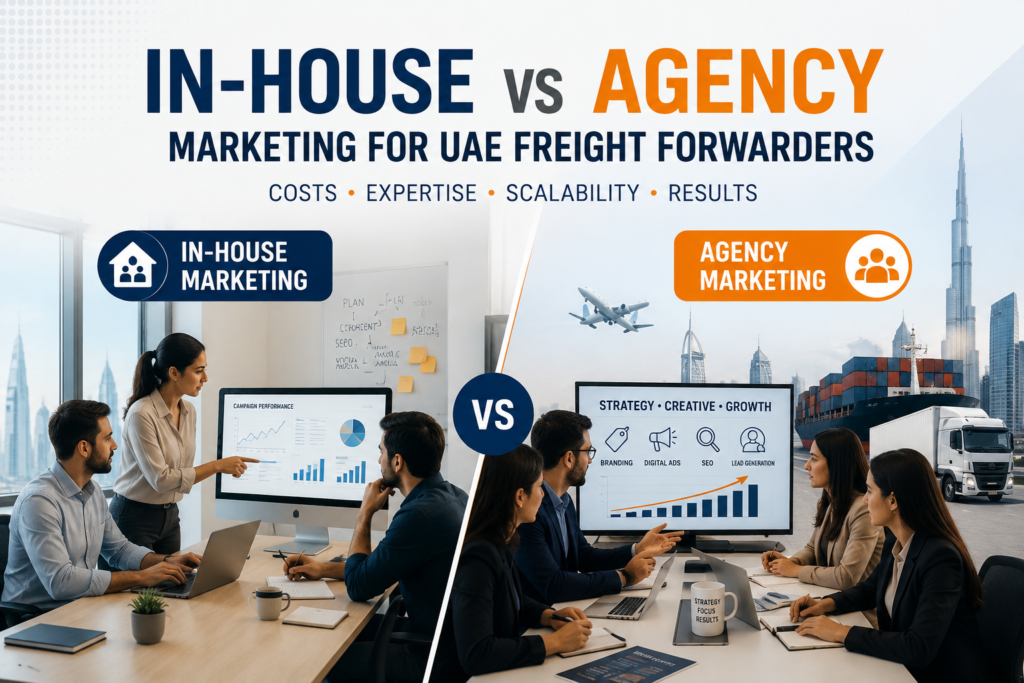
UAE Freight SEO Google Visibility Jebel Ali JAFZA Etihad Rail Why Most Freight Forwarding Companies in UAE Don’t Show Up on Google (And How to Fix It) By Anshul Kuntewar · Founder, RouteRush Digital Marketing · Last updated: July 2026 · 13 min read Most freight forwarding companies in the UAE are not showing up on Google — and it has nothing to do with the size of the market or the strength of the competition. Search “customs broker JAFZA” or “freight forwarder Jebel Ali” right now. What comes up is a freight marketplace listing, a directory aggregator, or a global integrator’s regional office page. What you won’t find, in most cases, is a well-run mid-tier UAE forwarder with genuine trade-lane expertise and years of relationships at Jebel Ali or Khalifa Port. That gap exists despite the UAE being one of the largest freight forwarding markets in the region — and that’s precisely the point. The top 10 players in the UAE freight forwarding market control only 45% of market share. The other 55% is split across hundreds of mid-tier and independent forwarders — most of whom are functionally invisible on Google for the exact searches their next client is making today. This blog is written for founders, MDs, and commercial directors of freight forwarding companies in the UAE who want to understand precisely why Google can’t find them, what it’s costing every month in lost enquiries, and exactly what to fix first. In This Guide Why Visibility Matters More in the UAE Than Most Forwarders Think Reason 1: Your Website Speaks to Visitors, Not to Google Reason 2: You’re Invisible on Google Maps in Your Own Emirate Reason 3: Forty-Plus Free Zones, Zero Free-Zone-Specific Content Reason 4: Your Site Is Too Slow for a Market That Doesn’t Wait Reason 5: No Schema — Google Is Guessing What You Do Reason 6: You’re Absent From Where UAE Shippers Actually Look First Reason 7: Almost Nobody Is Linking to You The UAE-Specific Opportunity Nobody Is Taking The Fix — What to Do and in What Order Realistic Timeline: When Will You See Results? Why Visibility Matters More in the UAE Than Most Forwarders Think The common objection from UAE forwarder founders: “We’ve built our book of business on relationships — port contacts, trade associations, referrals from shippers we’ve served for a decade. Why does Google matter?” It matters because digital platforms are actively reshaping how freight gets booked in the UAE right now. Commission-based booking agents are already facing margin erosion as digital freight platforms disintermediate traditional ocean and air cargo procurement — and mid-tier operators who survive this shift are the ones consolidating around niche trade-lane expertise and advisory value, which is exactly what strong content and search visibility communicate to a prospective client before they ever call. The commercial reality of the UAE freight market in 2026: Jebel Ali Port handled 15.5 million TEUs in 2024 — nearly 18% of DP World’s entire global container volume — and DP World’s broader UAE capacity has pushed past 100 million TEU following an 8.3% year-on-year jump. Every one of those containers belongs to a shipper who chose a forwarder somehow. IMARC Group / DP World, 2025 The top 10 players control only 45% of the UAE freight forwarding market. The remaining 55% is contested by mid-tier and independent forwarders — meaning visibility is a genuinely winnable battle, not a losing one against giants. Aviaan Market Research, 2025 Dubai’s non-oil foreign trade has surpassed AED 2 trillion, with UAE freight forwarding projected to keep growing at roughly 6–7% CAGR through 2030 — meaning the volume of new shippers actively searching for a forwarder keeps expanding every year. Aviaan / Bonafide Research, 2025–2026 Over 40 free trade zones operate across the UAE, each with its own customs nuances and forwarder specializations — a level of local complexity almost no forwarder website currently addresses in its content. Coherent Market Insights, 2025 96.55% of all web pages receive zero organic traffic. In a market this large, the gap between forwarders who’ve done the SEO work and those who haven’t is not marginal — it’s total. Ahrefs, 2025 The UAE freight market keeps growing. New shippers — especially those new to the region, new to Jebel Ali’s free zone system, or actively switching providers — default to Google first. Right now, that search mostly surfaces marketplaces and global integrators. It doesn’t have to. The 7 Real Reasons Freight Forwarding Companies in UAE Don’t Show Up on Google 01 Your Website Speaks to Visitors, Not to Google Most UAE freight forwarder websites were built to look credible to a human visitor — a hero shot of Jebel Ali’s container stacks, a services list, a contact form. That’s a brochure. It tells Google almost nothing specific about what you actually do or where. Google ranks specificity. A manufacturer setting up in Dubai South searches “customs clearance Dubai South.” An importer at JAFZA searches “freight forwarder Jebel Ali Free Zone.” A pharma company searches “cold chain freight forwarder Dubai MOHAP certified.” Generic homepage copy that says “Your Trusted Logistics Partner” matches none of these searches — and ranks for none of them either. What this looks like in practice Search “customs broker JAFZA” right now. The results are dominated by directories, freight marketplaces, and DP World’s own service pages. Independent, specialized JAFZA-based forwarders with genuine free-zone expertise are largely absent from page 1 — not because they lack the expertise, but because no page on their site targets that exact search. The Fix Build dedicated pages for each specific service-plus-location combination: “Sea freight forwarder Jebel Ali,” “customs clearance JAFZA,” “air cargo agent Dubai International Airport,” “cold chain logistics MOHAP certified Dubai,” “freight forwarder Khalifa Port Abu Dhabi.” Rewrite your homepage title to lead with your primary service and hub, not a generic tagline. 02 You’re Invisible on Google Maps in Your Own Emirate Most UAE forwarders have never properly optimised their Google Business Profile — and the UAE’s
Why Most Freight Forwarding Companies in Oman Don’t Show Up on Google (And How to Fix It)
Oman Freight SEO Google Visibility Muscat Logistics Sohar Port Vision 2040 Why Most Freight Forwarding Companies in Oman Don’t Show Up on Google (And How to Fix It) By Anshul Kuntewar · Founder, RouteRush Digital Marketing · Last updated: June 2026 · 13 min read Most freight forwarding companies in Oman are not showing up on Google — and the reason has nothing to do with competition. Search “customs clearance agent Muscat” or “freight forwarder Sohar Port” right now. What you’ll find at the top is not a well-established Omani freight SME with two decades of port relationships and genuine operational depth. It’s an AZFreight directory listing. A Freightnet aggregator page. A market research summary from a consultancy that has never handled a single shipment. The actual freight forwarding companies in Oman best positioned to serve those searches — the ones with real Sohar Free Zone experience, genuine customs clearance expertise, and deep knowledge of Oman’s ROP documentation requirements — are nowhere to be found. Not buried on page 3. Functionally non-existent in Google’s results for the exact searches their next clients are making every day. This is not because the Oman freight market is saturated with digitally sophisticated competitors. It’s the opposite. Oman’s freight forwarding SEO landscape is one of the most underdeveloped in the Gulf — which means the companies that fix the problems described in this blog will not just improve their rankings, they will own them entirely, often within 90 days of doing the work. This blog is written for founders, MDs, and commercial directors of freight forwarding companies in Oman who have built real operations and want to understand precisely why Google is invisible to them, what it’s costing in lost revenue every month, and what to do about it starting today. In This Guide Why Google Visibility Matters More Than Most Oman Freight Companies Think Reason 1: Your Website Is Built for Visitors, Not for Google Reason 2: Google Doesn’t Know You Exist Locally Reason 3: You Have No Content — So You Have No Authority Reason 4: Your Website Is Too Slow to Rank Reason 5: No Schema — Google Has to Guess What You Do Reason 6: You’re Invisible Where Your Buyers Are Looking First Reason 7: Nobody Is Vouching for Your Website The Oman-Specific Opportunity Nobody Is Taking The Fix — What to Do and in What Order Realistic Timeline: When Will You See Results? Why Google Visibility Matters More Than Most Oman Freight Companies Think The immediate objection from most Omani freight company founders is familiar: “We run on relationships. Our clients come from referrals, trade networks, and direct contacts at Sohar Port or Salalah Free Zone. We’ve never needed Google.” That’s historically accurate and increasingly insufficient. Oman’s freight forwarding market is highly fragmented — the presence of both large international players and numerous local firms means no single company dominates any niche. Clients who know exactly what they want and where to find it will call their existing forwarder. But clients who are new to Oman, new to international freight, or actively looking to change their logistics partner will do exactly one thing before making contact: they search Google. The commercial reality of organic search in B2B freight: 61% of B2B decision-makers start the buying process with a search engine. For new entrants to Oman — international companies opening regional offices, manufacturers expanding at Sohar Free Zone, exporters new to Omani customs procedures — Google is often the only discovery channel. — DemandGen Report, 2025 SEO leads close at 14.6% vs 1.7% for outbound leads — an 8.6x difference in conversion quality. A buyer who found you on Google matched your specific offer to their specific need. That’s a fundamentally different conversation from a cold call. — HubSpot, 2025 200+ weekly sailings link Sohar, Salalah, and Duqm to 86 global ports — generating sustained demand from new shippers who have no existing forwarder relationship in Oman and will find their partner online. — Wings Way Training, 2025 5.65 million TEU — Oman’s container port traffic projected for 2025, growing as Duqm’s special economic zone reaches operational scale. Every new shipper entering that ecosystem is a potential Google searcher. — Statista, 2026 96.55% of all web pages get zero organic traffic. The gap between companies that have done the work and those that haven’t is not marginal — it is total. — Ahrefs, 2025 The freight market in Oman is growing. The buyers that growth generates will find their forwarder somewhere. Right now, that somewhere is a directory aggregator or an international giant with a local office. It doesn’t have to be. But it will keep being that until Omani freight SMEs fix the problems below. The 7 Real Reasons Freight Forwarding Companies in Oman Don’t Show Up on Google 01 Your Website Is Built for Visitors, Not for Google The most fundamental reason most freight forwarding companies in Oman don’t show up on Google is structural: their websites were built to look professional, not to rank. A professionally designed website with a hero image of a cargo ship, a services list, and a contact form is a digital brochure. It tells a visitor what you do. It tells Google almost nothing. Google needs specificity: what service, in what location, for what cargo type, matching what search intent. Without that specificity built into page architecture — title tags, H1 headings, meta descriptions, URL structure, content depth — no page can rank for any commercially meaningful search. The typical Omani freight company homepage title says “Welcome to [Company Name]” or “Freight Forwarding Company Oman.” Neither is what buyers search. A manufacturer at Sohar Free Zone searches “FCL freight forwarder Sohar Port.” A Muscat importer searches “customs clearing agent Muscat.” A Salalah exporter searches “cold chain logistics Salalah export.” Generic pages do not match specific intent — and Google ranks them accordingly, which is to say, not at all. What this looks like in practice Search “customs clearance agent Sohar Free
Why Most Freight Forwarding Companies in Qatar Don’t Show Up on Google (And How to Fix It)
Qatar Freight SEO Google Visibility Doha Logistics Hamad Port 2026 Why Most Freight Forwarding Companies in Qatar Don’t Show Up on Google (And How to Fix It) By Anshul Kuntewar · Founder, RouteRush Digital Marketing · Last updated: June 2026 · 13 min read Most freight forwarding companies in Qatar are not showing up on Google — and the frustrating truth is that competition isn’t the reason. Search “customs clearance agent Doha” or “freight forwarder New Industrial Area Qatar” right now. What you’ll find at the top of the results is not a page belonging to a Qatar-based freight SME with 15 years of operational expertise. It’s a Freightnet directory listing. An AZFreight aggregator page. A Crane Worldwide Logistics global offices page. A generic article from numberanalytics.com. The actual freight forwarding companies best positioned to serve those searches — the ones with real Hamad Port relationships, genuine customs clearance expertise, and local operational knowledge — are nowhere to be seen. Not on page 2. Not on page 3. Effectively invisible. This is not because the Qatar freight market is too competitive for SMEs to rank. It’s the opposite. Qatar’s freight forwarding digital landscape is one of the least competitive organic search markets in the Gulf — which means the companies that fix the problems described below will not just improve their rankings, they will own them. This blog explains exactly why most freight forwarding companies in Qatar don’t show up on Google, what each failure costs in real commercial terms, and precisely what to do about it. It’s written for founders, MDs, and commercial directors who have built real freight operations and want a digital presence that finally reflects that. In This Guide Why Google Visibility Matters More Than Most Qatar Freight Companies Think Reason 1: Your Website Has No Keyword Architecture Reason 2: Google Doesn’t Know Where You Are Reason 3: You Have No Content — So You Have No Authority Reason 4: Your Website Loads Too Slowly to Rank Reason 5: No Schema — Google Has to Guess What You Do Reason 6: You’re Not Listed Where Your Buyers Are Looking Reason 7: Nobody Is Linking to Your Website The Fix — What to Do and in What Order Realistic Timeline: When Will You See Results? Why Google Visibility Matters More Than Most Qatar Freight Companies Think Let’s address the objection most freight company founders raise immediately: “Our business runs on relationships. We don’t need Google.” That’s partially true and increasingly less true every year. Referral networks and relationship-driven sales are real and valuable in the Qatar freight market. A recommendation from a trusted supply chain contact carries genuine weight. But those relationships have a ceiling. They scale with people, not with strategy. And they cannot reach the buyer who has no existing forwarder relationship — the new business establishing its supply chain in Qatar’s New Industrial Area, the international company opening a regional office near Hamad International Airport, the manufacturer expanding production in Ras Bufontas Free Zone and needing a logistics partner for the first time. Those buyers do exactly one thing before making any commercial decision: they search Google. The commercial reality of organic search in B2B in 2026: 61% of B2B decision-makers start the buying process with a search engine. — DemandGen Report, 2025 SEO leads close at 14.6%. Outbound leads close at 1.7%. That’s an 8.6x difference in conversion quality. A buyer who found you through Google is dramatically more likely to become a client than one reached through cold outreach. — HubSpot, 2025 Organic search generates 44.6% of all B2B revenue — more than any other digital channel, including paid search. — BrightEdge, 2025 748% ROI — what a well-executed B2B SEO campaign delivers on average, meaning QAR 7.48 returned for every QAR 1 invested. For freight companies with high contract values, that number compounds dramatically. — First Page Sage, 2025 96.55% of all web pages get zero organic traffic from Google. The opportunity gap between the companies that have done the work and those that haven’t is not marginal — it is total. — Ahrefs, 2025 The argument isn’t that referrals don’t matter. It’s that organic search captures an entirely different buyer — one with immediate, transactional intent — that referrals will never reach. For a Qatar freight company where a single new account can be worth QAR 50,000–300,000 annually, missing that buyer category entirely is a material revenue gap. Now let’s talk about exactly why it’s happening. The 7 Real Reasons Freight Forwarding Companies in Qatar Don’t Show Up on Google 01 Your Website Has No Keyword Architecture The most fundamental reason most freight forwarding companies in Qatar don’t show up on Google is that their websites are built for human visitors, not for search engines — and even for human visitors, they communicate poorly. The typical Qatar freight company homepage title tag says one of three things: the company name only, “Home,” or a generic phrase like “Freight Forwarding Company in Qatar.” None of these are what your buyers are searching. A procurement manager at a Qatar Petroleum supplier doesn’t search “freight forwarding company Qatar.” They search “dangerous goods air freight Doha,” “project cargo specialist Hamad Port,” or “customs clearance agent New Industrial Area.” Google’s ranking algorithm matches the specificity of a search query to the specificity of a page. A homepage titled “Freight Company Qatar” cannot rank for “customs clearance Ras Bufontas Free Zone” because nothing on that page signals specific expertise in that service or location. Google will rank the AZFreight directory page — which mentions hundreds of Qatar freight companies — above your homepage, because the directory page at least contains the specific location and service combination the user searched. This is fixable. But it requires building proper keyword architecture: one page, one primary keyword, with content depth that demonstrates genuine expertise in that specific service and location combination. What this looks like in practice Search “LCL shipping company Doha Qatar” right now. The first organic