
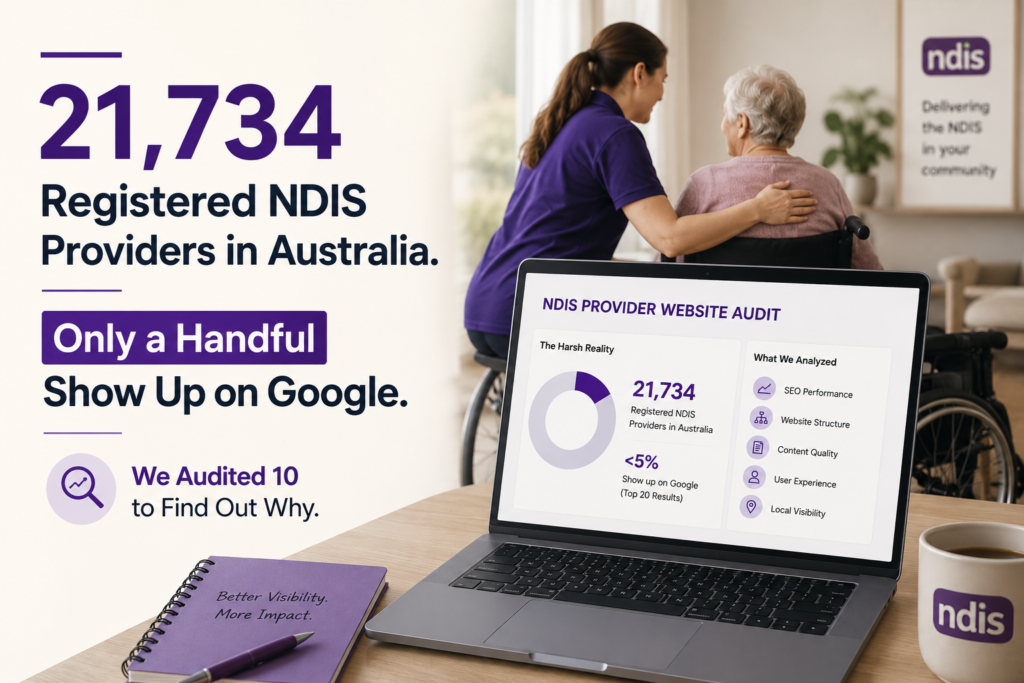
21,734 Registered NDIS Providers in Australia. Only a Handful Show Up on Google. We Audited 10 to Find Out Why.
761,442 active participants across Australia in 2026
Only one of them will be yours — if you've done the work.
There are 21,734 registered NDIS providers in Australia competing for the same participants, the same support coordinator referrals, and the same Google searches. The scheme is worth $45 billion annually and growing. And yet, when we spent several weeks auditing NDIS provider websites across Australia — from Brisbane to Perth, from metropolitan hubs to regional providers — we found the same extraordinary thing on almost every site we looked at.
Nobody had done the work.
Not in any meaningful sense. Websites existed. Some looked professional. Some had clearly cost real money to design. But from a digital visibility standpoint — the standpoint of a participant's family searching at 11pm, or a support coordinator shortlisting providers in Logan or Parramatta — these websites were effectively invisible.
We audited 10 of them. We found the same 10 mistakes on almost every single one. This blog documents exactly what we found, what it's costing these providers in lost participant enquiries, and precisely how to fix it.
This is written for NDIS provider founders, CEOs, and operational directors who understand that a participant who can't find you on Google is a participant who finds your competitor instead. There are no soft takes here. Just findings, numbers, and fixes.
$45.0 billion — total NDIS market size in Australia, 2026. — IBISWorld, 2026
761,442 active participants across all states and territories, with new participants entering the scheme every quarter. — NDIS Quarterly Report, 2026
269,000+ active providers — but no single provider holds more than 1.3% market share. The market is hyper-fragmented. Digital visibility is how you capture a disproportionate share. — NDIS Provider Dataset, March 2026
90% of Australians research services online before making a decision. For NDIS participants and their families, that research starts on Google. — Google Consumer Insights, 2025
- 10 of 10 providers had no dedicated suburb or location pages beyond a generic service area list
- 9 of 10 had a Google Business Profile that was incomplete, unverified, or last updated before 2024
- 10 of 10 had zero schema markup of any kind — missing rich results entirely
- 8 of 10 had mobile PageSpeed scores below 55 — classified as “Poor” by Google
- 7 of 10 had service pages under 400 words — Google classifies these as thin content
- 10 of 10 had no content strategy targeting support coordinator searches
- 9 of 10 had a backlink profile of fewer than 25 referring domains
- 8 of 10 had no accessibility features despite serving participants with disabilities
- No Google Business Profile — or One That's Actively Hurting Them
- Targeting the Wrong Keywords on Every Page
- Zero Suburb-Level Location Pages
- No Content Targeting Support Coordinator Searches
- Thin, Generic, or Duplicated Service Pages
- No Schema Markup — Invisible to Rich Results
- Critically Slow Mobile Load Speed
- Zero Accessibility Features on Disability Provider Websites
- No Backlink Profile — Google Sees an Unknown Entity
- Not Listed on NDIS Directories Where Support Coordinators Actually Search
- The Queensland/SEQ Opportunity — Why This Market Is Different
- The Cumulative Cost and Where to Start
What We Audited and How
We selected 10 NDIS provider websites across Australia covering a range of service types — community nursing, in-home support, SIL, social and community participation, and mental health support — and across metropolitan and regional markets including Brisbane, Sydney, Melbourne, Perth, and South East Queensland's growth corridor.
Each audit covered: Google Business Profile completeness and accuracy, on-page SEO including title tags, meta descriptions, H-tag structure and keyword targeting, Core Web Vitals and mobile performance, schema markup presence, internal linking architecture, content depth and originality, NDIS-specific accessibility compliance, backlink profile strength, and directory presence across Kinora, Clickability, and MyCareSpace.
We have not named the providers. The goal is not embarrassment — it's pattern recognition. Because the patterns are universal across almost every NDIS provider website we have ever audited, and they are entirely fixable.
No Google Business Profile — or One That's Actively Hurting Them
Nine of the ten providers we audited had a Google Business Profile that was either unclaimed, unverified, outdated, or actively misleading. Two had profiles showing addresses that no longer matched their operational location. Three had phone numbers that went to voicemail with no callback. One had a profile photo last updated in 2021 showing a staff member who had long since left.
This matters enormously. When a participant's family in Logan or a support coordinator in Parramatta searches "NDIS provider near me" or "in-home support NDIS [suburb]," Google's Local Pack — the three-result map box that sits above all organic results — is the first thing they see. It commands the highest click-through rate on the page. And none of these providers were appearing in it for any search that mattered commercially.
The GBP is free. It takes less than two hours to optimise properly. And it is the single highest-leverage action a provider can take today — yet it remains the most consistently neglected asset across the entire NDIS digital landscape.
Targeting the Wrong Keywords on Every Page
Every homepage we audited made one of two mistakes: targeting only a brand name ("Welcome to [Provider Name]") or targeting an impossibly broad keyword ("NDIS Services Australia") for which they had no domain authority to compete. One homepage title tag simply read: "Home." On a site that had been live for four years.
The misalignment between keyword targeting and search intent is the core problem. An NDIS provider in Brisbane targeting "NDIS services" is competing against Life Without Barriers, Cerebral Palsy Alliance, and Scope — organisations with decades of authority and thousands of backlinks. The provider targeting "mental health NDIS support Logan" or "in-home care NDIS Ipswich" is competing against almost nobody — and winning.
Zero Suburb-Level Location Pages — Invisible in Local Searches
Not one of the 10 providers had a dedicated location page targeting a specific suburb, local government area, or growth corridor. Most listed their service areas in a paragraph on the homepage or a generic "Where We Operate" page. None had pages targeting suburb-specific searches that participants and support coordinators actually make.
This is the most consistently missed opportunity in NDIS digital marketing. Suburb-level searches — "NDIS provider Logan," "SIL accommodation Greenbank," "disability support services Moreton Bay" — have high commercial intent, low competition, and zero existing optimised content from most providers. A single well-built location page targeting one suburb can rank within 60–90 days and generate consistent enquiries for years.
No Content Targeting Support Coordinator Searches
Support coordinators are the most valuable referral source in the NDIS ecosystem. When a support coordinator recommends your service to a participant, that referral typically converts at a far higher rate than any other lead source — and it often comes with multiple follow-on participants from the same coordinator's caseload.
Not one of the 10 providers we audited had a single piece of content designed to be found by a support coordinator doing a Google search. No guides on how to refer participants. No pages explaining what support coordinators need from a provider. No content targeting searches like "how to find SIL provider for NDIS participant" or "what to look for in NDIS community nursing provider."
The providers winning the support coordinator referral game aren't winning it only through networking and coffees. They're winning it because when a coordinator Googles information relevant to their work, those providers' content keeps appearing — building familiarity and credibility before any direct conversation ever happens.
Thin, Generic, or Duplicated Service Pages
Seven of the ten service pages we audited were under 400 words. Three were clearly templated or borrowed from another provider, with only the organisation name changed. Two used AI-generated boilerplate that named the service but said nothing specific about how that service was delivered, what participants could expect, or what made the provider's approach different.
Google classifies NDIS-related content under its "Your Money or Your Life" (YMYL) framework — the highest-scrutiny category for search evaluation. This means E-E-A-T (Experience, Expertise, Authoritativeness, Trustworthiness) standards are applied rigorously. A service page that says "We provide high-quality in-home support services tailored to individual participant needs" communicates nothing to Google's quality evaluators and nothing to the family reading it at midnight trying to decide who to trust with their family member's care.
Pages with 1,000+ words of original, expert content rank for an average of 3.7x more keywords than pages under 400 words. — Backlinko, 2025
Google's YMYL evaluation framework means that for NDIS providers, vague content is not just unhelpful — it's a ranking penalty. The algorithm evaluates whether a real expert with real operational knowledge clearly produced the content. Thin pages fail this test consistently. — Google Search Quality Evaluator Guidelines, 2025
No Schema Markup — Invisible to Rich Results
Not one of the 10 websites had any schema markup. Not basic LocalBusiness schema. Not Service schema. Not FAQPage schema despite several having FAQ sections. Not Article schema on blog posts. Google explicitly recommends structured data for local service businesses, and for NDIS providers operating in YMYL territory, schema is how you tell Google — unambiguously — what your business is, what it does, where it operates, and what your reviews say.
Without schema, Google has to infer all of this from your content. It does so imperfectly. With schema correctly implemented, your listing becomes eligible for rich results — star ratings, service information, FAQ answers — displayed directly in search results before a user even clicks. In a trust-driven category like disability support, appearing with structured credibility signals in the SERP is a significant advantage over a bare blue link.
Critically Slow Mobile Load Speed — Penalised Before the Page Is Read
Eight of the ten websites scored below 55 on Google's PageSpeed Insights mobile test. Three scored below 35. These are websites being actively penalised in rankings every single day purely because of load speed — before Google has even evaluated their content quality or keyword relevance.
The irony is particularly acute for NDIS providers: 47% of users expect pages to load in 2 seconds or less, and participants and families searching for disability support often do so on older mobile devices or slower connections. A provider whose website takes 8 seconds to load on mobile has already lost the family before they've read a single word about the services.
A 1-second delay in page load time results in a 7% reduction in conversions. — Akamai, 2025
53% of mobile users abandon a site that takes longer than 3 seconds to load. — Google, 2025
Core Web Vitals are a confirmed Google ranking factor. A site scoring “Poor” on LCP, CLS, or INP is being algorithmically disadvantaged in favour of faster competitors — regardless of content quality.
Zero Accessibility Features — On a Disability Provider Website
Eight of the ten websites had no meaningful accessibility features: no alt text on images, no skip navigation links, no keyboard-navigable menus, colour contrast ratios that failed WCAG 2.1 standards, and font sizes that would be illegible for participants with visual impairments.
The irony should not require elaboration. NDIS providers exist to serve people with disabilities. A website that is inaccessible to a participant with low vision, motor impairment, or cognitive disability is a website that is literally excluding the people it claims to support. Beyond the ethical dimension, accessibility is increasingly a Google ranking signal — and it is an audit criterion that the NDIS Quality and Safeguards Commission is beginning to apply to provider digital assets.
No Backlink Profile — Google Sees an Unknown Entity
Nine of the ten providers had fewer than 25 referring domains linking to their website. Five had fewer than 10. One had a single backlink from a directory that had since been deindexed. In Google's evaluation framework, a website with no external links pointing to it is an unverified, unendorsed entity in a YMYL category — the worst possible position for a provider asking participants to trust them with their care.
For NDIS providers, the backlink opportunity is actually more accessible than most industries. Industry associations, disability directories, local council disability inclusion pages, partner organisations, and NDIS-specific aggregators all represent legitimate, high-relevance backlink sources that most providers have never approached.
Not Listed on NDIS Directories Where Support Coordinators Actually Search
Eight of the ten providers we audited had incomplete or entirely absent profiles on the three platforms that dominate NDIS discovery for support coordinators: MyCareSpace, Clickability, and Kinora. These are not just directory listings — they are the platforms support coordinators use daily to find and shortlist providers for their participants' specific needs and locations.
Not appearing in these directories means being completely absent from a discovery channel that drives significant referral volume for the providers who use it well. Several providers had claimed their listings but left them with placeholder text, no service descriptions, and no photos — which is arguably worse than not appearing at all.
Everything above applies to every NDIS provider in Australia. But for providers in South East Queensland specifically, there is an additional dimension worth understanding. Brisbane and South East Queensland is the fastest-growing NDIS market in Australia. The 2032 Olympics infrastructure pipeline has accelerated population growth across the SEQ region — Moreton Bay, Logan, Ipswich, and Redland City are all growing at rates that outpace the inner city, and new NDIS participants are arriving in these corridors every quarter. Provider supply has not kept pace with this growth. The competition in organic search for suburb-specific NDIS terms across Logan, Caboolture, Ipswich, and the Gold Coast hinterland is, in many cases, almost non-existent. A provider who builds proper suburb pages, optimises their GBP, and publishes consistent content targeting these corridors in 2026 will own those search results by 2027 — before the market catches up.
The Cumulative Cost — What These 10 Mistakes Add Up To
For an NDIS provider making all 10 of these mistakes, the digital reality is stark: their website exists but generates no meaningful enquiry volume. They are 100% dependent on word-of-mouth, support coordinator relationships they've built through personal contact, and occasional referrals from directories they haven't optimised. All of these have natural ceilings and zero compounding effect.
| Mistake | Prevalence | Severity |
|---|---|---|
| Incomplete or abandoned Google Business Profile | 9 of 10 | Critical |
| Wrong keyword targeting across all pages | 10 of 10 | Critical |
| No suburb-level location pages | 10 of 10 | Critical |
| No content targeting support coordinator searches | 10 of 10 | Critical |
| Thin or duplicated service pages | 7 of 10 | High |
| No schema markup | 10 of 10 | High |
| Mobile PageSpeed score below 55 | 8 of 10 | High |
| No accessibility features | 8 of 10 | High |
| No meaningful backlink profile | 9 of 10 | High |
| Absent or incomplete directory listings | 8 of 10 | Medium |
Where to Start — Sequenced by Impact and Effort
This Week — Zero Cost, Maximum Impact
- Fully optimise your Google Business Profile — every field, real photos, all services listed by name
- Claim and complete your MyCareSpace, Clickability, and Kinora profiles
- Rewrite your homepage title tag and H1 with your primary service + location keyword
- Run PageSpeed Insights and identify your top 3 speed bottlenecks
Month 1 — Foundation Build
- Build and publish 4–6 location pages targeting your highest-volume service suburbs
- Rewrite your 3 most important service pages to 800+ words each
- Implement LocalBusiness and Service schema on all key pages
- Run a WCAG 2.1 accessibility audit and fix critical failures
Month 2–3 — Content and Authority
- Launch a blog with your first 2 posts targeting support coordinator searches
- Build remaining location pages for all service areas
- Begin a systematic Google review request process with existing participants
- Submit to disability sector directories and local council community pages
"We assumed our website was doing its job because it looked good. It wasn't until we saw the GSC data that we understood what we were missing — we were ranking on page 4 for our own service area and had no idea." — Founder, NDIS provider, SEQ, post-audit
Done in this sequence, most NDIS providers begin seeing suburb-level ranking movement within 60–90 days, their first consistent organic enquiries within 4–6 months, and a compounding, measurable organic lead generation channel within 9–12 months.
For a deeper look at the specific SEO strategy that builds this foundation, read our companion guide: How to Get More NDIS Participants Through Google Without Paying for Ads.
Is Your NDIS Website One of the 10?
We'll run the same audit on your website — GBP, on-page SEO, mobile speed, schema, accessibility, content depth, backlinks, and directory presence — and give you a specific, prioritised action plan. No agency pitch attached. Just a clear picture of where you stand and what it's costing you.
Request Your Free NDIS Website Audit →