
LinkedIn Outreach for Freight Forwarders: What Actually Works in 2026
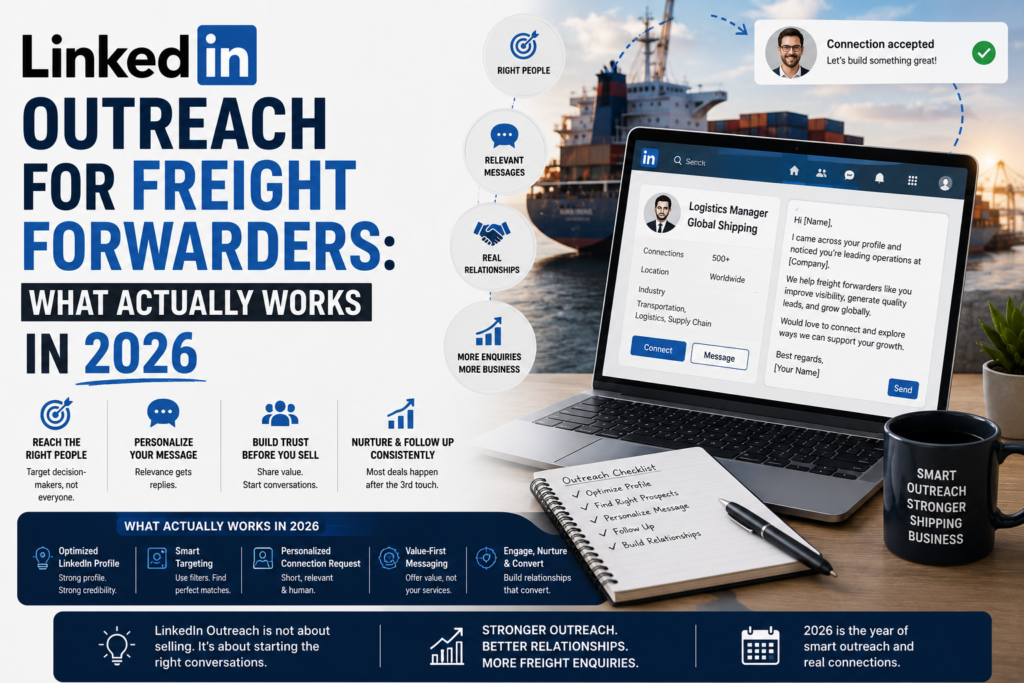
LinkedIn Outreach for Freight Forwarders: What Actually Works in 2026
Every freight forwarder in India has, at some point, tried LinkedIn outreach. Most of them tried it once, sent thirty near-identical connection requests, got two replies and zero enquiries, and quietly concluded that "LinkedIn doesn't work for logistics."
LinkedIn outreach isn't broken. What's broken is treating it as a volume game — the same copy-pasted message sent to a hundred strangers — in a channel that, by 2026, has become saturated with exactly that kind of message. The forwarders actually generating enquiries from LinkedIn this year are doing something quieter and slower: they're building enough visible credibility that a personalized message lands as relevant instead of spammy, and they're writing messages short enough that a busy shipping manager actually reads them.
This is, again, an E-E-A-T problem before it's an outreach-technique problem. A decision-maker at a freight buyer's company scrolls through your profile in about the same ten seconds they'd spend on your website. What they see there — or don't see — decides whether your message gets a reply or gets ignored, regardless of how good the message itself is.
Your LinkedIn message is not the first impression. Your profile and company page are. By the time someone reads your outreach, they've already glanced at who you are — and decided, in a fraction of a second, whether you're worth three more seconds of attention.
This applies across whichever Indian port your outreach is anchored to — whether you're reaching shippers routing through JNPT (Nhava Sheva), Mundra, Chennai, Kolkata/Haldia, Cochin, Vizag, Tuticorin, Kandla, or Krishnapatnam. The port changes your talking points. It doesn't change the psychology of what makes a stranger reply to a cold message.
Why 2026 killed the old cold-message playbook
The generic three-paragraph InMail — "Hi, I hope this finds you well, I wanted to reach out because we specialize in freight forwarding solutions across all major trade lanes..." — has been sent to nearly every logistics decision-maker on LinkedIn at this point, from multiple forwarders, multiple times over. Inboxes have adapted. The pattern-match happens instantly: generic opener, no specific detail, obvious mail-merge — delete, no reply.
What still works is the opposite of that pattern: a message that could only have been written for that specific person, referencing something true and current about their company, their shipments, or their market — sent by a sender whose profile already reads as credible before the message is even opened.
Before you send a single message: fix what your profile says about you
This is the step almost every freight forwarder skips, and it's the one that decides whether outreach works at all.
Experience
Your "About" section and recent posts should show real shipments and real ports handled — not a copied company description.
Expertise
A headline naming your actual specialty — routes, cargo types, ports — instead of "Freight Forwarding | Logistics | Supply Chain."
Authoritativeness
Visible mutual connections, association memberships, and endorsements from people in the industry, not just connection count.
Trustworthiness
A real photo, a complete profile, a company page that's actually active — not a placeholder logo and zero posts.
What to actually fix
- Replace your headline. "Founder at [Company] | Freight Forwarding" tells a reader nothing. "Helping exporters ship reliably out of JNPT & Mundra to the Middle East and Africa" tells them exactly why they should care.
- Rewrite your About section as a case, not a brochure. One or two real examples of shipments handled, ports served, and problems solved outperform a paragraph of industry buzzwords every time.
- Post before you pitch. A profile with zero posts and a message in someone's inbox on the same day reads as a cold sales account. A profile with a few recent, genuinely useful posts — a note on port congestion, a shipping cost trend, a lesson from a recent shipment — reads as an active professional worth replying to.
- Fix your company page. Many freight forwarders send outreach from a personal profile that links to a company page with a stock logo, no description, and no followers. Prospects check — and an empty company page undercuts every claim in your message.
What actually works in 2026: the message itself
Once the profile is credible, the message can be short — and it should be. The messages generating replies in 2026 share a consistent structure: a specific, verifiable observation about the prospect, the implication of that observation, and a low-pressure next step. Nothing more.
The structure that's working
- Identity — one line on who you are and why you're relevant to them specifically.
- Specific finding — something true and current about their business: a new market they're exporting to, a product line, a recent expansion, a shipment pattern visible on their own website or LinkedIn activity.
- Implication — why that finding matters to their freight costs, transit reliability, or growth plans.
- Soft CTA — an easy, low-commitment next step. Not "let's schedule a call," but "worth a quick chat?" or "happy to send over what I noticed, no obligation."
Kept under roughly 70–80 words, this structure reads as a note from a person who did their homework — not a sales pitch.
"Noticed [Company] recently expanded shipments into the UAE market — congratulations on the growth. We work with a few Indian exporters on that same Gulf lane out of Mundra and JNPT, and freight costs on that route have shifted a fair bit this quarter. Happy to share what we're seeing if it's useful — no pressure either way."
"Saw your team ships regularly to South Africa out of Chennai. A lot of exporters on that lane are getting caught out by transit time changes this year. If it's helpful, I can send a short note on what's changed — otherwise, no worries at all."
Connection request vs. InMail: what's working differently in 2026
The two channels now serve different purposes, and treating them the same is a common mistake.
Connection requests
Best used with a short, personal note — not a pitch. A single line referencing something specific ("Saw your recent post on export growth into Oman — would love to connect") gets accepted at a far higher rate than a blank request or an immediate sales message attached to it. The goal of the connection request is only to get accepted; the actual pitch comes later, once you're in their network and they've seen at least one more post from you.
InMail
Best reserved for warmer, more specific outreach where you've already done real research — because InMail credits are limited and a generic InMail wastes both the credit and the prospect's attention in one shot. This is where the identity + finding + implication + soft CTA structure matters most.
Timing and cadence: what a realistic 2026 sequence looks like
Very few replies come from the first message. A realistic, non-pushy sequence over roughly two to three weeks looks like this:
- Day 1: Personalized connection request with a one-line note.
- Day 3–4 (after acceptance): No pitch yet — just react to or comment on one of their recent posts, if there is one, to stay visible.
- Day 7: The main outreach message, using the identity + finding + implication + soft CTA structure.
- Day 14 (if no reply): One short, easy follow-up — "Totally understand if timing isn't right — happy to reconnect whenever it's useful." No repeated pitching.
This mirrors the same principle covered in how to handle replies like "I'm a bit occupied, will connect in due course" — the goal is to stay visible and low-pressure, not to chase.
What no longer works in 2026
- Mass, unpersonalized InMail blasts. Reply rates on generic templates have fallen sharply as LinkedIn's own algorithms and prospects alike have gotten better at spotting them.
- Leading with pricing or a rate card. Cost-first outreach with no context reads as a race-to-the-bottom pitch, not a relationship — and rarely earns a reply from a serious buyer.
- Pitching immediately after a connection is accepted. It signals the connection itself was only ever transactional.
- Long, multi-paragraph opening messages. Anything requiring more than 15–20 seconds to read gets skimmed or skipped by a busy operations manager.
Measuring what's actually working
Reply rate alone is a misleading metric — a message that gets a fast "not interested" reply is functionally the same as no reply. The metrics worth tracking are connection acceptance rate, reply rate on the main outreach message, and — most importantly — the conversion from reply to an actual quote request. Small, steady improvements in the specificity of your messages tend to move that last number more than any change in sending volume.
Bringing it together
LinkedIn outreach for freight forwarders in 2026 rewards exactly the same things a website does: real experience made visible, genuine expertise instead of generic claims, third-party credibility, and a trustworthy, human presence. The message matters — but only after the profile behind it has already done the work of making that message worth reading.
The forwarders quietly winning new business out of JNPT, Mundra, Chennai, and every other major Indian port aren't sending more messages than everyone else. They're sending fewer, more specific ones, from profiles that already look like the kind of company worth replying to.
Frequently asked questions
How many LinkedIn messages should a freight forwarder send per day?
Fewer, more personalized messages consistently outperform high-volume, generic ones. A realistic, sustainable pace is somewhere around 10–15 genuinely researched messages a day rather than 50 templated ones — both for reply quality and to stay within LinkedIn's own limits on connection requests and InMail.
Should I use LinkedIn Sales Navigator?
It helps with finding the right people faster — filtering by industry, company size, and role — but it doesn't change whether your message gets a reply. The targeting is only as useful as the personalization behind each message.
What if a prospect views my profile but doesn't reply?
That's usually a sign your profile did its job — it earned a look. A short, low-pressure follow-up a week or two later, rather than assuming disinterest, often reopens the conversation.
Is cold email or LinkedIn outreach better for GCC markets?
Response rates on cold email tend to be lower across several GCC markets, which is why LinkedIn — particularly InMail with a relationship-first, educational tone — has become the more reliable channel for that region, while other markets may still respond well to a mixed approach.
Want outreach messages written for your actual prospects?
RouteRush builds LinkedIn and cold outreach specifically for freight forwarders — researched, personalized, and never templated.
Talk to Us About OutreachRelated reading
How to Turn Website Visitors Into Actual Shipping Enquiries
Why Most Freight Forwarding Companies Don't Show Up on Google
How Freight Forwarders Can Generate Leads Without Cold Calling
Anshul Kuntewar
Founder & CEO, RouteRush Digital — helping freight forwarders grow across India, GCC, UK, Australia, and South Africa