
freight-forwarding-marketing-india
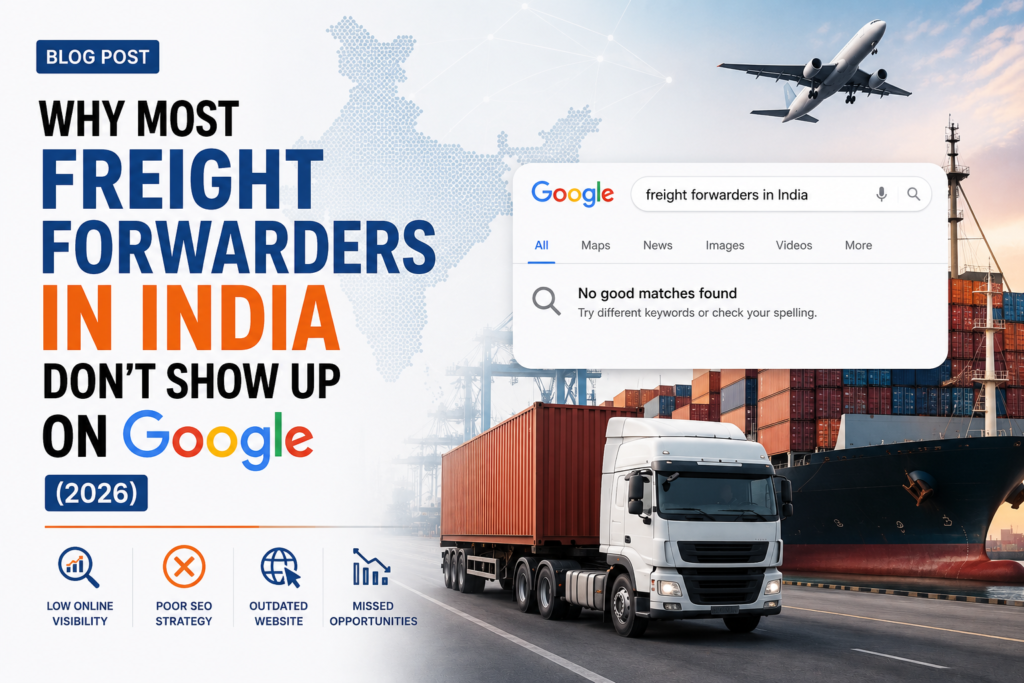
Freight Forwarding Marketing in India: The Complete Guide (2026)
Everything a freight forwarder, CHA, or NVOCC in India needs to know to get found on Google, generate consistent inbound leads, and stop competing on price alone. India's freight and logistics market is worth over $315 billion and growing at nearly 9% a year, yet most forwarders are still invisible for the exact searches their next client is making right now. This guide covers why, and exactly what to do about it.
Source: Mordor Intelligence, 2026; Forwarding Companies directory data, 2026
What's Covered In This Guide
- The State of Freight Forwarding Marketing in India
- The Hubs That Matter Most, and Why Each Is Different
- 8 Mistakes Costing Indian Freight Forwarders Clients
- SEO for Freight Forwarders: Where to Actually Focus
- What a Freight Forwarder Website Actually Needs
- Content Marketing: What to Write and Why
- Google Business Profile & Local SEO
- Google Ads & LinkedIn Ads for Freight Forwarders
- Social Media & LinkedIn Strategy
- Reviews, Reputation & Trust Signals
- A Practical 90-Day Roadmap
- Frequently Asked Questions
The State of Freight Forwarding Marketing in India
India's freight forwarding industry is in a strange position. The market is enormous and growing fast, e-commerce, pharma exports, PLI-driven manufacturing, and the Dedicated Freight Corridor are all pulling more cargo through Indian ports and ICDs every year. And yet the industry's digital presence hasn't caught up. Search any major directory, FFFAI, ACAAI, GoodFirms, or Clutch, and you'll find hundreds of Indian forwarders, many with decades of real operational history, competing entirely on relationships and price, with a website that does none of the work it could be doing.
This isn't a criticism of the industry's competence. Indian freight forwarders are some of the most operationally sharp businesses anywhere, navigating customs complexity, GST compliance, and multimodal logistics daily. It's a gap in how that expertise gets represented online, and that gap is exactly where the opportunity sits for the forwarders who close it first.
Freight forwarding marketing in India isn't the same discipline as marketing a retail brand or a SaaS product. Buyers are B2B, sales cycles are long and relationship-driven, and trust is earned through demonstrated expertise, not clever ad copy. A freight forwarder that understands this builds a very different kind of marketing engine than the one being sold by generic digital agencies.
The Hubs That Matter Most, and Why Each Is Different
Mumbai (JNPT / Nhava Sheva)
India's busiest container port and the heart of the country's sea freight industry. The highest concentration of freight forwarders, CHAs, and NVOCCs in India operates in and around Mumbai and Navi Mumbai, anchoring the Mumbai-JNPT corridor, one of India's two largest freight demand centers.
Delhi NCR (ICD Tughlakabad / Dadri)
India's primary landlocked freight gateway, connected to JNPT and other ports via rail through the Dedicated Freight Corridor. The anchor of the Delhi-Mumbai Industrial Corridor and a major air cargo hub through IGI Airport.
Chennai
South India's primary port and the center of the automotive and electronics export corridor. A distinct buyer profile from Mumbai or Delhi, dominated by manufacturing clients with tight just-in-time shipping requirements.
Each hub has its own search behavior, its own buyer profile, and its own competitive gap. A Chennai-based forwarder specializing in automotive component exports is searched for completely differently than a Delhi NCR forwarder handling pharma air cargo, yet most Indian freight forwarder websites make no distinction at all, offering the same generic "we do freight forwarding" homepage regardless of hub, cargo type, or client industry. Beyond these three, Mundra, Kolkata, Bengaluru, and Ahmedabad are all growing secondary hubs worth building dedicated content for as your marketing matures.
8 Mistakes Costing Indian Freight Forwarders Clients
Homepage Targeting No Specific Keyword at All
The most common issue on Indian freight forwarder websites is a homepage title tag that's just the company name, or a generic phrase like "Leading Logistics Company in India." National keywords like "freight forwarder India" are dominated by DHL, Delhivery, Blue Dart, and Allcargo, no SME forwarder is winning that keyword. The real opportunity is hub-specific and service-specific: "customs clearance agent JNPT," "air freight forwarder Chennai," "ICD Tughlakabad CHA services."
No Hub or Port-Specific Service Pages
Very few Indian freight forwarders build dedicated pages around the specific port, ICD, or airport they operate through. A buyer searching "FCL shipping Nhava Sheva" or "air cargo agent IGI Airport" is showing exact intent, they've already decided what they need, they're choosing who. Almost no SME forwarder has built a page that speaks directly to that search.
Incomplete or Unclaimed Google Business Profiles
The Local Pack, the three-result map box above organic search, drives the highest click-through rate for local B2B searches like "customs house agent near me" or "freight forwarder Chennai." A large share of Indian freight forwarders have never fully claimed or optimized this listing, despite it costing nothing and taking under an hour to set up properly.
No Content Addressing Real Buyer Questions
Indian importers and exporters search very specific, compliance-driven questions: "how to file shipping bill on ICEGATE," "GST e-way bill for export cargo," "documents required for IEC code registration," "AEO certification benefits for exporters." Almost none of this is being answered by the freight forwarders best positioned to answer it, it's being answered by government portals, CA blogs, and generic content sites with no connection to any specific forwarder a buyer could actually hire.
Thin Service Pages With No Operational Detail
Freight forwarding sits squarely in Google's YMYL (Your Money or Your Life) content category, poor service has real financial and operational consequences for clients, so Google's quality evaluation looks for genuine, specific expertise. A service page that's a paragraph and a contact form signals the opposite. Real detail, specific documentation requirements, cargo types handled, process steps, builds trust with both buyers and search algorithms simultaneously.
Slow Mobile Sites in a Mobile-First Market
India has one of the highest rates of mobile-first internet usage globally, yet many SME logistics websites are still built on outdated page builders with unoptimized images and no CDN, resulting in multi-second load times on mobile networks. A slow-loading site is a lost enquiry before a single word is read, and it's an algorithmic ranking penalty on top of that.
No Schema Markup
LocalBusiness, Service, and FAQPage schema tell Google exactly what a business is, where it operates, and what it offers, in a format Google doesn't have to guess at. Very few Indian freight forwarder websites implement this, meaning Google is left inferring basic facts that could simply be stated directly.
Weak Backlink Profiles Relative to National Players
Large national players carry backlink profiles built over decades. SME forwarders rarely pursue the backlink sources genuinely available to them, FFFAI and ACAAI member directories, Chamber of Commerce listings in Mumbai, Delhi, and Chennai, GoodFirms and Clutch profiles, and trade publication guest content, all accessible without needing DHL-level brand recognition.
SEO for Freight Forwarders: Where to Actually Focus
SEO for a freight forwarder isn't about chasing the biggest-volume keyword, it's about winning the keywords that actually convert. Three keyword categories matter most:
1. Hub + Service Keywords
"Freight forwarder JNPT," "customs clearance agent Chennai," "air cargo agent Delhi NCR." These combine location and service intent, exactly what a buyer types when they've already decided what they need and are choosing who to hire.
2. Cargo or Industry-Specific Keywords
"Pharma cold chain logistics India," "automotive component export shipping Chennai," "textile export freight forwarder." Specialization keywords convert at a much higher rate than generic ones, because the buyer is pre-qualified by their own search.
3. Compliance and Documentation Keywords
"IEC code registration process," "shipping bill filing ICEGATE," "GST e-way bill for exports," "AEO certification India." These bring in buyers earlier in their research journey, before they've chosen a forwarder, letting you build trust and capture the enquiry before a competitor even shows up.
Technical SEO fundamentals still apply and shouldn't be skipped: fast mobile load times, clean site structure, HTTPS, proper heading hierarchy, and schema markup. But for a freight forwarder, content strategy and keyword targeting matter more than technical perfection, most competitors have neither.
What a Freight Forwarder Website Actually Needs
Hub-Specific Landing Pages
A dedicated page for each port, ICD, or airport you operate through, not a single generic "our locations" page.
Detailed Service Pages
FCL, LCL, air freight, customs clearance, warehousing, each as its own page with real process detail, not a shared paragraph.
Trust Signals
IATA, FIATA, MTO, AEO accreditations displayed prominently, along with years in operation and real client logos where permitted.
Fast, Mobile-First Design
Sub-3-second load time on mobile, since the majority of Indian B2B research now happens on a phone, even for enterprise decisions.
Clear, Low-Friction Enquiry Path
A short quote request form, WhatsApp click-to-chat, and a visible phone number, freight buyers want to talk to a human fast.
A Real Resources/Blog Section
Where compliance and documentation content lives, this is what captures early-stage searches and builds long-term organic traffic.
Content Marketing: What to Write and Why
Content marketing for freight forwarders works best when it answers a specific, real question a buyer or their operations team is actually searching, not generic "5 benefits of freight forwarding" listicles that already saturate the space. Strong content categories include:
- Documentation and compliance guides: IEC registration, ICEGATE filing, e-way bills, AEO certification, Incoterms explained for Indian exporters.
- Cargo and industry-specific guides: shipping pharma, automotive components, textiles, or perishables from India, with real regulatory and packaging detail.
- Hub and port guides: what to expect shipping through JNPT vs. Mundra vs. Chennai, congestion patterns, typical transit times.
- Comparison and decision content: FCL vs. LCL, air vs. sea for time-sensitive cargo, choosing between a forwarder and a direct carrier relationship.
Content built this way does double duty, it ranks for genuine search demand, and it demonstrates exactly the kind of operational expertise that makes a buyer comfortable handing over a shipment worth lakhs or crores of rupees to a company they've never worked with before.
Google Business Profile & Local SEO
For any freight forwarder with a physical office, warehouse, or branch presence, the Google Business Profile is one of the highest-leverage, lowest-cost pieces of the entire marketing stack. It should include accurate service categories, all branch locations as separate listings where legitimate, real photos of your facility and team, and a steady stream of client reviews. Local Pack visibility, the map-based results above organic listings, converts disproportionately well for "near me" and city-specific searches, and most Indian freight forwarders are leaving this almost entirely unclaimed or half-filled.
Google Ads & LinkedIn Ads for Freight Forwarders
Paid ads work differently for freight forwarders than for consumer businesses, the goal isn't volume, it's precision. Google Ads targeting high-intent, hub-specific keywords ("customs clearance agent JNPT") can generate qualified enquiries quickly while organic SEO builds in the background. LinkedIn Ads work well for reaching specific decision-makers, import/export managers, supply chain heads, at target companies, particularly when paired with retargeting after they've engaged with your content. Neither channel should run without clear tracking back to actual enquiries and closed shipments, not just clicks.
Social Media & LinkedIn Strategy
LinkedIn is the primary social channel that matters for B2B freight forwarding marketing in India, this is where import/export managers, supply chain heads, and procurement teams actually spend their professional attention. A consistent posting cadence, sharing real operational insight, market updates, case studies, and company milestones, builds the kind of familiarity that makes a buyer comfortable reaching out directly. Posts from an individual, particularly the founder or a senior team member, tend to reach further and build more trust than company-page-only posting. Instagram and Facebook can support brand awareness but rarely drive direct B2B enquiries in this industry.
Reviews, Reputation & Trust Signals
In an industry where a buyer is trusting a company with cargo worth real money and tight deadlines, reviews and reputation carry outsized weight. A systematic process for requesting Google reviews after successful shipments, keeping FFFAI, ACAAI, GoodFirms, and Clutch profiles complete and current, and prominently displaying accreditations (IATA, FIATA, MTO, AEO) all compound over time into a trust profile that's genuinely difficult for a newer or less established competitor to replicate quickly.
A Practical 90-Day Roadmap
| Timeframe | Action |
|---|---|
| Week 1 | Claim and fully optimize your Google Business Profile for every city you operate in |
| Week 1 | Rewrite your homepage title tag and H1 around one specific hub + service keyword |
| Week 1 | Complete your FFFAI, ACAAI, GoodFirms, and Clutch listings fully, don't leave them half-filled |
| Weeks 2-4 | Build dedicated hub pages for your primary ports/ICDs (JNPT, Chennai, ICD Tughlakabad, etc.) |
| Weeks 2-4 | Rewrite your top 3 service pages to 800+ words with real operational detail |
| Month 2 | Launch a content calendar answering real compliance and documentation questions your clients search |
| Month 2 | Set up a small, tightly targeted Google Ads campaign on 5-10 high-intent hub keywords |
| Month 3 | Start a consistent LinkedIn posting cadence from the founder or senior team profile |
| Ongoing | Build a systematic Google review request process and pursue Chamber/industry directory backlinks |
Frequently Asked Questions
How do freight forwarders get clients in India?
Traditionally through referrals, industry relationships, and cold outreach. Increasingly, buyers research and shortlist freight forwarders online before ever making a call, which means a strong Google presence, website, and reviews now directly influence how many enquiries a forwarder receives, independent of existing relationships.
What is the best digital marketing strategy for freight forwarders?
A combination of hub and service-specific SEO, a fast and detailed website, a complete Google Business Profile, consistent LinkedIn presence, and a systematic review-generation process. Paid ads can accelerate results but shouldn't replace an organic foundation, since freight forwarding buyers research extensively before committing.
How much does SEO cost for a logistics company in India?
Costs vary widely based on scope and competitiveness of target keywords, but SME freight forwarders typically see meaningful investment ranges from modest monthly retainers for local, hub-specific SEO up to significantly higher spend for national keyword competition. The right starting point is usually hub and service-specific SEO, which costs less and converts better than chasing national terms.
How long does SEO take to show results for freight forwarders?
Most freight forwarders start seeing measurable ranking movement within 3-4 months for hub and service-specific keywords, with meaningful lead flow building over 6-12 months. Freight forwarding SEO is a long-term asset that compounds, not a one-time campaign.
What keywords should a freight forwarder target?
Hub-specific service keywords ("customs clearance agent JNPT"), cargo or industry-specific keywords ("pharma cold chain logistics India"), and compliance/documentation keywords ("IEC code registration process") consistently convert better than broad national terms like "freight forwarder India," which are dominated by large national players.
Do freight forwarders need a website, or is a directory listing enough?
A directory listing alone is not enough. Directories like FFFAI, ACAAI, GoodFirms, and Clutch are valuable supplements and backlink sources, but a dedicated website is what allows a forwarder to build hub-specific pages, detailed service content, and the trust signals a serious buyer looks for before committing a shipment.
How can a freight forwarder rank on Google Maps?
By fully claiming and completing a Google Business Profile for every branch location, choosing accurate service categories, uploading real photos, and building a steady stream of genuine client reviews. Local Pack visibility drives some of the highest click-through rates for city-specific and "near me" searches in this industry.
Is LinkedIn effective for freight forwarder marketing?
Yes, LinkedIn is the primary social channel where the actual B2B buyers, import/export managers, supply chain heads, and procurement teams, spend their professional attention, making it more effective for freight forwarding marketing than Instagram or Facebook.
Should freight forwarders run Google Ads?
Google Ads can work well when targeted precisely at high-intent, hub-specific keywords, generating qualified enquiries quickly while organic SEO builds in the background. It works best as a complement to a strong organic and content foundation, not a replacement for one.
What makes a freight forwarding website trustworthy to buyers?
Clear display of accreditations (IATA, FIATA, MTO, AEO), detailed service pages with real operational information rather than generic copy, visible client reviews, fast load times, and an easy way to reach a real person quickly, freight buyers are trusting a company with time-sensitive, high-value cargo and want reassurance before committing.
How can a small freight forwarder compete with large players like DHL or Allcargo online?
Not by competing on the same broad, national keywords, those are effectively unwinnable for an SME. Small and mid-sized forwarders win by going hyper-specific: a single hub, a single cargo type, or a single industry vertical, where a large generalist player has no dedicated content and no reason to rank.
What is the ROI of digital marketing for a freight forwarding business?
ROI compounds over time rather than showing up immediately. Early gains typically come from Google Business Profile optimization and paid ads, while SEO and content marketing build a growing base of organic, low-cost-per-lead enquiries over 6-12 months that continues generating leads long after the initial investment.
Is Your Freight Forwarding Marketing Working as Hard as Your Operations Team?
We'll audit your website, search visibility, and Google Business Profile, and give you a specific, prioritised plan. No agency pitch, no retainer commitment required.
Request Your Free Freight Marketing AuditAnshul Kuntewar · Founder, RouteRush Digital Marketing Agency
Anshul is a digital marketing strategist specialising in SEO and organic lead generation for freight and logistics companies across India, South Africa, UAE, Qatar, Australia, and the UK. Connect on LinkedIn →
[…] the page connected to your broader service architecture. RouteRush’s India freight forwarding marketing guide provides wider planning context; the corridor page should resolve a narrower shipment […]