
Build a Freight Forwarding Sales Pipeline in Australia (2026)
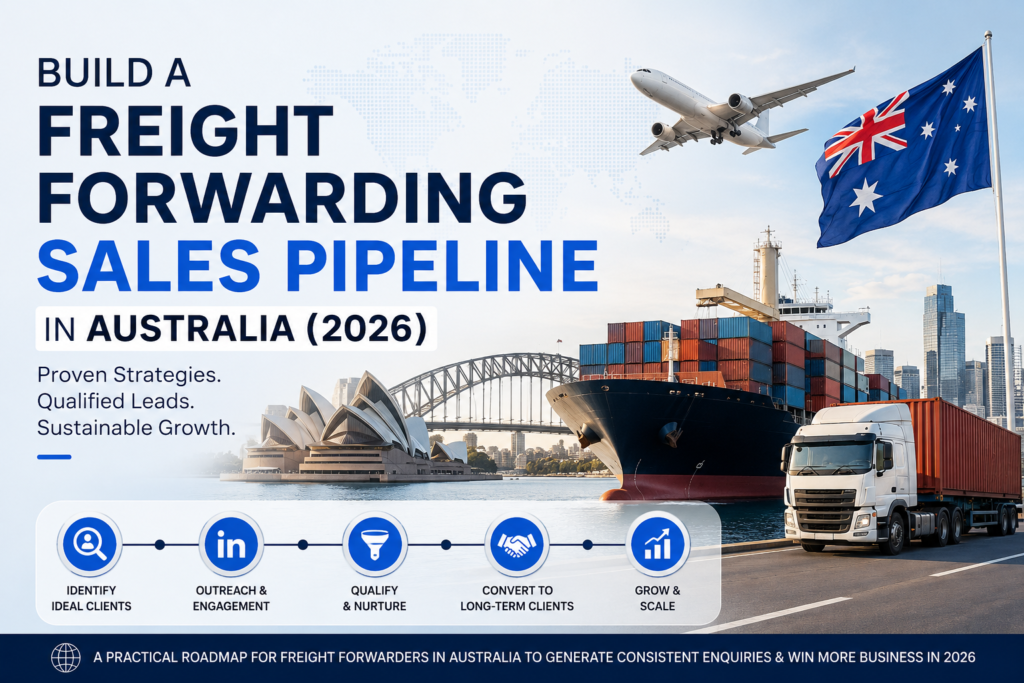
Freight Forwarding Marketing · Sales Strategy
How to Build a Freight Forwarding Sales Pipeline That Doesn't Rely on Relationships in Australia
Your Melbourne relationships don't reach Perth. In a country this large, no personal network can cover the whole market — only a systemized pipeline can.
What's Covered In This Guide
- Why Relationship-Only Sales Is a Risk, Not a Strength
- 7 Ways to Build a Pipeline That Doesn't Depend on Who You Know
- What's Quietly Keeping You Relationship-Dependent
- Where Pipeline Risk Concentrates, Port by Port
- A Practical Roadmap
- Frequently Asked Questions
Why Relationship-Only Sales Is a Risk, Not a Strength
Most Australian freight forwarders still win new business almost entirely through referrals and long-standing personal relationships — and logistics is one of the strongest verticals for a different approach precisely because so few competitors have built one. Decision-makers are identifiable, the buying cycle is predictable, and most competitors are still relying on brokers and referrals rather than any structured, repeatable system.
Australia adds a specific dimension to this risk that smaller, denser markets don't face: geography. A forwarder's personal network built around Melbourne or Sydney simply doesn't transfer to Perth, Darwin, or the mining corridors around Port Hedland — the country is too large, and the regional markets too distinct, for one relationship network to cover them all. On top of that, DSV's $23.6 billion acquisition of DB Schenker is actively reshaping who buyers' contacts are across the industry, right as Australia's $45.96 billion e-commerce sector and record Inland Rail investment are creating substantial new demand. A relationship-only sales model has no mechanism for capturing growth this geographically and structurally dispersed; a systemized pipeline does. Meanwhile, the broader B2B data reinforces why: inbound channels like SEO and referrals produce sales cycles 2-3 times shorter than pure outbound at comparable complexity, but referrals alone still only convert around 26% of the time — meaning even your best channel needs a system behind it, not just goodwill.
7 Ways to Build a Pipeline That Doesn't Depend on Who You Know
Build inbound content around the specific ports and regions you serve. SEO-driven content (port pages, cargo-type guides, region-specific breakdowns for WA, the Northern Territory, and regional Queensland) generates leads that arrive already searching for what you offer — no relationship required, and inbound-sourced deals close 2-3x faster than cold outbound at similar complexity.
Run structured outbound alongside referrals, not instead of them. Logistics is one of the strongest verticals for outbound specifically because decision-makers (procurement heads, supply chain directors) are identifiable and the buying cycle is predictable — most competitors simply haven't built the system yet, which is exactly the opportunity in regions where your personal network doesn't naturally reach.
Put every enquiry and relationship into a CRM, not a salesperson's memory or phone contacts. When client relationships live in a CRM rather than in one person's head, the business survives that person's departure — and survives the geographic gap when a client's operations expand into a state or region your team has no personal history in.
Qualify leads systematically instead of chasing whoever calls first. With a median B2B win rate now around 19-21% and lead-to-customer conversion around 2.9%, a defined qualification process (cargo type, volume, port, urgency) prevents your team from spending months on deals that were never going to close.
Formalize account-based targeting by region, not just by industry. Given how differently buyer behavior and competition vary between, say, Port Botany's e-commerce importers and Port Hedland's mining exporters, a systemized approach segmented by region and cargo type captures opportunity a single relationship network never could.
Track pipeline velocity, not just win rate. Pipeline velocity (opportunities × average deal value × win rate ÷ sales cycle length) shows whether you're actually generating revenue efficiently, not just closing occasional deals — a metric relationship-only selling rarely tracks at all.
Build a retention and renewal process for existing clients. As the market consolidates around scale players like the merged DSV-DB Schenker entity, a systemized check-in cadence and account review schedule protects existing relationships from being poached by a larger competitor with more resources but less personal history.
What's Quietly Keeping You Relationship-Dependent
- No CRM, or one nobody actually updates. If client history and pipeline status live in someone's head or a personal notebook, the business has no visibility into its own sales process — and no way to onboard a new salesperson without starting from zero.
- A relationship network concentrated in one or two states. Australia's geographic scale means a forwarder's strong Melbourne or Sydney relationships provide essentially zero coverage in Western Australia, the Northern Territory, or regional Queensland — a structural gap relationship-only selling can't close.
- No defined qualification criteria. Without a system for scoring leads by cargo type, volume, and fit, sales time gets spent equally on every enquiry regardless of how likely it is to close.
- Assuming industry consolidation won't touch your relationships. As larger players like the merged DSV-DB Schenker entity expand, buyer contacts shift roles or move to competitors — a relationship-only model has no way to notice or respond to this until an account is already gone.
Where Pipeline Risk Concentrates, Port by Port
Australia's freight activity concentrates around a handful of major ports, each tied to different cargo types, trade lanes, and regional buyer profiles. Relationship dependency and pipeline-building opportunity vary meaningfully by hub.
Port of Melbourne, Victoria
The most relationship-dense forwarder market in the country. A forwarder with a genuinely systemized pipeline stands out sharply against competitors relying purely on legacy relationships here — and that system is what allows the same forwarder to extend reach into regions their Melbourne network never touched.
Port Botany, Sydney, New South Wales
A fast-growing e-commerce and consumer goods import hub. New importers and retailers entering this space regularly have no existing Sydney forwarder relationships — a systemized inbound and outbound approach captures this growth far more reliably than waiting for a referral.
Port of Brisbane, Queensland
The fastest-growing of the major container ports, with strong ties to agricultural and beef exporters. A systemized approach built around cold-chain and agricultural logistics expertise can break into this segment even without pre-existing relationships in the Queensland market.
Fremantle, Western Australia
The clearest illustration of Australia's geography problem: a forwarder's east-coast relationship network provides essentially no coverage here. A systemized pipeline built specifically for WA's distinct buyer base and freight economics is the only realistic way to capture this market from outside the state.
Port Hedland, Western Australia
An extremely specialized, bulk iron-ore export market almost entirely disconnected from general container-freight relationships anywhere else in the country. Deep, expertise-led content and outreach built specifically for mining logistics is the only path in.
Port of Newcastle, New South Wales
A bulk and resource-sector-focused market with long-standing, technical buyer relationships. Content and outbound built around genuine coal and bulk logistics expertise can break in where generic relationship networking cannot.
Port of Adelaide, South Australia
A smaller, more relationship-driven buyer base than the eastern seaboard ports. Warm, systemized outbound sequencing tends to outperform cold outreach here, since existing relationships still carry real weight in this segment — but a forwarder without an existing SA network still needs a system to build one.
Port of Gladstone, Queensland
A narrow, highly technical LNG and coal hub. Outreach volume here should stay low and precisely targeted — a systemized, expertise-led approach works better than broad relationship networking in such a specialized segment.
Port of Darwin, Northern Territory
Limited existing digital and sales activity from competing agencies, combined with the region's geographic distance from every other major hub, creates real opportunity for a forwarder with a systemized pipeline built specifically for this market to stand out sharply.
Port of Townsville, Queensland
A smaller, specialized market tied to mining and tropical agriculture. A modest, well-researched systemized outreach effort can realistically reach a meaningful share of relevant decision-makers who have no reason to already know a forwarder based elsewhere in the country.
A Practical Roadmap
| Timeframe | Action |
|---|---|
| Week 1 | Move all client and prospect relationships out of individual memory/contacts and into a shared CRM |
| Week 1 | Define lead qualification criteria (cargo type, volume, port, urgency) |
| Weeks 2-4 | Build inbound content for your top 3-5 ports, prioritizing regions outside your existing relationship network |
| Weeks 2-4 | Identify target accounts by region and cargo type, not just industry |
| Month 2 | Launch a multi-touch outbound sequence against your target account list |
| Month 2 | Set up a renewal/retention cadence for existing clients |
| Month 3 | Track pipeline velocity and win rate by source and region to see what's actually working |
Frequently Asked Questions
Isn't relationship-based selling still the most important channel in Australian freight forwarding?
Relationships remain valuable — referral leads convert well and shouldn't be abandoned. The risk isn't relationships themselves; it's that Australia's geographic scale means no relationship network can realistically cover the whole country, and consolidation is reshaping the ones you do have.
How does Australia's geography specifically affect this more than other markets?
A forwarder's relationship network is inherently regional — strong ties in Melbourne provide almost no coverage in Perth or Darwin. In a country this large, a systemized pipeline isn't just more efficient than relationship-only selling, it's the only way to realistically expand into regions your personal network doesn't reach.
How long does it take to build a pipeline that isn't relationship-dependent?
Most forwarders start seeing early inbound or outbound pipeline signal within 4-8 weeks, but building this into a reliable, diversified revenue source alongside existing relationships typically takes 3-6 months of consistent execution.
Do we need a full CRM system, or can we start simpler?
Start with whatever system your team will actually use consistently — even a well-maintained spreadsheet is a major improvement over relationships living in one person's head. The goal is visibility and continuity, not a specific tool.
Will building a systemized pipeline actually reduce our dependence on our best salespeople?
Yes, over time — a documented process, shared CRM data, and defined qualification criteria mean a new team member can be productive faster and a departure doesn't take the account history and relationship context with them.
Get Started
Ready to Build a Pipeline That Doesn't Depend on Who You Know?
We'll audit your current sales process, help you build inbound content around ports and regions your relationship network doesn't already cover, set up structured outbound targeting, and put a real system behind the relationships you already have.
Request Your Free Pipeline AuditRelated reading
- How to Build a Freight Forwarding Sales Pipeline That Doesn't Rely on Relationships in India
- How to Build a Freight Forwarding Sales Pipeline That Doesn't Rely on Relationships in UAE
- LinkedIn Outreach for Freight Forwarders in Australia: What Actually Works in 2026
Anshul Kuntewar
Founder, RouteRush Digital Marketing Agency — a freight forwarding marketing agency specialising in sales pipeline strategy, SEO, and lead generation for freight and logistics companies across Australia, the UAE, India, Oman, South Africa, and Qatar. Connect on LinkedIn →
This guide reflects B2B sales and Australian freight market benchmark data current as of mid-2026. Individual results vary by port, cargo type, region, and existing relationship base.