
Build a Freight Forwarding Sales Pipeline in UAE (2026)
Freight Forwarding Marketing · Sales Strategy
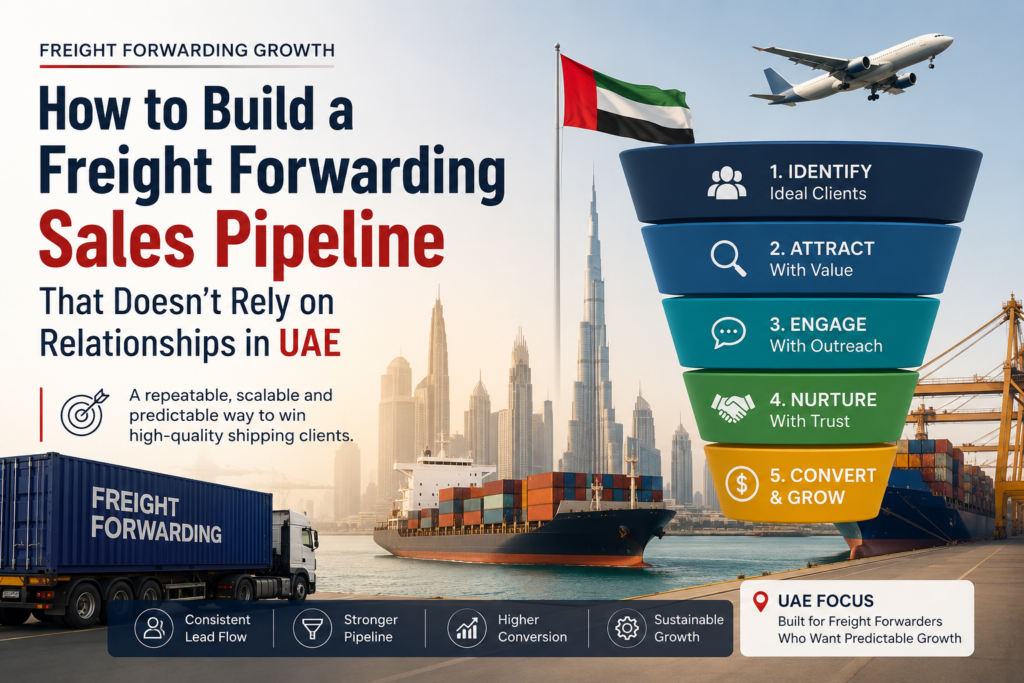
How to Build a Freight Forwarding Sales Pipeline That Doesn't Rely on Relationships in UAE
UAE non-oil trade is up nearly 49% since 2021. A large share of that growth is companies with zero existing forwarder relationships — meaning relationship-only sales structurally misses an increasingly large part of the opportunity.
What's Covered In This Guide
- Why Relationship-Only Sales Is a Risk, Not a Strength
- 7 Ways to Build a Pipeline That Doesn't Depend on Who You Know
- What's Quietly Keeping You Relationship-Dependent
- Where Pipeline Risk Concentrates, Port by Port
- A Practical Roadmap
- Frequently Asked Questions
Why Relationship-Only Sales Is a Risk, Not a Strength
Most UAE freight forwarders still win new business almost entirely through referrals and long-standing personal relationships — and logistics is one of the strongest verticals for a different approach precisely because so few competitors have built one. Decision-makers are identifiable, the buying cycle is predictable, and most competitors are still relying on brokers and referrals rather than any structured, repeatable system.
That relationship-only model has a structural weakness: it doesn't survive a key salesperson leaving, a long-standing contact moving on, or simply having exhausted your existing network's reach. This matters more in the UAE than most markets — non-oil foreign trade has climbed to $1.42 trillion, nearly 49% above 2021 levels, meaning a large share of the buyers entering the market now are new entrants with no legacy relationships to lean on at all. Meanwhile, the broader B2B data shows why a systemized pipeline outperforms relationship-only selling at scale: inbound channels like SEO and referrals produce sales cycles 2-3 times shorter than pure outbound at comparable complexity, but referrals alone still only convert around 26% of the time — meaning even your best channel needs a system behind it, not just goodwill. Most B2B teams also need 3-5x pipeline coverage relative to their revenue target just to hit quota reliably, which is nearly impossible to sustain from relationships alone once you're trying to grow past a certain size.
7 Ways to Build a Pipeline That Doesn't Depend on Who You Know
Build inbound content around the specific lanes and cargo types you handle. SEO-driven content (route pages, cargo-type guides, port-specific pages) generates leads that arrive already searching for what you offer — no relationship required, and inbound-sourced deals close 2-3x faster than cold outbound at similar complexity.
Run structured outbound alongside referrals, not instead of them. Logistics is one of the strongest verticals for outbound specifically because decision-makers (procurement heads, supply chain directors) are identifiable and the buying cycle is predictable — most competitors simply haven't built the system yet, which is exactly the opportunity.
Put every enquiry and relationship into a CRM, not a salesperson's memory or phone contacts. When client relationships live in a CRM rather than in one person's head, the business survives that person's departure, visa change, or relocation without losing the account or the pipeline history behind it — a genuine risk in a market with as much cross-border talent mobility as the UAE.
Qualify leads systematically instead of chasing whoever calls first. With a median B2B win rate now around 19-21% and lead-to-customer conversion around 2.9%, a defined qualification process (cargo type, volume, lane, urgency) prevents your team from spending months on deals that were never going to close.
Formalize your account-based targeting toward new market entrants. With non-oil trade nearly 49% above 2021 levels, a large share of your addressable market consists of companies with no existing UAE forwarder relationship at all — a deliberate, multi-touch sequence targeting these new entrants works the same way whether or not you personally know anyone there.
Track pipeline velocity, not just win rate. Pipeline velocity (opportunities × average deal value × win rate ÷ sales cycle length) shows whether you're actually generating revenue efficiently, not just closing occasional deals — a metric relationship-only selling rarely tracks at all.
Build a retention and renewal process for existing clients. A systemized check-in cadence, account review schedule, and expansion conversation turns existing relationships into a predictable, repeatable revenue stream rather than something that only gets attention when a client happens to call.
What's Quietly Keeping You Relationship-Dependent
- No CRM, or one nobody actually updates. If client history and pipeline status live in someone's head or a personal notebook, the business has no visibility into its own sales process — and no way to onboard a new salesperson without starting from zero.
- All new business tied to 2-3 people. If the majority of your revenue traces back to a small handful of personal relationships, the business is one departure, visa change, or relocation away from a serious revenue gap — a real risk given how mobile the UAE's logistics workforce is.
- No defined qualification criteria. Without a system for scoring leads by cargo type, volume, and fit, sales time gets spent equally on every enquiry regardless of how likely it is to close.
- Ignoring the flood of new market entrants. With non-oil trade growing nearly 49% since 2021, a relationship-only sales model structurally misses every new company entering the market with no prior UAE forwarder relationship — which is an increasingly large share of the opportunity.
Where Pipeline Risk Concentrates, Port by Port
The UAE's freight and logistics activity concentrates around a handful of ports, each tied to different cargo types, trade lanes, and buyer profiles. Relationship dependency and pipeline-building opportunity vary meaningfully by hub.
Jebel Ali Port, Dubai
The most mature and relationship-dense forwarder market in the country, anchoring the Jebel Ali Free Zone (JAFZA). Long-standing personal networks run deep here, which also means a forwarder with a genuinely systemized pipeline stands out sharply against competitors still relying purely on legacy relationships.
Khalifa Port, Abu Dhabi
A newer, more technologically advanced terminal with a distinct industrial and project-cargo buyer base compared to Dubai. Relationship networks here are less entrenched than at Jebel Ali — real opportunity for a systemized pipeline to capture share before legacy relationships fully form.
Port Rashid, Dubai
A smaller, niche cargo operation (notably used car exports) alongside cruise traffic. A narrower buyer base where existing relationships run deep within that specific niche — content and outbound targeting that speaks directly to this niche outperforms generic prospecting.
Mina Zayed, Abu Dhabi
A smaller, more relationship-driven buyer base than Dubai's ports. Warm, systemized outbound sequencing (rather than cold blasting) tends to outperform here, since existing relationships still carry real weight in this segment.
Port of Fujairah
A highly specialized bunkering and bulk oil hub outside the Strait of Hormuz. An extremely technical buyer base disconnected from general container freight relationships — a forwarder building genuine expertise-led content here can capture buyers that pure relationship networking never reaches.
Khor Fakkan Port, Sharjah
A key transshipment hub increasingly relevant amid Red Sea disruptions, drawing overflow business from forwarders and shippers with no prior Sharjah-specific relationships. A strong candidate for systemized, timely outbound targeting rather than waiting for a referral.
Sharjah (Port Khalid) & Hamriyah Port
A more operationally focused buyer base than Dubai's, less driven by brand relationships and more by demonstrated capability and cost efficiency — a systemized pipeline built around clear service differentiation converts better than relationship-based pitching here.
Saqr Port, Ras Al Khaimah
A smaller, niche bulk cargo market (particularly construction materials) where the total pool of existing relationships is naturally limited — a well-targeted systemized outreach effort can reach a meaningfully high share of relevant decision-makers.
Ajman Port
Limited existing sales and marketing activity from competing agencies here creates real opportunity for a forwarder with a genuinely systemized pipeline to stand out sharply against thin competition.
Umm Al Quwain Port
The UAE's smallest and least developed port, where a modest, well-researched systemized outreach effort can capture disproportionate share of the limited existing digital and sales activity.
A Practical Roadmap
| Timeframe | Action |
|---|---|
| Week 1 | Move all client and prospect relationships out of individual memory/contacts and into a shared CRM |
| Week 1 | Define lead qualification criteria (cargo type, volume, lane, urgency) |
| Weeks 2-4 | Build inbound content for your top 3-5 trade lanes and ports served |
| Weeks 2-4 | Identify target accounts by industry and volume, prioritizing new market entrants |
| Month 2 | Launch a multi-touch outbound sequence against your target account list |
| Month 2 | Set up a renewal/retention cadence for existing clients |
| Month 3 | Track pipeline velocity and win rate by source (referral vs. inbound vs. outbound) to see what's actually working |
Frequently Asked Questions
Isn't relationship-based selling still the most important channel in UAE freight forwarding?
Relationships remain valuable — referral leads convert well and shouldn't be abandoned. The risk isn't relationships themselves; it's having no system underneath them, so the business can't function, scale, or survive turnover without them.
How long does it take to build a pipeline that isn't relationship-dependent?
Most forwarders start seeing early inbound or outbound pipeline signal within 4-8 weeks, but building this into a reliable, diversified revenue source alongside existing relationships typically takes 3-6 months of consistent execution.
Do we need a full CRM system, or can we start simpler?
Start with whatever system your team will actually use consistently — even a well-maintained spreadsheet is a major improvement over relationships living in one person's head. The goal is visibility and continuity, not a specific tool.
With so many new companies entering the UAE market, where should we focus first?
Prioritize account-based targeting toward companies that are new to the UAE market or expanding into it — they have no existing forwarder relationship to overcome, making them the fastest path to pipeline that doesn't rely on who you know.
Will building a systemized pipeline actually reduce our dependence on our best salespeople?
Yes, over time — a documented process, shared CRM data, and defined qualification criteria mean a new team member can be productive faster and a departure doesn't take the account history and relationship context with them.
Get Started
Ready to Build a Pipeline That Doesn't Depend on Who You Know?
We'll audit your current sales process, help you build inbound content around your actual trade lanes, set up structured outbound targeting toward new market entrants, and put a real system behind the relationships you already have.
Request Your Free Pipeline AuditRelated reading
- How to Build a Freight Forwarding Sales Pipeline That Doesn't Rely on Relationships in India
- LinkedIn Outreach for Freight Forwarders in UAE: What Actually Works in 2026
- Why Your Freight Forwarding Website Isn't Converting (Even With Traffic)
Anshul Kuntewar
Founder, RouteRush Digital Marketing Agency — a freight forwarding marketing agency specialising in sales pipeline strategy, SEO, and lead generation for freight and logistics companies across the UAE, India, Oman, South Africa, Qatar, and Australia. Connect on LinkedIn →
This guide reflects B2B sales and UAE freight market benchmark data current as of mid-2026. Individual results vary by trade lane, cargo type, and existing relationship base.