
Why Your Freight Forwarding Website Isn’t Converting (Even With Traffic)
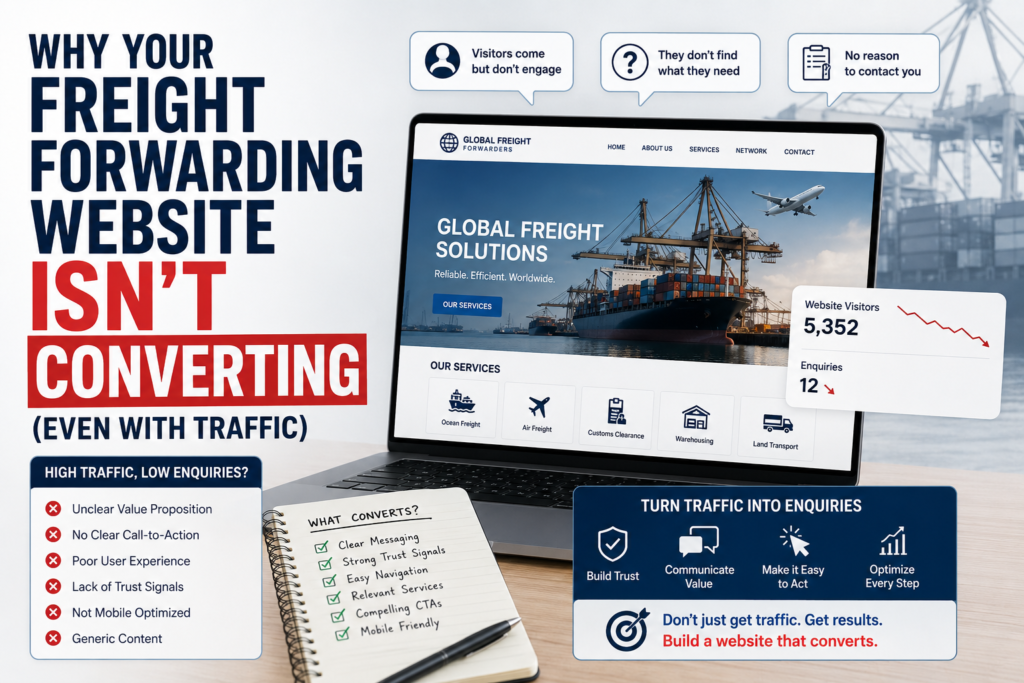
Freight Forwarding Marketing · Conversion Strategy
Why Your Freight Forwarding Website Isn't Converting (Even With Traffic)
Traffic went up. Enquiries didn't. If that sentence describes your last few months, the problem isn't your SEO — it's everything that happens after someone lands on your site.
What's Covered In This Guide
- The Traffic Trap: Why Visitors Aren't the Same as Enquiries
- 7 Reasons Freight Forwarding Websites Leak Conversions
- What a Converting Website Does Differently
- Where the Conversion Gap Hits Hardest, Port by Port
- A Practical Roadmap to Fix It
- Frequently Asked Questions
The Traffic Trap: Why Visitors Aren't the Same as Enquiries
Every freight forwarder chasing SEO eventually hits the same wall: traffic goes up, and enquiries don't follow. It's one of the most common — and most misunderstood — problems we see when auditing logistics websites across India.
The instinct is to blame the marketing channel. It's rarely the channel. Across 14 industries and more than 100 million data points, the median B2B website converts visitors into leads at roughly 2.9%, split between form submissions and calls. For considered, complex-service industries like freight and logistics — where a buyer is choosing who moves their cargo, not adding an item to a cart — that number is frequently lower still unless the website is doing real work to earn trust and remove friction.
India's freight and logistics market is worth an estimated $315.89 billion in 2026 and is projected to reach $476.51 billion by 2031, growing at roughly 8.57% annually. That's a large and expanding pool of exporters, manufacturers under PLI schemes, and e-commerce sellers actively searching for forwarders right now. Traffic finding your site was never the hard part. Converting it is.
7 Reasons Freight Forwarding Websites Leak Conversions
The quote request is buried, vague, or both. Many forwarder websites still route every enquiry through a generic "Contact Us" page with no indication of what happens next, how fast they'll hear back, or what information to have ready. A visitor who's ready to act now needs a direct, obvious path — "Get a Quote," not "Contact Us."
Trust signals aren't visible where the decision happens. IATA, FIATA, MTO, and AEO accreditations, years in operation, ports served — these build credibility, but only if they're shown near the point of decision, not buried on an "About" page three clicks deep.
The homepage is generic, not route- or port-specific. A forwarder handling JNPT-to-Jebel Ali LCL shipments loses a highly qualified visitor the moment that visitor can't quickly confirm "yes, they do this exact lane." Generic homepage copy forces buyers to keep searching rather than enquire.
Mobile experience is an afterthought. A large share of B2B research in India now happens on mobile, particularly among younger import/export managers doing early-stage research between meetings. A slow, hard-to-navigate mobile site loses that visitor before they ever reach a form.
There's no social proof. No client logos, no case studies, no testimonials, no numbers (shipments handled, years active, countries served). Buyers making a high-stakes logistics decision look for evidence someone like them has trusted this forwarder before.
The quote form asks for too much, too soon. Long forms with a dozen mandatory fields before a human ever responds are a proven conversion killer across B2B — shorter forms with a fast human follow-up consistently outperform long ones asking for everything upfront.
There's no fast, low-friction way to ask a quick question. Indian B2B buyers increasingly expect a WhatsApp or live-chat option for a fast first question, especially for time-sensitive shipments. A site offering only a contact form and a generic email address adds a delay many buyers won't wait through.
What a Converting Website Does Differently
None of this requires abandoning your SEO strategy — it means pairing the traffic you're already earning with a site built to convert it:
- A single, obvious "Get a Quote" CTA repeated at the top, middle, and bottom of every page — not competing with five other equally-weighted buttons
- Accreditations and years-in-business shown above the fold, not just listed once on an About page
- Dedicated pages per port and per major trade lane (JNPT to Jebel Ali, Mundra to Colombo, Chennai to Singapore) so a visitor searching that exact route lands on content built for them
- A short quote form (name, company, cargo type, origin/destination, contact number) with a promise of fast human follow-up
- Real client logos, shipment volumes, and short case studies, even simple ones ("500+ TEUs cleared monthly through JNPT for X client")
- A WhatsApp or live-chat option visible on every page for buyers who want a fast answer before committing to a full enquiry
- Fast load times and a genuinely usable mobile layout, tested on an actual phone, not just a desktop browser at 100% zoom
Where the Conversion Gap Hits Hardest, Port by Port
India has 13 government-administered major ports under the Ministry of Ports, Shipping and Waterways, plus Mundra — the country's largest port by cargo volume — and over 200 non-major and intermediate ports managed by state maritime boards. Traffic and conversion behave differently depending on the hub a forwarder operates from, because buyer expectations and competitive intensity vary port to port.
Mumbai & JNPT (Nhava Sheva), Maharashtra
The highest concentration of freight forwarders in India operates here, and buyer research is fast and comparison-heavy. A slow site or vague quote process loses the visitor to a competitor's tab within seconds.
Mundra Port, Gujarat
India's largest port by cargo volume, with a rapidly growing base of agri-export and container clients who are often searching cold, with no prior forwarder relationship — meaning the website has to do all the trust-building work a referral normally would.
Deendayal Port (Kandla), Gujarat
A long-established bulk cargo hub. Buyers here often have specific, technical cargo questions — a site without route- and cargo-specific content answers them nowhere near fast enough.
Chennai Port, Tamil Nadu
Serves a dense automotive and electronics export corridor where manufacturers expect precision — vague service pages without specific cargo-type detail read as inexperience.
Kamarajar Port (Ennore), Tamil Nadu
A newer major port with a less established forwarder base — an opportunity for a well-converting website to capture disproportionate share before competitors catch up.
V.O. Chidambaranar Port (Tuticorin), Tamil Nadu
Buyers here are often comparing multiple regional forwarders directly; the site with the clearest, fastest quote process typically wins the enquiry.
Visakhapatnam Port, Andhra Pradesh
Bulk commodity buyers researching new forwarders for diversification need clear proof of experience with that specific cargo type, not general logistics copy.
Paradip Port, Odisha
The highest cargo volume among major government-run ports, but digital marketing and conversion-focused websites remain rare here — meaning a well-built site stands out sharply against thin competition.
Kolkata & Haldia (Syama Prasad Mookerjee Port), West Bengal
A historic trade hub connecting to Bangladesh and Nepal; buyers researching cross-border documentation need that answered directly on-site, not left to a follow-up call.
Cochin Port, Kerala
Strong existing trade in spice, seafood, and coir exports to the Middle East — forwarders trying to diversify cargo types need a website that can prove capability beyond their traditional base.
New Mangalore Port, Karnataka
A smaller, growing hub where a genuinely fast, mobile-friendly, trust-building website has real room to convert a higher share of the still-limited search traffic.
Mormugao Port, Goa
Historically iron-ore-relationship-driven; forwarders expanding into container or general cargo need a site that proves that specific new capability clearly, not just legacy credentials.
Port Blair, Andaman & Nicobar Islands
India's smallest major port, where limited local competition means even a modest, well-structured website can convert a meaningfully high share of the traffic that does arrive.
A Practical Roadmap to Fix It
| Timeframe | Action |
|---|---|
| Week 1 | Audit your current homepage against the 7 conversion leaks above |
| Week 1 | Cut your quote form down to 5 essential fields and add a fast-response promise |
| Weeks 2-4 | Build or update dedicated pages for your top 3-5 trade lanes and ports served |
| Weeks 2-4 | Add accreditations (IATA, FIATA, MTO, AEO), years in business, and real client proof above the fold |
| Month 2 | Add a WhatsApp or live-chat option visible on every page |
| Month 2 | Test your site on an actual mobile phone and fix load-speed and layout issues |
| Month 3 | Compare conversion rate (enquiries ÷ visitors) before and after, by page and by traffic source |
Frequently Asked Questions
We're already ranking well and getting traffic — why isn't it converting?
Ranking well solves discovery, not decision-making. Once a buyer lands on your site, a separate set of factors — trust signals, clarity, form friction, mobile usability — determines whether they actually enquire. Traffic and conversion are two different problems that need two different fixes.
What's a good conversion rate for a freight forwarding website?
There's no single universal number, but B2B websites broadly convert visitors to leads at 2-3% on average, with top performers reaching 5-7%. Complex, considered-purchase services (which freight forwarding is) often sit toward the lower end unless the site actively addresses trust and friction — which is exactly where the highest-leverage fixes are.
Should we redesign the whole website or fix specific pages first?
Start with the pages carrying the most traffic and the clearest buyer intent — usually your homepage and your top 2-3 service or route pages. A full redesign is rarely necessary; targeted fixes to CTAs, trust signals, and form length typically move the needle faster than a ground-up rebuild.
Does adding a WhatsApp button really make a measurable difference?
For Indian B2B buyers specifically, yes, directionally — a fast, low-commitment way to ask a first question removes a real barrier for buyers who aren't ready to fill out a full enquiry form yet but are ready to start a conversation.
How long does it take to see a measurable improvement after fixing conversion issues?
Most sites see a measurable shift in enquiry rate within 4-8 weeks of implementing the core fixes (shorter forms, clearer CTAs, visible trust signals), assuming traffic volume stays consistent enough to compare before-and-after data meaningfully.
Get Started
Ready to Turn Your Traffic Into Enquiries?
We'll audit your current website against every leak in this guide, benchmark your conversion rate against your specific ports and trade lanes, and build a fix list ranked by impact.
Request Your Free Conversion AuditRelated reading
- Freight Forwarding Marketing in India: The Complete Guide
- Why Referrals Alone Won't Scale Your Freight Forwarding Business Anymore
- How Much Should a Freight Forwarder Spend on Digital Marketing?
Anshul Kuntewar
Founder, RouteRush Digital Marketing Agency — a freight forwarding marketing agency specialising in SEO and conversion-focused website strategy for freight and logistics companies across India, South Africa, UAE, Qatar, Australia, and the UK. Connect on LinkedIn →
This guide reflects freight forwarding market and B2B conversion benchmark data current as of mid-2026. Individual results vary by trade lane, cargo type, and competitive intensity at each port.