
Why Referrals Alone Won’t Scale Your Freight Forwarding Business Anymore (2026)
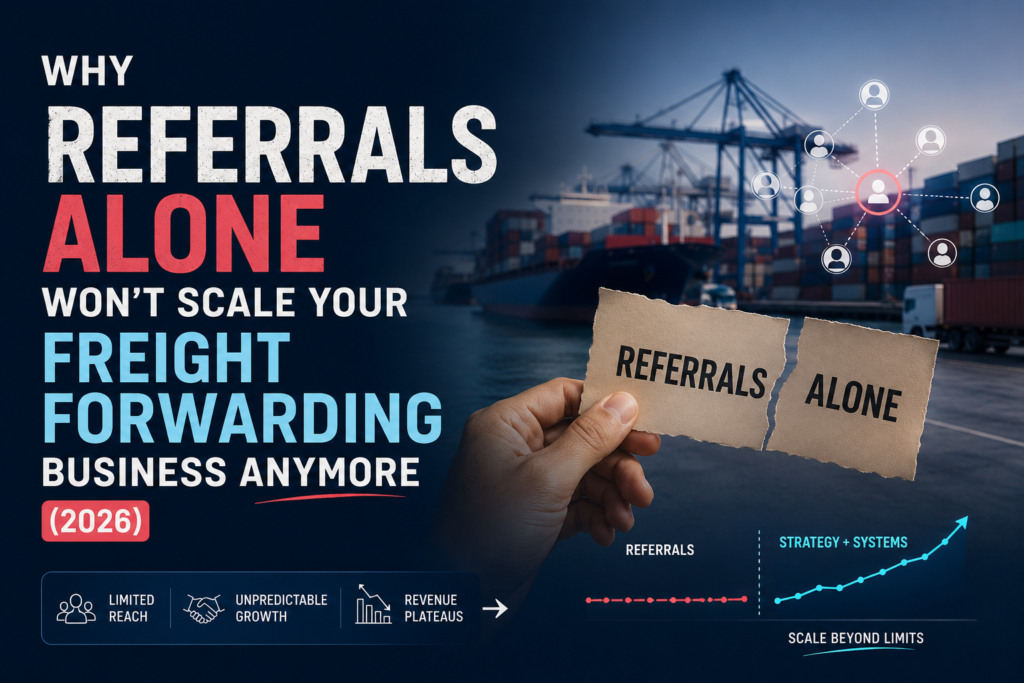
Why Referrals Alone Won't Scale Your Freight Forwarding Business Anymore
Referrals got you here, and they're real, valuable business built on trust. But every freight forwarder that's tried to grow past a certain size in India hits the same wall: referrals are finite, they don't compound, and they can't be scheduled. Here's why the ceiling exists, and what to build alongside referrals to break through it, port by port.
About this guide: Written by the RouteRush team, a digital marketing agency working exclusively with freight forwarders, CHAs, and logistics companies across India, the UAE, South Africa, Qatar, Australia, and the UK. Market figures are sourced from Mordor Intelligence and the Ministry of Ports, Shipping & Waterways (Sagarmala Programme, Maritime India Vision 2030). Where we describe a general pattern rather than citing a specific published statistic, we say so directly.
What's Covered In This Guide
Why Referral-Only Growth Has a Ceiling
Almost every established freight forwarder in India built their business on referrals, an exporter tells another exporter, a CHA vouches for a forwarder to a client, a long relationship with a shipping line brings in adjacent business. This is genuinely valuable. Referred clients tend to trust faster, negotiate less aggressively, and stay longer. There's nothing wrong with referrals as a channel.
The problem is treating referrals as the entire growth strategy rather than one channel among several. Referral volume is a function of your existing client base and network size, it grows roughly in proportion to how many satisfied clients you already have, not in proportion to how much effort you put in. That means referral-only growth is inherently linear at best, and often slower, while the market opportunity around you is growing much faster.
Source: Mordor Intelligence, 2026; Ministry of Ports, Shipping and Waterways, Maritime India Vision 2030
A market growing at close to 9% a year is generating new demand, new exporters, new manufacturing hubs under PLI schemes, new e-commerce sellers needing cross-border logistics, that has no existing relationship with your business at all. Referrals can't reach a company that's never heard of you and has no mutual contact to introduce you. That demand is only accessible through visibility: search, content, and a credible online presence.
6 Reasons Referrals Stop Scaling a Freight Forwarding Business
Referral Volume Is Capped by Your Existing Network
You can only get referred by people who already know you. As your business grows, the pool of people who know you grows too, but slowly, and usually only as fast as you personally build new relationships. This is why many forwarders plateau at a revenue level that matches roughly what their personal and professional network can sustain, and no further.
Referrals Don't Reach New Markets or New Hubs
If you want to start serving clients through a port or hub where you have no existing presence, JNPT to Mundra, or Chennai to Vizag, your referral network usually doesn't extend there either. Entering a new hub through referrals alone means starting from zero relationship-building all over again, which is slow and unpredictable.
Referrals Are Unpredictable and Unschedulable
You can't forecast referral volume the way you can forecast a marketing pipeline. A good quarter might bring five referred leads, a quiet quarter might bring none, and there's no lever to pull to guarantee a specific number of enquiries in a specific month. This makes hiring, capacity planning, and revenue forecasting genuinely difficult for a referral-dependent business.
Younger Buyers Verify Online Even When Referred
Even when a client is referred to you, a growing share of decision-makers, particularly younger import/export managers and procurement leads, still check your website and search for your name before committing. A referral gets you the introduction, it doesn't guarantee the close. A weak or outdated online presence can quietly undo a warm referral before you even get on a call.
Your Competitors Aren't Standing Still
The freight forwarders who do invest in SEO, content, and a real digital presence are capturing the exact demand that referrals can't reach, new businesses searching cold with no prior relationship to anyone in the industry. Every year a forwarder relies purely on referrals, competitors building genuine visibility online are compounding an advantage that gets harder to close.
Referrals Concentrate Risk in a Few Relationships
If a large share of your business flows from two or three key referral relationships, a single relationship ending, a key contact retiring, changing companies, or a competitor building a closer relationship with them, can meaningfully shrink your pipeline overnight. A diversified lead generation system spreads that risk across many independent channels instead of a handful of people.
What to Build Alongside Referrals, Not Instead of Them
None of this means abandoning referrals, they remain one of the highest-trust, lowest-cost channels available to any freight forwarder. The goal is to build parallel channels that capture the demand referrals structurally can't reach:
- Hub and service-specific SEO: ranking for searches like "customs clearance agent JNPT" captures buyers with zero prior connection to your network.
- A complete, optimized Google Business Profile: for every port or city you operate in, capturing local "near me" search intent that has nothing to do with referrals.
- Content answering real compliance questions: IEC registration, ICEGATE filing, GST e-way bills, capturing buyers early in their research, before anyone has referred them to anyone.
- A consistent LinkedIn presence: building familiarity with import/export managers and supply chain heads who don't yet know anyone who could refer you.
- A systematic Google review process: building trust signals visible to buyers who found you cold, with no referral to vouch for you.
Referrals and digital visibility aren't competing strategies, they reinforce each other. A referred prospect who then finds a strong, credible website and good reviews converts faster. A cold prospect who found you through search converts faster if, once they ask around, someone in their network has actually heard of you.
Where the Referral Ceiling Hits Hardest, Port by Port
India has 13 government-administered major ports under the Ministry of Ports, Shipping and Waterways, plus Mundra, the country's largest port by cargo volume, and over 200 non-major and intermediate ports managed by state maritime boards. Referral networks are almost always geographically concentrated, built around the hub where a forwarder has operated longest, which means the referral ceiling is felt differently depending on where you're trying to grow.
Mumbai & JNPT (Nhava Sheva), Maharashtra
The highest concentration of freight forwarders and CHAs in India operates here, which means referral networks are dense but also heavily contested. Digital visibility is what differentiates you from dozens of other forwarders with equally strong local relationships.
Mundra Port, Gujarat
India's largest port by cargo volume, and a rapidly growing hub for containerised agri exports. Forwarders without an established Gujarat network will find referrals here especially slow to build, making SEO and content the faster path in.
Deendayal Port (Kandla), Gujarat
A long-established bulk cargo hub with legacy relationships built over decades. Newer or smaller forwarders trying to enter this market face a particularly high referral barrier to entry.
Chennai Port, Tamil Nadu
South India's automotive and electronics export corridor runs on tight, established manufacturer relationships. Referral networks here are strong but narrow, digital visibility helps reach manufacturers outside your immediate circle.
Kamarajar Port (Ennore), Tamil Nadu
A newer major port relative to Chennai, meaning referral networks are still forming. This is a hub where a forwarder building digital presence early has a real first-mover advantage over relying on relationships that don't fully exist yet.
V.O. Chidambaranar Port (Tuticorin), Tamil Nadu
A significant regional hub where referral networks tend to be tightly local to Thoothukudi and southern Tamil Nadu, limiting reach into other parts of the state or country without a digital presence.
Visakhapatnam Port, Andhra Pradesh
Dominated by bulk commodity relationships built over years with steel, coal, and ore exporters. Diversifying into other cargo types here almost always requires reaching buyers outside the existing referral circle.
Paradip Port, Odisha
The highest cargo volume among government-run major ports, but a market where digital marketing adoption among forwarders remains very low, meaning the referral ceiling is currently the default state for most operators here.
Kolkata & Haldia (Syama Prasad Mookerjee Port), West Bengal
A historic, relationship-driven trade hub connecting to Bangladesh and Nepal. Referral networks run deep but are geographically bounded, limiting growth into other Eastern India corridors without broader visibility.
Cochin Port, Kerala
Strong existing relationships in spice, seafood, and coir exports to the Middle East. Forwarders looking to diversify into new cargo categories or new export markets from Cochin need visibility beyond their established referral base.
New Mangalore Port, Karnataka
A smaller but growing hub where referral networks are less dense than Mumbai or Chennai, creating real room for a forwarder investing early in digital visibility to establish a strong local ranking presence.
Mormugao Port, Goa
Historically concentrated around iron ore export relationships. Forwarders looking to expand beyond this legacy base into broader container or general cargo work face a real referral gap that digital visibility can close.
Port Blair, Andaman & Nicobar Islands
India's smallest major port, where the local business community and referral network is naturally limited by geography. A digital presence here can matter disproportionately given how few forwarders actively compete for visibility.
The pattern across every port: the busier and more established the hub, the denser but more contested the referral networks. The newer or smaller the hub, the more the referral ceiling is simply the current default, and the bigger the first-mover opportunity for a forwarder willing to build real digital visibility before competitors catch on.
A Practical Roadmap for Moving Beyond Referrals
| Timeframe | Action |
|---|---|
| Week 1 | Map which ports/hubs your current referral network actually covers, and which it doesn't |
| Week 1 | Claim and fully optimize your Google Business Profile for every location you operate in |
| Weeks 2-4 | Build a dedicated page for the hub where your referral network is weakest but growth potential is highest |
| Weeks 2-4 | Start a consistent LinkedIn posting cadence from a founder or senior team profile |
| Month 2 | Launch a content calendar targeting compliance and documentation questions your referred and cold prospects both search |
| Month 2 | Set up a systematic Google review request process for every completed shipment |
| Month 3 | Review which channel, referral or digital, is generating leads in the hubs you mapped in week 1, and double down accordingly |
Frequently Asked Questions
Should I stop relying on referrals if they're limiting my growth?
No, referrals remain one of the highest-trust, lowest-cost channels available. The goal isn't to replace them, it's to build parallel channels, SEO, content, LinkedIn, that capture demand referrals structurally can't reach on their own.
How do I know if my business has hit a referral ceiling?
Common signs include: revenue growth roughly flat year over year despite steady operational quality, most new business coming from a small handful of repeat referral sources, and difficulty entering new hubs or cargo types despite having capacity to serve them.
Which is more reliable long-term, referrals or digital marketing?
They serve different purposes rather than competing directly. Referrals are unpredictable but high-trust and low-cost. Digital marketing, once built, is more predictable and scalable, though it takes months to build momentum rather than being instant. A mature freight forwarding business typically relies on both.
Can digital marketing actually replace what referrals do for trust?
Not entirely, but it can approximate it. Google reviews, case studies, accreditations (IATA, FIATA, MTO, AEO), and detailed service content all serve the same trust-building function a referral does, just at scale and without requiring a personal introduction for every new client.
Is it worth investing in digital marketing for a hub where I already have strong referral relationships?
Often yes, because even referred clients increasingly verify a company online before committing. A strong digital presence doesn't just bring in new leads in that hub, it also protects and reinforces the referrals you're already receiving there.
Ready to Build Growth That Doesn't Depend on Who You Know?
We'll review your current referral network, identify where the ceiling is limiting you, and build a specific plan to reach the demand referrals can't. No inflated retainer pitch, just a clear path forward.
Request Your Free Growth AuditRelated reading
Anshul Kuntewar · Founder, RouteRush Digital Marketing Agency
Anshul is a digital marketing strategist specialising in SEO and organic lead generation for freight and logistics companies across India, South Africa, UAE, Qatar, Australia, and the UK, working directly with freight forwarders and CHAs to build growth systems that don't depend solely on referral networks. Connect on LinkedIn →