
How Small NDIS Providers Can Compete With Large Disability Organisations and Marketplace Platforms
NDIS Marketing · Competitive Positioning
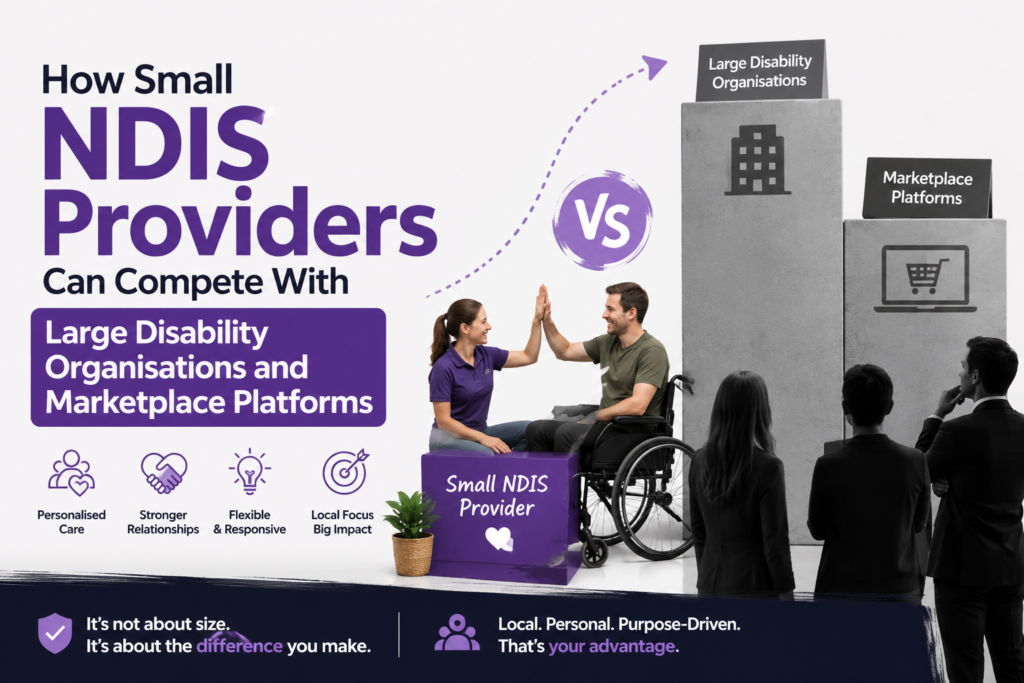
How Small NDIS Providers Can Compete With Large Disability Organisations and Marketplace Platforms
Nine of the ten largest NDIS providers by revenue reported negative adjusted operating results in 2026. Scale doesn't guarantee stability — and that's exactly where a smaller provider's real opportunity sits.
What's Covered In This Guide
- Why This Matters for Small NDIS Providers Right Now
- Two Very Different Threats: Large Organisations and Marketplace Platforms
- 7 Ways Small Providers Actually Compete
- What's Quietly Costing You Against Both Threats
- What This Looks Like in Practice
- A Practical Roadmap
- Frequently Asked Questions
Why This Matters for Small NDIS Providers Right Now
The NDIS now supports more than 761,000 participants, with total payments reaching $46.3 billion — a scheme still growing, but under real cost-growth pressure, with National Cabinet targeting a reduction in annual cost growth to 8% by July 2026, down from 10.8% a year earlier. That pressure is reshaping the competitive landscape in a way that should genuinely encourage smaller providers: nine of the ten largest NDIS providers by revenue recently reported negative adjusted operating results. Scale, it turns out, does not guarantee financial viability in this sector — several large organisations have already exited service lines they found unsustainable.
At the same time, small and mid-sized providers face two genuinely different kinds of competition, not one. Large, established disability service organisations — names like Aruma (formed from the merger of House with No Steps and The Tipping Foundation, now supporting more than 4,000 people across NSW, Queensland, Victoria, and the ACT) and Life Without Barriers (operating across every state and territory) — compete on brand recognition, diversified service lines, and national scale. Separately, support worker marketplace platforms like Mable and Hireup compete by disintermediating providers altogether, letting self-managed and plan-managed participants book independent support workers directly. These are not the same threat, and they don't call for the same response.
Two Very Different Threats: Large Organisations and Marketplace Platforms
Large disability service organisations compete on scale, brand, and service breadth. Aruma reports annual revenue around $247 million; Life Without Barriers operates supported independent living, out-of-home care, mental health support, and disability employment services nationally. Their advantage is diversification and name recognition — a family who has heard of a provider before is more likely to consider them, even without direct experience. Their disadvantage, increasingly visible in 2026, is that this scale comes with real financial strain: most of the largest providers are currently operating at a loss on an adjusted basis, and several have exited service lines that weren't sustainable.
Marketplace platforms compete by removing the provider relationship entirely. Mable, founded in 2014, is an online marketplace connecting participants directly with independent support workers — as of March 2026, Mable itself is not NDIS-registered, meaning it's only usable by self-managed and some plan-managed participants, not NDIA-managed plans. Mable charges a combined take rate of roughly 16.6% built into the rate participants pay, with support workers setting their own rates within NDIS price limits. Hireup takes a different approach: it directly employs its support workers rather than treating them as independent contractors, handling tax, superannuation, and insurance, with pricing set against the NDIS price guide rather than negotiated. Both platforms are explicitly built around giving participants more autonomy over who supports them — which is exactly the flexibility a traditional agency-based provider has to compete with directly, not around.
7 Ways Small Providers Actually Compete
Compete with large organisations on continuity, not scale. A large provider's size often means a rotating roster of staff and less individual attention per participant. A smaller provider who can promise — and consistently deliver — the same one or two support workers over time offers something genuine scale frequently can't replicate operationally.
Compete with marketplaces by being the "no admin" option. Mable and Hireup shift real coordination work onto the participant or their family — finding replacement workers, managing schedules, handling issues directly. A registered provider's core value proposition against this is doing that coordination work for the family, not just providing support hours.
Make your registration status a genuine differentiator against Mable specifically. Since Mable is not NDIS-registered and can't be used by NDIA-managed participants, being clearly, visibly registered is a real point of differentiation for exactly the segment of the market marketplace platforms structurally can't serve.
Specialize in a category where large generalist organisations spread themselves thin. With autism, psychosocial disability, and developmental delay services capturing a growing share of sector revenue, a smaller provider who builds genuine depth in one of these categories can out-compete a large, broad-service organisation on expertise specifically.
Use financial stability as a quiet, honest selling point. With most large providers currently operating at a loss and some exiting service lines, a smaller, financially sustainable provider has a legitimate, honest story to tell about consistency and longevity — without needing to name any specific competitor's difficulties.
Offer the personal relationship marketplaces can't provide. Hireup's employed-worker model offers more consistency than Mable's contractor marketplace, but neither offers the kind of ongoing, provider-level relationship management — service planning, goal tracking, coordination with allied health — that a genuine agency relationship includes.
Be visibly present where families are actually comparing options. Families increasingly research providers, marketplaces, and large organisations side by side in the same sitting — a smaller provider needs the same visible registration status, reviews, and clear service description as the options they're being compared against, not just as good service behind the scenes.
What's Quietly Costing You Against Both Threats
- Looking financially uncertain when you're not. In a sector where large providers are visibly exiting service lines, a smaller provider's website that looks thin or outdated can accidentally signal instability, even when the underlying business is healthy.
- Not stating your registration status clearly against marketplace competition. If a family comparing you to Mable can't immediately see that you're NDIS-registered and marketplace platforms often aren't, you're not getting credit for a genuine structural advantage.
- Trying to match a large organisation's service breadth instead of your own depth. A small provider claiming to do everything a national organisation does, only smaller, rarely wins that comparison — depth in a specific category wins it instead.
- Underestimating how much coordination burden matters to families. Families who've tried a marketplace platform and found the admin burden heavier than expected are a real, current audience — messaging that doesn't speak to this misses them.
- No visible continuity-of-care promise. If your website doesn't say anything about staff consistency, a family has no way to know this is a strength before choosing you.
What This Looks Like in Practice
The following are illustrative scenarios based on common patterns in the sector, not verified case studies of specific named providers.
A provider positioning around continuity against a large organisation. Recognizing that families researching options from a large, well-known provider are often worried about which specific support worker they'll actually get, a smaller provider makes "the same two support workers, every time" a headline commitment on its homepage — directly addressing a concern the larger competitor's scale makes harder to promise.
A provider addressing families who tried a marketplace platform first. After noticing several new enquiries mentioned frustration with managing worker cancellations on a marketplace platform, a provider adds a short, direct page explaining what a registered provider handles that a marketplace leaves to the family — capturing families mid-reconsideration.
A provider specializing in one underserved category. Rather than offering broad, generalist disability support, a provider builds deep expertise and content specifically around autism support services, an area of genuinely growing demand, and out-competes larger, more generalist organisations on depth for that specific need.
A Practical Roadmap
| Timeframe | Action |
|---|---|
| Week 1 | Audit your website for whether registration status and continuity-of-care are stated clearly |
| Week 1 | Identify one service category where you can credibly claim genuine depth over breadth |
| Weeks 2-3 | Build a short page addressing what a registered provider handles that a marketplace platform leaves to the family |
| Weeks 2-3 | Collect and display specific reviews that speak to staff consistency and reliability |
| Month 2 | Publish content targeting families researching both large organisations and marketplace platforms |
| Month 2 | Make your financial stability and service continuity part of your visible messaging, without naming competitors |
| Month 3 | Track which angle — continuity, registration status, or category depth — is converting best, and focus there |
Frequently Asked Questions
Can a small NDIS provider really compete with large organisations like Aruma or Life Without Barriers?
Yes, particularly on continuity of care and category-specific expertise — large organisations' scale often comes with staff rotation and generalist service breadth that a smaller, more focused provider can genuinely outperform on for a specific participant need.
Is Mable or Hireup actually a threat to a traditional registered provider?
Yes, for a specific segment of the market — self-managed and plan-managed participants who value flexibility and are willing to take on more coordination themselves. For NDIA-managed participants and families who want a provider to handle coordination, a registered agency remains the more natural fit, and that distinction is worth stating clearly.
Should we mention Mable or Hireup by name in our marketing?
It's generally more effective not to name them directly. Focus on explaining what your service includes — coordination, continuity, registration — and let families draw their own comparison rather than appearing to attack a specific competitor.
Is it true that most large NDIS providers are losing money?
According to recent industry analysis, nine of the ten largest providers by revenue reported negative adjusted operating results, and several have exited unsustainable service lines. This doesn't mean these organisations are failing, but it does mean scale alone isn't the safe, stable choice families might assume it is.
How do we compete on price against a marketplace where workers set flexible rates?
Price alone is rarely the right battleground — marketplace rates before fees can look competitive, but the real comparison families should be making is total value including coordination, consistency, and support. Lead with that comparison rather than trying to match marketplace pricing directly.
How long does it take to see results from this kind of positioning?
Most providers see measurable movement in enquiries within 4-8 weeks of clarifying registration status, continuity commitments, and category-specific expertise on their website, with authority-building content compounding over 3-6 months.
Get Started
Ready to Position Against Both Large Providers and Marketplace Platforms?
We'll audit your website and messaging for how clearly it addresses both competitive threats, help you identify the category or service where you have genuine depth, and build content that reaches families actively comparing their options.
Request Your Free Positioning AuditRelated reading
- How NDIS Providers Can Get More Referrals Without Cold Calling
- How to Get Support Coordinators to Actually Recommend You
- What an NDIS Provider's Homepage Should Actually Say (With Examples)
Anshul Kuntewar
Founder, RouteRush Digital Marketing Agency — working with NDIS providers across Australia on website strategy, SEO, and positioning that helps smaller providers compete confidently against both large organisations and marketplace platforms. Connect on LinkedIn →
This guide reflects NDIS sector, provider, and marketplace platform data current as of mid-2026. Provider revenue and service details are drawn from public reporting and may change; confirm current details directly with each organisation.