
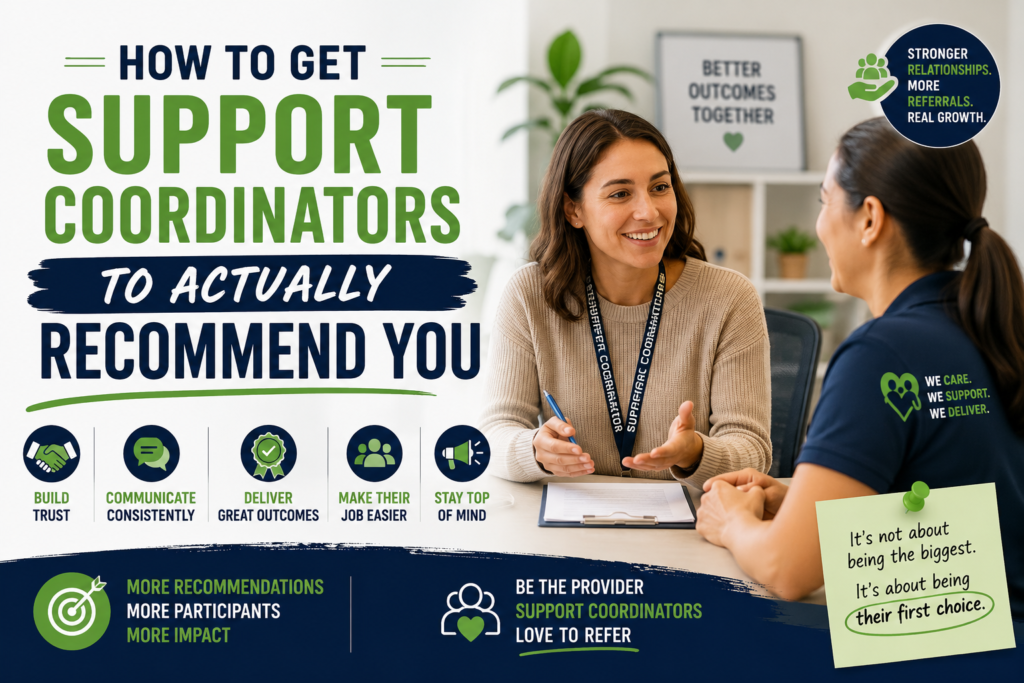
How to Get Support Coordinators to Actually Recommend You
NDIS Marketing · Referral Strategy
How to Get Support Coordinators to Actually Recommend You
Coordinators are legally required to offer genuine choice, not exclusivity. Your job isn't to become their only option — it's to become the one they can confidently put on the shortlist every single time.
What's Covered In This Guide
- Why Support Coordinators Are the Referral Source Worth Getting Right
- What's Actually Changing in Support Coordination Right Now
- 7 Ways to Become the Provider a Coordinator Confidently Recommends
- What Quietly Disqualifies You From a Coordinator's Shortlist
- What This Looks Like in Practice
- A Practical Roadmap
- Frequently Asked Questions
Why Support Coordinators Are the Referral Source Worth Getting Right
As of the most recent official data, roughly 45% of active NDIS participants had support coordination funded in their plan, and around 85% of support coordination payments went to registered providers. That's a huge, concentrated channel: a relatively small number of coordinators are actively involved in choosing providers for a very large share of the participant base. Get recommended consistently by even a handful of coordinators in your area, and you have a genuinely reliable, ongoing referral pipeline — very different from hoping individual families find you through search or word of mouth alone.
This concentration also means the economics of coordinator relationships are unusually favorable compared to most other referral or marketing channels. A single support coordinator typically manages a caseload of several dozen participants at any given time, each of whom may need multiple providers across different support categories over the life of their plan. A provider who earns genuine trust with one coordinator isn't just picking up one referral — they're positioning themselves for a recurring stream of introductions as that coordinator's caseload turns over and new participant needs arise. Very few other referral sources offer that kind of compounding value from a single relationship.
But this channel runs on different rules than a typical referral relationship, and most providers court it the wrong way. A support coordinator isn't a salesperson you're trying to win over with charm or incentives — they're bound by conflict-of-interest obligations that require them to present genuine, unbiased options. The NDIS Quality and Safeguards Commission's most recent campaign found that most support coordinators do provide participants with at least three service options, as they're required to. Your job isn't to become their only option. It's to become the option they can confidently, safely put on that shortlist every time — which is a different, and in some ways easier, thing to earn.
What's Actually Changing in Support Coordination Right Now
This matters more than usual at the moment, because the ground is shifting under the support coordination role itself. The NDIS Independent Review has recommended replacing support coordination with a new "Navigator" role altogether, and specifically recommended that organisations delivering navigation be barred from offering other NDIS-funded services. The NDIS Commission's own recent campaign work found real uncertainty among providers about what this transition means for their operations, layered on top of limited communication about timing.
Two things follow from this for a provider trying to build coordinator relationships today. First, conflict-of-interest scrutiny is intensifying, not easing — the NDIA's newer PACE reporting templates now require coordinators to actively identify and manage real or perceived conflicts, and the NDIS Commission identified 4,748 providers as in-scope for a recent compliance review specifically because they billed for both support coordination and other services in the same period. Second, coordinators themselves are operating under more uncertainty and more compliance pressure than they were a year or two ago — which means a provider who makes a coordinator's job easier and safer, rather than adding to their compliance burden, has a genuine edge right now.
There's a workforce dimension to this too, worth understanding if you're trying to build durable coordinator relationships rather than one-off contacts. Most providers delivering support coordination now require staff to hold at least a Certificate III in a relevant field, with many seeking allied health backgrounds specifically for higher-intensity Level 3 coordination work. That's a more formally qualified, more professionally accountable workforce than existed in the sector's earlier years — which means the coordinators you're building relationships with today are increasingly likely to be operating under closer internal supervision and more documented process than in the past. A provider whose own compliance and communication match that level of professionalism will simply be easier for a coordinator to justify recommending, in writing, if their own organisation ever reviews the decision.
7 Ways to Become the Provider a Coordinator Confidently Recommends
Make your registration and compliance status impossible to get wrong. The NDIS Commission's own campaign found that 11% of providers had outdated or incorrect NDIS Commission contact details in the documents they gave participants — a real, common quality gap. A provider whose registration status, service categories, and contact details are accurate and easy for a coordinator to verify removes a genuine, common source of hesitation.
Respond fast enough that you're still an option by the time the coordinator finishes their shortlist. Coordinator-facing referral platforms increasingly publish response-time benchmarks as a trust signal — median response times under 15 minutes, with the large majority answered within an hour. A coordinator building a shortlist under time pressure will remember, and keep using, whoever responded fastest and most completely the last time.
Give coordinators a one-page overview they can hand straight to a participant. A coordinator juggling a caseload doesn't have time to summarize your services from scratch every time. A clear one-pager — registration groups, service area, typical response time, how to make a referral — makes it easy for them to include you on a shortlist with minimal extra effort. Keep it current: update it whenever your capacity, service categories, or contact details change, and resend it to your coordinator contacts rather than assuming they'll notice a website update on their own.
Never ask a coordinator to steer a participant toward you exclusively. Given how much regulatory attention conflict of interest is currently receiving, any request that reads as trying to secure exclusivity or preferential treatment is a genuine risk to the coordinator, not just an ethical grey area — and it will cost you the relationship if they sense it, because their compliance obligations come first.
Make yourself easy to work with across multiple coordinators, not just one. Because coordinators are required to offer genuine choice, being one reliable name among several a coordinator trusts is both more compliant and more resilient than trying to become any single coordinator's default — if that one relationship changes, you haven't lost your entire referral pipeline.
Be the provider who explains things clearly, including your limits. A coordinator's job is easier when a provider is upfront about capacity, waitlists, and what you don't do — this reduces the coordinator's own risk of setting a participant up with a mismatched provider, which is precisely the kind of outcome conflict-of-interest and quality obligations are designed to prevent.
Show up in the professional spaces where coordinators actually look for information. LinkedIn, local provider directories, and NDIS-specific professional networks are where many coordinators do initial research on providers. Consider also that many coordinators work within larger agencies with internal knowledge-sharing between colleagues; a good experience with one coordinator often travels informally to others on the same team, so consistency across every interaction compounds in ways that are easy to underestimate.
What Quietly Disqualifies You From a Coordinator's Shortlist
- Outdated or inaccurate registration details. If a coordinator or participant can't easily verify your registration status, you're a compliance risk to recommend, regardless of your actual service quality.
- Slow or inconsistent responses. A coordinator working through a shortlist under time pressure will simply move on if you don't respond quickly and completely the first time.
- Any hint of pressure for exclusivity. Coordinators are actively being trained and audited on conflict-of-interest management right now — a provider who asks for special treatment is asking them to take on real compliance risk.
- Being unclear about your actual capacity or fit. A coordinator who refers a participant to a provider that turns out to be full, or a poor match, bears real consequences for that mismatch.
- No visible digital presence a coordinator can point a participant to. If a coordinator recommends you and the participant can't find or verify you online afterward, that referral quietly falls through.
- Inconsistent experiences across different staff members. A coordinator who has a great interaction with one team member and a poor one with another can't reliably predict what a participant will experience.
- Treating the relationship as transactional rather than ongoing. A provider who only reaches out when actively chasing a referral, rather than maintaining light contact in between, comes across as opportunistic rather than genuinely reliable.
What This Looks Like in Practice
The following are illustrative scenarios based on common patterns in the sector, not verified case studies of specific named providers.
A provider fixing a registration visibility gap. After noticing that its NDIS Commission registration details hadn't been updated since a service category expansion two years earlier, a provider corrects the listing and adds a matching, accurate summary to its website and one-pager. A coordinator who previously hesitated to recommend the provider because the paperwork didn't match what the provider claimed to offer now has no reason for that hesitation.
A provider building a genuinely fast response habit. Rather than treating coordinator enquiries as lower priority than direct family enquiries, a provider sets an internal standard of responding to any coordinator contact within the same business day, with a complete answer rather than a placeholder reply. Over a few months, coordinators managing tight shortlist deadlines begin defaulting to this provider specifically.
A provider being upfront about capacity limits. Instead of saying yes to every enquiry regardless of actual availability, a provider tells coordinators clearly when they're near capacity for a specific support category and gives a realistic timeframe for when that might change. Coordinators come to trust this provider's availability statements as accurate, which paradoxically makes them more likely to recommend the provider when capacity does open up.
A Practical Roadmap
| Timeframe | Action |
|---|---|
| Week 1 | Audit and correct your NDIS Commission registration details wherever they're publicly listed |
| Week 1 | Build a one-page provider overview coordinators can hand directly to participants |
| Weeks 2-3 | Identify the 10-15 support coordination agencies genuinely active in your service area |
| Weeks 2-3 | Reach out with the one-pager and a clear, honest statement of your current capacity |
| Month 2 | Set and consistently meet a stated response-time standard for coordinator enquiries |
| Month 2 | Build a simple LinkedIn or provider-directory presence coordinators can verify you through |
| Month 3 | Track which coordinators are actually referring, and follow up with a simple thank-you and capacity update |
Frequently Asked Questions
Is it appropriate to offer a support coordinator any kind of incentive for referrals?
No — this is one of the clearest conflict-of-interest risks in the current regulatory environment, and it puts the coordinator's compliance standing at risk, not just your own. Build the relationship on reliability, responsiveness, and easy verification instead.
How does the shift toward Navigator roles affect this strategy?
It reinforces it. With real uncertainty about the future of support coordination and increasing conflict-of-interest scrutiny, coordinators are under more pressure to justify every recommendation as genuinely in the participant's interest — which rewards providers who make that justification easy, not providers chasing exclusive arrangements.
How many support coordinators do we actually need a relationship with?
Fewer than most providers assume, but more than one. Because coordinators are required to offer genuine choice, being a trusted option for 10-15 coordinators in your actual service area is both more compliant and more resilient than depending on one or two relationships.
What if a coordinator never gets back to us after we reach out?
Don't take this personally or assume it means rejection — coordinators manage large caseloads and shifting priorities. A brief, low-pressure follow-up after a few weeks, with an updated capacity note, is more effective than repeated outreach.
Does being registered matter more than being a good fit for a specific coordinator's caseload?
Both matter, but accurate, verifiable registration is the baseline that lets a coordinator consider you at all. Fit and reliability are what turn that consideration into an actual, repeated recommendation.
Should we track which specific coordinators refer participants to us?
Yes, and keep it simple — a shared record of which coordinators have referred, how recently, and any notes on their preferences turns an informal relationship into something your whole team can maintain, even if the staff member who built the original relationship moves on.
What should we do if we suspect a coordinator is being pressured by their own organisation to favor certain providers?
This isn't something to address directly with the coordinator, since it may reflect internal pressures outside their control — but continuing to build your own reputation for reliability and easy verification remains the right response regardless of what's happening at other providers.
How long does it typically take to see coordinator referrals start coming in consistently?
Most providers see the first coordinator referral within 4-8 weeks of consistent, professional outreach, with a reliable, repeating pattern typically forming over 3-6 months as coordinators build trust in your responsiveness and fit.
Get Started
Ready to Build a Referral Relationship With Coordinators That Actually Works?
We'll audit your registration visibility and online presence for what coordinators actually check, help you build a one-pager that makes referring you easy, and put a simple system behind outreach to the coordinators active in your service area.
Request Your Free Referral Strategy SessionRelated reading
- How NDIS Providers Can Get More Referrals Without Cold Calling
- NDIS Provider Website Checklist: What Google (and Participants' Families) Actually Look For
- What an NDIS Provider's Homepage Should Actually Say (With Examples)
Anshul Kuntewar
Founder, RouteRush Digital Marketing Agency — working with NDIS providers across Australia on website strategy, SEO, and referral-growth systems that turn coordinator and allied health relationships into a reliable, compliant source of new participants. Connect on LinkedIn →
This guide reflects NDIS Quality and Safeguards Commission data and conflict-of-interest guidance current as of mid-2026. Support coordination is undergoing structural change following the NDIS Independent Review; providers should confirm current requirements directly with the NDIS Commission.