
Why Oman Freight Forwarders Should Post on LinkedIn Themselves
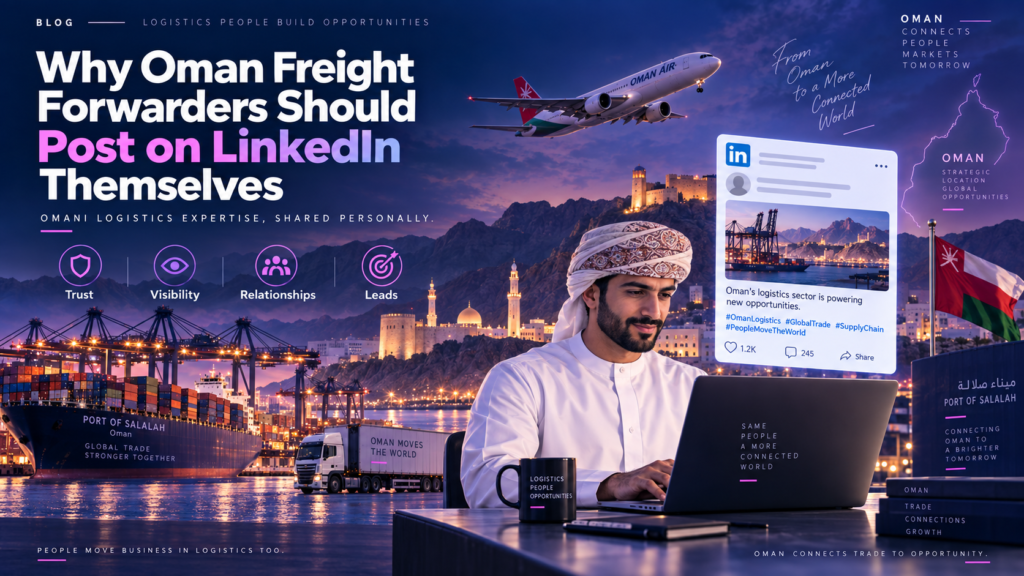
RouteRush / Oman freight growth
Why Oman Freight Forwarders Should Post on LinkedIn Themselves — Not Just Their Company Page
Before reading any further, answer five quick questions honestly. When did your company's LinkedIn page last post something? If a prospect in Muscat searched your name right now, would they find a real person, or just a logo? Do you know whether your competitors are showing up in searches where you aren't? Does anyone on your team actually know what a post that performs well looks like? And if someone messaged your business on LinkedIn tomorrow, is there a clear next step, or would it land in an inbox nobody checks?
Most Oman freight forwarders answer at least three of these in a way they're not proud of. That's not a criticism — it's simply where almost the entire industry currently sits, which is exactly why the businesses that fix even one or two of these gaps stand out disproportionately.
This isn't really a LinkedIn strategy problem. It's a visibility audit most forwarders have never actually run on themselves.
By RouteRush · Freight and logistics marketing
Updated
Editorial context: This guide focuses on marketing and content strategy for Oman freight forwarding businesses. The questions above are a self-assessment tool, not a scored diagnostic tied to any specific client outcome, and results will vary by network, sector and consistency.
The direct answer
Should Oman freight forwarders post on LinkedIn personally, or is the company page enough?
For most Oman freight forwarders, the company page alone isn't enough, because LinkedIn's algorithm distributes content from real people far more widely than content from brand pages. The five questions above are a practical way to find out where your business actually stands — and for Oman freight forwarders trying to grow their visibility on LinkedIn, the fix rarely requires a marketing overhaul. It usually means one or two real people inside the business posting consistently, and a clear process for what happens after someone responds.
Question one: when did your company page last post?
If the honest answer is "months ago" or "I'm not sure," that's worth sitting with for a moment. A dormant company page isn't neutral — it actively signals something to anyone who checks it before reaching out, usually that the business either isn't active online or doesn't prioritise being findable. Neither impression helps you when a prospect is quietly comparing three forwarders before picking up the phone.
The fix here isn't necessarily reviving the page itself. It's recognising that the page was likely never going to solve this on its own, even fully active — which is exactly what the rest of this audit gets into.
Question two: what does a search actually find?
Search your own name, or the name of your operations lead, on LinkedIn. If the result is a bare profile with a job title and nothing else, that's what a prospect sees too, and it tells them almost nothing about whether you're any good at the work.
Compare that to a profile with a handful of genuine posts about real shipments — a delay worked around at Sohar or Salalah, a rate observation on a China or East Africa lane. That second profile answers a question the first one leaves completely open: does this person actually know what they're doing? A prospect deciding who to trust with cargo is asking exactly that question, whether they realise it or not.
This applies just as much to the owner's profile as to anyone junior on the team. A prospect researching a forwarder before a large or complex shipment is often looking specifically for the person who'd actually be handling the decision-making, not just a generic company representative — so an empty or outdated profile at the top of the business can be an even bigger gap than a quiet one further down.
Question three: are your competitors more visible than you?
This one stings a little, because it usually means someone else is capturing attention that could have been yours. Search a few relevant terms — "freight forwarder Oman," a specific trade lane, a service you offer — and see whose names and posts actually surface.
If it's consistently the same one or two competitors, it's rarely because their service is better. It's because someone at that business decided to show up consistently, and LinkedIn's algorithm has been rewarding that consistency for months, compounding a lead that gets harder to close the longer it goes unaddressed.
Question four: does your team know what a good post actually looks like?
Many Oman freight forwarders who do attempt LinkedIn posting default to what feels safe — service announcements, generic captions, reposted industry news with no added perspective. It looks like effort, but it rarely performs, because none of it gives a reader a reason to stop scrolling.
What tends to work instead: a specific shipment story with a real problem and resolution, an honest observation about rates or capacity, a lesson from something that went wrong. If nobody on your team has a clear sense of this distinction, that's a gap worth closing before posting more — volume without direction just produces more content nobody engages with.
Question five: what happens after someone actually messages you?
This is the question most freight forwarders haven't thought through at all, and it's arguably the most costly gap of the five. A DM that gets seen days later, or answered by whoever happens to check LinkedIn that week, loses the exact momentum that made the prospect reach out in the first place.
A LinkedIn message deserves the same discipline as a website enquiry: a clear owner, a fast first response, and a structured next step — not an informal, whenever-someone-gets-to-it approach that quietly lets good opportunities go cold.
What do your answers actually mean?
Mostly weak answers
Your business is likely invisible to a meaningful share of prospects who research online before calling. This is common, fixable, and worth prioritising over other marketing spend first.
A mix
You have some foundation — a page, occasional posts, or a rough process — but gaps in consistency or follow-up are likely costing you enquiries you never even see.
Mostly strong answers
You're ahead of most of the market. The focus now is refining what's already working and making sure the follow-up process scales as volume grows.
Wherever you land, the value of this exercise isn't the score — it's knowing specifically which of the five gaps to close first, rather than guessing at a broad "we should do more marketing."
How do you actually close these gaps?
Start with whichever question produced the weakest honest answer, not all five at once. If the issue is visibility, pick one or two people to post twice a week, minimum, built from real shipment work rather than polished campaigns. If the issue is follow-up, fix that process before investing more time in posting — reach without a working response process just produces more missed opportunities, not more shipments.
Give it a genuine few weeks before reassessing. A profile with a small existing network typically needs time before LinkedIn's algorithm and your own connections start responding meaningfully — early quiet weeks are normal, not evidence the approach doesn't work for Oman's market.
Resist the urge to fix all five gaps simultaneously in week one. Trying to overhaul the company page, launch a personal posting habit, and build a new follow-up process all at once usually collapses within a fortnight, because none of the three gets enough attention to actually stick. Sequencing the fixes, weakest gap first, gives each change a realistic chance to take hold before the next one starts, and it also makes the whole effort easier to sustain across a small team without anyone feeling overloaded.
How do you turn LinkedIn attention into actual freight enquiries?
Fixing questions one through four gets you noticed. Question five — what happens after someone reaches out — is what actually determines whether that attention turns into a booked shipment.
RouteRush's guide on freight forwarding lead conversion in Oman covers exactly this handoff in more depth — qualifying what the prospect needs, scoping a clear quote, and following up with a defined next step — and it applies as directly to a LinkedIn DM as to a website form.
RouteRush's article on how Oman freight forwarders turn industry updates into leads goes further into structuring this kind of content-driven interest into a genuine, quoted opportunity rather than letting it stay as likes and comments.
Who inside an Oman freight forwarding business should actually run this?
Whoever has real, current involvement in shipments and enough authority to speak honestly about the business — usually the owner for market-level commentary, and someone in sales or operations for the day-to-day stories that tend to perform best. A junior hire with no operational context rarely produces content that answers the "does this person know what they're doing" question a prospect is really asking.
If sustaining this consistently isn't realistic for your team alone, RouteRush's comparison of in-house marketing versus hiring an agency for Oman freight forwarders can help you weigh whether outside support for structure and planning makes sense, while the actual posting still comes from real people inside the business.
Does the company page still matter after all this?
Yes, in a narrower role than most businesses currently give it — verifying you're a real, established operation once someone's already found you through a personal post or referral, and resharing the strongest content from your team. RouteRush's broader digital marketing guide for Oman freight forwarders covers how this fits alongside search visibility and paid channels as part of a wider growth strategy.
Don't expect the page to fix the gaps this audit surfaces on its own — it wasn't built to solve question two through five, and treating it as the whole strategy is usually how businesses end up back at question one a year later.
Frequently asked questions
How do I know if my Oman freight forwarding business is actually visible on LinkedIn?
Search your own name and your competitors' names for relevant terms. If competitors consistently surface and you don't, and your company page has been quiet for months, visibility is likely a genuine gap worth addressing.
What's the fastest way to improve LinkedIn visibility for an Oman freight forwarder?
Get one or two real people inside the business posting twice a week about genuine shipment work, rather than trying to revive or heavily invest in the company page alone.
Why do some Oman freight forwarders show up more often on LinkedIn searches than others?
Usually consistency, not service quality. LinkedIn's algorithm rewards accounts that post and engage regularly, and that advantage compounds the longer it continues.
What should happen after someone messages a freight forwarder on LinkedIn?
The same discipline as a website enquiry — a clear owner, a fast first response, and a defined next step, rather than an informal approach that lets the conversation go cold.
Does LinkedIn visibility actually lead to booked freight shipments?
Not directly. It creates conversations that still need proper qualification and follow-up before they become a shipment — visibility alone isn't the whole solution.
Should an Oman freight forwarder still keep the company LinkedIn page active?
Yes, but in a supporting role — verifying the business and resharing strong personal content — rather than expecting it to solve visibility on its own.