
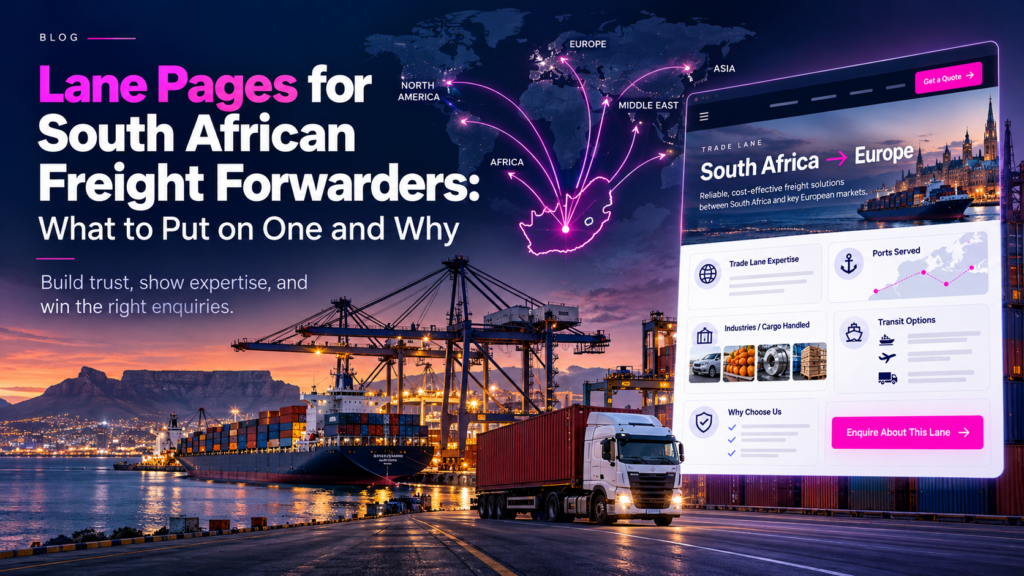
Lane Pages for South African Freight Forwarders: What to Put on One and Why
South African importers read a lane page with one eye on the port and one on their landed cost. The pages that win answer the questions disruption and the rand have taught them to ask.
Illustrative lanes only. Choose the ones you actually run.
Editorial context: the lanes, gateways and sample wording are illustrative. Square brackets in the example copy mark facts you must replace with your own verified ones.
Your operations team could run the Shanghai–Durban–Gauteng lane in their sleep. They know which terminals slow down in peak, which trucking partners are reliable on the N3, and what to do when vessels bunch up. Your website says "Sea freight to South Africa." The importer reading it knows none of what your team knows, and has been burned often enough to ask about it. A lane page is where that knowledge becomes visible.
The general framework is in lane pages for freight forwarders, and how importers in South Africa search for a freight forwarder explains what buyers have in mind when they land. This piece is the South African version: built around the five questions local buyers have learned to ask.
Start from the five questions South African importers ask
Each question maps to one part of the page. If a part is missing, the buyer is left guessing, and a buyer who guesses usually asks a competitor instead.
Will it arrive when you say it will?
Congestion, road and rail constraints, weather and industrial action have made reliability the first test. Don't promise a transit time. Give a range, say which gateway you usually favour, and say what you do when it's congested and how fast the buyer hears about it.
What will it really cost me by the time it lands?
Rand movements mean a quote can change by the time cargo clears. Explain what is fixed and what floats, state how long the quote is valid, and show import VAT and customs duty, paid to SARS at clearance, as separate lines. A rival that leaves them out will look cheaper, and the buyer can only see the difference if your page shows it.
Are you who you say you are?
In this market, credentials are checked early, sometimes before price. Put them where they can be seen, with documents that can be opened. B-BBEE certificates expire, so show the date and keep it current. Buried in a footer, a status that could win you work does nothing.
Can you take it further?
Many importers also need cargo moved on into the region. If you run it, give it its own lane page or a clearly separate block. Say which border posts you use, what a realistic border delay looks like and how you track the truck. If you only arrange it through partners, say so. Don't claim a service you don't run.
Who do I call when something goes wrong?
After years of disruption, buyers care less about promises that nothing will go wrong than about what happens when it does. Name who looks after the shipment, how often you update, and how a problem is escalated.
Add a dated status note to each lane
Because conditions on South African lanes change, one of the most credible things a lane page can carry is a short, dated note on current conditions: how the gateway is running, whether you're seeing longer dwell times, what you're advising buyers this month. Two or three lines, with the date and the name of the person who wrote it, tell a buyer that someone is actually watching the lane.
This does three things at once. It answers the reliability question with current information instead of a general promise. It gives you a reason to revisit the page every month, which keeps it fresh. And it shows a buyer comparing five forwarders that one of them is paying attention. Only publish what your own team has seen, and take the note down or update it when it stops being true, because an out-of-date status note does more harm than none.
The page at a glance
| Buyer's question | Block on the page | Proof to attach |
|---|---|---|
| Will it arrive? | Transit range, gateway choice, disruption plan | Your own shipment history on the lane, written honestly |
| What will it cost? | Quote structure, rand and USD rules, VAT and duty lines | A sample quote layout |
| Are you credible? | Credentials block | Downloadable certificates with dates |
| Can you go further? | Regional leg or separate lane page | Border posts, permits, tracking method |
| Who do I call? | Named contacts and update rhythm | A real person's name and role |
Mistakes South African forwarders make on lane pages
- Promising a fixed transit time. Given port conditions, a promise you can't keep is worse than a range you can.
- Burying B-BBEE and SAAFF in the footer. For many buyers these are early filters, so they belong near the top of the page.
- Writing "competitive rates" instead of explaining the rand. Experienced importers want to know how currency is handled, not that you're cheap.
- Cloning pages by swapping Durban for Cape Town. Each gateway has its own dynamics, so each page needs its own details.
- Letting dates go stale. Certificates, schedules and charges change. RouteRush's piece on how South African freight forwarders turn industry updates into leads shows how updates can keep lane pages current.
Which lanes to build first
Choose lanes you run every week, with the shippers you want more of, and start with three. A lane page is positioning in practice: it tells the market which lanes you want to be known for. Judge each one by the quality of enquiries it brings. Count how many arrive with the commodity, volume and delivery point already stated, and how many reach a quote. RouteRush's guide on why South African freight forwarders get enquiries but don't win shipments covers what happens next.
When you choose, resist the pull toward the biggest gateway by default. Durban is where most forwarders compete, which makes a generic Durban page the hardest one to stand out on. A lane through Cape Town for a specific kind of importer, or an Eastern Cape lane for automotive suppliers, may have far fewer strong competing pages and a shipper type you already know well. The aim isn't to cover the map. It's to be the obvious answer for a handful of shippers on a handful of lanes, and to grow the list as each page proves it can bring in buyers worth quoting.
A two-week plan
If keeping the pages accurate is more than your team can manage, RouteRush's digital marketing guide for South African freight forwarders covers building this visibility, and in-house versus agency marketing for South African freight forwarders helps frame who should own it.
Quick answers
- What is a lane page for a South African freight forwarder?
- A page about one route, such as Shanghai to Durban to Gauteng, written for one kind of shipper so a buyer can recognise their own shipment and see how you handle reliability, cost and compliance on it.
- How should a lane page handle port congestion?
- Give a transit range, name the gateway you usually favour, and explain what you do and how fast you tell the buyer when it's congested, including any alternative gateway you'd propose.
- Should a lane page show B-BBEE status?
- Yes, clearly and near the top, with the level, the certificate date and a downloadable document. Many buyers check it early.
- How should a lane page explain pricing given rand volatility?
- Say which parts are quoted in USD, how and when they convert to rand, how long the quote is valid, and show import VAT and customs duty as separate lines.
- Should cross-border lanes have their own page?
- Yes, if you run them. Border posts, permits and delays are different from a port-to-hub move, so a separate page is clearer.
- How many lane pages should I start with?
- Three, for lanes you run weekly and want to grow. Add more only as each one proves it brings qualified enquiries.
Which lane would you build first?A good lane page only helps if the rest of the path holds up too. See where you could be losing possible enquiries between the first search and the first reply.
See Where You Could Be Losing Possible Enquiries