
Small Freight Forwarders in Australia vs. DHL & Toll
Freight Forwarding Marketing · Australia
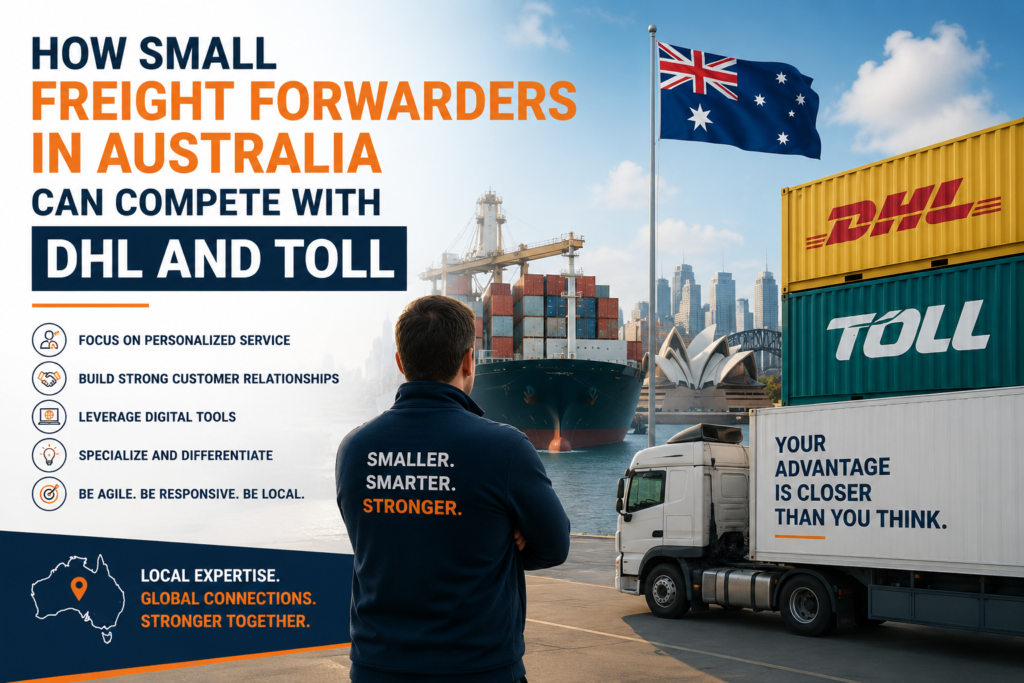
How Small Freight Forwarders in Australia Can Compete With DHL and Toll
On this page
Why This Matters Right Now Real Pain Points Where Small Forwarders Win Step-by-Step Process Examples in Practice Ports Tools Checklist FAQsPort congestion, avoidable delays, and broader logistics inefficiency are estimated to cost the Australian economy more than $16 billion annually — and 2026 has brought the strictest biosecurity enforcement season DAFF has ever run, alongside newly enforced PFAS chemical bans.
Why This Matters Right Now
For any forwarder operating in this market, the margin for error on compliance has genuinely narrowed compared to just a year or two ago. Toll Group is the domestic name most small Australian forwarders are actually measuring themselves against day to day — a 137-year-old business, founded in 1888 by Albert Toll as a horse-and-cart coal-hauling service in Newcastle, that grew into one of the country's largest logistics operators before Japan Post acquired it for roughly A$6.5 billion in 2015.
That acquisition hasn't been the smooth integration Japan Post hoped for: Toll posted that A$685.3 million loss in a single financial year during the pandemic period, struggled to properly integrate the different systems it inherited through years of rapid acquisition, and was forced to shut down a range of services after a major cyberattack. Japan Post ultimately sold off Toll's domestic express division to Allegro Funds in 2021, though Toll continues acquiring specialist businesses — including Transolve Global, a wine, bulk liquids, and perishables forwarding specialist, in 2025.
DHL, meanwhile, operates as one of the two or three largest global integrators in air and ocean freight forwarding worldwide. Between DHL's global scale and Toll's long domestic history — even with its own well-documented integration struggles — these are the two names most likely to come up first when an Australian shipper searches online. But a market this compliance-heavy, recovering from a large incumbent's own operational turbulence, is exactly the kind of environment where a smaller, more careful forwarder can genuinely compete on trust and precision rather than scale.
Real Pain Points Australian Forwarders Are Actually Navigating
The BICON system requires checking import conditions for almost every category of goods — getting it wrong can mean cargo seizure, mandatory re-exportation, or destruction.
A single paperwork error or an untreated timber pallet can leave cargo stranded at the dock accumulating storage fees at hundreds of dollars a day.
Heightened biosecurity inspection has created documented backlogs at Melbourne, Port Kembla, Brisbane, and Fremantle.
A new biosecurity cost recovery charge now applies to high-volume, low-value cargo processing — a detail many smaller importers aren't tracking closely.
A near-A$700 million single-year loss, failed system integration, and a cyberattack serious enough to force service shutdowns are documented events, not hypotheticals.
DAFF and the ABF are applying more sophisticated risk profiling to seafood, meat, dairy, used vehicles, and pharmaceuticals.
Where Small Forwarders Actually Win
Can prevent the kind of costly seizure or re-export order that erodes a shipper's trust in logistics providers generally.
A smaller forwarder's ops lead can update affected shippers directly and quickly — a genuine advantage over a larger organisation's layered process.
In a market where the largest domestic incumbent has its own well-documented integration struggles, consistency and direct accountability is a real, honest differentiator.
Deep expertise in one biosecurity-sensitive category offers preventative guidance a generalist competitor typically can't match.
A Practical Process to Compete Online
Directly addresses the single biggest source of costly delay for many importers.
A regularly updated note on current conditions builds trust with shippers who've already read about these delays elsewhere.
Being the clear, accurate source on documentation requirements builds real authority.
Build content and positioning specifically where DAFF and ABF scrutiny is heaviest and your expertise is genuinely strongest.
A legitimate, honest way to appeal to shippers wary of large-scale operational disruption, without disparaging any specific competitor.
Captures search interest from importers actively trying to understand what's changed.
Reassures shippers worried about avoidable demurrage and storage fees.
Tells you where to focus content and positioning next.
Examples in Practice
The following are illustrative scenarios based on common patterns in the Australian freight sector, not verified case studies of specific named companies.
A forwarder specializing in timber and wooden goods biosecurity compliance. A dedicated guide to fumigation certificate requirements and BICON conditions captures enquiries from importers who've been burned by this exact issue before.
A forwarder communicating proactively about Port Kembla inspection delays. Regular updates on current wait times build trust with importers actively searching for current, accurate information rather than a static reliability claim.
A forwarder positioning around consistency amid a major competitor's disruption. Without naming any specific competitor, messaging emphasizing stable ownership and a consistent track record resonates with shippers who experienced real disruption elsewhere.
Ports: What Your Positioning Should Address
| Port | What matters most to shippers here right now |
|---|---|
| Port of Melbourne, Victoria | Active communication about current biosecurity inspection backlogs |
| Port Botany, Sydney, New South Wales | E-commerce and SAC pathway compliance for high-volume, low-value imports |
| Port Kembla, New South Wales | Documented inspection delays — proactive updates matter more than reliability claims |
| Port of Brisbane, Queensland | Biosecurity scrutiny on food, agricultural, and cold-chain imports |
| Fremantle, Western Australia | Inspection backlog transparency for WA's Asia-facing import volumes |
| Port Hedland, Western Australia | Specialized bulk export logistics, largely insulated from general import biosecurity issues |
| Port of Newcastle, New South Wales | Bulk and resource-sector cargo with established, technical compliance needs |
| Port of Adelaide, South Australia | A smaller, more relationship-driven market where compliance expertise still differentiates |
| Port of Gladstone, Queensland | Narrow, technical LNG and coal cargo, low general-import biosecurity exposure |
| Port of Darwin, Northern Territory | Limited existing competition, an opening for a forwarder with clear compliance positioning |
| Port of Townsville, Queensland | Regional agricultural and mining cargo with specific quarantine considerations |
Tools That Help Level the Playing Field
BICON (Biosecurity Import Conditions System) fluency, communicated clearly on your site
Visible familiarity with the Integrated Cargo System and import declaration processing
A pre-clearance workflow requesting documentation as soon as cargo departs origin
Google Search Console and local SEO tools for port, commodity, and compliance-specific searches
A simple system to track enquiries by commodity category and port
Genuine reviews speaking to compliance handling and communication, not just general reliability
The Competing-Online Checklist
- BICON and biosecurity compliance expertise is stated clearly, not assumed
- Current inspection backlog conditions are communicated proactively for the ports you serve
- Content exists explaining the SAC pathway and biosecurity cost recovery charges
- Positioning specializes visibly in one or two high-scrutiny commodity categories
- Your pre-clearance process is explained, not just claimed
- PFAS and other newly enforced compliance requirements are addressed in your content
- Messaging emphasizes stability and direct accountability without disparaging competitors
- Enquiries are tracked by commodity category and port to guide ongoing focus
Frequently Asked Questions
Can a small Australian forwarder really compete with DHL or Toll online?
Yes, particularly around genuine BICON and biosecurity compliance expertise, proactive communication about port-specific inspection delays, and specialization in specific high-scrutiny commodity categories — areas where a large integrator's standardized process and a large domestic incumbent's own documented integration challenges both leave real room.
How much does Australia's biosecurity regime actually affect competitive positioning?
Significantly — with 2026 described as DAFF's strictest biosecurity season yet and newly enforced PFAS bans on top of it, genuine compliance expertise has become one of the clearest, most concrete differentiators a forwarder can offer, well beyond generic service quality claims.
Is it appropriate to reference a competitor's operational history, like Toll's cyberattack or losses, directly in marketing?
It's safer and more effective to avoid naming any specific competitor's difficulties directly. Instead, position your own stability, consistency, and direct communication as a genuine strength — shippers who experienced disruption elsewhere will recognize the contrast without needing it spelled out.
Should a small forwarder try to handle every biosecurity-sensitive commodity category?
No — specializing visibly in one or two categories where you have genuine, deep expertise builds more credible authority than claiming broad competence across everything DAFF regulates.
How long does it take to see results from this kind of positioning?
Most forwarders see measurable movement in relevant search visibility within 2-3 months, with authority-building content around biosecurity compliance and port-specific conditions compounding over 6-12 months as more shippers search for these specific, current concerns.
Want a full audit of how your positioning compares to what shippers are searching for?
We'll identify your highest-leverage gaps and build a prioritized plan to close them.
Request Your Free Website & SEO AuditAnshul Kuntewar
Founder, RouteRush Digital Marketing Agency — specialising in SEO, website strategy, and lead generation for freight and logistics companies across Australia, the UAE, Oman, India, South Africa, and Qatar, working directly with freight forwarders and CHAs to compete effectively against much larger competitors online.
This guide reflects Australian biosecurity, customs, and freight market data current as of mid-2026, sourced from the Australian Border Force, the Department of Agriculture, Fisheries and Forestry, and independent freight forwarding advisories. Figures for DHL and Toll Group are cited for market context only and are drawn from publicly available corporate history and reporting.