
How Australian Freight Forwarders Can Generate Qualified Leads From LinkedIn in 2026
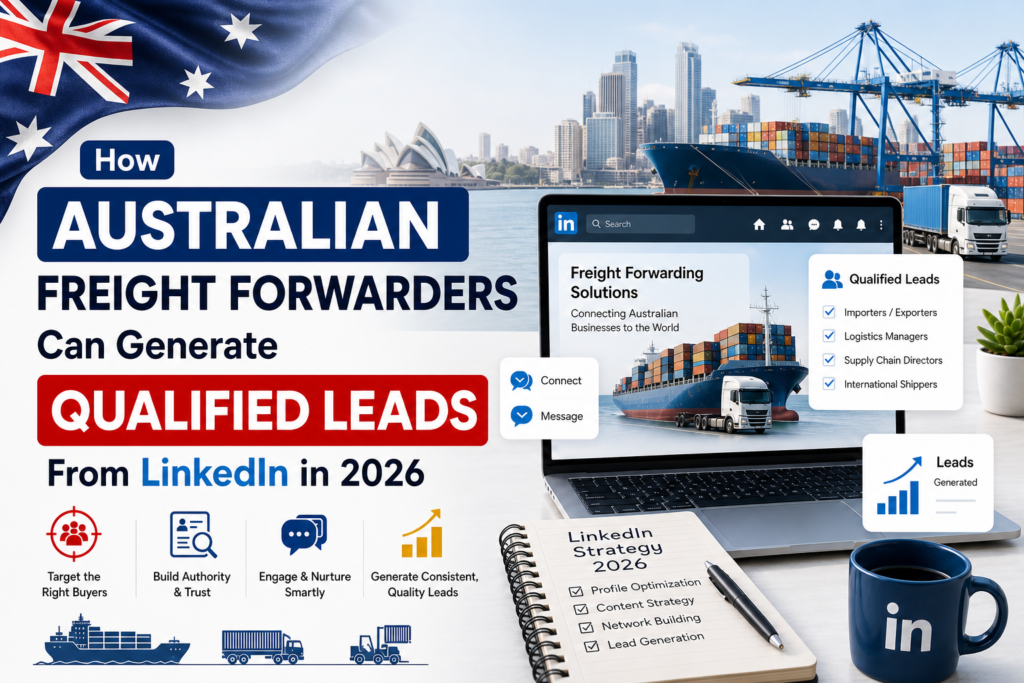
Freight Forwarding Marketing · Australia
How Australian Freight Forwarders Can Generate Qualified Leads From LinkedIn in 2026
On this page
The short answerWhy LinkedIn matters Position your companyProfiles that build trust Content shippers valueFind qualified prospects Outreach without spamAustralian freight markets Practical examplesMeasure real results 90-day action planFrequently asked questionsShort answer: Australian freight forwarders can generate qualified LinkedIn leads by choosing a defined shipper segment, publishing useful advice through credible people, and using account-based outreach to begin relevant conversations. The goal is not to attract every importer or exporter. It is to become familiar and trustworthy to the companies whose cargo, routes, and operational risks match your real strengths.
Many freight companies begin with the wrong question: how many messages can we send? A better question is: which buyers have a problem we understand well enough to discuss? The difference matters. A generic pitch about global coverage, competitive rates, and end-to-end solutions looks like every other approach in the inbox. A useful explanation about biosecurity preparation, container planning, or a specific trade lane gives the buyer a reason to pay attention.
A strong LinkedIn system follows a sensible order. Define the right accounts. Make your expertise easy to verify. Publish answers to real shipping questions. Engage with relevant people. Then start a conversation when there is a genuine reason. By the time a prospect requests a quote, your name and judgement should not feel completely unfamiliar.
Why LinkedIn matters for freight forwarding in Australia
DataReportal's Digital 2026 Australia report says LinkedIn had 18.0 million registered members in Australia in late 2025. That potential advertising audience was equal to 66.6% of the total population and 84.7% of adults aged 18 and above. These figures describe registered members and potential ad reach, not monthly active users. Even with that important limitation, they indicate unusually broad professional coverage.
The commercial environment also fits professional content and relationship building. The Australian Government describes freight and logistics as an essential part of the national economy and estimates that the sector accounts for about 8.6% of GDP. Australia's supply chains connect major container ports, airports, intermodal terminals, regional producers, mines, manufacturers, retailers, construction projects, and a large import economy spread across long distances.
Different gateways serve different customers. Melbourne is Australia's largest container and general cargo port. Port Botany supports Sydney and New South Wales. Brisbane serves Queensland and northern supply chains. Fremantle is a major gateway for Western Australia. Adelaide supports South Australian industry and exports. Air cargo through Sydney, Melbourne, Brisbane, and Perth serves urgent, high-value, and temperature-sensitive freight.
LinkedIn will not replace referrals, tenders, trade associations, agent networks, events, email, or direct selling. It strengthens those channels by giving buyers a place to assess the people behind the company. A procurement manager may meet your salesperson at an industry event, read an operations post later, check the company page, and only then reply to an email. Visibility helps reduce the uncertainty that exists before a buyer shares a real shipment brief.
Start with a position buyers can remember
Australian forwarders often describe themselves with the same broad phrases: reliable global service, tailored solutions, competitive rates, and complete supply-chain support. Those statements may be sincere, but they do not tell a buyer when your company is the right choice. Clear positioning explains who you help, what you move, where you operate, and which commercial or operational risk you are especially capable of managing.
"Freight forwarding in Australia" is too broad to guide useful content or prospecting. A more memorable position could be "biosecurity-aware imports for machinery distributors," "food and beverage exports from Victoria," "project freight for Western Australian mining suppliers," "ecommerce imports through Port Botany," or "Australia to New Zealand freight for mid-market manufacturers."
We help [specific type of shipper] move [specific cargo] through [port, airport, or trade lane] while reducing [specific delay, compliance, cost, or communication risk]. Every part should be supported by real experience, licences, facilities, partners, or documented work.
A narrow entry point does not mean turning away all other business. It gives the market something specific to remember. Once a conversation begins, your sales team can discuss the wider service range. Specialisation is most useful when it reflects operational truth.
Do not claim expertise in dangerous goods, pharmaceuticals, perishables, customs, biosecurity, oversized cargo, or controlled goods simply because the keywords attract traffic. These areas require genuine knowledge and, in some cases, approvals or licensed professionals. Marketing should never promise what operations cannot safely deliver.
Use expert profiles to build trust and the company page to verify it
Freight services are delivered by people who make decisions, explain risk, and respond when plans change. Choose one or two credible voices to lead your LinkedIn activity. This may be a founder, branch manager, licensed customs broker, commercial director, project logistics specialist, or operations leader.
Build a useful personal profile
The profile headline should explain who the person helps and where their experience is relevant. A title such as "Managing Director" establishes seniority but says little about the problems the person understands. A clearer headline might mention Australian importing, a cargo niche, or a major trade lane.
The About section should describe experience in plain language, name the main areas of focus, and give the reader a sensible contact route. Add a professional photograph, correct location, company link, and selected proof. Proof may include an approved case example, licence, professional accreditation, industry presentation, operational guide, or client recommendation.
Recommendations are most valuable when they describe a specific situation. "Great service" is pleasant but weak evidence. A recommendation explaining how someone handled a difficult import, kept communication clear, or supported a time-sensitive movement gives the reader more useful context.
Protect client confidentiality. Do not publish a customer's name, rates, volumes, suppliers, delays, cargo details, or commercial terms without permission. An anonymised example can still show expertise by explaining the type of problem, the options considered, the decision, and the lesson.
Make the company page credible
The company page should confirm the legal business, Australian offices, website, contact details, employee connections, service areas, and recent activity. If customs brokerage is offered, describe it accurately. The Australian Border Force explains that only the owner of goods or a licensed customs broker can submit an import declaration to enter goods for home consumption, and that customs brokers are licensed by the Department.
Do not present a partner's licence or facility as your own. If customs, transport, quarantine, warehousing, or specialist handling is delivered through another business, explain the relationship honestly. A well-managed partner model can be credible. A misleading capability claim can quickly fail buyer due diligence.
Publish answers Australian shippers can use
The best content topics usually come from quote requests, customer calls, documentation problems, and operational handovers. Importers and exporters do not need vague inspiration. They need clear explanations that help them prepare, compare options, understand responsibilities, or avoid preventable costs.
- Information required for an accurate Australian import or export freight quote
- What importers should check in BICON before goods are shipped
- How customs and biosecurity responsibilities differ
- Common reasons containers face inspection, treatment, storage, or delivery delays
- When air freight can be commercially better than a delayed sea shipment
- What affects container delivery planning from Melbourne, Botany, Brisbane, or Fremantle
- Questions to ask before moving machinery, food, timber, chemicals, or oversized cargo
- What overseas agents should include in a complete Australian pre-alert
- How seasonal biosecurity measures can affect selected cargo and origins
- What an importer should clarify about Incoterms, duty, GST, and local charges
Australia's biosecurity environment gives forwarders many useful topics, but accuracy is essential. The Department of Agriculture, Fisheries and Forestry says import conditions vary according to the goods and their country of export or origin. It directs importers to the Biosecurity Import Conditions system, known as BICON, to determine whether goods can be imported and which requirements apply.
A blog post should not replace a live BICON check, licensed customs advice, or transaction-specific biosecurity guidance. State the date reviewed, link to the official source, and explain which facts can change. If an import permit, treatment, inspection, approved arrangement, or commodity-specific condition may apply, say so clearly.
Use an answer-first content structure
Begin with the user's question and provide the direct answer in the first two or three lines. Next, explain the conditions that can change the answer. Use numbered steps for a process. Add an anonymised example when it clarifies the issue. Finish with the information, documents, or next action the reader needs.
This structure helps readers and search systems. SEO, AEO, and GEO are not separate writing styles. A page is easier to understand when it has one clear topic, direct answers, descriptive headings, trustworthy sources, and enough context to prevent misleading summaries. There is no phrase that guarantees visibility in an AI-generated response.
Let real experts sound like themselves
Your operations team may not have time to write weekly articles. Record a short conversation with a salesperson, broker, or operations specialist. Ask what customers misunderstood, which quote arrived without essential information, what changed on a lane, or what delay could have been prevented. Turn that discussion into a draft, verify technical claims, and let the expert approve the final version.
Do not remove every trace of personality. A clear opinion supported by experience can be more memorable than polished corporate language. Use plain sentences, explain limitations, and avoid pretending that one shipment proves a universal rule.
Build a qualified account list before sending messages
A connection is not a lead, and a logistics job title does not automatically indicate buying authority. Define four things before searching: the type of company, the relevant role, the likely freight need, and the evidence that your service may fit.
Account filters can include industry, state, company size, import or export activity, likely port, trade lane, product category, and operational footprint. Relevant roles may include supply chain manager, procurement manager, import manager, export manager, logistics manager, warehouse manager, operations director, project manager, or business owner. Titles vary, especially in smaller companies, so read the person's responsibilities.
Useful timing signals include a warehouse opening, market expansion, product launch, export award, new distribution agreement, construction project, recruitment drive, ecommerce growth, or public supply-chain problem. Treat these signals as clues, not proof. Never suggest that you know a company's cargo, costs, or current provider when the information is not public.
A large list of loosely matched contacts encourages generic automation. A smaller list of accounts that your team understands supports better research, useful content, warm introductions, and commercially relevant conversations.
Sales Navigator can help filter and save accounts, but the software does not create relevance. A disciplined CRM or spreadsheet can be enough at first. Record why the company fits, who may influence the decision, which signal you noticed, what content may help, and the next appropriate action.
Use LinkedIn outreach without sounding automated
Before connecting, read the person's profile, company website, public news, and recent posts. Follow the account. Comment only when you can add a useful observation. Empty praise and copied responses do not establish professional credibility.
Mention a shared industry, event, trade lane, location, or issue. Keep the note brief and do not attach a brochure.
Share a checklist, answer, or observation connected to the person's work. It should remain useful even if no sale follows.
Ask about a genuine operational priority that cannot be answered by glancing at the company website.
If a real need appears, suggest a short call or email exchange and explain what it will cover.
A first message might say: "I saw your team is expanding distribution into Victoria. We work with machinery importers through Melbourne, so the update caught my attention. Is biosecurity preparation or final delivery planning the bigger concern at this stage?" Use this only when the context and experience are true.
Follow up once or twice with a useful reason, then stop. Repeated automated messages can damage the reputation you are trying to build. Follow LinkedIn's current platform rules and Australia's privacy requirements. Personalisation should come from responsible research, not invented familiarity or unnecessary collection of personal data.
Match LinkedIn content to Australian freight markets
Australia is not one uniform freight market. The buyer, cargo, distance, port, and compliance risk change by state and gateway. Use this table as a planning guide, then validate every assumption against your own customers and operational capability.
| Market or gateway | Likely audience | Useful LinkedIn angle |
|---|---|---|
| Melbourne and Victoria | Retail, food, manufacturing, automotive, machinery, and national distributors | Container imports, biosecurity preparation, inland delivery, seasonal peaks, and national distribution |
| Port Botany and Sydney | Consumer goods, ecommerce, technology, healthcare, construction, and NSW importers | Import readiness, terminal handovers, metro delivery, high-value cargo, and warehouse planning |
| Brisbane and Queensland | Retail, food, agriculture, construction, resources, and regional distributors | Queensland distribution, project freight, agricultural trade, container planning, and regional delivery |
| Fremantle and Western Australia | Mining suppliers, machinery, energy, construction, food, and WA importers | Long-distance delivery, project cargo, heavy equipment, biosecurity, and remote-site planning |
| Adelaide and South Australia | Food and wine, manufacturing, defence, automotive supply, and industrial businesses | Export preparation, specialised cargo, trade-lane options, and interstate connections |
| Australian air cargo | Healthcare, electronics, urgent parts, ecommerce, perishables, and high-value shippers | Time-critical imports, cold chain, security, customs readiness, and final-mile planning |
| Regional and project freight | Mining, agriculture, renewable energy, construction, and infrastructure contractors | Site access, oversized cargo, permits, delivery sequencing, storage, and risk planning |
Port conditions, carrier schedules, biosecurity directions, customs rules, terminal processes, and local delivery constraints can change. Verify current details with the Australian Border Force, DAFF, port authorities, carriers, terminal operators, and other responsible organisations before publishing advice or promising an outcome.
What effective execution can look like
These are illustrative scenarios based on common freight-marketing patterns. They are not presented as verified case studies of named companies.
A forwarder interviews its broker and operations team about the information most often missing before machinery is shipped to Australia. It publishes a checklist covering commodity detail, cleanliness, timber packaging, BICON checks, and delivery requirements. Sales shares it with selected machinery distributors rather than sending a general services brochure.
A project logistics specialist publishes a series about route surveys, site access, lifting requirements, cargo dimensions, and delivery sequencing. The posts explain which facts must be confirmed and avoid claiming that every project follows the same process. Contractors can assess the specialist's judgement before sharing an enquiry.
An export team creates practical content about booking information, cut-offs, temperature requirements, documents, and handovers. Each article links to the appropriate government source when regulation is discussed. The content attracts conversations from producers who value preparation more than promotional claims.
An Australian forwarder creates a pre-alert guide for overseas partners covering documents, shipment data, biosecurity questions, and local contact requirements. The guide improves incoming enquiries and gives network agents a concrete reason to remember the company.
Measure qualified movement, not surface engagement
Followers, impressions, and likes can help diagnose distribution, but they are not the commercial result. Define a qualified lead before the campaign begins. For one forwarder, it may be an importer with recurring containers. For another, it may be an overseas agent with regular Australian nominations or a project contractor with a confirmed opportunity.
A practical monthly dashboard can track target-account profile views, connection acceptance, replies from relevant roles, saves, visits to service pages, content-assisted enquiries, discovery calls, quote requests, qualified opportunities, and revenue influenced. Add a short quality note. Twenty approaches from job seekers or vendors do not outweigh two serious shipper conversations.
Use tagged links where appropriate, record LinkedIn as a source or influence in the CRM, and ask prospects how they found the company. Attribution will not always be simple. A buyer may see a post, receive a referral, attend an event, and search Google before making contact. LinkedIn may contribute without being the only source.
Set honest expectations
A credible profile may attract relevant engagement within several weeks, but freight sales cycles vary. Vendor onboarding, credit checks, tenders, contracts, and operational testing can extend the timeline. Evaluate the programme over at least 90 days, then continue if target-account engagement and qualified conversations are improving.
No responsible agency can guarantee a fixed number of qualified leads without understanding your market, offer, reputation, sales capacity, and definition of a lead. Lead generation depends on positioning, trust, targeting, content, follow-up, and delivery. A weakness in any one area can reduce results.
A 90-day LinkedIn plan for Australian freight forwarders
Select one priority segment. Interview sales, brokerage, and operations. Update the lead profile and company page. Define proof, approval rules, qualification criteria, and baseline metrics. Build the first 50 target accounts.
Post twice each week. Rotate direct answers, checklists, process explainers, and anonymised lessons. Follow target accounts and record recurring questions. Do not pitch everyone who engages.
Contact a small number of well-matched people each day. Use genuine context, offer something relevant, and record the outcome. Have qualified colleagues check technical answers before sales makes commitments.
Compare audiences, topics, replies, calls, quotes, and opportunities. Keep combinations producing qualified movement. Fix weak positioning or targeting before increasing volume.
Frequently asked questions
Does LinkedIn work for freight forwarding lead generation in Australia?
Yes, when the target buyers use LinkedIn and the forwarder has a clear, credible reason to be contacted. DataReportal reported 18.0 million registered LinkedIn members in Australia in late 2025. Results still depend on audience fit, expertise, content, outreach, and follow-up.
Should we post from a personal profile or company page?
Use both for different purposes. A knowledgeable person should lead expert conversation and relationship building. The company page should verify the business through accurate locations, services, people, contact details, licences, and proof.
How often should an Australian freight forwarder post?
Two strong posts per week is a practical starting point for many small teams. Publish only as often as you can maintain accuracy and usefulness. One specific expert post is better than daily generic promotion.
What should freight forwarders post about?
Answer real questions about quotes, documentation, customs, biosecurity, ports, routes, cargo handling, transit variables, and avoidable costs. Focus on the commodities and lanes your team genuinely understands.
Is Sales Navigator necessary?
No. It can make account research and tracking easier, but clear qualification and relevant outreach matter more. Start with a defined market and disciplined process before adding expensive tools.
Can we automate LinkedIn outreach?
High-volume automation can create irrelevant messages, platform risk, privacy concerns, and reputational damage. Smaller researched batches are usually safer for relationship-led freight sales. Follow LinkedIn's current rules and Australian privacy obligations.
How long does LinkedIn lead generation take?
Relevant conversations may begin within weeks, but assess a new programme over at least 90 days. The commercial cycle may be longer when tenders, contracts, credit approval, vendor onboarding, or trials are involved.
How does EEAT apply to freight forwarding content?
Show real operational experience, identify the author and reviewer, cite official sources, distinguish fact from opinion, update time-sensitive details, protect customer confidentiality, and avoid guarantees. Honest limitations strengthen trust.
How should we handle customs and biosecurity content?
Use current ABF, DAFF, and BICON information, state the review date, and have a qualified person check technical claims. Explain general preparation without presenting a blog post as transaction-specific customs, biosecurity, tax, or legal advice.
Want to know where your LinkedIn presence and website lose freight prospects?
Get a Freight Growth Score for a focused review of your visibility, trust signals, and conversion path.
Get Your Free Freight Growth ScoreAnshul Kuntewar
Founder of RouteRush, a digital marketing agency specialising in SEO, LinkedIn strategy, and lead generation for freight forwarders and logistics companies in Australia and international markets.
Sources and review note: Audience data: DataReportal, Digital 2026: Australia. Freight context: Australian Government freight and supply chains. Customs licensing: Australian Border Force. Biosecurity: Department of Agriculture, Fisheries and Forestry. Reviewed 15 August 2026. Platform features, port conditions, customs requirements, biosecurity directions, and market data can change. Confirm current details with the responsible authority.