
How New and Smaller Freight Forwarders Can Build Trust Online
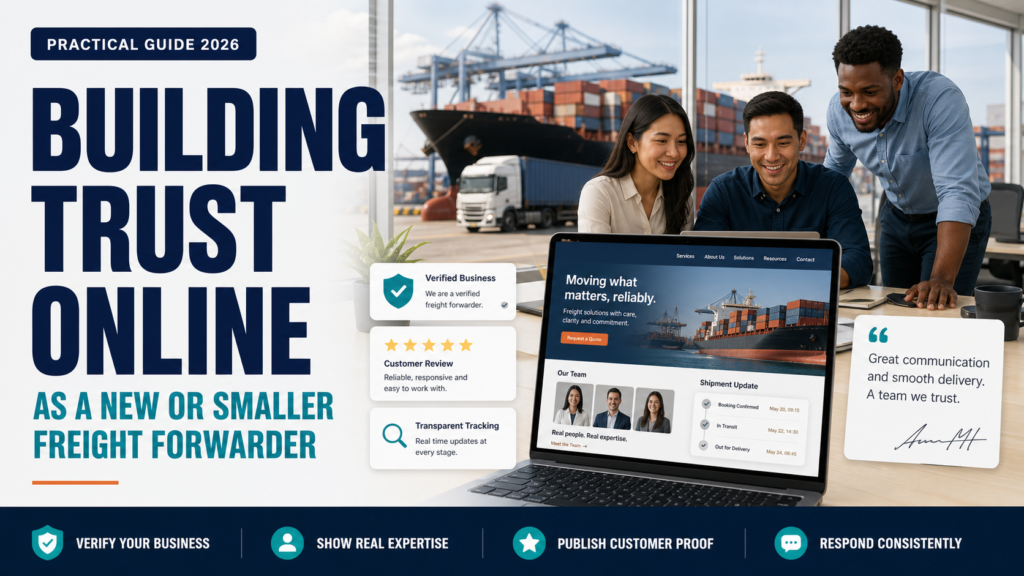
Freight Forwarding Marketing · Trust
How Can a New or Smaller Freight Forwarder Build Trust Online?
On this page
The direct answerWhat buyers need to trust The online trust stackBuild a credible website Buyer verification scorecardProof without big case studies Verify credentialsUse reviews responsibly Teach before sellingProve trust after the enquiry Trust-damaging mistakes90-day action plan Frequently asked questionsA new or smaller freight forwarder builds trust online by making its identity easy to verify, defining its real capabilities, showing who is accountable, proving relevant knowledge, and responding consistently. You do not need to look bigger than you are. You need to look competent, honest, reachable, and prepared.
Online trust in freight forwarding means a prospective customer can verify who the company is, understand what it can responsibly handle, see evidence of relevant competence, and predict how the team will communicate when a shipment does not follow the original plan.
Smaller forwarders often assume that trust comes from office count, years in business, or a long list of global locations. Those signals can help, but they are not the whole decision. Buyers also evaluate clarity, specialist knowledge, responsiveness, accountability, and whether the company understands their cargo.
The wrong response is to imitate a multinational website. Stock photographs, vague claims, invented scale, and a map covered in pins may create the appearance of size, but they do not answer the buyer's real questions. Who will handle the shipment? What can this team genuinely do? Which parts are delivered through partners? What happens when something changes?
A smaller forwarder can compete by reducing uncertainty more effectively than a larger competitor. This guide shows how.
Understand what a freight buyer is being asked to trust
Freight forwarding involves more than choosing a carrier. FIATA describes forwarding as a broad set of services covering carriage, consolidation, storage, handling, packing, distribution, customs and fiscal matters, insurance, documents, payment support, and supply-chain management. It also highlights regulatory compliance and risk management as areas where specialised knowledge matters.
That means a buyer may be trusting the forwarder with:
- Cargo value, condition, handling requirements, and delivery deadlines
- Commercial invoices, packing lists, transport documents, and confidential supplier information
- Customs, security, biosecurity, licensing, and commodity-specific requirements
- Carrier bookings, space, equipment, cut-offs, and local handovers
- Duty, taxes, destination charges, demurrage, detention, and storage exposure
- Communication across shippers, consignees, agents, carriers, brokers, terminals, and transporters
- Escalation and decision-making when the original plan no longer works
Online trust must therefore go beyond attractive design. The website and profiles should give a buyer enough evidence to believe that the company can manage responsibility. Good marketing does not remove every concern. It makes the important facts easier to inspect.
Build a complete online trust stack
Trust rarely comes from one review, one certificate, or one polished page. It develops when several signals agree with each other. Think of those signals as a stack.
The legal business name, location, ownership, contact details, and responsible people are clear.
The website explains what the company handles, where it operates, and which limitations or partners apply.
Profiles, articles, guides, and answers demonstrate practical freight knowledge.
Licences, memberships, reviews, customer references, directories, and partner relationships can be verified.
Enquiries receive clear, timely responses and operational promises match the public claims.
If one layer contradicts another, confidence falls. A website may claim 24-hour support while messages go unanswered for three days. A salesperson may claim in-house customs capability while the website provides no broker information. A certificate may be displayed after it has expired. Consistency is part of proof.
Experience
Show real shipment questions, anonymised lessons, cargo context, photographs, and the judgement used by your team.
Expertise
Name qualified people, explain their roles, cite licences accurately, and publish advice within their genuine competence.
Authoritativeness
Earn relevant memberships, directory listings, references, links, industry participation, and recognition from credible third parties.
Trustworthiness
Keep identity, claims, credentials, policies, contact details, reviews, and day-to-day behaviour accurate and consistent.
Build a website that answers verification questions
A trustworthy freight website does not need dozens of pages. It needs the right pages with accurate information. Start with a clear homepage, About page, service pages, location or market pages, contact page, privacy information, and useful resources.
Make the homepage specific
The first screen should explain the target customer, main service, and relevant market. "Your trusted global logistics partner" could describe thousands of companies. "Sea and air freight support for machinery importers between China and East Africa" gives the visitor a reason to continue.
Add a sensible next action. A qualified visitor may need to request a quote, speak with a named person, or download a preparation checklist. Do not force every visitor into a generic contact form without explaining what information is needed.
Write an honest About page
New companies sometimes avoid discussing their age. There is no need to hide it. Explain why the business was started, what experience the founders bring, which customer problem they wanted to solve, and how the operation is structured.
Distinguish company age from team experience. "Founded in 2025 by professionals with experience in project freight and customs operations" is more accurate than implying the company itself has decades of history.
Include the legal business name, registration jurisdiction, physical operating location, leadership names, and relevant memberships or licences. Only show information that can be confirmed. If privacy or security prevents publishing a home-based address, use an appropriate registered or serviced business address and explain how meetings are handled.
Create narrow service pages
Each service page should explain who the service is for, what is included, what information is required, which parties may be involved, and what can affect timing or cost. A smaller forwarder often earns more trust from one detailed trade-lane or cargo page than from fifteen thin pages repeating the same claims.
For example, a machinery-import page could cover dimensions, weight, Incoterms, packaging, treatment or cleanliness concerns, permits, lifting requirements, and final-delivery access. The page does not need to reveal private processes. It should show that the team knows which questions matter.
Use clear contact details
Publish a business-domain email address, phone number, office hours, location, and normal response expectation. Free email addresses are not automatically fraudulent, but a domain email aligned with the website is easier to verify.
Use secure forms and collect only information needed for the enquiry. Tell users how their data will be handled. Do not ask for sensitive documents through an unsecured generic form.
What freight buyers may verify before making contact
This scorecard turns vague advice about “looking credible” into questions a buyer can actually investigate. You do not need every signal on day one, but unanswered high-risk questions should be fixed first.
| Buyer question | Useful online evidence |
|---|---|
| Is this a real business? | Legal name, registration context, domain email, operating location, named leadership, and consistent directory details |
| Can it handle my freight? | Specific service pages, cargo or lane experience, qualification questions, and honest capability boundaries |
| Who is accountable? | Named sales and operations contacts, complete profiles, responsibilities, and an escalation route |
| Are the claims verifiable? | Current licence, membership, insurance, facility, partner, and accreditation details with verification links |
| What happens when plans change? | Update process, exception examples, response expectations, and clear separation of facts from estimates |
Create proof even when you do not have big case studies
A young company may not have a long client list. That does not mean it has no evidence. Proof can come from process, expertise, documentation, partner validation, and small completed engagements.
If you have zero public reviews: do not invent social proof. Start with founder and team credentials, verifiable registrations, a clear operating process, one useful checklist, real photographs, transparent partner coverage, and privately available references where permission exists. Ask for an honest review only after completing suitable work.
Publish anonymised work examples
With permission, explain a real shipment problem without exposing the customer. Describe the cargo category, origin and destination at an appropriate level, the planning challenge, the options considered, and the lesson. Avoid publishing rates, supplier names, volumes, or documents that could identify the business.
A machinery shipment arrived at the quoting stage without final dimensions or delivery-access information. Before confirming the service, the team requested packing details and checked the receiving site's unloading capacity. The lesson is not that the forwarder performed a miracle. It is that early questions prevented a weak plan.
A modest, believable example is more persuasive than a dramatic story with no evidence.
Turn methods into visible proof
Show how the team qualifies an enquiry, what a complete pre-alert contains, how documents are checked, or how customers receive updates. You do not need to reveal confidential systems. A clear checklist demonstrates preparation.
Useful proof assets include:
- A freight-quote information checklist
- A shipment-onboarding guide
- A named escalation process
- An example status-update format with private data removed
- A cargo-specific preparation guide
- A trade-lane FAQ reviewed by an operations professional
- A facility, equipment, or team walkthrough using real photographs
- A downloadable company profile with legal and contact details
Ask whether references can be offered privately
Some customers will not approve a public logo but may be willing to speak privately with a serious prospect. Ask first. Never suggest that a customer is available as a reference without consent.
Put real people behind the business
Buyers want to know who is accountable. Add leadership and operational profiles with professional photographs, names, responsibilities, relevant experience, and business contact routes. Avoid anonymous labels such as "our expert customs team" when no responsible person is visible anywhere.
Link team profiles to complete LinkedIn pages. The job title, company, dates, location, and expertise should broadly agree across the website and LinkedIn. Small differences are normal. Major contradictions create doubt.
The founder's story should focus on customer relevance, not personal mythology. Explain what the founder learned, why the business exists, and how that experience shapes service. Avoid describing every founder as a visionary disrupting logistics.
Use photographs from real work
Real office, team, warehouse, port-visit, meeting, and event photographs can make a smaller business easier to believe. Follow site rules, safety requirements, and customer confidentiality. Do not photograph documents, cargo labels, security controls, or restricted areas without permission.
Stock photography can support design, but it should not imply ownership of aircraft, vessels, warehouses, trucks, or facilities the company does not own or operate.
Make licences, memberships, and insurance verifiable
Credentials can reduce uncertainty, but only when described accurately. Name the issuing organisation, credential holder, scope, identification number where appropriate, validity period, and verification route. Do not use a partner's licence as if it belongs to your company.
Freight requirements differ by country and service. Depending on the business model, relevant proof may include customs-broker licensing, freight association membership, IATA cargo accreditation, FIATA membership through the applicable route, authorised economic operator status, dangerous-goods training, insurance, company registration, tax registration, or approved-facility information.
FIATA maintains membership information for associations and individual freight and logistics companies. FIATA also says its documents and forms are distributed through authorised channels and have established use in international trade. If you claim FIATA membership or authority to use specific documents, make sure the claim can be checked.
A row of industry logos can mislead visitors about membership, accreditation, partnership, or software use. Label each relationship clearly and follow the organisation's brand rules.
Explain insurance carefully
State the kind of insurance held, the insured entity, and any important scope limitations that can be shared. Do not imply that freight liability insurance automatically insures the customer's cargo against every risk. Encourage customers to discuss cargo insurance needs based on the shipment and contract.
Build reviews and testimonials responsibly
A new forwarder may have only a few reviews. That is acceptable. Five detailed, genuine reviews can be more credible than fifty vague ratings that appeared in one week.
Ask for feedback after a completed piece of work, not before the outcome is known. Make the request neutral. Do not require a five-star review, offer hidden incentives, or prevent dissatisfied customers from responding.
A useful review may mention communication, preparation, problem-solving, documentation, or the type of movement. Customers should decide what they are comfortable sharing. Remove confidential information before republishing a testimonial on the website and obtain permission.
Respond to negative feedback calmly
Do not argue publicly or reveal shipment details. Acknowledge the concern, state that the company wants to review the facts, and move the conversation to a private channel. If the business made a mistake, explain the corrective action without writing a legal admission you are not authorised to make.
A thoughtful response can show accountability. A defensive response can damage trust more than the original complaint.
Teach before asking for the sale
Helpful content gives a smaller forwarder a way to demonstrate knowledge before it has broad brand recognition. Google recommends people-first content that shows first-hand experience, clear sourcing, author background, and information created to help an intended audience. Google also states that trust is the most important part of EEAT.
Write about questions your team actually receives:
- What information is required for an accurate freight quote?
- Which Incoterm responsibilities should be confirmed before booking?
- Why do shipment dates change between estimate and confirmation?
- What can cause demurrage, detention, storage, or inspection charges?
- How should a shipper prepare machinery, food, chemicals, or oversized cargo?
- What does a complete pre-alert contain?
- When is air freight commercially sensible?
- What should an overseas agent know before nominating a shipment?
Use named authors and reviewers. Cite official rules when discussing customs, security, dangerous goods, biosecurity, sanctions, or permits. Add a review date. State when advice depends on country, commodity, contract, carrier, or live conditions.
Do not publish mass-produced articles on routes the team has never handled. A smaller library of specific, accurate content is a better trust asset than hundreds of interchangeable pages.
Use LinkedIn to connect knowledge with people
Let founders and specialists share operational lessons in their own voices. LinkedIn's recent B2B research emphasises that trust develops through credible people and useful thought leadership, including stakeholders who may not be visible during early sales conversations.
Company posts can verify the business, while personal profiles make judgement and responsibility visible. Keep names, roles, dates, services, and locations consistent across both.
Prove trust after the enquiry arrives
Marketing creates an expectation. The response process confirms or breaks it. A smaller forwarder can often outperform a larger competitor through careful qualification and communication.
Confirm receipt and state when a useful response can be expected.
Collect origin, destination, cargo, dimensions, weight, readiness, Incoterm, service, and special requirements before promising a price.
Label provisional schedules, third-party charges, assumptions, exclusions, and validity clearly.
Identify the responsible contact and which services are delivered by the company or by partners.
Document commitments, update the customer when conditions change, and avoid silence during exceptions.
Speed matters, but an immediate incomplete quote is not necessarily trustworthy. A well-structured response that identifies missing information may demonstrate more competence than a fast number built on assumptions.
Online mistakes that damage trust
Explain agent and partner coverage honestly. Do not present third-party offices as company branches.
Never invent testimonials, copy another forwarder's case study, or imply involvement in cargo your team did not handle.
Review certificates, memberships, insurance references, and directory links on a schedule.
Avoid guaranteed clearance, zero delays, cheapest rates, and perfect delivery claims that ignore third-party and regulatory risk.
A website with no names, address, registration context, or direct contact route makes verification harder.
A 90-day online trust plan for a smaller forwarder
Confirm legal details, domains, email security, licences, insurance descriptions, memberships, locations, team profiles, and public directory entries.
Clarify the homepage, About page, contact page, and two priority service pages. Remove unsupported claims and stock imagery that implies false ownership.
Create a quote checklist, onboarding guide, team page, one anonymised example, and a verification page for credentials and memberships.
Request honest reviews from completed customers, align LinkedIn profiles, update directories, and ask approved partners to confirm relationships accurately.
Submit a test enquiry, check response time and clarity, review mobile pages, test forms and links, and ask an independent industry contact what still creates doubt.
Frequently asked questions
Can a new freight forwarder look trustworthy without years of company history?
Yes. Be transparent about company age while showing the team's relevant experience, real people, clear processes, verifiable credentials, useful knowledge, and consistent responses.
Should a smaller forwarder call itself a global logistics company?
Only if the wording accurately describes the operating model. Explain whether international coverage comes through owned offices, a formal network, or independent agents.
What should appear on the About page?
Include the reason the business exists, team experience, legal identity, operating location, target customers, real capabilities, responsible people, credentials, and contact route.
How can we show proof without naming customers?
Use anonymised examples, process guides, checklists, approved photographs, credentials, team experience, and privately offered references. Remove information that could identify the customer.
Are association memberships enough to establish trust?
No. Membership can support verification, but buyers also need clear capability, competent people, accurate communication, appropriate insurance, and reliable delivery.
How many reviews does a new forwarder need?
There is no magic number. Start with genuine feedback from completed work. Detailed and credible reviews are more useful than a sudden volume of vague ratings.
Should rates be displayed on the website?
Usually not for complex freight services because price depends on cargo, route, timing, terms, and third-party charges. Explain the quote process and required information instead.
How often should credentials and website claims be reviewed?
Review core claims quarterly and whenever a licence, insurance policy, membership, office, partner, service, or responsible employee changes. Time-sensitive regulatory content may need more frequent checks.
Will online trust signals guarantee enquiries?
No. They reduce uncertainty, but demand also depends on market fit, visibility, targeting, reputation, sales activity, pricing, and operational performance.
Does your freight website give buyers enough reason to trust you?
Get a Freight Growth Score for a focused review of your visibility, credibility, and lead-conversion path.
Get Your Free Freight Growth ScoreAnshul Kuntewar
Founder of RouteRush. His work focuses on SEO, websites, LinkedIn strategy, and lead generation for freight forwarders and logistics companies. This article was reviewed against the cited search, B2B trust, and freight-industry sources on 20 August 2026.
Sources and review note: Search guidance: Google on people-first content and EEAT and Google on generative AI search features. Freight context: FIATA on forwarding, membership information, and standard documents. B2B trust context: LinkedIn Marketing Solutions. Reviewed 20 August 2026. Licensing, membership, insurance, platform features, and regulations vary by country and can change. Verify live details with the responsible organisation.