
How to Choose a Digital Marketing Agency for Freight Forwarders
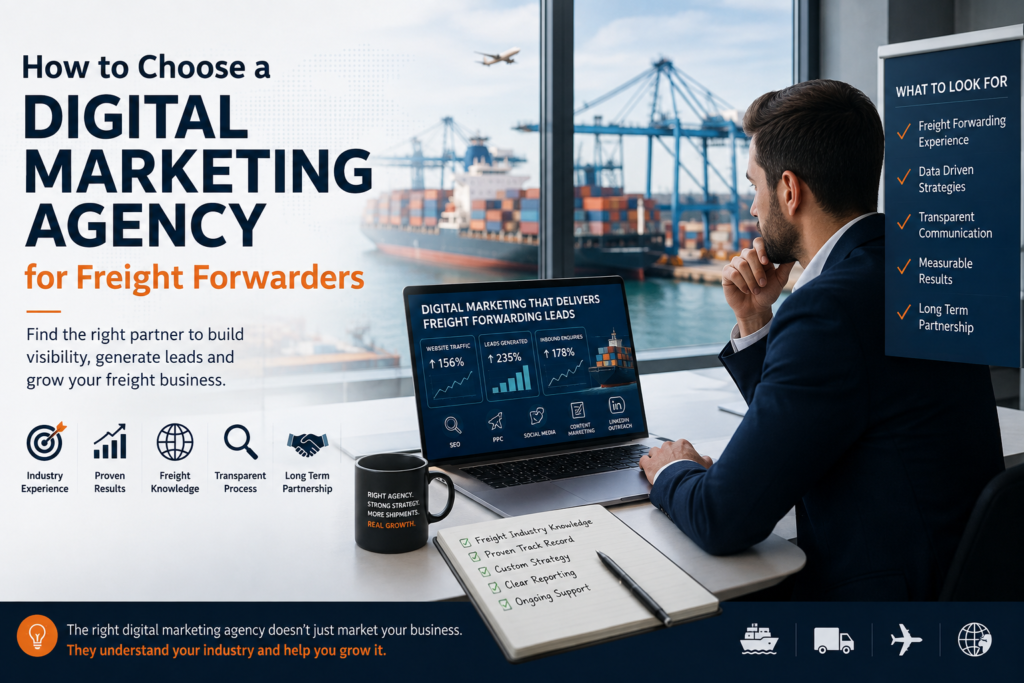
Freight Forwarding Marketing · Agency Selection
How to Choose a Digital Marketing Agency for Your Freight Forwarding Business
Most freight forwarders hiring a marketing agency for the first time make the same mistake: they evaluate agencies the way they'd evaluate a general contractor — on price, on a polished pitch deck, on whether the account manager seems responsive in the first meeting. None of that predicts whether the agency actually understands how a shipper decides between three forwarders.
Why This Decision Is Harder Than It Looks
The data backs up why this matters: B2B companies that choose agencies with deep specialization in their specific category report 2.3 times higher lead-to-qualified-opportunity conversion than those who choose generalist agencies. Meanwhile, the broader agency industry is genuinely consolidating around specialization — 38% of agencies have already shifted at least one service line away from generic hourly billing toward outcome-based models, and the generalist, do-everything agency model is losing ground across B2B categories generally.
Freight forwarding is a small enough, specific enough niche that this gap between specialist and generalist performance tends to be even more pronounced than in broader B2B categories.
The Pattern Behind Most Failed Agency Relationships
There's a well-documented, almost predictable pattern to how B2B companies end up firing a marketing agency: somewhere between month six and month nine, the top-of-funnel dashboards still look healthy — traffic is up, leads are up — but the actual pipeline hasn't moved. Practitioners call this "activity theater." Reports look good because activity volume is high, but the volume isn't converting into anything sales recognizes as real opportunity.
For a freight forwarder specifically, this pattern shows up in a very recognizable way: an agency reports rising website traffic and form submissions, but the enquiries are from students researching logistics for a school project, competitors checking pricing, or shippers whose cargo type and volume don't match anything the forwarder actually handles. The dashboards look fine. The phone doesn't ring with real business. By the time this becomes undeniable, six months and a meaningful budget have usually already been spent.
Red Flags Worth Taking Seriously
A portfolio full of restaurants, law firms, and e-commerce brands doesn't transfer the specific knowledge freight forwarding marketing requires.
A senior partner leads the sales pitch, then hands the actual work to a junior team once the contract is signed. Ask directly, in writing, who does the work day to day.
If reporting leans entirely on traffic and impressions without connecting to qualified enquiries or closed business, you're at real risk of "activity theater."
Marketing that doesn't start by asking which specific ports, routes, and cargo types you handle well is generic marketing wearing a freight label.
Very small agencies show the highest client churn rate in the industry at 32% annually, frequently tied to founder dependency and limited capacity.
What Actually Predicts a Good Fit
A good agency asks about your typical time from first enquiry to signed shipment, not just generic lead-generation tactics.
An agency recommending the identical channel mix to every forwarder hasn't diagnosed your specific situation.
Real before-and-after data from a comparable client should be readily available, not need weeks to assemble.
SEO and content-driven visibility typically shows meaningful movement over 2-3 months and compounds over 6-12 months.
You should see clearly which pages or campaigns produce real enquiries, not just an aggregate traffic number.
Questions Worth Asking Before You Sign
A specific, detailed answer signals real experience. A vague answer about "logistics clients broadly" is a signal to probe further.
Directly tests the senior-team-bait-and-switch pattern — a confident agency will introduce your actual team without hesitation.
The answer should go beyond form submissions to something tied to cargo type, volume, and route match.
Listen for specificity and honesty about what won't move quickly, not just an optimistic timeline.
A direct, practical test of whether the agency understands how shippers actually search.
What This Looks Like Done Right
The following is an illustrative example of a well-fitted agency relationship, not a specific named case study.
A mid-sized forwarder specializing in two core ports signs with an agency that starts with a detailed audit of exactly which routes and cargo types the forwarder already does well. The first 90 days focus narrowly on fixing trust signals and building two or three genuinely detailed port pages, rather than a broad campaign across every channel at once. Reporting from month one ties specifically to enquiries matching the forwarder's actual target cargo profile. By month four, the forwarder can see which specific pages produce real, qualified enquiries — and the agency adjusts based on that data rather than sticking rigidly to the original plan.
The Agency Evaluation Checklist
- The agency has verifiable freight forwarding or logistics client experience, not just adjacent B2B work
- You've met the actual team who will work on your account, not just the sales team
- Proposed strategy is specific to your ports, routes, and cargo types — not a generic template
- Success metrics connect to real, qualified enquiries, not just traffic or impressions
- The agency can show real before-and-after results from a comparable client
- Timeline expectations are realistic and explained honestly, not just optimistic
- Reporting will show you which specific pages or campaigns produce real business
- Pricing is explained clearly, with no unexplained gap versus market rates
Frequently Asked Questions
Is a specialized freight forwarding marketing agency actually better than a general B2B agency?
Generally, yes, for this specific category — B2B companies choosing agencies with deep specialization in their niche report 2.3 times higher qualified conversion than those choosing generalists, and freight forwarding's specific buyer behavior rewards genuine category knowledge more than broad B2B experience alone.
How much should we expect to pay for freight forwarding marketing?
This varies enormously by scope and market, but pricing dramatically below typical market rates with no clear explanation is a more reliable warning sign than a specific number — very small, low-cost agencies show the highest client churn in the industry.
How long should we give an agency before judging whether it's working?
Give meaningful SEO and content work 3-6 months before expecting compounding results, but insist on visibility into leading indicators — search visibility movement, enquiry quality — well before that, so you're not waiting passively only to discover the "activity theater" pattern too late.
Should we hire one agency for everything, or different specialists for SEO, ads, and outreach?
For most small to mid-sized forwarders, one agency with genuine freight forwarding experience across channels is more practical than coordinating multiple specialist vendors — but only if that agency can demonstrate real depth in each channel it proposes.
What's the single best question to ask an agency to test if they actually understand freight forwarding?
Ask them to explain, specifically, why a dedicated page for one of your actual ports or routes would outperform a single general "Services" page. A genuinely experienced agency will answer this immediately and specifically.
Want to see what a freight-forwarding-specific audit and strategy actually looks like?
We'll walk through your current website, your ports, and your real growth constraints — no generic pitch deck.
Request Your Free Strategy ConsultationAnshul Kuntewar
Founder, RouteRush Digital Marketing Agency — specialising in SEO, website strategy, and lead generation exclusively for freight and logistics companies across India, the UAE, Oman, South Africa, Qatar, and Australia.
This guide reflects B2B and marketing agency industry research current as of mid-2026, sourced from The Starr Conspiracy, UnboundB2B, and Revenue Memo.