
How Freight Forwarders Generate Qualified Leads From LinkedIn
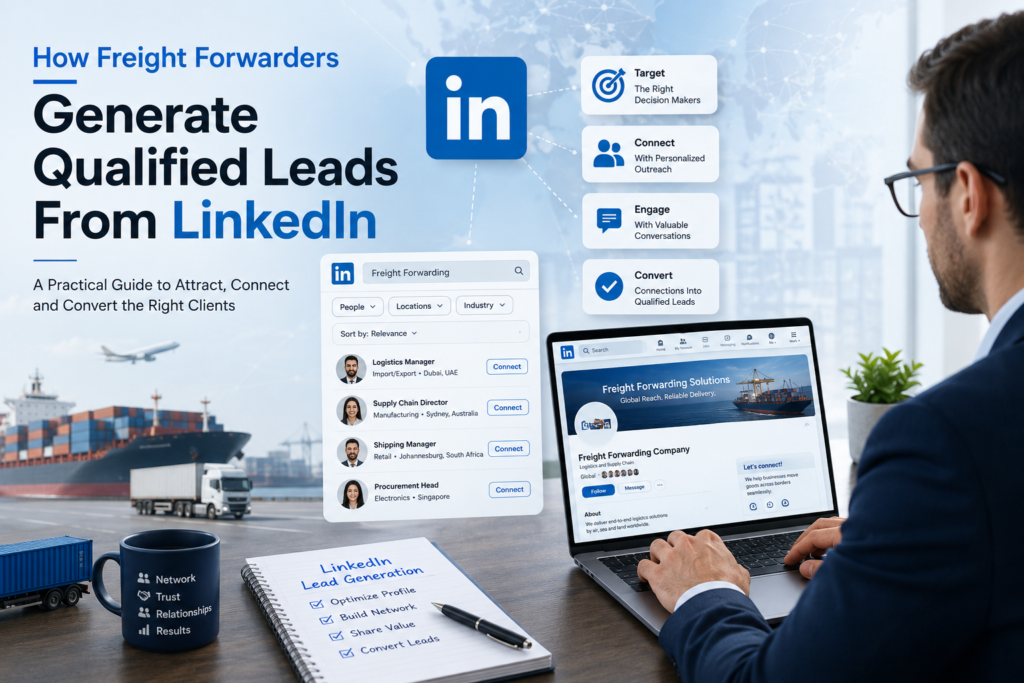
Freight Forwarding Marketing · LinkedIn Strategy
How Freight Forwarders Can Generate Qualified Leads From LinkedIn in 2026
On this page
Why LinkedIn Deserves More The Core Mistake Personal Profile Strategy Content Cadence Employee Advocacy Sales Navigator LinkedIn Ads Newsletters Measurement Examples in Practice Checklist FAQsMost freight forwarders who "do LinkedIn" mean one thing by it: sending connection requests and cold messages. That leaves the majority of LinkedIn's lead generation potential untouched.
Why LinkedIn Deserves More Than Just Cold Outreach
The scale alone justifies more attention. LinkedIn hosts 61 million senior-level influencers and 40 million decision-makers actively using the platform, and 80% of all B2B leads generated from social media come from LinkedIn — no other platform comes close. It also outperforms on efficiency: LinkedIn produces a 28% lower cost-per-qualified-lead than Google Ads for B2B campaigns.
This guide is deliberately broader than outreach tactics alone, because outreach is where most freight forwarders already put their entire LinkedIn effort — and it's also the one piece of the system that depends most heavily on the recipient already having some reason to trust the sender. Content, personal profile activity, and employee advocacy all work to build that baseline trust before an outreach message ever lands in someone's inbox, which is a large part of why forwarders who combine these elements consistently outperform those running outreach in isolation.
The Core Mistake: Treating LinkedIn as Only an Outreach Tool
A full LinkedIn lead generation system for a freight forwarder has four distinct components — personal profile and content, employee advocacy, Sales Navigator-driven outreach, and paid advertising — and most forwarders are only running one of them, usually outreach, in isolation. Each component does something the others can't, and they compound when combined rather than working as substitutes for one another.
1. Your Personal Profile Is a Bigger Lead Gen Asset Than Your Company Page
This is the single most consistently under-used lever in freight forwarding LinkedIn strategy: posts from individual profiles receive roughly 8 times the engagement of identical content posted from a company page, and personal profiles collectively reach up to 10 times more connections than a company page does. This gap is widening, not closing.
For a freight forwarder, this means the founder's or sales lead's personal LinkedIn activity — not the company page — is where most of the actual lead generation opportunity sits. A post about a shipment challenge solved, a route-specific insight, or a plain-language explainer on a customs change reaches more of the right people from a personal profile than the same content posted as a company update.
What this looks like in practice: instead of only posting company announcements from the business page, the same content gets reframed and posted from the founder's or a senior team member's personal profile, with a first-person perspective — "we just helped a client navigate X" rather than "[Company] announces X."
This doesn't mean the company page becomes irrelevant. It still matters as a credibility anchor — a prospect who's interested after seeing a personal post will very often click through to the company page to verify the business is real before responding to an outreach message or filling out a contact form. The company page's job shifts from primary content distribution to trust verification, which is a different but still essential role.
2. Consistent Content, Not Occasional Posts, Is What the Algorithm Rewards
Companies posting four times a week see double the engagement of less frequent posters, and pairing that cadence with employee advocacy compounds the lift to roughly 3x on top of that. Consistency matters more than perfect timing: posting daily at ordinary times consistently outperforms posting twice weekly at theoretically optimal times.
For a freight forwarder without a dedicated marketing team, a realistic minimum is three posts a week, with five to seven being the stronger target once a rhythm is established. Content that performs particularly well includes document-style carousel posts, which see roughly 3.2 times the engagement of standard text posts, since the swipe interaction itself signals engagement LinkedIn's algorithm rewards with additional distribution.
Content types that work well for a freight forwarder specifically:
- A short carousel explaining a customs documentation requirement, step by step
- A behind-the-scenes look at a specific shipment or route challenge and how it was resolved
- A plain-language breakdown of a recent trade policy or tariff change relevant to your core lanes
- A brief, specific client outcome story (with permission) — not a generic testimonial, but a real detail
3. Employee Advocacy Is Your Highest-Leverage, Lowest-Cost Channel
Employees are roughly 14 times more likely to share their own company's content than any other content they encounter on the platform, and just 3% of employees sharing content generates 30% of a company's total engagement on a given post. Advocacy content also performs better when it's genuinely personalized rather than copy-pasted — employees adding their own perspective on shared content outperforms identical copy-paste sharing by roughly 5 times.
This is a real, practical opportunity for even a small forwarder: identifying 10-20 willing team members, giving them ready-to-share content weekly, and coaching them to add a genuine personal note rather than reposting verbatim, turns a handful of employees into a distribution channel that collectively reaches far more people than the company page alone ever could.
4. Sales Navigator Changes the Math on Outbound
Sales Navigator's value isn't the tool itself — it's the targeting precision it adds to outreach that's already working. The ROI case is straightforward: if your average deal value is meaningful and your close rate from qualified meetings is reasonable, even one additional closed deal a year from Sales Navigator-driven targeting can produce a 25x return relative to its modest annual cost.
Sales Navigator also gives you a Social Selling Index (SSI) score, which is a genuinely useful internal benchmark — free LinkedIn users should generally aim for a score above 70, Sales Navigator users can reasonably push into the 80-90 range, and the top performers in any given industry set the real bar for competitive visibility.
For the specific tactics of writing connection requests, sequencing follow-ups, and structuring outreach messages that convert, we've covered this in depth separately for several markets — the principles hold globally: personalized notes roughly double acceptance rates compared to blank requests, and short, specific first messages consistently outperform long pitches.
5. LinkedIn Ads Work, But Only With Realistic Expectations
LinkedIn is genuinely the most expensive B2B lead generation platform on a cost-per-click basis, but that cost reflects targeting precision unavailable elsewhere. Q3 2026 data shows LinkedIn ad spend producing 6.01x pipeline ROI, with Q4 showing 2.46x revenue ROI specifically, and average B2B conversion rate on LinkedIn ads sitting around 2.74%.
The mistakes that waste budget fastest on LinkedIn ads are the same mistakes that waste budget anywhere, just more expensive per mistake: targeting too broadly, using generic creative, and following up slowly on leads that do convert. A freight forwarder running LinkedIn ads should start with a narrow, specific audience — a job title and industry combination tied to a real target segment — rather than a broad "logistics decision-makers" audience that burns budget on low-intent clicks.
6. LinkedIn Newsletters Are an Underused, Fast-Growing Format
LinkedIn newsletter subscriptions have grown roughly 150% year-over-year, making them one of the fastest-growing content formats on the platform in 2026 — and unlike a standard post, a newsletter actively notifies every subscriber when a new edition publishes, giving it a built-in re-engagement mechanism most other content types lack. A simple monthly or bi-weekly newsletter covering trade lane updates, customs changes, or shipping market conditions builds a direct, recurring touchpoint with prospects and existing clients alike.
Measuring What Actually Matters
91% of B2B marketers use content marketing in some form, and 74% say it's effective for generating leads — but the measurement discipline that separates a working LinkedIn strategy from an expensive hobby is tracking leads through the full funnel to actual revenue, not just counting engagement or form submissions.
The metrics that matter, by stage:
- Visibility metrics (engagement rate, impressions, follower growth) tell you whether content is reaching people, but say nothing about lead quality on their own.
- Lead generation metrics (form submissions, connection-to-conversation rate, meetings booked) are the first real signal of interest.
- Pipeline metrics (lead-to-MQL rate, meeting-to-opportunity rate) are what actually justify the time and budget invested.
What This Looks Like in Practice
The following are illustrative scenarios based on common patterns in the industry, not verified case studies of specific named companies.
A forwarder shifting content from the company page to the founder's profile. The same shipment insights and route updates moved to the founder's personal profile with a first-person voice. Engagement and profile-view-driven enquiries rose noticeably within weeks, with no change to the underlying content.
A forwarder building a small employee advocacy habit. Five team members agreed to share and add a short personal comment to one company post per week. Within a couple of months, their combined reach was outperforming the company page's organic reach on its own.
A forwarder using Sales Navigator to narrow an already-working outreach process. Filters targeted a specific job title and industry tied to their strongest existing client profile — improving reply rates without increasing outreach volume.
A forwarder testing a narrow LinkedIn ad audience before scaling. A small campaign targeted one specific job title within one industry vertical, producing a meaningfully lower cost-per-lead than a broader test run in parallel.
The LinkedIn Lead Generation Checklist
- Founder or senior team members post from personal profiles, not just the company page
- Posting cadence is at least 3 times a week, consistently, rather than sporadic
- At least some content uses document/carousel format for the engagement boost
- A small group of team members are actively encouraged to share and personalize company content
- Sales Navigator (or equivalent targeting discipline) narrows outreach to a specific, real segment
- Outreach messages are personalized and short, not generic templates
- Any LinkedIn ad campaign starts with a narrow, specific audience before scaling
- A LinkedIn newsletter is in place or planned as a recurring, lower-effort touchpoint
- LinkedIn activity is connected to a CRM to track leads through to actual revenue, not just engagement
Frequently Asked Questions
Should a small freight forwarder prioritize organic content or paid ads first?
Organic content and employee advocacy generally offer a better starting point for a smaller forwarder, since they cost time and consistency rather than a media budget, and the personal-profile engagement gap means even modest effort can produce real reach. Paid ads are worth adding once organic activity is established.
How much does LinkedIn advertising typically cost for a freight forwarder?
LinkedIn is genuinely more expensive per click than platforms like Google or Facebook, reflecting its targeting precision. Focus on starting with a narrow test audience and measuring cost-per-qualified-lead specifically, since that's the number that actually matters for ROI.
Is employee advocacy realistic for a small forwarder with only a handful of staff?
Yes — a small number of genuinely engaged employees produces a disproportionate share of total engagement. Five willing team members sharing and personalizing content weekly is a realistic, meaningful starting point.
How is this different from the connection-request and outreach tactics covered elsewhere?
This guide covers the full system — content, personal profile strategy, employee advocacy, and paid ads — that outreach sits inside. Outreach tactics remain important, but they're one component of a broader strategy, not the entire strategy on their own.
How long does it take to see real results from a LinkedIn lead generation strategy?
Organic content and profile-based engagement can show movement within weeks, but meaningful pipeline results typically need 3-6 months to measure honestly, given typical B2B freight forwarding sales cycles.
What's the single highest-leverage first step for a forwarder starting from a mostly inactive LinkedIn presence?
Start posting consistently from a personal profile rather than the company page, even just three times a week. This single shift tends to produce the fastest visible improvement relative to the effort involved.
Is a LinkedIn newsletter worth starting alongside regular posts?
Yes, as a complement rather than a substitute — newsletter subscriptions have grown roughly 150% year-over-year, and the built-in notification to subscribers gives it a re-engagement advantage regular posts don't have.
Do we need a large team to run all four parts of this system?
No — a founder or one or two senior team members posting consistently, five willing colleagues sharing content weekly, disciplined outreach using Sales Navigator's targeting, and a small, narrow ad test can all be run by a lean team.
Want help building a full LinkedIn lead generation system, not just an outreach campaign?
We'll audit your current LinkedIn presence and build a prioritized plan across content, advocacy, outreach, and ads.
Request Your Free LinkedIn Strategy SessionAnshul Kuntewar
Founder, RouteRush Digital Marketing Agency — specialising in SEO, LinkedIn strategy, and lead generation for freight and logistics companies across India, the UAE, Oman, South Africa, Qatar, and Australia.
This guide reflects LinkedIn marketing and B2B lead generation research current as of mid-2026, sourced from Digital Applied, LeadGen Economy, The Social Shepherd, and Martal. Platform algorithms and benchmarks change frequently — treat these figures as directional, not guaranteed.