
How Smaller Freight Forwarders in Australia Build Trust Online
Australian Freight Forwarding Marketing · Trust & Conversion
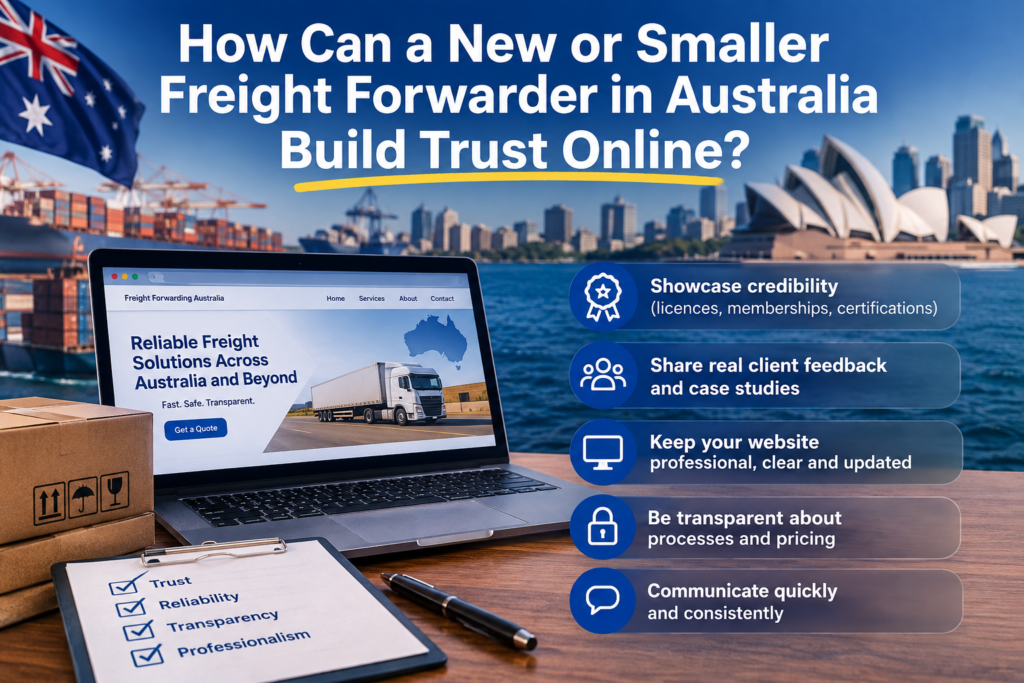
How Can a New or Smaller Freight Forwarder in Australia Build Trust Online?
On this page
The direct answerWhat Australian shippers risk The Australian trust stackBuild an inspectable website Shipper verification scorecardProof without massive case studies Put accountable people upfrontVerifying Australian credentials Earning genuine reviews under ACLOperational content that converts Proving trust after the quote requestTrust-damaging mistakes to avoid 90-day trust execution planFrequently asked questionsA new or smaller freight forwarder in Australia builds trust online by making its corporate identity immediately verifiable (ABN, ACN, registered office, and clear leadership), proving local port and biosecurity competency, putting named operational specialists upfront, clearly separating partner agency reach from owned assets, and maintaining transparent communication across quotation and delivery. Australian cargo owners and international forwarding agents do not expect an independent forwarder to own container vessels. They look for direct accountability, transparent landed-cost breakdowns, responsive communication, and proof that your team can navigate Australian border and wharf friction without costly surprises.
Online trust in Australian freight forwarding is not about polished aesthetics. It is a commercial risk-reduction mechanism. When an Australian importer, procurement officer, or overseas forwarding agent evaluates your website or LinkedIn profile, they are evaluating whether your business is legitimate, whether your team understands the regulatory friction points of Australian trade, and whether you will take ownership when weather, terminal congestion, or quarantine holds threaten their cargo.
Many smaller Australian forwarders make the mistake of imitating multinational logistics corporations. They fill their websites with generic stock photos of mega-ships, world maps littered with pins, and empty slogans like "Seamless Global Supply Chain Solutions." To an experienced cargo owner or overseas agent, this generic presentation triggers doubt. It hides the company's real strengths—direct access, agility, and local operational care—while leaving critical verification questions unanswered.
Who is actually coordinating the vessel booking? Does the forwarder hold an in-house customs brokerage licence, or do they partner with an accredited customs broker? How do they handle tight shipping line container detention clocks at Port Botany, Port of Melbourne, or Fisherman Islands? What happens during Brown Marmorated Stink Bug (BMSB) season when biosecurity holds threaten cargo? Showing mastery over these concrete operational realities is how independent forwarders win high-value accounts.
Understand what an Australian freight buyer is actually risking
Freight forwarding is rarely an impulsive purchase. Importers and exporters hand over valuable inventory, commercial relationships, and critical delivery timelines to their forwarders. According to FIATA’s description of freight forwarding, the profession encompasses international carriage, storage, customs clearance, fiscal compliance, documentation, and supply-chain risk management.
In the Australian trade landscape, cargo owners face substantial operational and financial exposures:
- Strict Container Detention Windows: Ocean carriers serving Australian ports typically grant only 7 to 10 calendar days of container free time. Demurrage and detention fees quickly escalate from $150 to over $400 per container per day.
- Wharf Infrastructure & VBS Fees: Stevedore terminal access charges, vehicle booking system (VBS / 1-Stop) slot costs, and empty container depot congestion require precise transport coordination.
- Biosecurity & Quarantine Compliance: Australia maintains one of the world's most rigorous biosecurity borders. Inadequate preparation for Department of Agriculture, Fisheries and Forestry (DAFF) requirements, BMSB seasonal measures, or ISPM 15 timber packing rules can lead to expensive onshore treatments or cargo re-export.
- Customs & Tariff Accuracy: Australian Border Force (ABF) declarations, Integrated Cargo System (ICS) reporting cut-offs, dumping duty liabilities, and correct Free Trade Agreement (FTA) origin documentation carry direct financial and legal consequences.
- Commercial Supply Chain Confidentiality: Protecting sensitive commercial invoices, supplier details, and customer lists from unauthorized exposure.
- Crisis Escalation: Having a reliable, senior contact who takes ownership when a coastal feeder is delayed or an air freight parcel is held on the tarmac.
When you recognize the scale of these risks, it becomes obvious why vague marketing copy fails. Buyers need verifiable evidence that your team is competent, compliant, and reachable.
Build an Australian freight online trust stack
Trust is not generated by a single digital asset. It is built through an integrated stack of consistent signals. If one layer contradicts another, confidence drops immediately.
The Australian Business Number (ABN), Australian Company Number (ACN), registered entity name, physical office address, and key founders are clearly stated and verifiable on public registers.
The website clearly explains core trade lanes, port specialisms, handled cargo types, and how international coverage is managed through vetted partner networks.
Published trade notes, preparation checklists, and technical articles demonstrate deep familiarity with Australian customs, biosecurity, and wharf cartage.
Industry association memberships (IFCBAA, FTA), IATA cargo accreditations, FIATA links, licensed broker connections, and genuine customer references are clearly documented.
Enquiries receive structured, itemized responses separating carrier freight from statutory local charges, with proactive updates during transit.
If an element in this stack is out of place—such as advertising 24/7 dedicated support but taking three days to answer an online quote request—trust dissolves. Consistency across all touchpoints is your strongest asset.
Practical Experience
Share anonymised shipment lessons, port-specific handling steps, cargo preparation advice, and how your team resolves supply chain bottlenecks.
Technical Expertise
Name qualified staff, detail licensed customs broker and biosecurity credentials, explain Incoterms 2020 accurately, and demonstrate regulatory fluency.
Industry Authority
Highlight active participation in Australian trade bodies (IFCBAA, FTA), vetted global forwarding alliances (WCA, JCtrans), and industry accreditations.
Commercial Transparency
Publish standard trading conditions, transparent billing structures, accurate physical address details, and clear marine transit insurance guidance.
Build a website that answers critical verification questions
Your website serves as an interactive due diligence portal. High-value cargo owners and overseas forwarding partners review your site to decide whether you are safe to work with. Structure your pages to resolve their primary questions quickly.
Make your homepage specific and grounded
Within five seconds, the top of your homepage should tell visitors who you serve, which trade lanes you specialize in, and where your Australian operations are based.
"Leading Australian logistics provider delivering seamless, innovative, end-to-end global supply chain solutions with world-class customer service."
"Specialist sea and air freight forwarder coordinating commercial imports and exports through Port Botany, Melbourne, and Brisbane. Dedicated account managers for Australian manufacturers, machinery importers, and wholesale distributors."
The second example builds immediate credibility. It clearly defines the company's operating scope, target industries, and primary port gateways. Pair this clarity with direct calls to action: request a detailed quote, speak directly with an operations coordinator, or download a port import preparation guide.
Write an honest, authentic About Us page
Logistics decision-makers frequently check the About Us page to confirm who owns the business and whether the leadership team has credible industry experience.
If your company was established recently, there is no need to hide it. Be proud of your modern systems and lean operational focus, while highlighting the accumulated career experience of your leadership team. For example: "Founded in Melbourne in 2023, our boutique forwarding team brings over 40 years of combined operational experience managing containerized cargo, customs clearance, and cold-chain logistics across Asia-Pacific trade lanes."
Include your legal company name, ABN, ACN, registered Australian office address, leadership bios, and active industry associations. If your team works across Sydney, Melbourne, and Perth, explain how your communication workflow covers Australian Eastern Standard Time (AEST) and Australian Western Standard Time (AWST).
Create focused service and trade-lane pages
Generic bullet points like "Sea Freight" and "Air Freight" do not demonstrate depth. Instead, build structured service pages tailored to specific commodities, industries, or major bilateral trade corridors.
- FCL & LCL Sea Freight from China & Southeast Asia: Covering origin CFS hubs, transshipment routes (Singapore, Port Klang), shipping line transit times, and de-hiring protocols at Australian container parks.
- Refrigerated & Perishable Agricultural Exports: Explaining reefer monitoring, Department of Agriculture export documentation, phytosanitary requirements, and air cargo allocations through Sydney (SYD) and Melbourne (MEL).
- Heavy Machinery & Industrial Equipment Handling: Detailing Out-of-Gauge (OOG) flat rack transport, coastal barging, route surveys, and rigorous DAFF soil cleanliness inspections.
- Retail & E-Commerce Consolidation Streams: Outlining bonded depot deconsolidation, pallet rework, inventory visibility, and domestic road freight on-forwarding.
Each dedicated page should outline necessary documentation, seasonal bottlenecks (such as Chinese New Year or peak agricultural harvests), regulatory requirements, and risk mitigation strategies.
Publish clear, direct contact details
Anonymous contact forms and generic email addresses damage credibility. Provide local business phone numbers with state area codes, direct corporate email addresses (e.g. operations@yourdomain.com.au), clear office hours, and weekend escalation contacts. For overseas agents in different time zones, outline your after-hours coverage clearly.
The Australian freight buyer's digital verification scorecard
Procurement professionals and overseas agents look for specific proof points when evaluating a forwarder. This scorecard outlines their primary verification checks and the exact digital evidence your website should display.
| Shipper Evaluation Area | Verifiable Digital Evidence on Your Website |
|---|---|
| Entity Authenticity & Solvency | Registered Australian Entity Name, active ABN and ACN displayed, physical business address, searchable ABR record, and standard trading terms. |
| Customs & Biosecurity Mastery | Clear explanation of customs clearance workflow, licensed customs broker credentials (or accredited partner broker), DAFF compliance procedures, and BICON familiarity. |
| Trade Lane & Cargo Specialisation | Detailed service pages specifying origin hubs, transit timelines, shipping line space allocations, equipment handling (reefer, OOG, DG), and seasonal risk management. |
| Operational Accountability | Named operations managers, customer support leads with direct contact routes, complete LinkedIn profiles, and documented escalation matrices. |
| Global Partner Reach | Transparent explanation of international agency network memberships (e.g. WCA, JCtrans, FIATA), detailing how overseas partners manage origin handovers. |
| Transparent Landed Cost Structure | Detailed quotation breakdowns separating international freight from local wharf charges, terminal access fees, customs entries, DAFF inspection fees, and cartage. |
Produce compelling proof without relying on massive case studies
Boutique Australian forwarders often worry they cannot compete because they lack case studies featuring major enterprise brands. In practice, middle-market importers and regional exporters care more about how you solve practical everyday shipping challenges for businesses of their size.
Starting with a lean client roster? Do not fabricate customer logos or inflate numbers. Build trust using transparent operational workflows, deep technical explainers, verified regulatory knowledge, clear quotation templates, and anonymised real-world case notes.
Document anonymised operational micro-studies
You can demonstrate high-level logistics competence without publishing client names or confidential rates. Write concise, factual case notes describing a specific shipping challenge, the steps your operations team took, and the practical outcome.
Scenario: An industrial importer needed three 40-foot High Cube containers of precision engineering machinery shipped from Genoa to Port of Melbourne during peak BMSB season.
Challenge: The overseas supplier failed to secure offshore heat treatment certificates prior to vessel departure, creating an immediate risk of a mandatory turn-around direction by border authorities.
Action: Our operations desk flagged the documentation gap during pre-alert checks 16 days before arrival. We coordinated with our Italian agency partner to obtain manufacturer declarations, arranged priority onshore secure unpack and treatment at an approved bonded facility with DAFF, and scheduled early VBS transport slots.
Result: The machinery was safely treated, cleared through customs, and delivered to the manufacturing facility with zero container detention charges and a turnaround delay of under 48 hours.
These real-world examples prove that your team communicates proactively, understands Australian regulations, and protects customer cargo under pressure.
Turn internal procedures into visible digital proof assets
Showing your prospective clients how thoroughly your team prepares before cargo moves demonstrates high operational standards.
Valuable digital proof assets include:
- Australian Import Quotation Checklist: A practical guide listing the critical variables required for an accurate landed-cost quote (Incoterms, HS codes, dimensions, weights, hazardous details).
- Pre-Alert & Document Review Protocol: A visual chart showing how your team audits Commercial Invoices, Packing Lists, Bills of Lading, and Certificates of Origin before vessel arrival.
- Wharf Detention & Demurrage Guide: An educational resource explaining shipping line free-time rules at Australian container terminals and how proactive booking prevents holding fees.
- DAFF Biosecurity Readiness Checklist: A seasonal guide covering timber packing verification (ISPM 15 stamps), cleanliness standards, and offshore treatment rules.
- Escalation & Emergency Communication Charter: A clear protocol outlining who takes responsibility when disruptions happen outside standard business hours.
Put real, accountable local people behind the business
Freight forwarding is built on communication and accountability. When a container is delayed or a customs entry is queried, shippers do not want an anonymous support ticket or an overseas call centre. They want to speak directly with an experienced local logistics professional who knows their shipment.
Showcase the actual specialists managing your operations, customs brokerage, and client service:
- Detailed Team Profiles: Include professional headshots, full names, job titles, direct contact numbers, and brief summaries of each specialist's industry background.
- Licensed Customs Brokers & Technical Leads: If your company employs an in-house Licensed Customs Broker, highlight their credentials and years of experience navigating the Australian Border Force.
- Aligned LinkedIn Profiles: Ensure team members maintain complete, professional LinkedIn profiles reflecting their current roles, responsibilities, and industry discussions.
- Authentic Local Photography: Use real photos of your team at work—in your Australian office, reviewing documentation, visiting local container depots, or inspecting cargo.
Large multinational forwarders frequently rotate account managers and route communications through rigid ticketing queues. As an independent Australian forwarder, your greatest strength is direct, senior accountability. Use your digital presence to show that clients get dedicated access to experienced professionals who treat every shipment as a priority.
Make Australian registrations, licences, and affiliations easily verifiable
Credibility grows when claims are easy to verify. When listing business credentials, include exact registration numbers, issuing authorities, and official verification links.
Provide direct Australian business verification pathways
Australian corporate buyers and procurement officers routinely perform background checks before opening trade accounts. Make this seamless:
- Australian Business Register (ABR) Lookup: Display your 11-digit Australian Business Number (ABN) in your website footer and verification section, linking directly to the official ABN Lookup register.
- ASIC Company Registration: If operating as a proprietary limited company (Pty Ltd), include your Australian Company Number (ACN) and legal corporate name as listed on the ASIC corporate register.
- Customs Brokerage Transparency: If you hold a corporate customs broker licence under the Customs Act 1901, display your licence details. If you deliver clearance through an accredited partner broker, explain that structure clearly: "Customs clearance delivered in partnership with fully licensed, ABF-accredited Australian Customs Brokers."
- DAFF Approved Arrangements: If your facility or partner depot operates under an Approved Arrangement with the Department of Agriculture, Fisheries and Forestry, specify the arrangement category and how it supports smooth biosecurity clearance.
- Industry Association Memberships: If your business belongs to the International Forwarders and Customs Brokers Association of Australia (IFCBAA), the Freight & Trade Alliance (FTA), or holds IATA/FIATA credentials, display official member badges with explanatory notes on the operational standards they require.
Displaying an uncaptioned row of shipping line, airline, and government logos on your homepage looks misleading. Clearly label every relationship: "Member: IFCBAA," "Accredited Agency Partner: WCA World," "Contracted Freight Agent for Major Ocean Carriers."
Explain Marine Cargo Insurance and Terms of Trade
Shippers often confuse forwarder liability with comprehensive cargo insurance. Forwarders typically operate under Standard Trading Conditions (such as those established by IFCBAA), which limit liability in the event of unforeseen maritime casualties or general average declarations.
Demonstrate honesty by explaining the clear difference between Forwarder Liability and Marine Transit Insurance. Encourage clients to assess their insurance needs for every consignment, and clarify whether your team can arrange cargo cover through an Australian Financial Services Licence (AFSL) authorization or referral partner. Protecting clients from unhedged losses builds lasting loyalty.
Build genuine reviews and social proof under Australian Consumer Law
Client reviews, testimonials, and industry recommendations build strong credibility. In Australia, they must be collected and presented with strict adherence to commercial accuracy.
The Australian Competition and Consumer Commission (ACCC) enforces strict rules against misleading or deceptive conduct. Creating fake testimonials, offering undisclosed incentives for reviews, editing feedback to distort its sentiment, or publishing misleading endorsements violates Australian Consumer Law and can result in severe penalties and reputational harm.
A structured approach to gathering B2B reviews
Collect authentic, compliant customer feedback systematically:
Ask for a review immediately after successfully completing a complex shipment, clearing a challenging customs entry, or delivering an urgent project.
Ask neutral questions that invite specific feedback: "How was our communication during the customs clearance process?" or "How smoothly was container delivery handled at your receiving warehouse?"
With permission, publish the reviewer's full name, job title, company name, and industry sector. A testimonial from a named Logistics Manager carries far more authority than an anonymous quote.
If you receive constructive criticism online, do not argue publicly or disclose confidential shipment details. Acknowledge the comment calmly, state your commitment to operational quality, and offer to resolve the issue directly over the phone.
Publish high-intent operational content that teaches before it sells
Content marketing for a freight forwarder should focus on answering specific regulatory, documentation, and operational questions. Rather than publishing generic articles about high-level industry trends, write practical guides that solve the daily problems faced by Australian cargo owners.
Google’s helpful content standards reward content that reflects genuine subject-matter experience, clear sourcing, and practical utility. Focus your content on high-intent topics:
- Understanding Australian Wharf Infrastructure Surcharges: A transparent guide explaining terminal access fees at Port Botany and Melbourne, why stevedores levy them, and how they appear on commercial invoices.
- Navigating BMSB Seasonal Measures in Australia: An annually updated explainer detailing target risk countries, offshore treatment windows, container sealing rules, and how to prevent quarantine re-export.
- Maximising Free Trade Agreement (FTA) Tariff Preferences: Explaining how Australian importers use ChAFTA (China), JAEPA (Japan), KAFTA (Korea), CPTPP, or A-UKFTA to legally reduce customs duties using compliant Certificates of Origin.
- Air Cargo Chargeable Weight Calculation: A practical walkthrough explaining how airlines calculate volumetric weight (1:6000 ratio) for bulky air consignments moving through Sydney or Melbourne air cargo terminals.
- Navigating Australian Customs Lodgement (ICS): Explaining the document pipeline from arrival notices and tariff classification to GST payment via the Deferral Scheme and final release.
Attribute each article to a named specialist on your team, include an editorial review date, and link to authoritative government bodies such as the Australian Border Force, DAFF, or DFAT.
Use LinkedIn to establish thought leadership among Australian supply chain leaders
LinkedIn is the primary networking platform for Australian supply chain directors, procurement managers, and overseas freight partners. Corporate company pages verify your business, while personal leadership profiles build authentic relationships.
Encourage your operational leads and founders to share real-time operational observations: port congestion updates, shipping line schedule changes, biosecurity notices, or tips for container de-vanning. Grounded, informative updates build credibility and keep your company top-of-mind when shipping contracts come up for review.
Prove trust from the moment an enquiry lands in your inbox
Marketing brings an enquiry to your desk, but trust is won or lost during the quotation and onboarding process. An incomplete, slow, or vague response immediately cancels out the positive impression made by your website.
Send an immediate confirmation email identifying the assigned operations coordinator by name and specifying when a comprehensive quote will be delivered.
If essential details are missing (such as exact dimensions, gross weights, ready dates, Incoterms, or hazardous classifications), request clarification upfront instead of quoting on assumptions that cause disputes later.
Clearly break down ocean/air freight, statutory Australian customs and biosecurity fees, terminal infrastructure surcharges, wharf cartage, and destination delivery. Clearly state quote validity dates and exchange rate assumptions.
Explain the scheduled shipment milestones: origin collection, vessel carrier, estimated transit days, customs lodgement timing, and how regular tracking updates will be shared.
When unexpected disruptions occur (such as weather delays, port blank sailings, or customs holds), notify the customer immediately with clear facts and mitigation options rather than waiting for them to chase you.
Online mistakes that instantly destroy trust for smaller Australian forwarders
Building digital credibility takes consistent effort, but several common mistakes can undermine your reputation immediately. Avoid these pitfalls:
Claiming that your boutique forwarding business owns container vessels, cargo aircraft, and hundreds of global branch offices damages credibility with experienced buyers. Focus on your agility, direct communication, and vetted international agency partnerships.
Omitting your ABN, registered company name, and physical Australian address makes your business look high-risk. Display complete corporate and contact details openly.
Attracting clients with low ocean freight rates and then surprising them with inflated destination handling charges (DTHC), document turnover fees, or unexpected administrative costs destroys trust and leads to invoice disputes.
Never promise "Guaranteed 100% On-Time Delivery" or "Zero-Delay Customs Clearance." Experienced cargo owners know that maritime weather, port congestion, and border audits happen. Promise rigorous preparation, transparent communication, and rapid problem resolution instead.
Stock photos showing left-hand drive American trucks, overseas highway signs, or foreign terminal facilities look out of place on an Australian logistics website. Use authentic images of Australian logistics environments.
A 90-day online trust execution plan for Australian forwarders
Improving your digital credibility is a structured process. Follow this quarterly roadmap to build an authoritative, high-converting digital presence:
Confirm your ABN/ACN listings on ABR and ASIC, configure domain email security (SPF, DKIM, DMARC), verify your physical address on Google Business Profile, audit your association memberships (IFCBAA/FTA), and update team LinkedIn profiles.
Rewrite your Homepage, About Us, and Contact pages with clear Australian trade lane positioning, transparent corporate details, authentic staff photos, and distinct capability boundaries.
Publish at least three detailed service pages covering your primary trade lanes (e.g. Asia-Australia FCL, Trans-Tasman air freight, or project machinery logistics) complete with documentation checklists and FAQs.
Develop a downloadable Australian Import Quotation Checklist, publish two anonymised operational case studies, create a clear landed-cost explainer, and establish a compliant B2B review collection workflow.
Conduct mystery quotation enquiries on your website, review mobile usability and contact forms, test all external verification links, and review enquiry response times with your operational team.
Frequently asked questions
Can a newly established freight forwarder in Australia compete with multinational logistics giants online?
Yes. Mid-sized and smaller Australian shippers often prefer independent forwarders who provide direct access to experienced logistics managers, flexible communication, and tailored service. By demonstrating verified legal identity, deep local port and customs knowledge, and transparent pricing on your website, you can win profitable accounts from large multinationals.
Should an Australian forwarder display fixed freight rates on its website?
Generally no. International freight rates change frequently due to bunker adjustments (BAF), currency fluctuations (CAF), seasonal surcharges, terminal access costs, and commodity specifics. Instead of displaying static rates, explain your quotation process, outline required shipment details, and provide rapid, fully itemized landed-cost proposals.
How can we prove international capabilities if we only have offices in Australia?
Be completely transparent about your operating model. Explain that your business belongs to vetted global forwarding networks (such as WCA World, JCtrans, or FIATA-affiliated alliances) that connect you with accredited, independent partner forwarders in over 150 countries. This gives shippers the advantage of local origin knowledge paired with dedicated Australian account management.
What should an Australian freight forwarder put on its verification page?
Include your registered legal business name, ABN, ACN, registered office address, corporate customs brokerage licence number (or partner details), DAFF Approved Arrangement references, IFCBAA or FTA membership certificates, IATA/FIATA affiliations, and links to the official ABN Lookup and ASIC registers.
How do Australian Consumer Law (ACL) rules affect website testimonials?
The ACCC strictly prohibits false, misleading, or deceptive commercial representations. All reviews and testimonials on your website must reflect genuine experiences from real clients. Do not edit reviews in ways that alter their true sentiment, do not offer undisclosed incentives for positive reviews, and secure written permission before publishing client names or corporate logos.
Why is biosecurity and customs content so effective for attracting Australian shippers?
Customs clearance delays and DAFF biosecurity holds are the most expensive, stressful friction points for Australian importers. When your website provides clear, authoritative, and up-to-date guidance on managing these border risks, logistics managers recognize your technical competence and trust you to manage their high-value cargo.
Does your freight website inspire complete confidence in Australian cargo owners?
Request a comprehensive Freight Positioning & Trust Audit to identify conversion bottlenecks, verify your digital credentials, and attract high-margin shipping accounts.
Get Your Free Freight Growth ScoreAnshul Kuntewar
Founder of RouteRush. Specializing in search engine positioning, high-intent website architecture, LinkedIn B2B strategy, and qualified lead generation for independent freight forwarders, customs brokers, and logistics companies across Australia, Asia, and global trade corridors. This guide was reviewed against Australian border regulations, industry standards, and search engine best practices on 22 August 2026.
Sources, Regulatory References & Review Note: Australian trade and corporate context referenced from the Australian Business Register (ABR), Australian Securities and Investments Commission (ASIC), Australian Border Force (ABF), Department of Agriculture, Fisheries and Forestry (DAFF), Australian Competition and Consumer Commission (ACCC), IFCBAA, and FIATA. Search and content guidelines referenced from Google Search Central EEAT documentation. Reviewed 22 August 2026. Maritime freight rates, terminal access charges, customs regulations, and biosecurity measures change frequently. Always verify live operational requirements with relevant authorities and licensed professionals.
[…] guide on how smaller Australian freight forwarders build trust online goes deeper into this — for a market with a real cultural preference for directness, demonstrated […]