
In-House Marketing vs Agency for Freight Forwarders in India
Freight Forwarding Growth Strategy · Indian Logistics Leadership
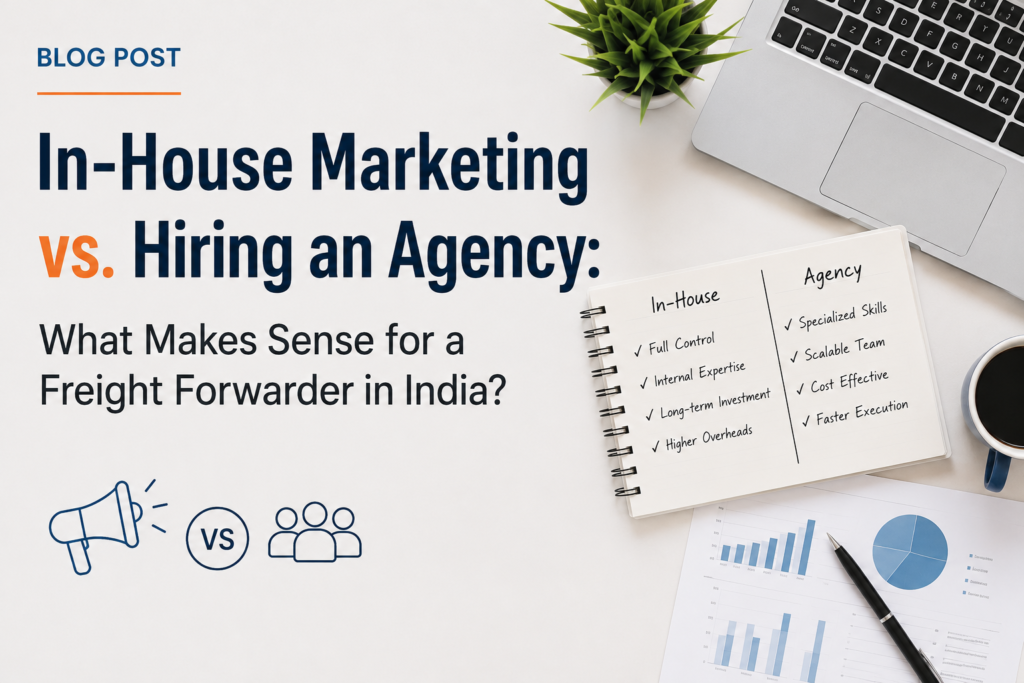
In-House Marketing vs. Hiring an Agency: What Makes Sense for a Freight Forwarder in India?
On this page: Executive Navigation
The direct executive answer The changing commercial reality in India Why freight marketing is uniquely difficult The real financial math (INR ₹ TCO) Four operational paths compared In-house marketing: strengths & pitfalls The generalist agency trap The specialized freight agency advantage The hybrid model: scaling forwarders Decision matrix: turnover & growth stage 6 commercial KPIs promoters must track Marketing capability readiness checklist Costly leadership mistakes to avoid 90-day marketing transition roadmap Frequently asked questionsIf your freight forwarding business in India clocks under ₹50 Crore in annual turnover (or under ₹4 Crore in gross freight margin), partnering with a specialized logistics marketing agency delivers 3x to 5x higher commercial ROI than hiring a solo in-house marketer.
Customer acquisition in Indian shipping demands six distinct technical competencies: commercial search architecture, route-specific SEO, high-converting B2B copywriting, search advertising with negative keyword filtering, CRM pipeline tracking, and WhatsApp lead automation. A single in-house hire in India (typically earning ₹5 Lakh to ₹9 Lakh annually) cannot master all six disciplines while navigating ICEGATE customs clearance, GST e-way bills, Port Terminal Handling Charges (THC), and Incoterms 2020. You end up with a junior executive designing festival graphics while your sales desk receives zero qualified container inquiries.
For forwarders doing ₹50 Crore to ₹200 Crore turnover with multiple branch offices (e.g., Mumbai, Delhi, Chennai, Mundra, Ahmedabad), the optimal structure is an agile hybrid model: an internal marketing coordinator capturing operational proof points from pricing and branch desks, paired with a specialized freight agency managing technical search infrastructure, trade lane SEO, and digital authority.
| Annual Turnover (INR) | Recommended Setup | Primary Commercial Focus |
|---|---|---|
| Emerging (₹5 Cr – ₹25 Cr) | Specialized Agency Only | Rapid inbound RFQs, trade lane credibility, zero payroll overhead |
| Established (₹25 Cr – ₹75 Cr) | Specialized Agency + Sales Liaison | Scale Google Ads, customs SEO, automated WhatsApp CRM |
| Mid-Sized (₹75 Cr – ₹200 Cr) | Agile Hybrid Model | In-house sales enablement lead + specialized technical agency |
| Large Group (₹200 Cr+) | In-House Dept + Specialist Partners | In-house brand/PR team backed by route-specific acquisition |
The Changing Commercial Reality of Indian Freight
For decades, the Indian freight forwarding sector grew through three traditional channels:
- Relationship-driven field sales: Reps visiting industrial clusters in Bhiwandi, Manesar, Guindy, Peenya, or Sanand with printed rate cards.
- Customs House Agent (CHA) reciprocity: Port connections at Nhava Sheva (JNPT), Mundra, Chennai, or Kolkata for clearance referrals.
- Overseas network directories: Nomination routing from international partners via WCA World, JCtrans, or FIATA directories.
While field sales and agent networks remain vital, decision-making within Indian export-import (EXIM) enterprises has undergone a fundamental digital shift.
The Rise of the Digitally Native EXIM Procurement Leader
When an auto-component exporter in Pune needs urgent DDP air freight to Frankfurt, or a chemical manufacturer in Gujarat needs hazardous (DG) ISO tanks shipped to Jebel Ali, the second-generation promoter or supply chain head does not wait for a cold call. They search Google and LinkedIn directly: "customs clearing broker Nhava Sheva DDP," "ISO tank operator Mundra to Middle East," or "AEO certified freight forwarder Delhi."
They evaluate your website within 15 seconds on mobile. If they encounter a dated template with broken links and no proof of AEO certification or port clearance credentials, they click away. If your digital presence fails to establish instant technical credibility, you are silently disqualified from high-margin freight tenders before your sales team even knows the opportunity existed.
Why Freight Marketing in India Is Uniquely Challenging
Many Indian freight founders feel "digital marketing does not work in logistics" because a generic agency previously ran basic ads that flooded them with calls from retail consumers tracking personal courier parcels.
Marketing freight in India is uniquely difficult due to four distinct commercial realities:
1. The Consumer Noise and Negative Intent Minefield
Search engines in India are flooded with millions of consumers searching for courier tracking and personal parcels. Broad bidding on phrases like "cargo shipping to USA" or "best transport company in Mumbai" wastes 85% of ad spend on retail shoppers sending 2 kg gift boxes abroad. Filtering this requires an extensive negative keyword fortress (excluding thousands of retail courier and tracking terms) combined with precise B2B intent triggers (such as FCL container booking, ocean bill of lading, project cargo ODC movement, customs clearance ICEGATE, and customs broker CHA license).
2. High Transaction Values and Compliance Stakes
A commercial exporter moving 15 TEUs of engineering goods monthly is managing consignments worth crores of Rupees. A single regulatory error in Shipping Bill filing on ICEGATE, incorrect HS code classification, or missing Certificate of Origin documentation can trigger heavy port demurrage, shipping line detention penalties, and customs penalties under the Indian Customs Act.
Commercial supply chain heads evaluate forwarders based on concrete operational proof points: AEO (Authorized Economic Operator) status, FFFAI/AMTOI/MTO registrations, direct port handling infrastructure at key gateways (JNPT, Mundra, Hazira, Chennai, Cochin, Tuticorin), and ICD rail connectivity (e.g., ICD Tughlakabad, Dadri, Whitefield, Sanathnagar).
| Generic Marketing (Fails with Shippers) | Specialized Logistics Marketing (Wins) |
|---|---|
| "Fast, reliable global shipping solutions" | "Direct weekly FCL consolidation from Nhava Sheva to Rotterdam with in-house customs clearance and 4-hour quote SLA" |
| "We handle all your cargo needs" | "Specialized Class 3 & 8 hazardous chemical freight via Mundra & Hazira, backed by certified DG documentation" |
| "Call us today for the best prices" | "Download our 2026 India-Europe Trade Lane Customs & Landed Cost Benchmark" |
3. Lengthy Evaluation Cycles & WhatsApp Speed-to-Quote
Unlike retail e-commerce, B2B freight contracting in India spans weeks to months, requiring approvals from purchase managers, finance teams, and plant heads. Furthermore, procurement heads demand near-instant communication. If an inbound commercial RFQ lands on your website form and sits untouched for 24 hours, the shipper has already booked with another forwarder. Digital architecture for Indian logistics must instantly route verified corporate inquiries into internal sales desks and trigger real-time WhatsApp notifications for prompt response.
The Real Financial Math: In-House Cost vs. Specialized Agency (INR ₹)
Forwarding directors often make a flawed comparison: pitting an agency's monthly retainer (e.g., ₹60,000/month) against a junior employee's base salary (e.g., ₹40,000/month), while ignoring the hidden overheads of building an in-house department.
Let us evaluate the true Total Cost of Ownership (TCO) in the Indian market:
| Cost Component | Solo In-House Marketer (India) | Specialized Freight Marketing Agency |
|---|---|---|
| Base Salary / Gross CTC | ₹6,00,000 – ₹10,50,000 (₹50,000 – ₹87,500/month for 3–5 yrs exp) |
₹0 (All personnel covered in fixed retainer) |
| Statutory & Overhead (EPF, Gratuity, Bonus, Medical, Office space) |
₹90,000 – ₹1,60,000 (Typically 15% to 20% on top of base CTC) |
₹0 (Zero statutory liabilities or payroll taxes) |
| Recruitment & Sourcing (Naukri/LinkedIn portal fees, consultant charges) |
₹50,000 – ₹90,000 (One-time placement fee or platform subscription) |
₹0 (Immediate deployment within 7–10 days) |
| Software & Data Stack (Semrush/Ahrefs, Apollo, Canva, CRM, Email) |
₹1,80,000 – ₹3,60,000 (Enterprise software licenses at ₹15k–₹30k/month) |
₹0 (Agency provides its own enterprise analytics & tool stack) |
| Freelance Specialist Top-Ups (Web developer for WordPress/PHP, design, video) |
₹1,20,000 – ₹2,40,000 (External hourly support for technical tasks) |
₹0 (Full multidisciplinary team included in retainer) |
| Management & Training Time (15+ hours/month of Founder/MD time for direction) |
₹2,00,000 – ₹4,00,000 (Opportunity cost of senior executive time) |
₹30,000 – ₹50,000 (2 hours/month for strategic review & sales sync) |
| TOTAL ANNUAL INVESTMENT | ₹12,40,000 – ₹23,00,000 | ₹5,40,000 – ₹11,40,000 (₹45,000 – ₹95,000 / month) |
| Active Execution Capacity | 1 Person (Limited to 1–2 core skills) | Cross-Functional Team (SEO, PPC, Copy, Dev, CRM) |
In India, hiring an in-house marketer costs 1.5x to 2.5x more than a specialized agency retainer, while providing access to only a fraction of the necessary skill set. You pay full-time overhead for single-person capacity.
Four Operational Paths: A Side-by-Side Comparison
To make an informed decision, let us evaluate the four primary marketing models available to an Indian logistics enterprise:
1. Solo In-House Marketer
- Domain Fluency: Moderate (Learns internal ops, lacks macro market data).
- Skill Breadth: Narrow (Strong in graphics or social, weak in search/PPC).
- Ramp-Up Speed: 90 to 120 Days (Hiring, onboarding, tech setup).
- Turnover Risk: High (If employee leaves, marketing stops completely).
- Executive Time: 15 to 20 Hours / Month (Hands-on direction needed).
- Attribution: Rarely connected directly to booked freight revenue.
2. Generalist Digital Agency
- Domain Fluency: Very Low (Requires extensive industry training).
- Skill Breadth: Broad, but consumer-focused.
- Ramp-Up Speed: 60 to 90 Days (Slow industry learning curve).
- Turnover Risk: Low (Agency manages internal staffing).
- Executive Time: 10 to 15 Hours / Month (Fixing erroneous copy/targeting).
- Attribution: Vanity metrics (Impressions, clicks, social followers).
3. Specialized Freight Agency
- Domain Fluency: High (Immediate fluency in Incoterms, trade lanes, customs).
- Skill Breadth: Comprehensive B2B logistics growth stack.
- Ramp-Up Speed: 7 to 14 Days (Pre-built search and negative keyword assets).
- Turnover Risk: Zero (Contractual delivery and team continuity).
- Executive Time: 2 to 3 Hours / Month (High-level commercial review).
- Attribution: Commercial Inbound RFQs, Cost per Lead, Win Rate.
4. Agile Hybrid Model
- Domain Fluency: High (Combines internal ops stories with external market expertise).
- Skill Breadth: Complete end-to-end commercial pipeline execution.
- Ramp-Up Speed: 14 to 21 Days (Rapid operational alignment).
- Turnover Risk: Low (Resilient multi-tiered operational structure).
- Executive Time: 3 to 4 Hours / Month (Strategic alignment and pipeline audit).
- Attribution: End-to-end pipeline tracking from inquiry to repeat booking.
The In-House Route: Real Strengths and Critical Pitfalls
Having an internal marketing team member sitting in your office has clear appeal. However, leadership must weigh the genuine advantages against the common operational failure modes.
• Direct Physical Proximity: An internal employee can visit your CFS (Container Freight Station) or warehouse, photograph specialized project cargo (ODC) loaded on lowbed trailers, and document real-time stuffing operations.
• Rapid Sales Collateral Support: When your regional sales manager in Chennai or Delhi needs a customized rate proposal deck or branch flyer for an engineering client visit tomorrow morning, an in-house person can produce it quickly.
• Dedicated Focus: 100% of their working hours are invested exclusively in your company.
1. The "Unicorn Marketer" Fallacy: Logistics founders expect one person to write trade lane landing pages, optimize Google Ads negative keyword lists, design branding assets, configure CRM workflows, and analyze SEO data. No single professional excels at all of these at once. Inevitably, the employee defaults to comfortable tasks (designing daily social media banners) rather than revenue drivers (high-intent search capture and landed-cost conversion architecture).
2. Isolation and Lack of Strategic Guidance: A mid-level marketer in a freight forwarding firm has no experienced marketing director to review their keyword strategy, audit conversion tracking, or refine search targeting. Operating in a vacuum with no guidance, they burn time on low-impact tasks and eventually resign.
3. Zero Cross-Market Benchmark Intelligence: An in-house employee only sees your internal metrics. They cannot tell whether a ₹1,200 Cost Per Qualified Lead on ocean freight to Jebel Ali is competitive or inflated. A specialized agency, by contrast, manages campaigns across multiple trade lanes and knows precisely where your benchmarks should sit.
The Generalist Agency Trap: Why 90% of Campaigns Fail
Many Indian freight forwarders who feel "digital marketing only wastes money" previously hired a generic digital agency serving retail shops, clinics, and D2C brands. When applied to international logistics, their standard practices create immediate commercial waste:
- They Target Consumer and Tracking Search Queries: Generalist PPC managers set up broad search ads for terms like "cargo shipping" or "container transport," wasting your ad budget on retail consumers looking for package tracking or sending personal luggage.
- They Write Superficial, Fluffy Copy: Lacking logistics fluency, generic copywriters rely on clichés like "Seamless supply chain solutions" or "Global freight excellence," which fail to persuade professional supply chain managers.
- They Report Vanity Metrics Over Commercial Bookings: Generic agencies celebrate impressions and social media likes. In B2B freight forwarding, 50,000 social views are meaningless compared to three qualified RFQs from manufacturers needing 50 TEUs per quarter.
- They Ignore Customs and Port Realities: They create generic service pages that omit customs broker licences, port terminal access, bonded warehousing, and Incoterm clarity—the exact proof points procurement managers require.
When you hire a generalist agency, you end up spending six months educating their account team on the difference between LCL and FCL, why an Air Waybill is not a Bill of Lading, and what a bonded warehouse does. You are effectively paying them to learn your industry.
The Specialized Freight Agency Advantage
A specialized logistics marketing agency operates with pre-built domain expertise. From day one, they understand how your business generates profit, which trade lanes carry high margins, and how to position your services against multinational integrators.
- High-Intent Commercial Search Architecture: Targeting exact commercial search queries (e.g., "FCL sea freight Nhava Sheva to Rotterdam," "Customs clearing broker Chennai Port," "DDP shipping agent Mumbai to Dubai") while aggressively filtering consumer courier traffic.
- Inspectable Trust Architecture: Structuring your website as an interactive due diligence portal displaying corporate registrations, customs broker credentials, and verified trade associations (FFFAI, AMTOI, FIATA).
- Trade-Lane Specific Lead Magnets: Producing downloadable landed-cost calculators, import documentation checklists, and demurrage management guides that capture high-intent shipper details.
- Sales Pipeline Integration: Connecting website inquiries directly to your sales desk or CRM (HubSpot, Zoho, Salesforce, CargoWise) with automatic pre-qualification data (commodity type, estimated volume, Incoterm, origin/destination ports).
- Cross-Client Benchmark Intelligence: Leveraging data across international trade lanes to continually optimize your cost-per-lead and quote conversion rates.
The Hybrid Model: The Gold Standard for Scaling Forwarders
For mid-sized Indian freight forwarders generating ₹50 Crore to ₹200 Crore in annual turnover, the most profitable organizational model is an agile hybrid model.
The Hybrid Division of Labor
• Internal Role (Marketing Coordinator / Sales Enablement Lead): Sits in your office, interfaces with your operations and pricing desks, captures raw operational footage and project cargo case studies from branch offices, coordinates branch event participation, and ensures inbound quote requests are followed up by sales reps within 30 minutes.
• External Role (Specialized Freight Marketing Agency): Drives overall strategy, manages high-intent SEO, builds conversion-optimized landing pages, runs technical Google Search and LinkedIn ad campaigns, oversees CRM attribution, and writes authoritative, regulatory-grounded pillar content.
This structure leverages each party's natural strengths. The internal coordinator ensures deep operational alignment and rapid lead handover, while the specialized agency provides the technical expertise and multi-disciplinary execution that no single employee could replicate.
Decision Matrix: What Fits Your Turnover and Growth Stage?
Use this stage-by-stage framework to determine the right marketing structure based on your company's revenue, sales team maturity, and commercial objectives:
| Company Stage & Turnover (INR) | Recommended Model | Primary Focus & Resource Allocation |
|---|---|---|
| Emerging Forwarder / Regional CHA (₹5 Cr – ₹25 Cr Turnover / ₹50L – ₹2.5 Cr Margin) |
Specialized Agency Only | Build a credible digital trust portal, capture high-intent commercial search traffic for 2–3 primary trade lanes, and generate qualified inbound RFQs without adding internal payroll overhead. |
| Established Mid-Tier Operator (₹25 Cr – ₹75 Cr Turnover / ₹2.5 Cr – ₹7 Cr Margin) |
Specialized Agency + Sales Liaison | Scale paid search acquisition, build out comprehensive customs and port guide content, implement automated CRM pipeline tracking, and appoint a senior sales manager as agency liaison. |
| Scaling Multi-Branch Group (₹75 Cr – ₹200 Cr Turnover / ₹7 Cr – ₹18 Cr Margin) |
Agile Hybrid Model (In-House Lead + Specialized Agency) |
Hire an internal Sales Enablement Manager to capture local branch stories and coordinate sales follow-up, while retaining the specialized agency for technical SEO, paid ads, and brand architecture. |
| Enterprise Logistics Conglomerate (₹200 Cr+ Turnover / ₹18 Cr+ Margin) |
Internal Department + Specialist Agency Partners | Full in-house marketing team managing corporate communications, internal PR, and brand design, supported by specialized agencies for high-intent SEO, ABM campaigns, and performance marketing. |
6 Commercial KPIs Indian Forwarding Promoters Must Track
Regardless of whether you hire internally or engage an agency, marketing must be accountable to commercial revenue. Never judge marketing success by vanity metrics like website hits or social media likes. Track these six commercial indicators:
- Qualified Commercial Inbound RFQs (MQLs): The total number of quotation requests from verified commercial cargo owners specifying container counts, commodity types, weight/volume, and Incoterms (excluding consumer courier spam).
- Cost Per Qualified Freight Lead (CPQL): Total marketing spend (retainer/salary + ad spend) divided by the number of validated commercial quotation requests.
- Quote-to-Booking Win Rate (%): The percentage of inbound quotation requests that convert into booked shipments. If this is low, either pricing is uncompetitive or sales follow-up speed is too slow.
- Customer Acquisition Cost (CAC) per Active Shipper: The total marketing and sales investment required to acquire a new active account that completes at least one commercial booking.
- Shipper Lifetime Value to CAC Ratio (LTV:CAC): In freight forwarding, a good customer books repeatedly for 24 to 36 months. A healthy commercial growth engine should achieve an LTV:CAC ratio of at least 5:1.
- WhatsApp & Lead Response Velocity (Minutes): The average time taken between an inbound web inquiry landing and your sales desk making first contact. Top performers maintain an SLA of under 30 minutes during business hours.
Marketing Capability Readiness Checklist
Before making a hiring decision or engaging an agency, audit your internal operational readiness. Answering these questions clarifies what support you actually need:
- Defined Trade Lane Priorities: Do you have 3 to 5 core trade lanes where your carrier contracts, local handling, and pricing are genuinely competitive against multinational integrators?
- Rapid Quotation SLA: Does your operational pricing desk guarantee turnaround of standard air/ocean freight quotes within 2 to 4 hours of receiving an inbound inquiry?
- Clean Commercial CRM: Are all sales leads, rate proposals, and shipper interactions tracked centrally in a CRM (HubSpot, Zoho, Salesforce, CargoWise) rather than scattered across individual reps' inboxes?
- Inspectable Digital Credentials: Are your corporate registration numbers, customs broker accreditations, and industry memberships clearly documented and ready for web display?
- Designated Leadership Champion: Is there a managing director, commercial head, or sales lead who can spend 2 hours a month reviewing marketing pipeline data and providing strategic steering?
Costly Leadership Mistakes to Avoid
Executive teams often make avoidable errors during marketing restructuring. Avoid these four common traps:
Hiring a marketing person and then demanding that they make 50 cold outbound sales calls a day is a recipe for failure. Sales development and marketing are distinct disciplines. Marketing builds inbound trust and captures active intent; sales closes deals and manages relationships.
Never sign an agency contract that does not specify concrete monthly deliverables: published technical pillar guides, verified search ad structures, CRM pipeline integrations, and conversion audit milestones.
Marketing cannot operate in a vacuum. Whether internal or agency-based, your marketing team needs regular access to your operations desk to gather real-world stories about port congestion workarounds, customs inspection wins, and shipping line updates.
Switching marketing strategies every 90 days destroys momentum. High-intent SEO assets, organic trade lane rankings, and domain trust compound over time, delivering lower customer acquisition costs every subsequent year.
The 90-Day Marketing Transition Roadmap for Indian Forwarders
Whether you choose an internal hire, a specialized agency, or a hybrid model, execute your marketing transition using this structured quarterly roadmap:
Define top 3 high-margin trade lanes, audit existing website conversion bottlenecks, set up CRM pipeline stages, and establish clear quotation turnaround SLAs with the sales desk.
Overhaul the Homepage, About Us, and Verification pages with transparent licensing details, named operations staff, and grounded trade lane capability boundaries.
Launch targeted service pages for primary sea, air, and cross-border corridors, complete with downloadable import checklists and customs compliance FAQs.
Deploy targeted B2B Google Search campaigns with strict negative keyword architecture to capture high-intent commercial shippers while filtering consumer courier noise.
Conduct a full commercial pipeline audit with the sales team, analyze quote-to-booking win rates, calculate initial Cost Per Qualified Lead (CPQL), and refine conversion paths.
Frequently Asked Questions (FAQs)
Can an Indian freight forwarder succeed without any digital marketing?
While established forwarders can survive on existing client relationships and agent networks for a period, relying solely on traditional methods leaves the business vulnerable to client attrition. Modern shippers and younger procurement managers verify every vendor online before awarding contracts. Without a strong digital trust portal, your growth will stagnate while competitors capture high-intent search demand.
How long does it take for freight forwarding marketing to generate qualified quotes in India?
Well-architected commercial search advertising (Google Ads) with strict negative keyword filtering can generate qualified B2B quotation requests within 14 to 30 days. High-intent organic search (SEO) and content marketing typically compound over 3 to 6 months, building permanent digital assets that deliver continuous inbound leads at near-zero marginal cost.
Why shouldn't our freight forwarding sales reps just handle marketing?
Sales reps are trained to build one-on-one relationships, negotiate contracts, and close active deals. Asking them to master SEO, web development, copywriting, and advertising tracking distracts them from selling. High-performing logistics companies let sales reps focus on closing, while marketing fills their pipeline with pre-qualified quotation requests.
What should we look for when interviewing a marketing agency for freight in India?
Ask the agency to explain the difference between FOB and CIF under Incoterms 2020, how customs demurrage differs from detention, and how they filter out consumer courier package tracking searches on Google. If they cannot answer these questions fluently without consulting Google, they do not possess the domain expertise needed to market your freight business.
How much should an Indian freight forwarder budget for digital marketing?
As a general industry benchmark, growing B2B freight forwarders in India typically allocate 2% to 5% of their net revenue (gross margin) toward marketing. For an independent forwarder generating ₹3 Crore to ₹10 Crore in gross margin, this represents an annual marketing investment of ₹6 Lakh to ₹25 Lakh across agency retainers, advertising spend, and digital assets.
What is the biggest risk of hiring a solo in-house marketer?
The primary risk is single-point skill limitation. A solo marketer often excels at graphic design or social media but lacks the technical competence required for B2B search architecture, conversion rate optimization, and CRM pipeline automation, resulting in high payroll costs with low commercial pipeline generation.
Is your freight marketing generating qualified commercial shipping accounts?
Request a complimentary Freight Marketing & Pipeline Audit from RouteRush to evaluate your current setup, uncover conversion bottlenecks, and build a high-ROI growth engine.
Get Your Free Freight Growth ScoreAnshul Kuntewar
Founder of RouteRush, a specialized digital growth and marketing consultancy dedicated exclusively to independent freight forwarders, customs brokers, and logistics companies across India and global shipping corridors. Specializing in high-intent search engine positioning, conversion-focused website architecture, B2B LinkedIn strategy, and qualified lead generation.
Editorial & Industry References: Strategic frameworks referenced from the Federation of Freight Forwarders’ Associations in India (FFFAI), Association of Multimodal Transport Operators of India (AMTOI), Central Board of Indirect Taxes and Customs (CBIC) - ICEGATE, International Federation of Freight Forwarders Associations (FIATA), International Chamber of Commerce (ICC) Incoterms 2020, and Google Search Central EEAT Guidelines. Commercial marketing advice provided for executive evaluation; specific returns vary based on trade lane competitiveness, sales closing capabilities, and pricing competitiveness.