
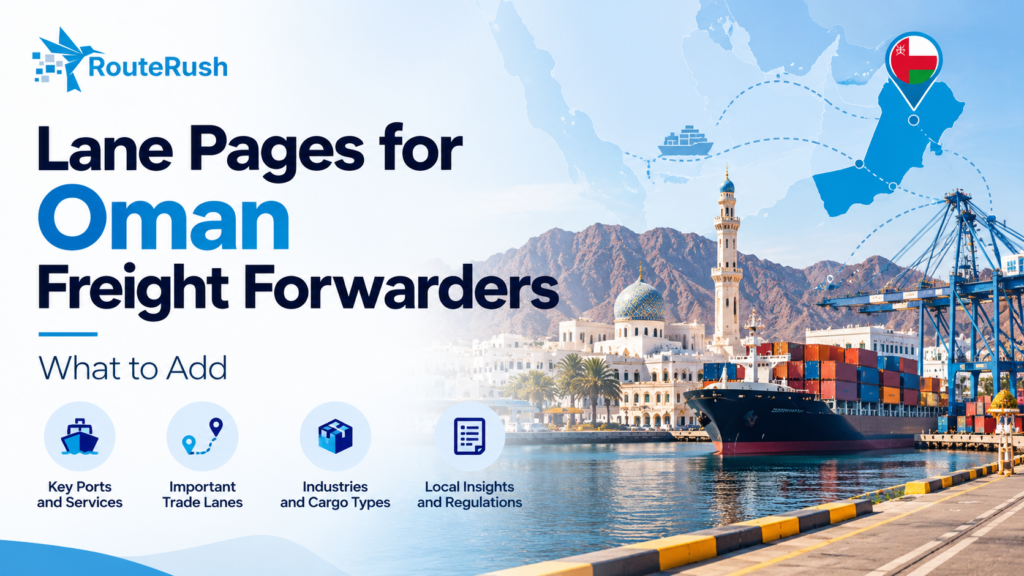
Lane Pages for Oman Freight Forwarders: What to Add
The right Oman lane page explains more than a sailing. It connects the arrival gateway, customs process, and inland journey to the warehouse or site where the customer needs the goods.
goods received
Illustrative route only. Confirm actual coverage, routing, and availability before publishing service claims.
A buyer asking for “shipping to Muscat” may need ocean freight arriving through Sohar and a truck to the receiving warehouse. Another buyer may need machinery delivered near Duqm. A third may be importing stock for a business in Salalah. These are not interchangeable delivery requests.
A helpful lane page makes those differences visible. It gives the buyer enough information to judge service fit and gives your quoting team a better starting point than “Please send your best rate to Oman.”
Build the page around the buyer's destination
Begin with the final receiving location, then describe the route that serves it. The gateway matters, but the customer usually measures success by whether the goods arrive where they can be received, stored, installed, or sold.
Oman's port network includes Sohar, Salalah, and Duqm, each of which should be named accurately when relevant to your service. Use Asyad's official ports overview for gateway context. Do not suggest that every port offers the same schedule, handling capability, or inland transport cost.
Choose priority lanes you operate and can explain in detail. A broad country page can introduce Oman coverage; individual lane pages should answer questions that differ meaningfully by origin, mode, gateway, or destination.
Show the entry point and the delivery boundary
Put the actual origin, arrival gateway, and destination coverage near the top. If the final gateway depends on the booking, explain how your team assesses it instead of presenting an unconfirmed itinerary as fixed.
For inland enquiries, request the governorate, wilayat or town, full address, location pin, and facility contact. The nearest familiar city may not reveal the distance, access conditions, or equipment needed for the final delivery.
If you offer UAE–Oman road services, describe them as cross-border movements. Identify pickup coverage, the destination, border coordination responsibilities, and the cargo or vehicle conditions your team must review.
Explain which option fits the cargo
A lane page should help a shipper narrow the options without pretending that mode selection can be reduced to one rule. Shipment size, packaging, urgency, handling, and total delivered cost all matter.
State the goods you support and those requiring review. Batteries, dangerous goods, chemicals, food, medical products, oversized machinery, and personal effects should not disappear under a general “all cargo” claim.
For machinery or project shipments, ask for packed dimensions, gross weight, lifting information, and photographs where useful. For temperature-sensitive goods, ask for the required temperature range and clarify which stages of the journey your controlled service covers.
Make transit estimates useful for planning
State precisely what your estimate measures. “Ten days” is incomplete if the buyer does not know whether the clock starts at pickup, cargo receipt, or vessel departure—and whether it stops at arrival or delivery.
Do not invent standard transit figures for an entire country pair. Use your operational records or confirmed service information, add a review date, and explain what can change the estimate.
For longer inland moves or remote locations, assess the delivery leg separately. Ask whether the facility is ready to receive the cargo and whether the necessary staff, unloading equipment, and entry arrangements will be available.
Include the cargo-ready date and required delivery date in the enquiry form. Where weather, holidays, or altered facility hours may affect the particular shipment, check the current conditions during planning rather than publishing a permanent blanket delay statement.
Explain who coordinates Bayan and the shipment documents
Buyers need a simple account of who does what. Identify the importing entity, the authorised clearance provider, and the information needed before the goods are dispatched.
Oman Customs' customs declaration service describes registration and declaration submission through Bayan, with supporting documents including a commercial invoice, origin-related certificate, and permit where required. Your page should connect that process to your actual service: who reviews the documents, who submits the declaration, and who communicates any missing requirements.
Keep customs duty, VAT, and other applicable government charges separate from brokerage and transport fees. Avoid quoting one combined percentage as if it applies to every commodity and movement. Classification, origin, value, procedure, and any qualifying relief need to be assessed for the actual shipment.
Free-zone delivery needs its own scope
If you serve a free zone or special economic zone, request the named receiving entity and facility, and ask whether the goods will remain there, move to the domestic market, or leave Oman again.
Oman's Tax Authority explains that zero-rating for qualifying Special Zone transactions is conditional. Do not translate a zone address into an automatic “no VAT” promise. Link to the authority's VAT Guide for Special Zones and have the transaction reviewed where needed.
For exports from Oman, describe the origin pickup, export documentation coordination, departure handling, and destination responsibilities. An export page should not simply reuse import instructions in reverse.
Show what the buyer is actually comparing
The most useful cost section separates the journey into understandable charge groups. It helps a customer compare proposals even when you cannot publish a dependable current rate.
State whether the quote uses OMR, USD, or more than one currency, and explain any conversion basis. If you advertise a starting price, publish its endpoints, shipment assumptions, inclusions, exclusions, and validity alongside it.
Explain how terminal storage and carrier-equipment charges can arise. Confirm the applicable free time for the actual booking and name the team responsible for monitoring cargo availability, collection, and return deadlines. Never imply that one carrier's allowance covers every shipment.
Show how the shipment reaches a usable delivery point
For a warehouse shipment, the final leg may be routine. For an industrial facility, remote site, or heavy item, receiving conditions can determine the vehicle, route, equipment, and delivery date.
Support the page with one genuine, relevant shipment example. Include the cargo type, origin, receiving-location type, challenge, and action taken. Use documented facts, avoid unsupported performance claims, and obtain customer permission where necessary.
Show the legal business name, office details, and relevant authorisations. Explain whether the lane is handled by your own team or with destination partners. Describe cargo insurance separately from carrier liability and make any offered coverage terms available.
Build an enquiry form that reduces back-and-forth
Carry the route into the form so the buyer does not have to repeat it. Ask for the information that affects the transport plan and let them select “not sure” for details they cannot yet confirm.
- Pickup and receiving points: origin address, Oman governorate or town, facility name, location pin, and any named zone.
- Cargo: product description, package count, dimensions, gross weight, units, stackability, and special handling needs.
- Timing: cargo-ready date and required delivery date.
- Commercial scope: agreed Incoterm and named place if known, plus pickup, clearance, delivery, storage, unloading, and insurance requirements.
- Intended movement: import for domestic use, zone receipt, export, temporary use, or onward movement.
- Contact: company name, business email, and preferred way to clarify the shipment.
Keep initial document uploads optional. Collect sensitive importer records and authorisations later through an appropriate secure process. If you accept WhatsApp enquiries, prefill the lane and essential shipment questions so the first message contains useful context.
Use a clear button such as “Request a Mundra–Oman Freight Quote.” Explain what follows: shipment review, confirmation of missing details, and a proposal with a defined scope. Only advertise a response-time commitment your team can maintain.
Keep lane pages useful for search and for sales
Use the actual route and service in the page title and main heading. Add concise sections answering real questions such as “Which Oman gateway will you use?”, “What does delivery include?”, and “Which documents should I prepare?” Link to related ocean, air, road, customs, and warehousing services.
Create separate pages when the content is genuinely different. A Sohar import lane with Muscat-area delivery and a project movement to Duqm may warrant different pages because the routing and receiving questions differ. Replacing city names in otherwise identical text does not provide that value.
If you publish Arabic and English versions, review the logistics terminology and keep both versions aligned. Assign an operations owner to check schedules, coverage, document guidance, and quote assumptions when they change.
Measure qualified enquiries, requests with sufficient shipment data, quotes issued, and bookings. If visitors repeatedly ask about unsupported goods or delivery areas, make those boundaries clearer on the page.
Questions Oman shippers and freight marketers ask
What is a lane page for an Oman freight forwarder?
It is a page describing a specific freight route and service, including origin coverage, the Oman entry gateway, final delivery area, transport options, responsibilities, costs, and details needed for a quote.
Should a shipping-to-Muscat page identify the arrival port?
Yes. A city delivery request does not identify the ocean gateway. Name the planned port and explain the inland movement to the receiving address, with routing confirmed for the actual booking.
How should we choose between Sohar, Salalah, and Duqm?
Assess the actual carrier service, cargo handling needs, final destination, availability, and complete transport cost. A lane page should explain the gateway used by your service rather than claiming one port is best for every shipment.
How much does freight to Oman cost?
A useful quote needs the origin, delivery location, cargo description, size, weight, timing, mode, and required services. Compare origin charges, main freight, Oman handling, clearance, government charges, and delivery together.
How long will shipping to Oman take?
Timing depends on origin preparation, transport schedules, connections, release, and final delivery. Ask whether the estimate covers only the main transport or the entire journey to the receiving location.
What is Bayan?
Bayan is Oman Customs' electronic system used for customs processes, including declaration submission. Your lane page should explain who handles the declaration and which registration, document, and representation arrangements must be confirmed.
Which documents should I prepare for an Oman import?
Start with the commercial invoice, packing information, transport details, origin information, and consignee details. The responsible clearance provider should confirm the applicable certificates, permits, and authorisations for the actual goods and procedure.
Is delivery to an Oman free zone automatically VAT-free?
No automatic conclusion should be drawn from the address alone. Special Zone VAT treatment depends on qualifying conditions and the transaction. Confirm the relevant position using current Tax Authority guidance.
Can a forwarder deliver to a remote or industrial site?
Where the service supports it, yes. Supply the exact location, access conditions, cargo dimensions, receiving contact, and unloading arrangements so the team can assess vehicles, equipment, timing, and price.
Do we need separate import and export lane pages?
Use separate pages when the services and buyer questions differ enough to justify them. If both directions share a page, clearly distinguish pickup, filing, clearance, and destination-delivery responsibilities.
Can the buyer follow the entire journey?
A useful lane page connects the gateway, paperwork, costs, and receiving conditions to a clear next step. Find the unanswered questions on your freight website.
Route examples are illustrative. Official references are linked beside the relevant topics. Confirm current shipment-specific requirements with the responsible operations, customs, and tax professionals.