
LinkedIn Lead Generation for Oman Freight Forwarders
Freight Forwarding Marketing · Oman
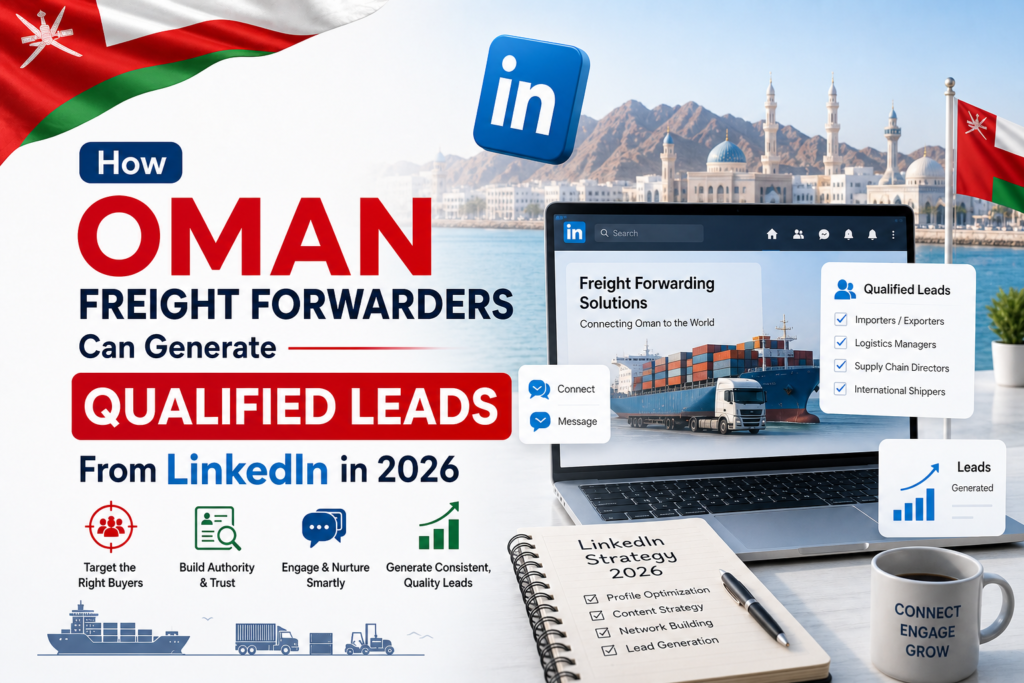
How Oman Freight Forwarders Can Generate Qualified Leads From LinkedIn in 2026
On this page
The short answerWhy LinkedIn matters in Oman Positioning your companyPersonal profile strategy Content that attracts shippersFinding qualified prospects A better outreach processOman market segments Practical examplesMetrics that matter 90-day planFrequently asked questionsShort answer: An Oman freight forwarder can generate qualified LinkedIn leads by choosing a specific shipper segment, publishing useful operational advice through a credible person, and using focused outreach to start relevant conversations. The goal is not to collect the most connections. It is to become familiar and trustworthy to the right importers, exporters, manufacturers, and project teams before they need a quote.
That sounds simple, but most freight companies reverse the order. They send a sales message first, then expect a prospect to trust a broad claim about worldwide service. A better approach is to show what you know about the prospect's cargo, route, port, customs process, or commercial pressure. When the message finally arrives, it feels connected to a real problem rather than copied from a template.
Why LinkedIn matters for freight forwarders in Oman
DataReportal's Digital 2026 Oman report says LinkedIn had 1.30 million registered members in Oman in late 2025. That was equal to 23.5% of the country's total population and 32.6% of adults aged 18 and above. These figures come from LinkedIn's advertising resources, so they describe registered members and potential ad reach, not monthly active users. That distinction matters, but the numbers still show a substantial professional audience.
The commercial setting also fits LinkedIn. Oman's logistics market includes ports, airports, industrial estates, economic zones, manufacturers, importers, and companies serving GCC trade corridors. Invest Oman, the government's investment gateway, presents logistics as a priority sector under Oman Vision 2040. The Public Authority for Special Economic Zones and Free Zones oversees Duqm, Sohar Free Zone, Salalah Free Zone, Al Mazunah, and other zones. Each cluster contains businesses that may need forwarding, customs, warehousing, project cargo, or regional distribution support.
LinkedIn will not replace referrals, trade events, email, or direct sales. It improves those channels by making expertise visible. A buyer who meets your team at an event may check the founder's profile that evening. An overseas agent may review your company page before sharing a shipment. A manufacturer receiving your email may search the salesperson's name before replying. Your presence should answer the quiet question behind each check: does this company understand freight in Oman?
Start with a clear position, not a list of services
Many forwarders describe themselves in almost identical terms: reliable, global, end-to-end, customer-focused, and cost-effective. Those phrases do not help a shipper decide when to contact you. Clear positioning tells the market what you handle especially well, for whom, and where.
For example, "freight forwarding in Oman" is too broad to guide good content or prospecting. A more useful position might be "temperature-controlled imports for food distributors through Sohar," "project cargo coordination for contractors serving Duqm," or "Oman to UAE road freight for industrial suppliers." You may provide many other services, but a narrow entry point gives prospects a reason to remember you.
We help [specific customer] move [specific cargo] through [route, port, or zone] while reducing [specific operational risk]. Support the sentence with genuine experience, licences, team knowledge, or documented examples.
Your position must be true. Do not claim specialist capability because the keyword looks attractive. If your team has limited experience in dangerous goods, pharmaceuticals, oversized cargo, or customs advice, do not imply otherwise. EEAT is not a paragraph added to the bottom of an article. It comes from showing real experience, naming the author, citing current sources, stating limitations, and keeping claims proportionate to the evidence.
Use personal profiles to build trust, then let the company page verify it
Freight buying is a business decision made between people. Put a knowledgeable person at the centre of your LinkedIn activity: a founder, commercial director, branch manager, customs specialist, or operations leader who can speak accurately. The company page still matters, but its main job is to confirm that the business behind the person is credible.
What the personal profile should show
The headline should explain who the person helps and in which part of freight, rather than simply saying "Managing Director." The About section should mention Oman, relevant ports or corridors, cargo strengths, and a clear way to make contact. The Experience section should state responsibilities and evidence without exaggeration. Add a professional photograph, company link, location, and selected work such as a practical guide, client-approved case example, event presentation, or customs checklist.
Recommendations can help, especially when they come from customers, overseas agents, or industry partners who describe a specific piece of work. Never invent recommendations or publish confidential shipment details. Ask permission before naming a customer, cargo owner, rate, volume, or incident.
What the company page should show
Keep the company description, website, Oman address, contact details, service coverage, and employee list current. Use a banner that says what the business actually does. Publish proof such as team activity, operational explainers, certifications, facility updates, and case examples. Avoid filling the page with festival greetings, stock photos, and vessel images that tell a buyer nothing about your capability.
Publish content that helps an Oman shipper make a decision
The safest content strategy is to answer questions your sales and operations teams already receive. Buyers rarely wake up wanting "thought leadership." They want to know what document is missing, why a clearance may be delayed, whether a route suits their cargo, what a handover requires, or what information a forwarder needs for an accurate quote.
Useful topics for an Oman freight forwarder include:
- Documents to check before cargo arrives at Sohar, Salalah, or Duqm
- Information needed to quote Oman to UAE road freight accurately
- When air freight may cost less overall than a delayed sea shipment
- Common causes of demurrage, storage, inspection, or documentation delays
- What importers should prepare before registering or working through Bayan
- How free-zone, local-market, and re-export movements differ in practice
- Questions to ask before moving oversized, hazardous, or temperature-sensitive cargo
- What overseas agents should include in a pre-alert for an Oman shipment
When discussing regulations, use an official source and state the review date. Oman Customs describes Bayan as its electronic single-window system. Link to the relevant Customs page rather than copying a rule from an old blog. If the answer depends on commodity, permit, origin, destination, or current procedure, say so and advise the reader to confirm the live requirement with the responsible authority or a qualified customs professional.
A format that works for technical freight content
Open with the question and give the direct answer in the first two or three lines. Add the conditions that can change the answer. Explain the process in numbered steps. Include a brief example from real work if permission and confidentiality allow. Finish with the information someone should gather or the next action they should take. This format is useful to people, easy for search engines to understand, and easier for AI answer systems to quote accurately.
Avoid pretending every post is a major insight. A clear explanation from an operations manager can be more useful than a dramatic opinion from a founder. Write in the person's natural voice. Record a short conversation with the expert, extract the practical points, confirm the facts, and let the expert approve the final post. This keeps human judgement in the work and reduces generic copy.
Build a prospect list that is small enough to understand
A qualified lead is not anyone with "logistics" in a job title. Define the account, role, need, and timing signals before searching. Start with companies that match your strongest service rather than every business in Oman.
Useful account filters include industry, location, company size, port or zone relevance, import or export activity, and likely cargo type. Useful roles may include supply chain manager, procurement manager, logistics manager, import manager, export manager, plant manager, project manager, or general manager. Job titles vary, especially in smaller businesses, so inspect the person's responsibilities instead of relying on the title alone.
Timing signals can make outreach more relevant. Look for a new facility, a free-zone announcement, a hiring drive, a product launch, expansion into Oman, a new project award, an event appearance, or a post about a supply problem. Use public information responsibly. Do not claim to know a company's shipping activity when you are only making an inference.
A list of 5,000 loosely matched contacts may create activity but little trust. A list of 100 accounts that your team understands can support better content, comments, introductions, and sales conversations.
Sales Navigator can help with filters and saved leads, but the tool does not make a message relevant. A spreadsheet or CRM with a clear account plan can outperform an expensive subscription used without discipline. Record why each account fits, who is involved, what signal you noticed, what content may help, and what the next sensible action is.
Use a conversation sequence, not a connection-and-pitch routine
Before contacting someone, review the profile, company website, recent news, and any public posts. Follow the company and the relevant people. Engage only when you can add something useful. A forced comment such as "great insights" is not relationship building.
Mention the shared market, event, route, or issue that makes the connection sensible. Keep it brief. Do not attach a brochure.
Share a checklist, answer, or observation connected to the prospect's work. Make it useful even if the person never buys from you.
Ask about a genuine operational priority. Avoid questions that can be answered by reading the company website.
If there is a real need, suggest a short call or email exchange. State what the conversation will cover and keep the promise.
A first message might say: "I saw your team is expanding distribution in Oman. We work with food importers through Sohar, so I thought your update was relevant. Are clearance documentation or inland delivery planning the bigger concern at this stage?" Use this only if every detail is true. The purpose is to open a focused conversation, not disguise a pitch.
Follow up once or twice with a useful reason. If there is no response, stop. Repeated automated messages can damage the exact reputation you are trying to build. LinkedIn's rules, privacy expectations, and local requirements still apply. Personalisation should come from genuine research, not hidden tracking or invented familiarity.
Match your LinkedIn angle to Oman's logistics clusters
Oman is not one uniform freight market. The buyer, cargo, commercial pressure, and content angle change by port, zone, and corridor. Use the table as a planning guide, then validate each assumption against your real customers and capabilities.
| Cluster | Possible audience | Useful LinkedIn angle |
|---|---|---|
| Sohar Port and Freezone | Industrial importers, manufacturers, metals, chemicals, food and regional distributors | Import preparation, industrial cargo, warehousing, UAE road links, and free-zone movements |
| Port of Salalah and Salalah Free Zone | Transshipment, re-export, consumer goods, food, and businesses serving southern Oman | Transshipment handovers, re-export documentation, regional distribution, and seasonal planning |
| Duqm | Energy, industrial projects, construction, fisheries, and project contractors | Project cargo planning, heavy equipment, site delivery, permits, and schedule risk |
| Muscat and airport cargo | Healthcare, technology, retail, urgent spares, and time-sensitive importers | Air freight decisions, cold chain, urgent clearance, and final-mile coordination |
| Khazaen and inland distribution | Warehousing, fulfilment, food, retail, and domestic distribution operators | Inventory flow, consolidation, inland transport, and distribution planning |
| Oman to UAE and GCC road corridors | Manufacturers, traders, project suppliers, and regional distributors | Border documents, truck selection, handovers, transit variables, and delivery planning |
Do not use the table to imply that every listed service is available at every location or suitable for every commodity. Port capabilities, customs procedures, carrier services, permits, and commercial conditions can change. Confirm current details through the relevant operator, Oman Customs, OPAZ, and other responsible authorities.
What good execution can look like
The scenarios below are illustrative. They show realistic strategy patterns, not verified results from named companies.
A forwarder interviews its clearance manager about the five information gaps that most often delay food import preparation. The team publishes a checklist, cites the relevant authority, and sends it only to food importers for whom it is genuinely relevant. Replies focus on documentation questions, giving the sales team a natural route into discovery.
A project logistics lead writes a short series on site surveys, lifting plans, route checks, and delivery windows. The posts do not claim that every project follows one process. They explain which variables must be checked. Contractors can see the team's reasoning before asking for capability information.
An Oman forwarder creates a pre-alert guide for overseas partners covering the information its operations team needs before arrival. Staff share it with selected network contacts and answer follow-up questions. The content supports agent relationships while also showing import competence to local buyers.
The managing director publishes a monthly note on one change affecting a defined customer segment. An operations specialist reviews every technical statement. The founder adds commercial context, while the company page stores the source links and service information prospects need to verify the business.
Measure qualified movement, not surface engagement
Likes and impressions can help diagnose distribution, but they are not the business result. Track whether the right accounts are moving closer to a useful conversation. Agree on what "qualified" means before reporting performance.
A practical monthly dashboard can include target-account profile views, connection acceptance rate, replies from relevant roles, content saves, visits to Oman service pages, discovery calls, quote requests, sales-qualified opportunities, and revenue influenced. Add notes on lead quality. Ten replies from job seekers or vendors are not stronger than two replies from suitable shippers.
Use campaign tags on website links where appropriate, record LinkedIn as a source in the CRM, and ask prospects how they found the business. Do not overstate attribution. A prospect may have seen a post, met the team at a conference, received a referral, and then searched Google before calling. LinkedIn may influence the decision without being the only source.
Reasonable expectations
A new profile may begin receiving relevant engagement within several weeks, but a freight sales cycle can take longer. Judge the system over at least 90 days, then continue if account quality and conversations are improving. No responsible agency can guarantee a fixed number of qualified leads without understanding your market, offer, reputation, resources, and definition of a lead.
A 90-day LinkedIn plan for an Oman freight forwarder
Choose one priority segment. Interview sales and operations. Update the lead profile and company page. Define qualification criteria, proof points, approval rules, and baseline metrics. Build the first 50 target accounts.
Post two useful pieces each week. Rotate direct answers, checklists, process explainers, and anonymised lessons. Follow target accounts and note recurring questions. Avoid pitching everyone who engages.
Contact a small number of well-matched people each day. Use account context, offer something relevant, and record the result. Ask operations to answer technical questions before sales makes commitments.
Compare topics, audiences, replies, calls, and opportunities. Keep the combinations producing qualified movement. Change weak positioning or targeting before simply increasing volume.
Frequently asked questions
Does LinkedIn work for freight forwarding lead generation in Oman?
Yes, when the target buyer uses LinkedIn and the forwarder has a clear reason to be contacted. Oman had 1.30 million registered LinkedIn members in late 2025 according to DataReportal. Results still depend on audience fit, expertise, offer, consistency, and follow-up.
Should a freight forwarder post from a personal profile or company page?
Use both for different jobs. A knowledgeable person's profile should lead expert conversation and relationship building. The company page should verify the business through accurate service, location, team, contact, and proof information.
How often should an Oman freight forwarder post on LinkedIn?
Two strong posts per week is a sensible starting point for many small teams. Publish only as often as you can maintain accuracy and usefulness. One specific expert post is better than five generic promotional posts.
What should freight forwarders in Oman post about?
Answer real shipper questions about documents, customs preparation, ports, routes, cargo handling, transit variables, free-zone movements, and quote requirements. Focus on the cargo types and corridors your team genuinely understands.
Should LinkedIn content be in English or Arabic?
Choose language based on the people you need to reach. English is widely used across international logistics, while Arabic may better serve some local buyers and government-facing topics. A bilingual approach can work if both versions are professionally reviewed rather than translated word for word without context.
Is Sales Navigator necessary?
No. It can make account and role research easier, especially for a larger prospecting programme, but good qualification and relevant outreach matter more than the subscription. Start with a clear target market and process.
Can we automate LinkedIn outreach?
Automation may increase volume, but it can also create irrelevant messages, platform risk, and reputational damage. For a relationship-led freight market, careful research and smaller batches are usually safer. Follow LinkedIn's current rules and applicable privacy requirements.
How long does it take to generate qualified leads?
Relevant conversations may begin in weeks, but evaluate a new programme over at least 90 days. The sales cycle may be longer where contracts, tenders, vendor registration, credit approval, or operational testing are involved.
How does EEAT apply to a freight forwarding blog?
Show real operational experience, identify the author and reviewer, cite official sources, distinguish fact from opinion, update time-sensitive details, protect client confidentiality, and avoid guarantees. Accurate limitations strengthen trust.
Want to know where your LinkedIn presence and website lose freight prospects?
Get a Freight Growth Score for a focused review of your visibility, trust signals, and conversion path.
Get Your Free Freight Growth ScoreAnshul Kuntewar
Founder of RouteRush, a digital marketing agency specialising in SEO, LinkedIn strategy, and lead generation for freight forwarders and logistics companies across Oman and international markets.
Sources and review note: Audience data: DataReportal, Digital 2026: Oman. Logistics and investment context: Invest Oman and OPAZ. Customs platform reference: Oman Customs. LinkedIn context: LinkedIn Marketing Solutions. Reviewed 13 August 2026. Platform features, audience figures, port services, and customs requirements can change. Confirm current operational and regulatory details with the responsible authority.