
How Freight Forwarders in Qatar Can Compete With Global Players
Freight Forwarding Marketing · Qatar
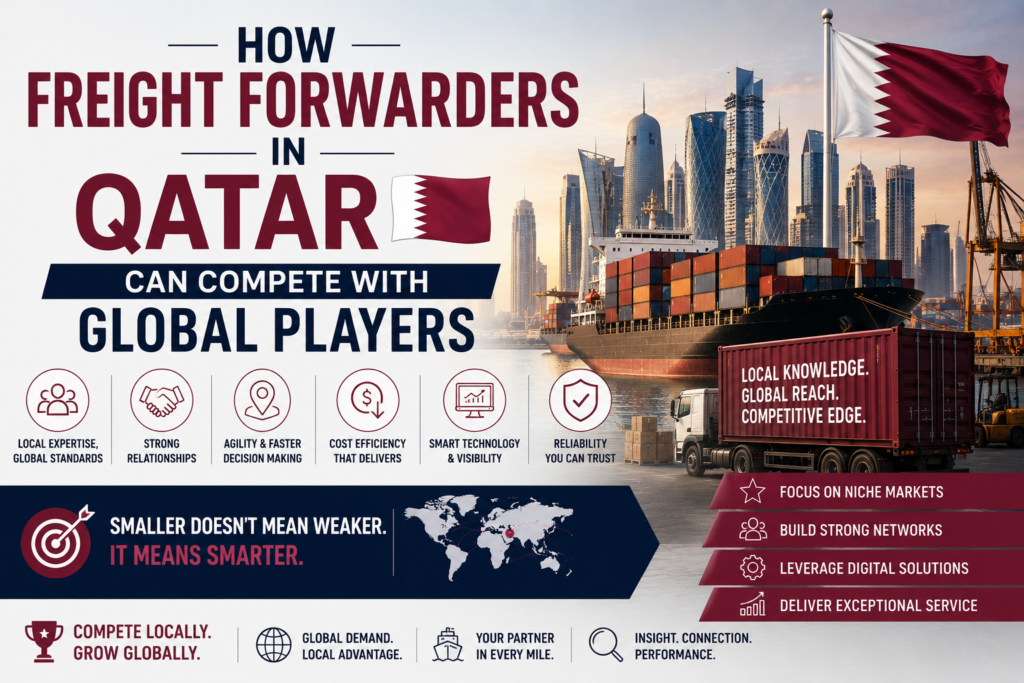
How Freight Forwarders in Qatar Can Compete With Global Players
On this page
Why This Matters Right Now Real Pain Points Where Smaller Forwarders Win Step-by-Step Process Examples in Practice Ports & Corridors Tools Checklist FAQsQatar recently cut free-zone land rents and launched a $1 billion incentive programme to attract international logistics operators. Cargo arriving by sea at Hamad Port can now reach markets across the Gulf, the Middle East, Africa, and Europe within four to eight hours via Hamad International Airport — a single, integrated logistics corridor few markets can match.
Why This Matters Right Now
Qatar's freight and logistics market is worth an estimated $10.7-14.7 billion in 2026 depending on the scope measured, growing at somewhere between 5.5% and 6.8% annually through the early 2030s. Sea and inland waterways freight forwarding represented nearly 72% of forwarding revenue in 2025, capitalizing specifically on Hamad Port's schedule reliability and integrated free-zone services that de-risk supply chains for shippers wary of Suez or Hormuz exposure.
Air freight forwarding is growing even faster, at a projected 5.55% CAGR through 2031, driven by electronics, pharmaceuticals, and other high-value cargo increasingly routed through Hamad International Airport's expanding capacity. Investment in logistics technology specifically has already reached roughly QAR 1 billion and is expected to double, reflecting how quickly the operational bar is rising across the sector.
That's a real advantage for the market as a whole, but it's also an open invitation for more global competition, not less. DHL, Kuehne+Nagel, DB Schenker, and Maersk already operate in Qatar alongside two dominant local players worth understanding specifically: Gulf Warehousing Company (GWC), Qatar's own homegrown logistics champion with deep bonded-warehouse and contract-logistics infrastructure, and Milaha (Qatar Navigation QPSC), the state-linked shipping and logistics conglomerate. A smaller or newer forwarder in Qatar isn't just competing with international giants — they're competing with a well-established, well-resourced domestic incumbent too.
Real Pain Points Qatari Forwarders Are Actually Navigating
Ministerial Decision No. 9 of 2023 requires all licensed road freight operators to equip vehicles with GPS tracking and maintain real-time data sharing with the National Transport Monitoring Center — a real ongoing cost harder to absorb at smaller scale.
Legacy system integration requires ERP upgrades many smaller freight forwarders struggle to finance — a gap that can directly threaten Authorized Economic Operator eligibility.
GWC, DHL, and Milaha already hold multi-year dedicated contract logistics arrangements with major energy, retail, and industrial clients — a hard segment to break into through price alone.
Qatar's $1 billion incentive programme means established domestic forwarders now face fresh, incentivized global competition in the free-zone segment.
Freight via Abu Samra/Salwa on the Saudi border is a smaller, specialized mode most large integrators' marketing rarely addresses in detail.
Growing e-commerce demand is pushing shippers toward long-term warehousing partnerships and dedicated fleet arrangements rather than one-off shipments.
Where Smaller Forwarders Actually Win
A smaller forwarder can move faster to establish a presence within Ras Bufontas or Umm Alhoul than a large multinational's slower internal approval processes typically allow.
With most competitors' attention concentrated on Hamad Port and the airport, genuine land-border mastery offers something both global integrators and GWC's sea/air focus don't emphasize.
Smaller or newer shippers are often a lower priority for GWC's dedicated relationships — exactly the account a nimble forwarder can serve well.
A forwarder who has genuinely solved this problem can turn it into a visible trust signal precisely because the difficulty is well known industry-wide.
A Practical Process to Compete Online
Stating GPS tracking compliance and completed ERP integration directly addresses a documented, real barrier.
Documentation, transit times, and how it complements sea and air fills a gap most competitors don't address.
Fresh enough that most local competitors haven't updated their positioning to reflect it yet.
Content aimed at growing e-commerce retailers and mid-sized importers reaches the segment least likely to be locked in.
Qatar's national advantage only helps you if shippers know you can actually execute on it.
Being the clear source on pre-arrival declaration or AEO eligibility builds authority in a confusing, recently changed area.
Competes more directly for the same evolving demand pushing the market toward long-term arrangements.
Tells you where to focus content and positioning next.
Examples in Practice
The following are illustrative scenarios based on common patterns in the Qatari logistics sector, not verified case studies of specific named companies.
A forwarder positioning around ERP and AEO compliance. Making its AEO-eligible compliance status a headline trust signal directly addresses a documented industry pain point shippers are increasingly aware of.
A forwarder building genuine Abu Samra land corridor expertise. A dedicated page explaining Saudi border documentation captures enquiries from shippers who specifically need this corridor and can't find detailed guidance elsewhere.
A forwarder entering the free-zone conversation early. Explicitly mentioning support for shippers relocating into Ras Bufontas or Umm Alhoul captures search interest before most local competitors update their messaging.
A forwarder targeting shippers outside GWC's dedicated-contract base. Specific outreach to growing e-commerce retailers and mid-sized importers positions the company as a flexible alternative for an underserved segment.
Ports & Corridors: What Your Positioning Should Address
| Port / Corridor | What matters most to shippers here right now |
|---|---|
| Hamad Port, Umm Al Houl | Schedule reliability and integrated free-zone services that de-risk supply chains from Suez or Hormuz exposure |
| Hamad International Airport Cargo | A $1.2B capacity expansion toward 5 million tonnes annually, plus niche live-animal handling capability |
| Doha Port | Legacy cargo and maritime tourism operations, with longer-established institutional forwarder relationships |
| Mesaieed Port (Umm Said) | Industrial and petrochemical cargo, with Mesaieed Industrial City attracting new distribution center investment |
| Ras Laffan Port | The cornerstone of Qatar's LNG expansion — a narrow, highly technical energy-logistics buyer segment |
| Al Ruwais Port | Regional trade and refrigerated food imports from neighboring countries |
| Abu Samra / Salwa (land border) | Qatar's only land freight corridor, connecting to Saudi Arabia and the wider GCC road network |
| Ras Bufontas & Umm Alhoul Free Zones | Bonded warehousing and near-dock manufacturing, now under a fresh $1B international incentive programme |
Tools That Help Level the Playing Field
GPS tracking and National Transport Monitoring Center integration under Ministerial Decision No. 9
ERP systems supporting pre-arrival declaration, protecting AEO eligibility
Blockchain-enabled bills of lading and instant quoting portals, increasingly standard at Hamad Port
Google Search Console and local SEO tools for Abu Samra and free-zone-specific searches
A simple system to track enquiries by corridor and shipper segment
LinkedIn and local directories for the international operators Qatar is actively attracting
The Competing-Online Checklist
- Compliance with Ministerial Decision No. 9's GPS tracking requirements is stated clearly, not assumed
- Pre-arrival declaration and AEO-eligible ERP integration status is visible as a trust signal
- A dedicated page exists explaining Abu Samra/Salwa land corridor documentation and transit times
- Positioning references the current free-zone incentive programme where relevant
- Content or outreach specifically targets shippers underserved by GWC's large dedicated contracts
- Your ability to move cargo through the integrated Hamad Port-airport corridor is explained, not just claimed
- Content exists explaining Qatar's customs modernization in plain language
- Enquiries are tracked by corridor and compliance concern to guide ongoing focus
Frequently Asked Questions
Can a smaller Qatari forwarder really compete with DHL, Maersk, or GWC online?
Yes, particularly around Abu Samra land-corridor expertise, visible compliance with recent regulatory changes, and serving shippers GWC's large dedicated contracts don't prioritize — areas where global integrators' broad presence and GWC's contract-locked capacity both leave genuine room.
Is GWC actually a bigger competitive concern than DHL or Maersk for a local forwarder?
In some segments, yes — GWC's deep bonded-warehouse infrastructure and multi-year contract logistics relationships with major energy and retail clients make it a formidable domestic incumbent specifically for larger, established shippers. Smaller and newer shippers, however, are often a lower priority for that kind of large-contract relationship.
How real is the ERP/AEO compliance barrier for smaller forwarders?
Genuinely real — industry analysis specifically identifies legacy customs system integration and the ERP upgrades it requires as a financing challenge for smaller freight forwarders that can threaten their AEO eligibility if unaddressed.
Is the Abu Samra land corridor a significant enough opportunity to build content around?
Yes, precisely because it's Qatar's only land freight corridor and receives comparatively little dedicated marketing attention from most forwarders, whose focus concentrates on Hamad Port and the airport.
How should a smaller forwarder respond to Qatar's new free-zone incentive programme?
By updating positioning to explicitly address it if relevant to your services — international operators researching Qatar because of the incentive programme are actively searching for local partners right now, and most established competitors haven't yet updated their own messaging.
Should a smaller forwarder try to compete on air freight given Hamad International Airport's expansion?
Selectively, rather than broadly. The airport's growing capacity suits specific high-value or time-sensitive cargo well, but competing head-on for general cargo is harder than finding a specific, underserved niche within that growth.
Does Qatar's small market size limit how much a smaller forwarder can realistically grow through these strategies?
It shapes the strategy rather than limiting it outright. Being genuinely excellent and visible in two or three specific niches captures a meaningful share of a smaller total pool more effectively than trying to compete broadly across every service line at once.
Want a full audit of how your positioning compares to what shippers are searching for?
We'll identify your highest-leverage gaps and build a prioritized plan to close them.
Request Your Free Website & SEO AuditAnshul Kuntewar
Founder, RouteRush Digital Marketing Agency — specialising in SEO, website strategy, and lead generation for freight and logistics companies across Qatar, the UAE, Oman, India, South Africa, and Australia, working directly with freight forwarders and CHAs to compete effectively against much larger competitors online.
This guide reflects Qatar freight, customs, and free-zone market data current as of mid-2026, sourced from Mordor Intelligence, MarkWide Research, and recent reporting on Qatar's free-zone incentive programme. Figures for DHL, Maersk, and GWC are cited for market context only and are drawn from publicly available industry reporting.