
How Small Freight Forwarders Can Compete With DHL Online
Freight Forwarding Marketing · Global Pillar Guide
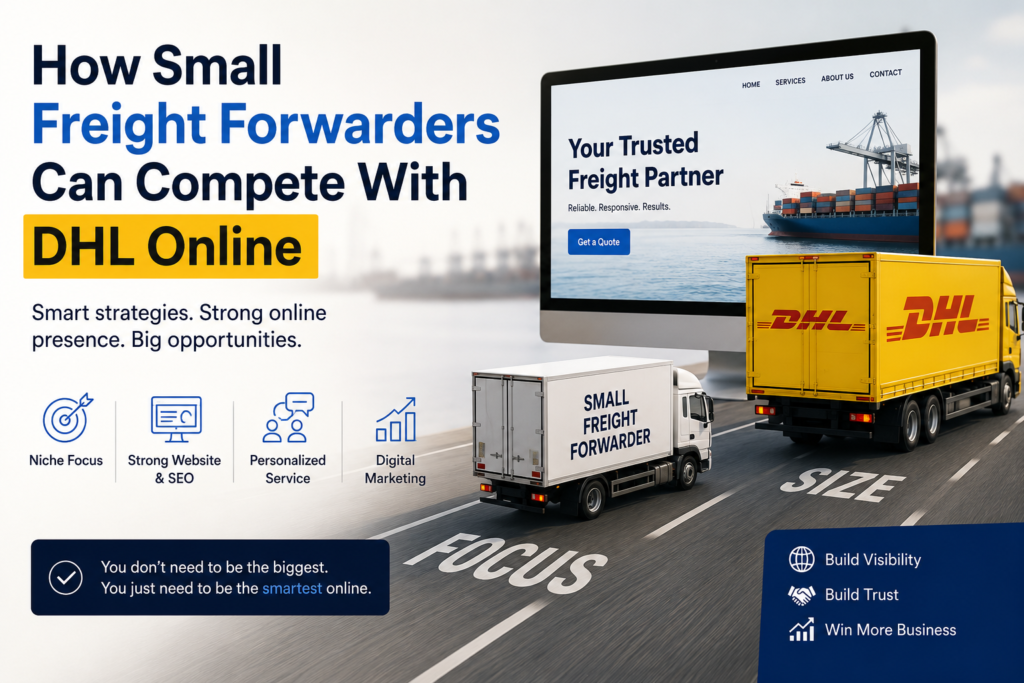
How Small Freight Forwarders Can Compete With DHL and Allcargo Online
On this page
Why This Matters Common Mistakes Your Real Advantages Step-by-Step Process Examples in Practice Tools Checklist FAQsA freight forwarder with 12 employees and a forwarder with 12,000 employees are now competing for exactly the same Google search — "freight forwarder near me," "ocean freight quote," "customs clearance agent." Search engines don't rank by company size. They rank by relevance, trust signals, and how well a page answers the question someone actually typed.
Why This Matters
The global freight forwarding market is worth an estimated $225.4 billion as of 2025, climbing toward $235.2 billion in 2026. It's also genuinely fragmented — DHL ranks second globally in both air and ocean freight forwarding, behind Kuehne+Nagel, and competes closely with DB Schenker and DSV for the top position depending on the report and methodology used. Beyond that handful of global integrators sits, in the words of one major market research firm, "a broad spectrum of major regional and specialized players" who collectively handle a substantial share of global freight volume. Small and mid-sized forwarders aren't a rounding error in this market. They're the majority of it.
Allcargo is a useful example of how this plays out in practice. Founded in Mumbai in 1993, the group built its international business — now operating as Allcargo Global through its ECU Worldwide subsidiary — around NVOCC LCL and FCL consolidation, and only recently restructured into separate listed entities to sharpen its focus. Even a company of that scale operates in specific service lines, not everywhere, doing everything, for everyone. That's true of every large forwarder. The question for a small forwarder isn't "how do we become DHL." It's "where does DHL's model leave gaps we can fill better."
This dynamic plays out differently depending on where in the world a forwarder operates, but the underlying pattern holds everywhere. In markets with dense port infrastructure and a large existing base of forwarders — parts of India, the Gulf, and coastal China, for example — the competitive pressure from other small and mid-sized forwarders is often more immediately relevant than pressure from a global integrator, simply because there are more of them competing for the same local searches. In smaller or newer markets, a large integrator's brand recognition matters more, but so does the fact that they typically have far less locally-specific content and far fewer dedicated local pages than a genuinely local competitor could build. Either way, the opportunity is the same: local and niche specificity beats broad global reach for the searches that actually convert.
Common Mistakes Small Forwarders Make Online
Most small forwarders don't lose online business to DHL or Allcargo directly. They lose it to their own website and their own habits.
Stock photos of containers and vague claims like "global network, local expertise" read as an attempt to impersonate a multinational — and offer none of the actual advantages either size has.
"We handle all cargo types to all destinations" is technically true for most forwarders and differentiates none of them.
One generic "Services" page instead of dedicated pages for specific ports and routes makes you invisible to the exact searches that would convert best.
No IATA/FIATA/AEO credentials, no client count, no reviews — large integrators don't need to prove legitimacy; smaller forwarders do.
A quote request left unanswered for two days signals inattention, even when that's not true — and the visitor has usually already moved on by the time you reply.
No blog, no guides, no answers to real customer questions — meaning Google has nothing to rank you for beyond your homepage.
The Structural Advantages You Actually Have
None of this is about competing on DHL's or Allcargo's terms. It's about recognizing where a smaller forwarder is structurally better positioned, not just cheaper.
A large integrator's pricing and exception-handling moves through layers built for consistency at scale. A small forwarder's owner can often solve a problem in the same conversation.
Many shippers specifically want to speak to the same person every time, not a rotating account queue — difficult for a large org by design, easy for a small one by default.
A large integrator must be broadly competent everywhere. A small forwarder can be the best specifically for one cargo type or corridor — and narrow expertise reads as more credible to a buyer with that specific need.
Large integrators optimize for volume shippers; a small or irregular shipper can be low priority to them. A smaller forwarder can build pricing specifically around that overlooked segment.
Port-specific congestion patterns and local trucking relationships are genuinely difficult for a global integrator to match at the same granular level.
A Practical Process to Compete Online
Choose a cargo type, trade lane, or industry vertical you're genuinely strong in, and make it the center of your homepage, not a footnote.
One page per major port and lane you handle — this lets you rank for the exact searches a large integrator's generic global pages rarely target directly.
Credentials, years in business, and shipment volume near your quote button, not buried on an About page.
A handful of specific, detailed reviews builds more trust with a skeptical first-time visitor than any homepage copy claiming reliability.
A stated response-time promise sets an expectation you can be held to — and meeting it consistently becomes a genuine differentiator.
Customs documents needed, average transit times, what to do about delays — exactly the practical depth large integrators' corporate-toned sites rarely go into.
A fast, low-friction way to ask a first question is a genuine advantage smaller, personally-run forwarders can execute better than call-center-style operations.
Your budget goes further chasing warm, already-interested visitors back to a quote form than building broad brand recognition.
Track every client and referral source in a CRM, however simple, so relationships survive staff turnover.
Measure enquiries by source and put more effort into whichever channel is already producing qualified leads.
What This Looks Like in Practice
The following are illustrative scenarios based on common patterns in the industry, not verified case studies of specific named companies.
A five-person forwarder specializing in perishables. The homepage leads with "Reefer & Perishables Freight Forwarding — [Port Name] to Europe," includes a dedicated cold-chain documentation page, and displays a stated 2-hour quote turnaround. A shipper searching "reefer freight forwarder [port name]" finds this page ranking above generic global logistics sites, because nothing on a large integrator's homepage targets that search as directly.
A regional forwarder building local SEO around three ports. Rather than claiming national coverage, the site builds a detailed page for each of the three ports it genuinely operates strongly in. Search visibility for those port-specific searches climbs because the pages are unambiguously the most relevant result — something a single "we serve the whole country" page can't replicate.
A newer forwarder using WhatsApp for first-contact speed. Instead of a contact form with a 24-48 hour reply window, a visible WhatsApp link and same-hour replies during business hours measurably improve conversion on urgent enquiries, since speed of first response often matters more than brand recognition for a time-sensitive booking.
A mid-sized forwarder consolidating scattered content into a real knowledge base. A structured library of guides — customs checklists by country, transit times by lane, what to do when a shipment is delayed — starts appearing for dozens of long-tail queries a large integrator's generic content doesn't address, becoming an ongoing source of enquiries with no added ad spend.
Tools That Help Level the Playing Field
Google Search Console (free), Ahrefs or SEMrush for identifying real customer searches
A fully completed Google Business Profile with accurate service areas and regular posts
A review-collection workflow paired with visible Google or Trustpilot reviews on-site
Even a maintained spreadsheet, or HubSpot's free tier, to move relationships into a shared system
WhatsApp Business for fast, trackable first-contact conversations
A simple CMS (WordPress, Webflow) for adding port/route pages without a developer
Google Ads and LinkedIn Ads for budget-controlled campaigns focused on your niche
The Competing-Online Checklist
- Homepage leads with a specific niche, not generic "global logistics" language
- Dedicated pages exist for each core port, route, and cargo type
- IATA/FIATA/AEO credentials and years in business are visible near the quote button
- At least 10-15 genuine client reviews are collected and displayed
- A stated response-time promise is published and consistently met
- At least one piece of practical, question-answering content is published monthly
- WhatsApp or live chat is active and monitored during business hours
- Retargeting ads are running for visitors who didn't convert on their first visit
- Client and referral relationships live in a shared system, not one person's memory
- Enquiry sources are tracked monthly to see what's actually working
Frequently Asked Questions
Can a small freight forwarder really compete with DHL or Allcargo online?
Yes, for the searches that matter most to a small forwarder's growth — specific, local, route- and niche-focused searches — because large integrators' broad, corporate websites rarely target these as precisely as a focused smaller competitor can. Competing for broad, generic global searches is a different, much harder game that isn't usually where a small forwarder's growth should come from anyway.
What's the single highest-impact thing a small forwarder can do first?
Build dedicated pages for the specific ports, routes, and cargo types you actually handle well, and make sure your trust signals (credentials, reviews, response-time promise) are visible on those pages. This alone addresses the two most common gaps in small forwarder websites.
Is it worth trying to rank for broad terms like "freight forwarder" globally?
Generally no — those searches are dominated by the largest, most established players and rarely convert well even when won. Ranking for specific, intent-rich searches ("LCL freight forwarder [port] to [destination]") is both more achievable and more likely to convert.
How important are Google reviews compared to a polished website?
Very important, and often underrated. A visitor comparing several forwarders in one sitting uses reviews as a fast trust check — a handful of specific, detailed reviews frequently outweighs a more polished but review-free website.
Should a small forwarder try to match large competitors on price?
Not usually as a primary strategy. Price matters, but a small forwarder competing purely on price is competing on the one dimension where scale genuinely helps large integrators most. Specialization, responsiveness, and service quality are generally more sustainable differentiators.
How long does it take to see results from this kind of strategy?
Local and niche-specific SEO improvements typically show measurable movement within 2-3 months, while content and reputation-building compound over 6-12 months. Paid retargeting can show results within weeks, since it's working with visitors who already showed interest.
Does a small forwarder need a big marketing budget to compete?
No — many of the highest-impact steps (niche positioning, trust signals, review collection, WhatsApp responsiveness) cost time and consistency more than money. Paid advertising can accelerate results but isn't required to start.
What if our website already looks professional but still isn't generating enquiries?
A polished design with generic copy is one of the most common patterns behind underperforming forwarder websites. Looking professional and being specific are two different things — check whether a first-time visitor can tell, within five seconds, exactly what you specialize in and whether you serve their route, before assuming the issue is visual design.
Is it better to compete against large integrators directly, or avoid their search terms entirely?
Avoid their search terms mostly, not entirely. Trying to outrank a global integrator for a broad, generic term is rarely worth the effort for a small forwarder. Redirecting that same effort toward specific, high-intent searches tied to your actual niche produces better results with a fraction of the competition.
What should a small forwarder do if they've tried competing broadly and it hasn't worked?
Narrow, rather than broaden. The most common reason this strategy underperforms is that a forwarder tries to compete on too many fronts at once instead of picking one or two ports, routes, or cargo specializations and genuinely owning them online first.
Want a full audit of where your website stands against this checklist?
We'll identify your highest-leverage gaps — niche positioning, port pages, trust signals, or response speed — and build a prioritized plan to close them.
Request Your Free Website & SEO AuditAnshul Kuntewar
Founder, RouteRush Digital Marketing Agency — specialising in SEO, website strategy, and lead generation for freight and logistics companies across India, the UAE, Oman, South Africa, Qatar, and Australia, working directly with freight forwarders and CHAs to compete effectively against much larger competitors online.
This guide reflects freight forwarding market and company data current as of mid-2026, sourced from Grand View Research, GMI Insights, Straits Research, and public company filings. Company figures for DHL and Allcargo are cited for market context only and are drawn from publicly available financial reporting.