
How Small Freight Forwarders in South Africa Can Compete With DHL and Bidvest
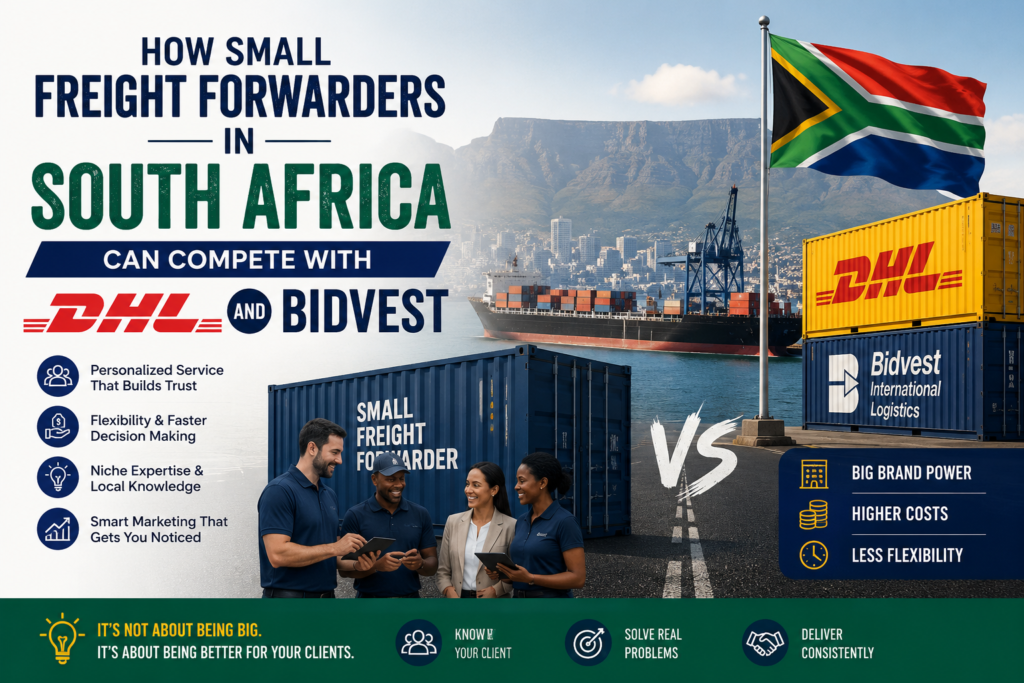
Freight Forwarding Marketing · South Africa
How Small Freight Forwarders in South Africa Can Compete With DHL and Bidvest
On this page
Why This Matters Right Now Real Pain Points Where Small Forwarders Win Step-by-Step Process Examples in Practice Ports Tools Checklist FAQsDurban was recently ranked the world's most-improved port by the World Bank and S&P, with its performance score surging 479 points in 2025. As of February 2026, 79 ships carrying roughly 145,000 containers were still queuing for berths across Durban, Ngqura, Cape Town, Port Elizabeth, and Richards Bay. Both of these things are true at once.
Why This Matters Right Now
Transnet's eight commercial seaports handled more than 300 million tonnes of cargo in the 2025/26 financial year — the strongest cargo throughput growth since 2011/12. That's genuine progress. It's also not the whole picture: years of underinvestment in equipment, ongoing energy instability, and rail capacity that's pushed more volume onto already-strained roads mean quayside gains don't always translate into faster cargo flow inland.
Bidvest International Logistics has weathered all of this from a position of enormous scale — founded in 1910 as part of what's now the 137,000-employee, JSE-listed Bidvest Group, with a presence at every major South African port and airport and, through its EMO Trans partnership, access to 250 offices in 120 countries. DHL operates as one of the two or three largest global integrators in air and ocean freight forwarding worldwide. Between them, these names are often the first a shipper encounters when searching online. But South Africa's current logistics reality — congested ports recovering unevenly, a newly liberalized rail sector, and volatile cross-border corridors — is creating openings that reward agility and local corridor knowledge more than raw scale.
Real Pain Points South African Forwarders Are Actually Navigating
Even with Durban's Pier 2 receiving an R11 billion investment to lift capacity from 2 million to 2.8 million TEUs, weather delays and anchorage congestion still appear at several terminals.
Beitbridge saw a 30-40% spike in dwell times during 2024 disruptions, forcing costly reroutes through Lebombo — while the new Kazungula one-stop border post is cutting dwell by up to 40% elsewhere.
Private operators now running on national rail infrastructure outperform state-run services on dwell time and cost, but cable theft and aging rolling stock continue to constrain reliability.
Cable theft affecting rail reliability, and hijacking risk on corridors like the chrome route between Steelpoort and Maputo, are ongoing operational concerns, not hypothetical ones.
The Kasumbalesa crossing on the Zambia-DRC corridor remains the region's worst bottleneck, with crossings taking up to two and a half days and queues stretching 40km.
Eight international shipping lines were referred to the Competition Tribunal in December 2025 over alleged price-fixing — an environment where transparent smaller-forwarder pricing becomes a real selling point.
Where Small South African Forwarders Actually Win
A small forwarder's ops lead can decide to reroute through Lebombo instead of a congested Beitbridge in the same conversation a shipper raises the concern.
Forwarders who've proactively built relationships with newly licensed rail operators can offer a faster, cheaper alternative before this becomes common industry knowledge.
Knowing in real time whether Beitbridge, Kazungula, or Lebombo is the better routing choice this month is easier to maintain for a smaller, hands-on forwarder.
With major shipping lines under regulatory scrutiny for alleged price-fixing, a smaller forwarder who explains their rates clearly has a real trust advantage.
A Practical Process to Compete Online
A regularly updated note on Durban or Ngqura berth queues builds more trust than a generic "reliable service" claim.
A dedicated page on current Beitbridge, Kazungula, and Lebombo conditions speaks to a shipper's real, current anxiety.
Still novel enough that stating it plainly differentiates you immediately.
A visible statement on cable-theft-related delays or corridor security answers a real, current concern.
Clearly explained rates build trust vague "competitive pricing" claims can't, especially amid carrier price-fixing scrutiny.
Naming each port with current operating conditions beats a single generic "nationwide coverage" page.
When disruption hits mid-shipment, a shipper needs to reach a decision-maker fast.
Tells you where to focus content and positioning next.
What This Looks Like in Practice
The following are illustrative scenarios based on common patterns in the South African logistics sector, not verified case studies of specific named companies.
A forwarder building border-crossing content for mining exporters. Regularly updated notes comparing Beitbridge, Kazungula, and Lebombo conditions give a mining exporter genuinely current guidance a larger competitor's static regional page doesn't offer.
A forwarder positioning around an early private-rail partnership. "Now offering private rail freight — faster dwell times, lower cost than road" captures shippers actively looking for alternatives to congested road corridors.
A forwarder addressing port congestion proactively. A short, regularly updated note on Durban and Ngqura berth queue conditions builds trust with shippers who've already seen the public reporting on vessel queues.
Ports: What Your Positioning Should Actually Address
| Port | What matters most to shippers here right now |
|---|---|
| Port of Durban, KwaZulu-Natal | Active communication about Pier 2 capacity gains versus ongoing berth queue reality |
| Port of Ngqura (Coega), Eastern Cape | Realistic buffer-time guidance given recent vessel queuing alongside Durban |
| Port of Cape Town, Western Cape | Throughput has beaten forecasts by up to 62% — positioning around reliable fruit-export capacity |
| Port Elizabeth (Gqeberha), Eastern Cape | Automotive component shippers needing predictable inland connection despite regional congestion |
| Richards Bay, KwaZulu-Natal | A R127 billion Transnet upgrade plan through 2031 — long-term bulk export capacity growth |
| Saldanha Bay, Western Cape | Technical, specialized iron ore and offshore energy cargo needing precise scheduling |
| East London, Eastern Cape | Automotive export reliability via South Africa's only river port |
| Mossel Bay, Western Cape | Specialized offshore oil and LNG logistics, low-volume but highly technical |
Tools That Help Level the Playing Field
Public Transnet berthing data and border-post reporting for current, not outdated, guidance
WhatsApp or a direct line for fast rerouting conversations during disruption
Google Business Profile and local SEO for port and corridor-specific searches
A simple system to track enquiries by corridor and cargo type
Genuine, specific client reviews alongside transparent pricing claims
A relationship with a licensed private rail operator — genuinely novel right now
The Competing-Online Checklist
- Homepage or a dedicated page addresses current port congestion honestly, not with a generic reliability claim
- Border-crossing-specific content exists for Beitbridge, Kazungula, and Lebombo conditions where relevant
- Any relationship with a private rail operator is stated explicitly, not left implied
- Cargo security and contingency planning are addressed directly for high-value or theft-risk corridors
- Pricing structure is explained transparently, not just claimed as "competitive"
- Each core port you serve has its own dedicated page with current, specific conditions
- WhatsApp or a direct line is available for urgent rerouting conversations
- Enquiries are tracked by corridor and cargo type to guide ongoing focus
Frequently Asked Questions
Can a small South African forwarder really compete with DHL or Bidvest online?
Yes, particularly around real-time port and border conditions, private rail partnerships, and cargo security planning — areas where a smaller forwarder's agility and current, hands-on corridor knowledge genuinely outperforms a large integrator's standardized, slower-moving process.
Is the newly liberalized rail sector actually a realistic opportunity for a small forwarder?
Yes — rail liberalization is recent enough that most shippers and even many forwarders haven't fully adjusted to it. A forwarder who proactively builds a relationship with a licensed private operator and publicizes it clearly has a genuine, currently underused differentiator.
How much does port congestion actually matter if Durban's performance has improved?
Both things are true at once — Durban's ranking as the world's most-improved port reflects real progress, but 79 ships queuing across South African ports as of early 2026 shows the improvement hasn't fully closed the gap yet. Shippers need a forwarder who acknowledges this honestly and plans buffer time accordingly.
Should a small forwarder try to cover every South African port and every SADC border crossing?
No — focus on the two or three ports and corridors where you have genuine, current operational knowledge, and build specific, regularly updated content around them rather than trying to speak generically to the whole region at once.
How long does it take to see results from this kind of positioning?
Most forwarders see measurable movement in corridor- and port-specific search visibility within 2-3 months, with authority-building content around border conditions and rail alternatives compounding over 6-12 months.
Want a full audit of how your positioning compares to current market conditions?
We'll identify your highest-leverage gaps and build a prioritized plan to close them.
Request Your Free Website & SEO AuditAnshul Kuntewar
Founder, RouteRush Digital Marketing Agency — specialising in SEO, website strategy, and lead generation for freight and logistics companies across South Africa, the UAE, Oman, India, Qatar, and Australia, working directly with freight forwarders and CHAs to compete effectively against much larger competitors online.
This guide reflects South African port, rail, and cross-border freight data current as of mid-2026, sourced from Container Management's Transnet berthing schedule analysis, Mordor Intelligence's South Africa Cross-Border Road Freight Transport Market report, and industry reporting from African Cargo and Bulk Handling and Metal.com. Figures for DHL and Bidvest are cited for market context only and are drawn from publicly available reporting.