
Small Freight Forwarders in UAE vs. DHL & Aramex Online
Freight Forwarding Marketing · UAE
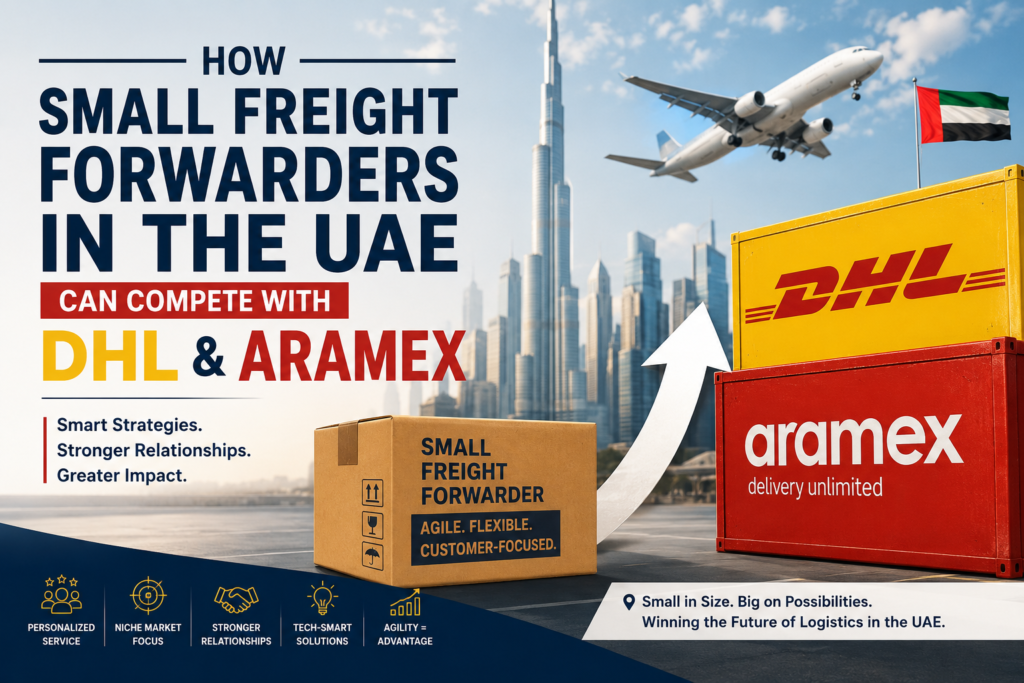
How Small Freight Forwarders in the UAE Can Compete With DHL and Aramex
On this page
Why This Matters Right Now Real Pain Points Where Small Forwarders Win Step-by-Step Process Examples in Practice Ports Tools Checklist FAQsHouthi drone and missile strikes in the Red Sea have forced major shipping lines around the Cape of Good Hope, adding ten days or more to average transit times. At the same time, new UAE-Vietnam and UAE-Jordan trade agreements are opening corridors that didn't exist a year ago. Both are reshaping who wins online right now.
Why This Matters Right Now
The UAE's trade position in 2026 is being shaped by two forces at once — Red Sea shipping disruption making the UAE's air-sea connectivity and re-export infrastructure more valuable than ever, and an actively expanding CEPA network opening genuinely new trade corridors.
Aramex is the domestic name most small UAE forwarders are actually measuring themselves against. Founded in 1982 in Amman, Jordan by Fadi Ghandour and Bill Kingson, the company relocated its headquarters to Dubai in 1985 and has grown into a logistics group spanning courier, freight forwarding, and warehousing across roughly 70 countries. What's genuinely interesting about Aramex's own history is that it built its dominance on a light-asset model — relying on local partnerships and technology rather than owning its own aircraft fleet the way some competitors do — which is a meaningfully different starting point than DHL's globally standardized infrastructure. Aramex is now majority-owned by ADQ, Abu Dhabi's sovereign wealth fund, since 2025, and continues actively acquiring specialist businesses, including Hawthorn Logistics Solutions in February 2026.
Between DHL's global integrator scale and Aramex's deep-rooted regional network, these are the two names most likely to come up first when a UAE shipper searches online. But a market this actively reshaped by new trade corridors, shipping disruption, and — critically — new compliance burdens is exactly where a smaller, more attentive forwarder can build genuine differentiation.
Real Pain Points UAE Forwarders Are Actually Navigating
FTA Decision No. 6 of 2026 significantly increases compliance obligations for Qualifying Free Zone Persons — a real, immediate burden a large integrator's dedicated compliance team absorbs far more easily.
Shippers are actively searching for alternative routing and re-export strategies — search intent most forwarder websites haven't updated their content to address.
The UAE-Vietnam and UAE-Jordan CEPAs are opening pathways new enough that very few shippers have an established forwarder relationship for them specifically.
Many smaller forwarders are navigating unfamiliar tax planning decisions on a real 31 December 2026 deadline, on top of their operational work.
A smaller forwarder who has grown or diversified services without formally updating documentation carries real regulatory risk.
Aramex's four-segment model gives shippers a single point of contact across very different needs, which a narrower forwarder has to counter with depth rather than breadth.
Where Small Forwarders Actually Win
A visible trust signal precisely because so many businesses are still catching up to it.
Real-time updates without the layered internal process a larger integrator's global routing decisions typically require.
A real head start over competitors who haven't yet updated their positioning for Vietnam or Jordan.
Genuine depth in one specific mode, cargo type, or corridor — a different, and for some shippers more valuable, kind of expertise than Aramex's breadth.
A Practical Process to Compete Online
Reassures shippers who are increasingly aware that free-zone tax compliance is no longer a formality.
Answers exactly what many shippers are searching for right now.
Fresh enough that most competitors haven't updated their messaging yet.
Builds confidence with shippers aware that mismatched licensing creates real regulatory risk.
A shipper wanting a true specialist will often choose genuine depth over a broader offering.
Builds authority in a genuinely confusing, fast-moving area.
A real, honest differentiator against larger, more process-heavy competitors.
Tells you where to focus content and positioning next.
Examples in Practice
The following are illustrative scenarios based on common patterns in the UAE logistics sector, not verified case studies of specific named companies.
A forwarder positioning around FTA Decision No. 6 compliance. Making proactive documentation processes a headline trust signal for free-zone-based shippers still working out what the changes mean.
A forwarder building Red Sea rerouting guidance. A regularly updated page comparing Suez versus Cape of Good Hope routing, with UAE hub options highlighted, captures shippers actively searching for alternatives.
A forwarder entering the UAE-Vietnam CEPA conversation early. Dedicated content and outreach targeting this emerging trade lane before competitors catch up.
Ports: What Your Positioning Should Address
| Port | What matters most to shippers here right now |
|---|---|
| Jebel Ali Port, Dubai | Positioning as a genuine Red Sea disruption alternative and CEPA-corridor gateway |
| Khalifa Port, Abu Dhabi | Industrial and project cargo shippers navigating new QFZP compliance requirements |
| Port Rashid, Dubai | Niche cargo operators needing clear guidance on evolving free-zone tax rules |
| Mina Zayed, Abu Dhabi | Smaller, relationship-driven shippers who value direct, personal compliance support |
| Port of Fujairah | Bunkering and bulk oil shippers still navigating tax compliance changes |
| Khor Fakkan Port, Sharjah | A key overflow and contingency hub amid Red Sea-driven rerouting demand |
| Sharjah (Port Khalid) & Hamriyah Port | Operationally focused shippers prioritizing capability and cost clarity amid new compliance costs |
| Saqr Port, Ras Al Khaimah | Bulk cargo shippers in a smaller, less saturated compliance-content market |
| Ajman Port | Limited existing digital compliance content — real opportunity for early, clear positioning |
| Umm Al Quwain Port | Minimal existing competition for compliance- and corridor-specific content |
Tools That Help Level the Playing Field
FTA EmaraTax portal familiarity — demonstrated fluency with Corporate Tax registration and filing
Real-time shipping route monitoring for accurate Red Sea and Cape of Good Hope guidance
Google Search Console and local SEO tools for port, CEPA corridor, and compliance-specific searches
A simple system to track enquiries by corridor and compliance concern
LinkedIn and local directories for shippers researching new CEPA trade opportunities
A relationship with a UAE tax or compliance advisor to stay current on fast-moving changes
The Competing-Online Checklist
- FTA Decision No. 6 compliance status is stated clearly, not assumed
- Content exists explaining current Red Sea disruption and rerouting options
- Positioning references relevant new CEPA corridors where applicable to your services
- Your licensed activities are described accurately and visibly, not vaguely
- Positioning leads with specific service depth rather than broad, generalized claims
- Content explaining UAE Corporate Tax changes is published in plain language
- Response speed and direct accountability are part of your visible pitch
- Enquiries are tracked by corridor and compliance concern to guide ongoing focus
Frequently Asked Questions
Can a small UAE forwarder really compete with DHL or Aramex online?
Yes, particularly around current compliance expertise (FTA Decision No. 6), Red Sea rerouting guidance, and early positioning on new CEPA trade corridors — areas where a large integrator's standardized process and even Aramex's broad service model both leave room for a smaller, more current and specialized competitor.
How serious is the new Corporate Tax compliance requirement for free-zone forwarders?
Genuinely significant — FTA Decision No. 6 of 2026 introduces a more documentation-driven, evidence-based approach to maintaining the 0% Corporate Tax rate for Qualifying Free Zone Persons, and businesses that wait until filing season to address it risk real compliance challenges and delays.
Is the Red Sea disruption actually a marketing opportunity, or just an operational headache?
Both — it's a genuine operational challenge, but it's also a real, current search intent among shippers actively looking for alternative routing guidance. A forwarder who addresses this directly and helpfully captures search interest a static "reliable service" homepage never will.
How real is the opportunity around new CEPA corridors like Vietnam or Jordan?
Genuinely real in the near term — these are new enough that very few shippers moving goods along these lanes have an established forwarder relationship yet, which is a meaningfully different situation than trying to win business on a mature, saturated corridor.
Should a small forwarder try to match Aramex's breadth of services?
Not usually — Aramex's four-segment model works because of its scale. A smaller forwarder generally competes better by offering genuine depth in one or two service lines than by trying to match that breadth thinly across everything.
How long does it take to see results from this kind of positioning?
Most forwarders see measurable movement in relevant search visibility within 2-3 months, with authority-building content around compliance changes and new trade corridors compounding over 6-12 months.
Want a full audit of how your positioning compares to what shippers are searching for?
We'll identify your highest-leverage gaps and build a prioritized plan to close them.
Request Your Free Website & SEO AuditAnshul Kuntewar
Founder, RouteRush Digital Marketing Agency — specialising in SEO, website strategy, and lead generation for freight and logistics companies across the UAE, India, Oman, South Africa, Qatar, and Australia, working directly with freight forwarders and CHAs to compete effectively against much larger competitors online.
This guide reflects UAE freight, tax compliance, and trade agreement data current as of mid-2026, sourced from the UAE Federal Tax Authority, public CEPA announcements, and independent trade and logistics reporting. Figures for DHL and Aramex are cited for market context only and are drawn from publicly available corporate history and reporting.