
Why Most Freight Forwarding Companies in South Africa Don’t Show Up on Google
Why Most Freight Forwarding Companies in South Africa Don't Show Up on Google
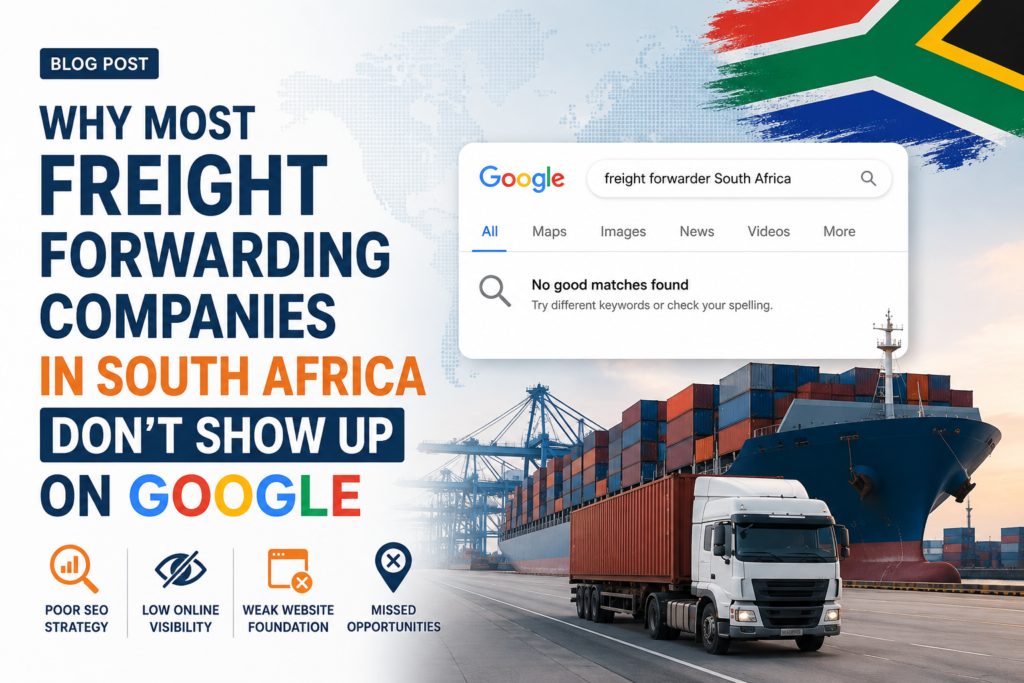
If you run a freight forwarding company in South Africa and you search your own services — "freight forwarder Durban," "customs clearing agent Cape Town," "air freight forwarder Johannesburg" — there's a good chance your business doesn't appear anywhere on the first page. Meanwhile, a handful of the same competitors, directories, and global marketplaces keep showing up for every search. This isn't bad luck, and it isn't because your service is worse. It's because most freight forwarding companies in South Africa are set up to be found by referral, not by Google — and referral-only growth has a ceiling.
In this article, we're breaking down exactly why this happens — not vague "do more SEO" advice, but the specific, fixable gaps we see on almost every freight forwarding site we audit in this market, from Durban and Cape Town to Johannesburg and Port Elizabeth.
- The website was built to look credible, not to get found
- Google Business Profile is unclaimed, incomplete, or inactive
- Zero content answering what buyers are actually searching
- Weak technical foundation working against you
- No backlinks or industry authority signals
- Competing against global marketplaces without a local edge
- A 2-minute self-audit for your own site
- Frequently asked questions
A Durban-based forwarder has been operating for over a decade, has a solid reputation, and a client base built entirely on referrals and repeat business. Their website looks professional — clean design, a logo, a contact form. But it has exactly five pages, no blog, no service breakdowns, and an unclaimed Google Business Profile. A freight buyer in Johannesburg searching for "customs clearing agent for FMCG imports" will never see them — because there's nothing on the site telling Google that's a service they offer, in a location they serve, at the level of specificity buyers are searching for. This is the single most common pattern we see, market after market.
1. The website was built to look credible, not to get found
One homepage, no depth
Most forwarder sites have a homepage, an about page, a contact page — and that's it. Google has nothing to match against searches like "sea freight forwarder South Africa to UAE" or "customs broker for FMCG imports Durban," because no page on the site actually targets those terms. Without dedicated pages for each service and trade lane, there's simply nothing for Google to rank.
This also affects trust signals once a buyer does land on the site. A single homepage trying to cover sea freight, air freight, customs clearing, warehousing, and project cargo all at once reads as generic — buyers can't quickly confirm you handle their specific cargo type or lane, so they bounce back to search results.
Build separate pages for each core service (sea freight, air freight, customs clearing, warehousing, project cargo) and each major trade lane you handle (e.g. South Africa–UAE, South Africa–China, South Africa–Europe).
Each page should target one clear search intent, include specific details (ports served, typical transit times, cargo types handled), and link to a clear next step — quote request, contact, or audit.
2. Google Business Profile is unclaimed, incomplete, or inactive
The single biggest missed opportunity for local freight searches
Searches like "freight forwarder near me" or "clearing agent Durban port" trigger Google's local map pack before any organic result appears. If your Google Business Profile isn't claimed, doesn't have your correct categories, service areas, photos, and regular posts, you're invisible in exactly the searches your actual next customer is making.
We also frequently find duplicate or outdated listings — old addresses, disconnected phone numbers, or a listing under a previous company name — actively competing with the correct one and diluting local ranking signals.
Claim and fully complete the profile: correct primary category (e.g. "Freight Forwarding Service"), accurate service areas, port/warehouse photos, and monthly updates.
Audit for duplicate listings and either merge or request removal. This alone often moves a forwarder into the local map pack within weeks.
3. Zero content answering what buyers are actually searching
No blog, no guides, no answers
Freight buyers search things like "how long does customs clearance take in South Africa," "documents needed for importing into South Africa," or "cost of shipping a container from China to Durban." These are exactly the searches with real buying intent — and almost no SA forwarder is answering them. The directories and global logistics blogs that do answer these questions are the ones showing up instead.
- Import/export documentation guides for South African customs
- Transit time and cost breakdowns for your most common trade lanes
- Industry-specific guides (e.g. FMCG cold chain, NDIS equipment imports, retail seasonal stock)
- Regulatory updates (SARS customs changes, port congestion advisories)
Publish practical, specific content around the real questions your sales team gets asked every week. This is the fastest way to outrank directories, because directories can't answer these questions with the same specificity — you can.
4. Weak technical foundation working against you
Slow load times, no schema markup, poor mobile experience
Even when a forwarder does have relevant content, a slow-loading site, missing structured data (LocalBusiness / Organization schema), and a clunky mobile experience quietly push rankings down. Google factors in page experience directly, and freight buyers increasingly research on mobile — often from a warehouse floor or the road, not a desk.
We also regularly find missing or duplicate meta titles, no XML sitemap submitted to Search Console, and broken internal links left over from old site migrations — small technical debts that compound over time.
Run a technical audit: page speed, mobile responsiveness, schema markup, and a proper XML sitemap submitted to Google Search Console.
These are largely one-time fixes with a lasting effect — unlike content and links, which need ongoing investment.
5. No backlinks or industry authority signals
Google doesn't just read your site — it reads who links to it
Most freight forwarder sites in South Africa have almost no backlinks from relevant industry sources: trade associations, chamber of commerce listings, port authority directories, shipping line partner pages, or logistics publications. Without these signals, Google has little reason to trust the site over an established directory with thousands of referring domains.
Get listed and linked from SAAFF (South African Association of Freight Forwarders), local chamber of commerce sites, port and terminal directories, and partner shipping lines.
These are high-relevance, high-trust links specific to your industry — far more valuable than generic directory submissions.
6. Competing against global marketplaces without a local edge
Big platforms rank on volume — you can win on specificity
Global freight marketplaces and directories rank well because of sheer domain authority and content volume. Most SA forwarders try to compete head-on with generic content instead of doubling down on what the big platforms can't offer: local expertise, specific port and customs knowledge, and named trade-lane experience.
Go narrow and specific — "customs clearing agent for FMCG imports at Durban Port" beats generic "freight forwarding services" every time, because that's what your actual buyer is typing.
The Opportunity
Because almost none of your competitors are doing this properly, the bar to rank in South African freight forwarding search results is lower than in most industries. A forwarder that fixes even three or four of the gaps above — service pages, Google Business Profile, a handful of buyer-intent articles, and a few relevant backlinks — can realistically move ahead of competitors who've been in business twice as long.
A 2-minute self-audit for your own site
Before you fix anything, it helps to know exactly where you stand. Here's what separates the forwarders who show up on Google from the ones who don't:
| Signal | Invisible on Google | Ranking on Google |
|---|---|---|
| Website structure | One homepage covering everything | Dedicated pages per service and trade lane |
| Google Business Profile | Unclaimed or incomplete | Fully claimed, categorized, updated monthly |
| Content | No blog or guides | Regular articles answering buyer questions |
| Technical health | Slow, no schema, no sitemap | Fast, structured data, sitemap submitted |
| Backlinks | Few or no industry links | Listed with SAAFF, chambers, port authorities |
| Positioning | Generic "freight forwarding services" | Specific lanes, cargo types, and locations |
Where to start: a practical order of operations
Frequently asked questions
How long does it take for a freight forwarding website to start ranking on Google?
For local searches (Google Business Profile, map pack), improvements can show within a few weeks. For organic rankings on service and trade-lane pages, expect a more realistic 3–6 months of consistent work, since it depends on competition in your specific city and lane.
Is Google Business Profile really that important for a B2B freight company?
Yes. Even though freight forwarding is B2B, buyers still search in local, near-me terms when looking for a forwarder in a specific port city — and the local map pack appears above organic results for those searches.
Do we need a blog if we already get most of our business through referrals?
Referrals will always matter in this industry, but they cap your growth to your existing network. A blog and proper SEO structure open up demand from buyers who don't know you yet — which is where most new market growth comes from.
What's the fastest single change we can make?
Claiming and fully completing your Google Business Profile is almost always the fastest-moving lever, followed by building out dedicated service pages instead of relying on one homepage.
Related reading
Want to see exactly where your site is losing visibility?
We'll record a free, no-obligation Loom video audit of your website — showing precisely what's blocking you from ranking, and what to fix first.
Get Your Free Audit