
Why NDIS Providers Need Smarter Marketing as Budgets Get Cut
Why NDIS Providers Need Smarter Marketing as Budgets Get Cut
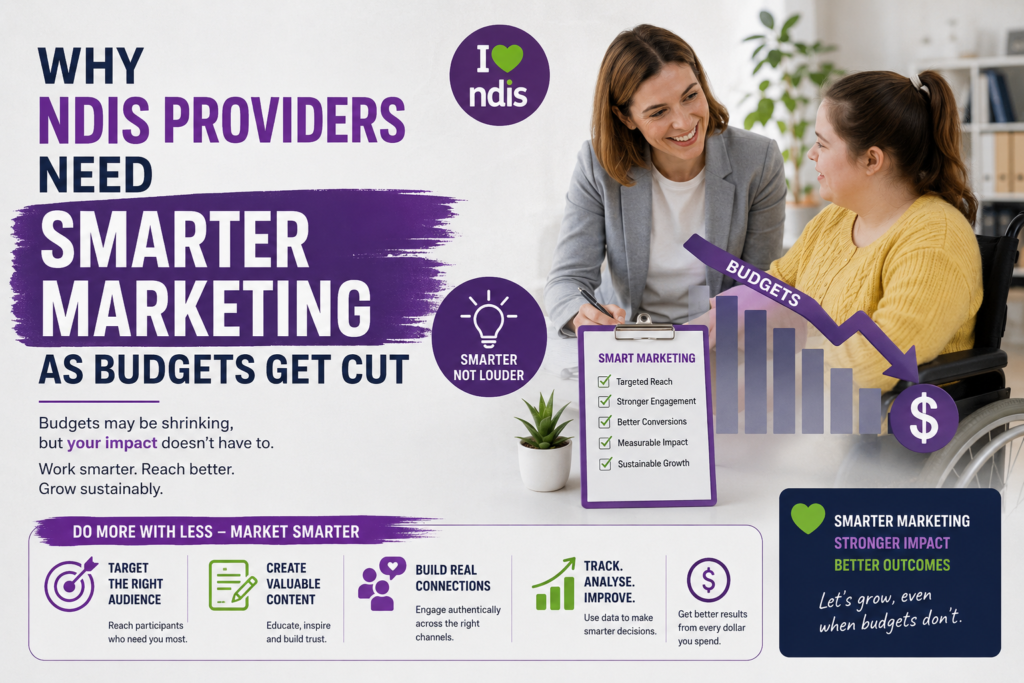
If you run an NDIS provider business, you've likely spent 2026 watching the ground shift under you — mandatory registration deadlines, tighter practice standards, and now confirmed cuts to participant budgets. In the middle of all this regulatory noise, one thing has quietly become urgent: NDIS provider marketing is no longer optional groundwork you'll get to eventually. As the pool of funded participants shrinks and their budgets tighten, the providers who are easiest to find, easiest to trust, and easiest to choose are the ones who'll keep their books full. Everyone else will feel the shrinkage first.
- What's actually changing in 2026
- The market is shrinking, not growing
- Registration is now a trust signal, not just paperwork
- Referral-only growth no longer covers the gap
- Support coordinators are choosing faster than ever
- The providers who adapt first win the remaining market
- A quick self-audit for your own provider business
- Frequently asked questions
What's actually changing in 2026
A few confirmed changes are reshaping the provider landscape right now, and they're worth understanding before we get to the marketing implications:
On top of the participation budget cuts, capacity-building daily activity budgets are being trimmed as well, with average plan costs targeted to fall back toward 2023 levels. Mandatory provider registration — previously covering a small share of the market — is being progressively expanded, with SIL and platform providers first in line and more categories of "high-risk supports" following over the next few years. None of this is speculation or a worst-case scenario; it's the confirmed direction the scheme is moving, with further consultation continuing through the second half of 2026.
Picture two NDIS providers offering near-identical community access and support coordination services, both fully registered and both delivering good care. Provider A relies on word-of-mouth and a handful of long-standing support coordinator relationships. Provider B has a clear, well-structured website, an active Google Business Profile, and content that answers the questions families and coordinators are actually searching. As the participant pool shrinks and existing coordinators become more selective with tightening budgets, Provider B keeps getting found and chosen. Provider A quietly loses ground — not because their care is worse, but because they were never visible to the participants now competing harder for a smaller pool of support hours.
1. The market is shrinking, not growing
Fewer participants, tighter budgets, same number of providers
For years, NDIS providers could grow simply by staying open — the participant pool and scheme spending were both expanding fast. That growth cushion is disappearing. With participation and capacity-building budgets being reset and a meaningful share of participants expected to exit the scheme under stricter eligibility assessment, the total available work is contracting while the number of registered providers stays roughly the same, at least in the short term.
That means growth from here mostly comes from taking market share from other providers, not from a rising tide lifting all boats. Providers who've never had to actively market themselves are entering a genuinely more competitive phase.
Treat marketing as a core part of running the business in 2026, not a nice-to-have. A clear, well-optimized website and active Google presence are now directly tied to how much of the shrinking participant pool reaches you first.
2. Registration is now a trust signal, not just paperwork
Being registered is becoming table stakes — showing it clearly is the differentiator
With mandatory registration now in effect for SIL and platform providers, and set to expand to more service categories over the coming years, registration status is shifting from a background compliance detail to something participants and coordinators actively check before choosing a provider. Many provider websites currently bury this information in a footer or leave it out entirely.
Display your NDIS registration number, registered service categories, and any relevant practice standards compliance clearly and prominently — not just because it's required, but because it's now a genuine trust-building conversion element on your site.
3. Referral-only growth no longer covers the gap
Word of mouth was enough when the market was growing — it isn't anymore
Referral networks built through support coordinators and existing families are valuable, but they're inherently limited to your existing relationships. As those same coordinators face more provider options chasing fewer available support hours, providers who only show up through referral are invisible to every new participant, family, or coordinator outside that existing circle.
Build a genuine online presence — a proper website, a complete Google Business Profile, and content answering the real questions families search (e.g. "how to choose an NDIS support coordinator," "what to ask an NDIS provider before signing up") — so new demand can find you beyond your existing referral circle.
4. Support coordinators are choosing faster than ever
Less time, more options, less patience for an unclear website
Support coordinators are managing tighter participant budgets and, in many cases, more administrative overhead from the registration and reporting changes. When they're comparing providers for a client, a confusing website, an unclear service list, or no visible registration status is often enough to move on to the next option — there simply isn't the time to chase down basic information anymore.
Make it effortless for a support coordinator to confirm, in under a minute, exactly what you offer, which areas you service, your registration status, and how to make contact. Friction that was tolerable in a looser market becomes a lost referral in a tighter one.
5. The providers who adapt first win the remaining market
This is a genuine first-mover opportunity, not just a defensive move
Because so much of the NDIS provider market has never invested in real marketing, the bar to stand out is still low. A provider that gets its website, Google presence, and content sorted out now — while most competitors are focused purely on registration and compliance — has a real window to capture disproportionate share of the participants who remain in the scheme.
The Opportunity
Regulatory upheaval usually causes providers to freeze and focus only on compliance. That's exactly why this is a good moment to move on marketing — competitors are distracted, and the providers who invest in visibility now will be the ones support coordinators and families default to once the dust settles on the 2026 reforms.
A quick self-audit for your own provider business
| Signal | Falling Behind | Positioned to Grow |
|---|---|---|
| Lead source | Almost entirely referral-based | Referrals plus active organic and local search presence |
| Registration status | Buried in footer or not mentioned | Displayed clearly, with service categories listed |
| Website clarity | Generic, hard to confirm services/areas served | Clear services, areas, and next steps within seconds |
| Google Business Profile | Unclaimed or incomplete | Fully claimed, updated, with reviews and photos |
| Content | No guidance for families or coordinators | Answers real questions families and coordinators search |
Where to start: a practical order of operations
Frequently asked questions
Isn't marketing for NDIS providers restricted by advertising rules?
There are legitimate rules around how supports are advertised and represented, particularly around claims made to participants. That's a reason to get marketing right — clear, accurate, and well-structured — not a reason to avoid it. Good marketing and compliant marketing aren't in tension.
We're already fully booked — do we still need to market?
Being fully booked today doesn't guarantee it in a shrinking, more competitive market. Providers who build visibility while demand is steady are far better positioned when participant numbers tighten further or a competitor opens nearby.
Should we focus on SEO, or is paid advertising faster?
SEO and a strong Google Business Profile tend to be the highest-value starting point for NDIS providers, since so much search happens locally and by service type. Paid ads can supplement this for faster short-term inquiries, but they work best once the underlying website and profile are solid.
How long before this kind of marketing shows results?
Google Business Profile improvements can move visibility within weeks. Website and content-driven organic growth typically takes 3–6 months to build meaningful momentum, which is exactly why starting now — ahead of the tighter 2026-27 market — matters.
Want to see where your NDIS provider business stands?
We'll record a free, no-obligation Loom video audit of your website and Google presence — showing exactly what's costing you inquiries as the market tightens.
Get Your Free Audit