
Who Can Help a Freight Forwarder Generate Qualified Leads?
RouteRush / Freight forwarder growth
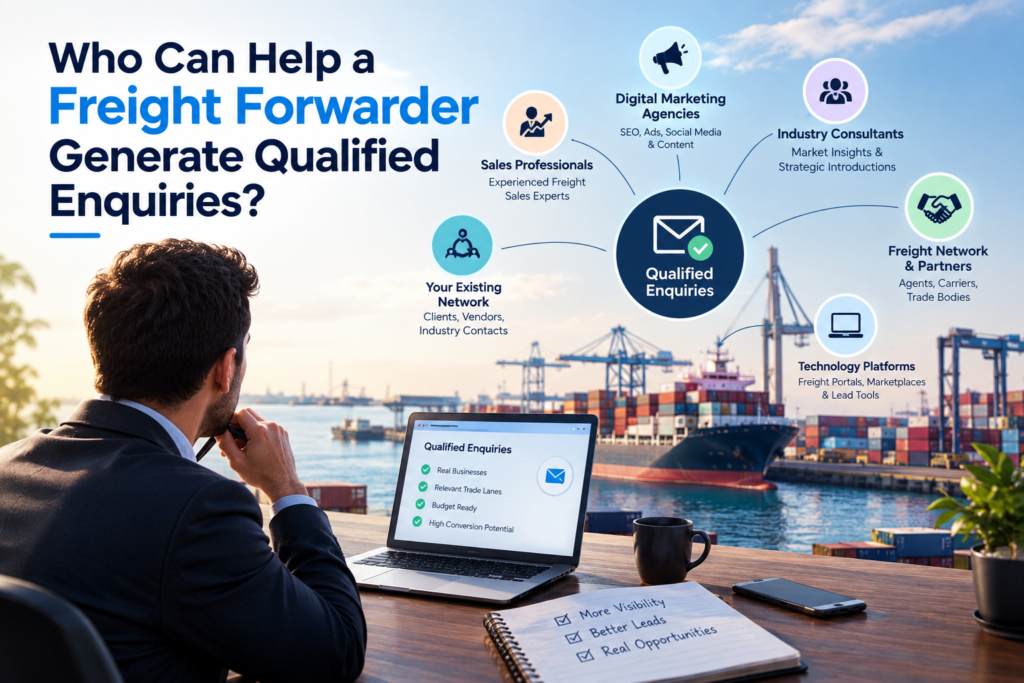
Who Can Help a Freight Forwarder Generate Qualified Enquiries?
I've spent the last several years building marketing systems specifically for freight forwarders — first working with exporters and forwarders here in India, then expanding into Australia, the UAE, Qatar, Oman, South Africa and the UK. Across all of that, one question comes up more often than any other, usually from a founder who's already tried something that didn't work: "Who should I actually be paying to bring in real enquiries, not just traffic?"
It's a fair question, and it's harder to answer honestly than most marketing content lets on. There isn't one right answer — a solo forwarder just getting started needs something very different from a fifteen-person operation with branches in three cities. What I want to do in this piece is walk through every realistic option I've actually seen freight forwarders use, what each one is genuinely good at, where each one falls short, and how to tell whether whoever you're paying is producing enquiries worth your sales team's time.
This isn't a pitch for one answer. It's the breakdown I wish someone had given me when I first started figuring out how freight forwarders actually generate qualified interest, rather than just noise.
By Anshul Kuntewar · Founder & CEO, RouteRush
Updated
Editorial context: This guide reflects my own experience running marketing for freight forwarding businesses across several markets. It's meant to help you evaluate options honestly, not to steer you toward any single one — the right fit depends entirely on your business's size, stage and existing capacity.
The direct answer
Who can actually help a freight forwarder generate qualified enquiries?
Five realistic sources exist: an in-house marketing hire, a marketing agency (generalist or freight-specialized), freelance specialists working on individual channels, a dedicated sales or business development hire focused on outbound, and your own network of industry contacts and referral partners. None of them is automatically the right answer — each is suited to a different stage of business, and the biggest mistake I see freight forwarders make isn't picking the "wrong" option, it's picking any of them without a clear way to measure whether the enquiries coming in are actually qualified.
In-house hire
Full context on your business, but limited by one person's skill set and bandwidth.
Specialized agency
Understands the freight buyer already, but you're one of several accounts they manage.
Generalist agency
Broad marketing skill, but often missing industry-specific context that shapes what actually converts.
Freelancers
Flexible and often cheaper per channel, but you're the one stitching the pieces together.
Sales / BD hire
Drives outbound conversations directly, but doesn't build the inbound visibility that compounds over time.
Your own network
The cheapest, highest-trust source of qualified interest — and the most consistently underused.
Why does "who" matter more than "how" for qualified enquiries?
Because almost anyone can generate more enquiries. Run enough traffic to a website, boost enough LinkedIn posts, blast enough cold emails, and the number goes up. I've seen freight forwarders proudly report a jump in website form submissions that turned out to be almost entirely spam, students researching a school project, or people three years away from actually needing a shipment moved. The number went up. Nothing useful happened.
The right partner, whoever it is, understands the difference between activity and qualified interest from the start. That means they know what a genuine buying signal looks like for a freight forwarder specifically — a real cargo type, a real timeline, some indication of decision-making authority — rather than optimising for the vanity metric that's easiest to report. This is the filter I'd apply to every option below, not just the ones I happen to be biased toward.
Can an in-house marketing hire generate qualified enquiries?
Yes, and for a certain stage of business, it's genuinely the right call. Someone inside your company has context an outsider takes months to build — they know your actual operational strengths, which lanes you're genuinely competitive on, and which prospects tend to be a good fit versus which ones waste everyone's time. That context alone can produce better-targeted content and campaigns than an external partner starting from zero.
The honest limitation is skill breadth. Freight forwarding marketing that actually works usually spans SEO, content, LinkedIn, paid advertising and basic sales process thinking — and it's rare to find one person who's genuinely strong across all of it. A single in-house marketer is often excellent at one or two of these and weak everywhere else, which shows up as inconsistent results a few months in. This tends to work best for a business large enough to eventually build a small team around that first hire, rather than expecting one person to run the entire system indefinitely.
Should you hire a generalist marketing agency, or one that specializes in freight and logistics?
This is the distinction I'd push hardest on, because I've watched it go badly more than any other decision in this list. A generalist agency can absolutely produce polished websites, well-run ad campaigns and decent-looking content — but if they've never worked with a freight forwarder before, they're learning your buyer, your sales cycle and your industry's specific objections on your budget, in real time.
I've seen this play out directly: a generalist agency builds a beautiful website full of language like "seamless global logistics solutions" that means nothing to an actual buyer trying to figure out whether this company handles their specific lane and cargo type. Meanwhile, an agency that's specifically worked with freight forwarders already knows that vague, generic service pages are one of the biggest reasons enquiries go to competitors — because I've written about that exact problem in the digital marketing guide I put together for freight forwarders, based on patterns I kept seeing across different markets.
That said, industry specialization isn't a magic guarantee either. A specialized agency that's grown complacent, or one juggling too many accounts to give yours real attention, can underperform a sharp generalist who's willing to actually learn your business properly. The specialization is a strong signal worth weighing heavily — it's just not the only thing that matters.
What about freelance specialists — SEO, LinkedIn ghostwriting, paid ads?
Freelancers can be a genuinely smart option, particularly for a smaller freight forwarder that needs real skill in one specific area without the overhead of hiring full-time or retaining a full-service agency. A strong freelance SEO specialist, or someone who writes LinkedIn content well, can move the needle on that one channel meaningfully, often at a lower cost per hour than an agency team.
The trade-off is coordination. When your SEO, your LinkedIn content, your website and your paid ads are each run by a different freelancer with no shared strategy, you end up with disconnected pieces that don't reinforce each other — your website might be saying one thing about your positioning while your LinkedIn content is saying something else entirely. This works best when you or someone on your team is actively directing the overall strategy and simply using freelancers to execute specific pieces of it, rather than expecting the freelancers themselves to coordinate a coherent system on their own.
Can a dedicated sales or business development hire generate qualified enquiries on their own?
Yes, and this option gets overlooked constantly because it doesn't feel like "marketing" in the way a website or a LinkedIn presence does. A skilled business development hire running structured outbound — researching target companies, reaching out directly, building relationships with the right contacts — can generate genuinely qualified conversations without waiting for inbound interest to build up over months.
What this approach doesn't do is build compounding visibility. Outbound conversations end when the outreach stops; content, search rankings and an active LinkedIn presence keep working even when nobody's actively pushing them that week. The strongest setups I've seen pair a BD hire's outbound effort with at least some inbound foundation, so the outbound conversations are landing with a prospect who's already seen your name somewhere, rather than a complete stranger hearing about you for the first time.
Do your own contacts and referral partners actually help generate qualified enquiries?
More than most freight forwarders give them credit for, and this is the option I think gets underused the most. Customs brokers, non-competing forwarders in other geographies, trucking partners, and industry association contacts are all sitting on referral relationships that rarely get actively tapped — most freight forwarders wait for these relationships to produce a lead organically rather than asking directly.
The enquiries that come through this route also tend to arrive pre-qualified in a way that's hard to replicate through any paid channel — someone who trusts your customs broker, and hears your name specifically recommended, shows up already predisposed to trust you too. I go into this in more depth, including exactly how to structure the ask, in the piece I wrote on turning industry relationships and updates into leads — the short version is that this channel needs the same deliberate process as any paid one, not just good intentions and occasional coffee meetings.
Can software or AI tools alone generate qualified enquiries?
Not on their own, no matter how good the tool is. I use plenty of tools in my own work — CRM systems to track pipeline, AI-assisted content drafting, automation for follow-up sequences — and every single one of them makes a person more effective. None of them replaces the judgment required to know what a good freight forwarding lead actually looks like, write content that genuinely reflects your business, or have the sales conversation that turns interest into a booking.
Be especially wary of anyone selling a tool as the whole solution — "install this chatbot and watch qualified leads roll in" is a pitch I've heard more than once, and it's never held up in practice. Tools are a real part of an effective system. They're not a substitute for the people directing that system.
How do you hold whoever you hire accountable for quality, not just quantity?
Regardless of which option you choose, the accountability question should be the same: are you measuring qualified enquiries, or just enquiries? I've seen agencies, freelancers and in-house hires all fall into the trap of reporting whatever number looks best — website visits, form submissions, impressions — because it's easier to report than the harder, more honest number of how many of those actually turned into a real, workable opportunity.
Build a simple, shared definition of what a qualified enquiry actually looks like for your business before anyone starts working — a real cargo type, a genuine timeline, some sign of decision-making authority — and review results against that definition specifically, not against raw volume. I cover how to structure this kind of tracking properly in my guide to building a real freight forwarding sales pipeline, and honestly, this single habit does more to protect you from wasted spend than almost any other decision on this page.
What questions should you actually ask before hiring anyone for this?
- Have you worked with a freight forwarder or logistics business before? Ask for specifics, not a general "we've worked in B2B" answer.
- How do you define a qualified enquiry, and how will you report on it? If the answer is vague or purely volume-based, that's worth noting.
- What happens in the first month, realistically? Anyone promising immediate, dramatic results from organic channels specifically is either inexperienced or not being straight with you.
- Who exactly will be doing the work day to day? Particularly with agencies, the person who pitched you isn't always the person handling your account.
- Can I see an example of a service page, post, or campaign you've built for a company like mine? Generic case studies without freight or logistics specifics are a signal worth taking seriously.
None of these questions are designed to catch anyone out. They're designed to surface, early, whether the person or team you're about to pay actually understands the difference between generating noise and generating enquiries you'd genuinely want your sales team spending time on.
So, who should you actually pick?
If I had to give one honest answer, it would be this: match the option to your stage, not to whatever's easiest to start with. A solo forwarder or very small team is usually best served by a mix of active referral outreach, which costs almost nothing, alongside either a specialized freelancer or a light-touch agency arrangement for one or two channels — trying to hire full-time or retain a large agency too early often means paying for capacity you can't yet use well.
A mid-sized forwarder with some existing traction is usually ready for either a strong in-house hire supported by specialist freelancers, or a genuinely freight-specialized agency handling the full system — the deciding factor tends to be whether you have someone internally capable of directing strategy, or whether you need that strategic direction to come from outside too. A larger, multi-branch operation typically benefits from combining an in-house lead who owns strategy and relationships with either agency or freelance support for execution at scale, plus a dedicated BD function running structured outbound alongside the inbound system.
Whichever combination you land on, the constant I'd hold onto is the accountability question from earlier in this piece — track qualified enquiries specifically, review it honestly every month, and be willing to change the combination if it isn't producing real results within a reasonable, clearly agreed timeframe.
Frequently asked questions
Is it better to hire in-house or use an agency for freight forwarder marketing?
It depends on your stage. A single in-house hire has strong context but limited skill breadth; an agency brings a fuller skill set but less inherent knowledge of your specific business. Many freight forwarders end up combining both over time.
Should a freight forwarder use a specialized freight marketing agency or a generalist one?
A specialized agency generally understands the freight buyer and industry-specific positioning faster, but attentiveness and quality of execution matter more than specialization alone. A strong generalist willing to learn the industry can still outperform a disengaged specialist.
Can referrals and industry contacts really replace paid marketing for freight forwarders?
Not entirely, but they're consistently underused relative to how effective they are. Referred prospects tend to trust the business faster and cost far less to reach than paid channels, and most forwarders never ask directly enough to capture this properly.
What's the difference between hiring for marketing versus hiring for sales or business development?
Marketing builds visibility that compounds over time — search rankings, content, LinkedIn presence. Sales or BD hires drive direct outbound conversations that produce faster but less compounding results. Most freight forwarders eventually need some of both.
Can AI tools or software alone generate qualified freight leads?
No. Tools can make a person or team more efficient, but they don't replace the judgment needed to define what a qualified lead looks like or the relationship-building that actually closes deals.
How do I know if a marketing agency or hire is actually generating qualified enquiries?
Agree on a clear definition of a qualified enquiry before work begins, and review results against that specific definition rather than raw traffic or form submission numbers.