
RouteRush / UAE freight growth
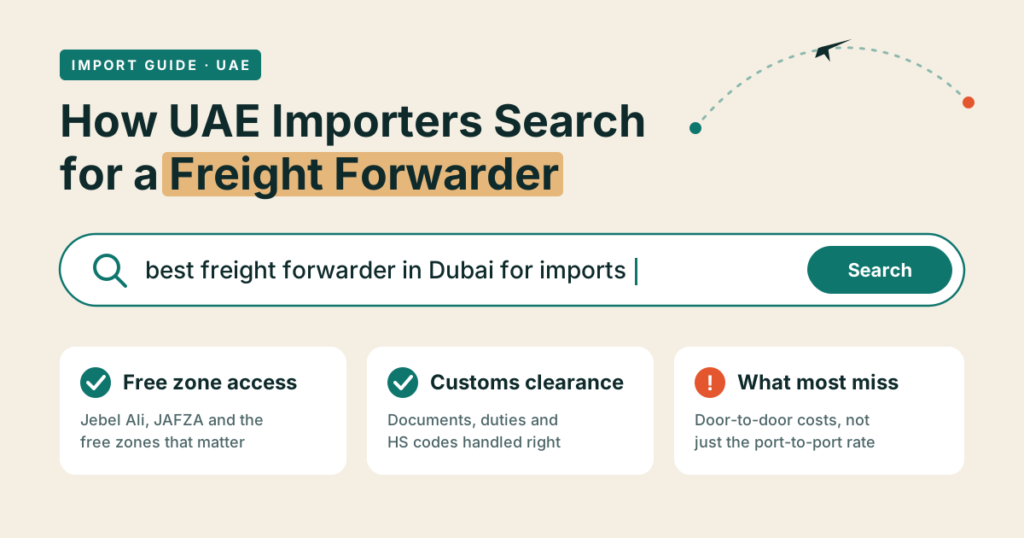
How Importers in the UAE Search for a Freight Forwarder, and What Most Companies Miss
A trading company in Dubai imports a full container of electronics from Shenzhen into Jebel Ali. The goods never actually enter the UAE market. Within two weeks, that same container has been broken down into four smaller shipments, each re-exported to a different buyer in Lagos, Nairobi, Riyadh and Karachi — the UAE was never the destination, it was the hub.
This is an extremely common pattern in the UAE, and it means the word "importer" is doing a lot of hidden work in this market. A large share of the businesses searching for a freight forwarder in Dubai or Abu Dhabi aren't importing for domestic use at all — they're importing in order to consolidate, process paperwork, and re-export onward, often to multiple markets from a single inbound shipment.
That single structural fact changes what UAE importers actually search for, what they need from a forwarder, and what most freight forwarder websites in this market completely fail to address.
Editorial context: This guide looks at buyer search behaviour specific to the UAE market, to help freight forwarders position and structure their own marketing more effectively. It isn't written for importers themselves, and examples are illustrative.
The direct answer
How do importers in the UAE actually search for a freight forwarder?
A significant share of UAE "importers" are really re-exporters using the UAE's free zones as a trans-shipment hub, so their searches lean toward consolidation, multi-destination routing and free zone customs expertise, not just a basic inbound shipment. On top of that, the UAE's importer base is unusually international — Indian, Emirati, Iranian, Lebanese, African and East Asian trading communities all operate here with their own networks and search habits — so there's no single dominant search pattern the way there is in a more homogeneous market. Most freight forwarders miss this entirely, building generic "import to the UAE" messaging for a buyer who's actually trying to move goods through the UAE, not into it.
Importer often means re-exporter
Many searches are really about consolidation and onward shipment, not a simple inbound delivery.
Free zone vs mainland matters
JAFZA, DAFZA and mainland customs are genuinely different processes, and buyers search for expertise in the specific one they need.
An unusually international buyer base
Trading communities from South Asia, the Gulf, East Africa and beyond each bring their own search habits and trusted networks.
Competing against global names
Smaller UAE forwarders show up in the same search results as major international logistics brands.
Why does "importer" in the UAE so often actually mean "re-exporter"?
Because the UAE's economy is built around exactly this role — a geographic and logistical hub between Asia, Africa, Europe and the rest of the Gulf, with free zones specifically structured to make bringing goods in, processing them, and sending them back out again straightforward and tax-efficient. A huge volume of what moves through Jebel Ali isn't destined for the UAE market at all.
This means a search that looks like a simple import enquiry — "freight forwarder Dubai container China" — is frequently attached to a far more complex requirement underneath: splitting a consolidated shipment into several onward destinations, handling certificates of origin for re-exported goods, managing documentation that satisfies both UAE customs and the destination country's requirements. A forwarder whose website only speaks to straightforward, single-destination import is quietly failing to answer the actual question a large share of these searchers are asking.
Why does free zone versus mainland matter so much in how UAE importers search?
Because the customs process genuinely differs between them, and a buyer who already knows which structure they're operating under searches with that specificity in mind — "JAFZA customs clearance," "DAFZA freight forwarder," or simply "Jebel Ali freight forwarder" rather than a generic "UAE import" search. Getting this wrong, or appearing not to understand the distinction, is an immediate credibility problem for a buyer who already knows exactly what they need.
A forwarder with genuine free zone experience who never states it plainly — which zones, which authorities, which specific customs workflows — is invisible to exactly the searches that would otherwise recognise and reward that expertise immediately.
Why is the UAE's importer base so much more international than most other markets?
Because Dubai and the wider UAE have attracted trading communities from across the world for decades — South Asian trading houses, Levantine and Iranian merchants, East African buyers, Chinese sourcing operations, and a growing base of European and American companies using the UAE as a regional base. Each of these communities tends to operate inside its own trusted network, often centred on specific trading districts or commodity markets within Dubai itself.
This means there's no single "UAE importer search pattern" the way a more homogeneous market might have — a South Asian trading house might still search using terms carried over from their home market, an East African buyer might search in a completely different way again. The practical implication is that a forwarder specialising in a specific trade lane or community — electronics traders moving goods toward East Africa, for instance — benefits far more from speaking directly and specifically to that audience than from trying to write generic copy broad enough to cover every possible buyer at once.
Why are smaller UAE forwarders competing against global logistics brands in search results?
Because the UAE, as a major logistics hub, is also home to or heavily served by some of the largest international freight and logistics names in the world, all of whom invest significant budget into search visibility. A smaller or mid-sized UAE forwarder searching for "freight forwarder Dubai" is competing directly against household logistics brands with vastly larger marketing budgets, not just other local firms.
Competing head-on for broad, generic terms against that kind of budget is rarely winnable. The more realistic path is competing on specificity instead — a particular free zone, a particular trade lane, a particular re-export corridor — territory the large multinational players rarely bother to target precisely, because it's not worth their scale to chase it. RouteRush's digital marketing guide for UAE freight forwarders goes deeper into building this kind of specific visibility rather than competing on broad terms no smaller business can realistically win.
What trust signals matter when the cargo is headed onward, not just inward?
For a re-export-focused buyer, trust isn't only about whether the forwarder can get a shipment into the UAE cleanly — it's about whether they can be relied on to get it back out again correctly, with the right documentation, to the right destination, without the kind of error that causes a problem at a second customs border the buyer may never even see directly. This adds a layer of risk, and therefore a layer of scrutiny, that a purely domestic import buyer wouldn't apply.
Demonstrated experience with multi-destination consolidation, correct certificate of origin handling for re-exports, and a track record across the specific onward markets a buyer cares about — West Africa, East Africa, the wider Gulf — reduces that perceived risk far more effectively than general reassurance about reliability. RouteRush's guide on how smaller UAE freight forwarders build trust online covers how to make this kind of specific expertise visible, even without a long client list to point to.
How does cross-border coordination shape the way UAE importers actually make contact?
Many UAE trading businesses are already coordinating constantly across borders — with suppliers in Asia, buyers in Africa or the Gulf, and partners in several time zones — and WhatsApp has become the default tool for that kind of fast, informal, cross-border communication well beyond what email alone can manage.
A freight forwarder enquiry in the UAE often starts life as a WhatsApp message, sometimes forwarded from a supplier or a buyer the importer is already coordinating with on the same thread, rather than a cold form submission. Being easy to reach and quick to respond on that channel specifically — not just email — matters more here than in markets where business communication stays more formally channeled.
What does a UAE importer's quote need to show that a purely domestic buyer's might not?
Clarity on which free zone or customs structure the quote assumes, since pricing and process can differ meaningfully between them. Explicit handling of re-export documentation and certificates of origin where relevant, rather than leaving that cost or process ambiguous until later. And where multiple onward destinations are involved, a clear breakdown of consolidation costs versus final-leg delivery costs per destination, so the buyer can actually compare the offer against competitors handling the same multi-leg complexity.
A quote that only addresses the inbound leg, when the buyer's real requirement is inbound-plus-onward, reads as incomplete — and in a market this price-competitive and comparison-heavy, an incomplete quote loses to a complete one even when the underlying numbers are similar.
What should a UAE freight forwarder actually build around all of this?
Start by being explicit about which free zones and customs structures you genuinely have deep experience in, rather than implying blanket UAE-wide expertise. Build content and service pages around the specific trade lanes and re-export corridors you want more of — a particular onward region, a particular commodity type — rather than one generic "import and export services" page trying to speak to every possible buyer at once.
Make WhatsApp a genuinely first-class contact channel, not an afterthought beneath a contact form. And once that first message does arrive, the comparison-heavy, multi-vendor nature of UAE trade means speed and clarity matter enormously — RouteRush's guide on freight forwarding lead conversion in the UAE picks up directly from here, and RouteRush's guide to building a real freight forwarding sales pipeline covers making sure a promising enquiry doesn't stall once it arrives. If managing all of this consistently isn't realistic for your team alone, RouteRush's comparison of in-house marketing versus hiring an agency for UAE freight forwarders covers that decision in more depth.
Frequently asked questions
Why do so many UAE "importers" actually need re-export support?
The UAE's free zones are structured as a trans-shipment hub between Asia, Africa, Europe and the Gulf, so a large share of inbound cargo is processed and consolidated for onward shipment rather than staying in the UAE market.
Does it matter whether a freight forwarder specialises in JAFZA, DAFZA or mainland customs?
Yes — the customs processes genuinely differ, and buyers who already know their own structure tend to search for and trust forwarders who clearly state relevant free zone or mainland expertise.
Why is the UAE importer search pattern harder to generalise than other markets?
Because the UAE's trading community is unusually international, with South Asian, Gulf, East African and East Asian trading networks each operating with their own habits, languages and trusted referral channels.
Why do smaller UAE freight forwarders struggle to rank for generic search terms?
Because they're competing directly against large international logistics brands with far bigger marketing budgets. Competing on a specific free zone, lane or re-export corridor is generally more realistic than competing on broad terms.
Should a UAE freight forwarder prioritise WhatsApp as a contact channel?
Yes, particularly for cross-border trading businesses already coordinating with suppliers and buyers over WhatsApp — enquiries frequently start on that channel rather than through a website form.
What should a UAE freight forwarder's quote include for a re-export shipment?
Clarity on the relevant free zone or customs structure, re-export documentation and certificate of origin handling, and a clear breakdown of consolidation versus final-leg delivery costs per destination.