NDIS Marketing · Website Copy What an NDIS Provider’s Homepage Should Actually Say (With Examples) By Anshul Kuntewar · NDIS Digital Marketing · 8 minute read A parent researching disability support isn’t browsing casually. They’re often exhausted, sometimes overwhelmed, and trying to make a decision that affects someone they love — usually while comparing several providers in the same sitting. Gartner’s research shows 77% of B2B and service buyers already find the decision process complex or difficult before they even start comparing options. For a family choosing an NDIS provider, that difficulty is personal, not abstract. Most NDIS provider homepages make that difficulty worse, not better. They lead with warmth (“We’re passionate about care”) when the visitor is silently trying to answer three much colder, more practical questions: Are you actually registered for what I need? Do you have capacity to take on a new participant? What happens if I get in touch right now? Here’s what each section of your homepage should actually say to answer them — with real examples. The Headline Replace warmth with specifics ✕ Most homepages say “Compassionate, Person-Centred Disability Support You Can Trust” ✓ It should say “NDIS-Registered Support Coordination & Daily Living Assistance in Western Sydney — New Participants Welcome” Every registered provider in the country could put “compassionate, person-centred” on their homepage — it signals good intentions but answers none of the practical questions a family actually has. The rewrite names specific registration groups, the service area, and a fact families desperately want without having to ask: whether you’re taking new participants right now. The Subheadline Answer the anxiety, not just the service ✕ Most homepages say “We provide a range of high-quality supports tailored to each participant’s individual goals.” ✓ It should say “A dedicated support worker you’ll actually recognise, not a rotating roster of strangers.” “Tailored” and “individual goals” could describe any provider. The rewrite names one of the most common, specific frustrations families raise about disability providers — inconsistent staffing — and directly promises the opposite. A family who’s been through provider turnover recognises this immediately. The Trust Bar Verifiable facts, not feelings ✕ Most homepages say “Caring. Professional. Experienced.” ✓ It should say “NDIS Registered Provider | Verified with the NDIS Commission | 11 Years in Operation | Currently Supporting 140+ Participants” None of “caring, professional, experienced” can be checked — Stanford’s web credibility research found unverifiable claims like these erode trust rather than build it. A specific participant count does something “experienced” never can: it proves other families made the same decision and stayed. The Services Snapshot One glance, not one paragraph ✕ Most homepages say A dense paragraph mentioning support coordination, daily living, community access, and allied health all in one sentence, with no visual separation — forcing a reread to work out what applies. ✓ It should say Support Coordination — help navigating your planDaily Living Support — in-home assistanceCommunity Access — support to participate locallyAllied Health — OT, physio, speech therapy referrals A visitor identifies their own situation in seconds rather than parsing a paragraph to work out whether it applies to them. The Service Area Section Name your actual suburbs, not “All of Australia” This is the section most NDIS homepages get wrong in the opposite direction from other industries — instead of being too vague, many overreach, claiming broad national coverage that a family in a specific suburb has no reason to trust. A support coordinator narrowing down options for a client needs to see their actual area named, in writing, before they’ll consider making the referral. Here’s what that section should actually say, city by city: Service area Example homepage line Sydney & Parramatta, NSW “In-home support across Western and Inner Sydney, with a local team based in Parramatta” Newcastle, NSW “Newcastle and Hunter Valley coverage, with same-week intake assessments” Melbourne & Geelong, VIC “Support coordination and daily living assistance across Melbourne’s western and southeastern suburbs” Ballarat, VIC “Regional Victoria coverage centred on Ballarat, including outreach to surrounding towns” Brisbane & Gold Coast, QLD “Community access and allied health referral support across Brisbane and the Gold Coast” Sunshine Coast, QLD “Sunshine Coast-based team, currently accepting new participants for daily living support” Perth, WA “Perth metro coverage, with a dedicated intake line for new participant enquiries” Adelaide, SA “Adelaide-based support coordination, servicing northern and eastern suburbs” Canberra, ACT “ACT-wide daily living and community access support, based in Canberra” Hobart, TAS “Hobart and southern Tasmania coverage, with in-person intake meetings available” Darwin, NT “Darwin-based team supporting participants across the greater Darwin region” Even three or four of these — the areas you actually and specifically serve — outperforms a single vague claim of national reach, because a family or coordinator can act on a named suburb in a way they can’t act on “Australia-wide.” The Call to Action One path in, not five ✕ Most homepages say “Refer a Participant,” “Contact Us,” “Learn More,” “Download Our Brochure,” “Join Our Team” — all competing for attention, forcing a guess at which one is meant for you. ✓ It should say One clear action, repeated: “Check Availability” — top, middle, and bottom of the page. Careers and brochure links can still exist, but shouldn’t visually compete with the one action a ready family or coordinator needs to find instantly. The Full Before-and-After ✕ Before “Welcome to Bright Pathways Support Services. We are a compassionate, person-centred provider dedicated to empowering participants to live their best lives. Our experienced team provides a range of high-quality, tailored supports across Australia. Get in touch today to find out how we can help.” ✓ After “NDIS-Registered Support Coordination & Daily Living Assistance in Western Sydney — New Participants Welcome” “A dedicated support worker you’ll actually recognise, not a rotating roster of strangers.” “NDIS Registered Provider | Verified with the NDIS Commission | 11 Years in Operation | Currently Supporting 140+ Participants” Check Availability Same provider. Same underlying quality of care. The only thing that changed is whether a family
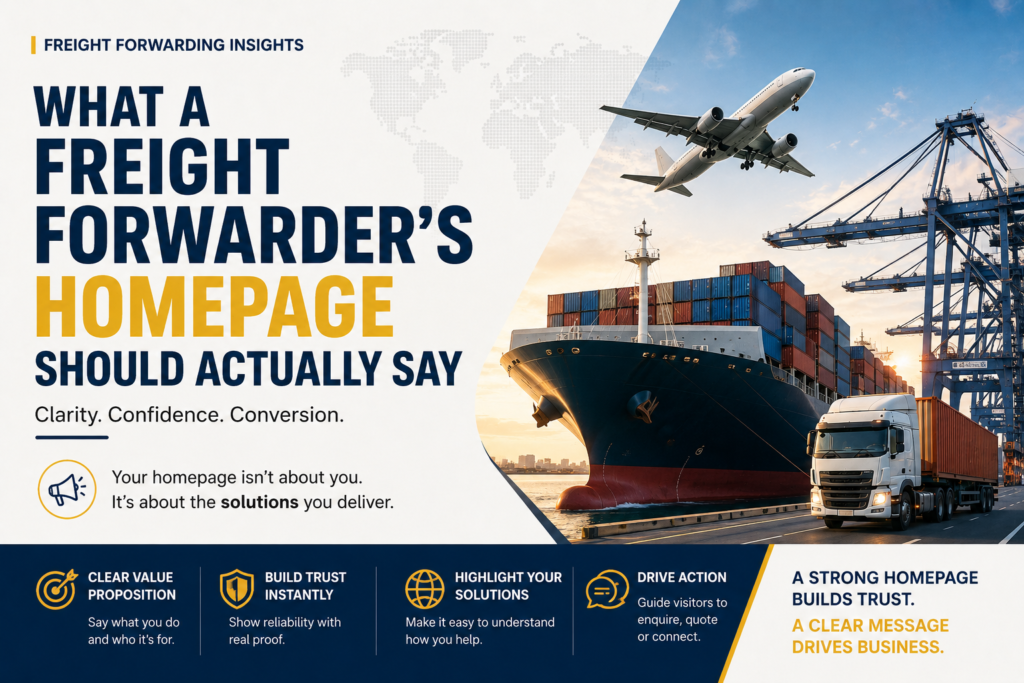
What a Freight Forwarder’s Homepage Should Actually Say
Freight Forwarding Marketing · Website Copy What a Freight Forwarder’s Homepage Should Actually Say (With Examples) in India By Anshul Kuntewar · Freight Forwarding Marketing Agency · 9 minute read You have five seconds. That’s roughly how long it takes a visitor to decide whether your homepage is worth another moment of attention — and Gartner’s research shows 77% of B2B buyers already find the purchase process complex or difficult before they even reach your site. A confusing homepage doesn’t just lose a visitor. It confirms their fear that working with you will be just as confusing. Most Indian freight forwarder homepages fail this test not because the design is bad, but because the copy answers the wrong question. It talks about the company (“Established in 1998… a trusted name…”) when the visitor is silently asking three much narrower questions: What do you actually move? Do you handle my route? What do I do next? Here’s what each section of your homepage should actually say to answer them — with real before-and-after examples. The Headline Stop announcing, start answering ✕ Most homepages say “Welcome to [Company Name] — Your Trusted Logistics Partner” ✓ It should say “FCL & LCL Ocean Freight from Mumbai and Chennai to 40+ Countries — Quoted in Under 2 Hours” Every competitor’s headline says “trusted partner” — it’s functionally invisible, filtered out as noise before the sentence finishes. The rewrite names the specific service, the specific ports, and a checkable promise. A visitor can confirm relevance in one sentence, which is the entire job of a headline. The Subheadline Name the buyer, not just the service ✕ Most homepages say “We provide comprehensive freight forwarding solutions tailored to your business needs.” ✓ It should say “Built for exporters shipping 1-20 containers a month who need a forwarder that answers the phone.” “Comprehensive” and “tailored” sound specific but commit to nothing. The rewrite filters (a massive enterprise shipper self-identifies as a mismatch, which is fine) and names a real, specific frustration — “answers the phone” — that anyone burned by an unresponsive forwarder recognizes instantly. The Trust Bar Specific numbers beat vague claims ✕ Most homepages say “Reliable. Trusted. Experienced.” ✓ It should say “IATA & FIATA Registered | AEO Certified | 14 Years in Operation | 2,000+ Shipments in 2025” Three adjectives with zero evidence get discounted automatically — Stanford’s web credibility research found unverifiable claims like these erode trust rather than build it. Every element in the rewrite is independently checkable. The Services Snapshot Show the decision tree, not a wall of text ✕ Most homepages say One paragraph listing ocean freight, air freight, customs clearance, warehousing, and project cargo — all equal visual weight, forcing a full read to find the one relevant service. ✓ It should say Ocean Freight (FCL/LCL) — for exporters shipping containersAir Freight — for time-sensitive cargoCustoms Clearance — standalone serviceProject Cargo — oversized shipments A visitor scans four cards in three seconds and clicks the one relevant to them — instead of reading a paragraph to extract the same information. The Ports & Lanes Section Name your actual ports, not “Pan-India” This is the single most commonly skipped section on Indian freight forwarder homepages — and one of the highest-leverage ones to add. A visitor searching for a specific port needs to confirm you actually serve it, in writing, before they’ll trust a quote request. “Pan-India coverage” doesn’t answer that; naming the port does. Here’s what that section should actually say, port by port: Port Example homepage line Mumbai & JNPT (Nhava Sheva), Maharashtra “Daily FCL sailings from JNPT to the Middle East, Europe, and the US East Coast” Mundra Port, Gujarat “Mundra-based team handling agri-export container bookings for the Kutch and Saurashtra region” Deendayal Port (Kandla), Gujarat “Bulk and breakbulk cargo clearance at Kandla, including chemical and project cargo handling” Chennai Port, Tamil Nadu “Automotive and electronics component shipments via Chennai, with dedicated reefer booking support” Kamarajar Port (Ennore), Tamil Nadu “Ennore container bookings for South India manufacturing exporters” V.O. Chidambaranar Port (Tuticorin), Tamil Nadu “Tuticorin LCL consolidation for South Tamil Nadu textile and garment exporters” Visakhapatnam Port, Andhra Pradesh “Bulk mineral and steel cargo handling out of Visakhapatnam” Paradip Port, Odisha “Paradip bulk and dry cargo forwarding for Eastern India industrial exporters” Kolkata & Haldia (Syama Prasad Mookerjee Port), West Bengal “Kolkata and Haldia clearance, including cross-border documentation for Nepal and Bangladesh trade” Cochin Port, Kerala “Cochin reefer bookings for spice, seafood, and coir exporters” New Mangalore Port, Karnataka “New Mangalore container and bulk cargo support for Karnataka coastal exporters” Mormugao Port, Goa “Mormugao iron ore and bulk cargo handling, with growing container capability” Port Blair, Andaman & Nicobar Islands “Port Blair inter-island and mainland cargo coordination” Even listing three or four of these — the ports you actually and specifically serve — outperforms a single line claiming “pan-India presence,” because it’s the difference between a claim and a fact a visitor can act on. The Call to Action One verb, repeated, not five competing options ✕ Most homepages say “Get a Quote,” “Contact Us,” “Learn More,” “Download Brochure,” “Book a Call” — all at once, forcing a choice between five vaguely-different actions. ✓ It should say One clear action, repeated: “Get a Quote” — top, middle, and bottom of the page. Every other link (brochure, about us, careers) can still exist, but shouldn’t visually compete with the one action that actually matters to a ready buyer. The Full Before-and-After ✕ Before “Welcome to Prime Cargo Logistics. We are a trusted logistics partner providing comprehensive freight forwarding solutions across India. With years of experience and a dedicated team, we ensure reliable and efficient service tailored to your business needs. Contact us today to learn more about how we can help you.” ✓ After “FCL & LCL Ocean Freight from JNPT & Chennai to 40+ Countries — Quoted in Under 2 Hours” “Built for exporters shipping 1-20 containers a month who need a forwarder that answers the
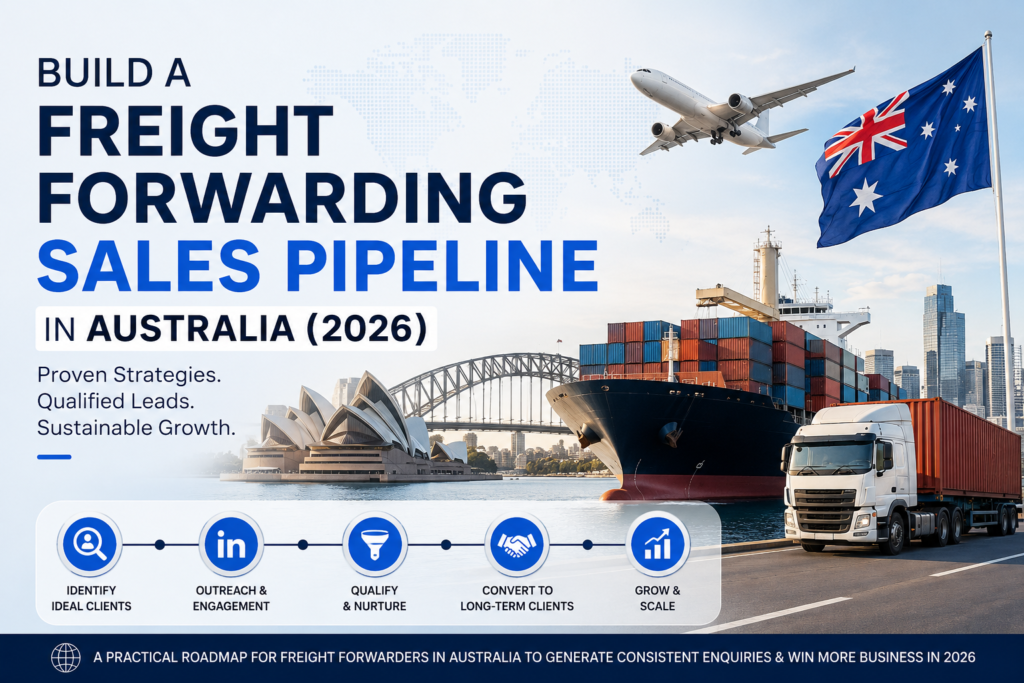
Build a Freight Forwarding Sales Pipeline in Australia (2026)
Freight Forwarding Marketing · Sales Strategy How to Build a Freight Forwarding Sales Pipeline That Doesn’t Rely on Relationships in Australia Anshul Kuntewar Freight Forwarding Marketing Agency 10 minute read Your Melbourne relationships don’t reach Perth. In a country this large, no personal network can cover the whole market — only a systemized pipeline can. About this guide: Written by the RouteRush team, a digital marketing agency working exclusively with freight forwarders, CHAs, and logistics companies across Australia, the UAE, India, Oman, South Africa, and Qatar. Sales pipeline and conversion figures are sourced from HubSpot’s 2024 State of Sales, Martal Group’s 2026 B2B Sales Benchmarks, 6sense’s 2025 Buyer Experience Report, Ebsta x Pavilion’s 2025 GTM Benchmarks, and Focus Digital’s 2026 Sales Cycle Length Report. Market figures are sourced from Mordor Intelligence’s Australia Freight Forwarding Market report. What’s Covered In This Guide Why Relationship-Only Sales Is a Risk, Not a Strength 7 Ways to Build a Pipeline That Doesn’t Depend on Who You Know What’s Quietly Keeping You Relationship-Dependent Where Pipeline Risk Concentrates, Port by Port A Practical Roadmap Frequently Asked Questions Why Relationship-Only Sales Is a Risk, Not a Strength Most Australian freight forwarders still win new business almost entirely through referrals and long-standing personal relationships — and logistics is one of the strongest verticals for a different approach precisely because so few competitors have built one. Decision-makers are identifiable, the buying cycle is predictable, and most competitors are still relying on brokers and referrals rather than any structured, repeatable system. Australia adds a specific dimension to this risk that smaller, denser markets don’t face: geography. A forwarder’s personal network built around Melbourne or Sydney simply doesn’t transfer to Perth, Darwin, or the mining corridors around Port Hedland — the country is too large, and the regional markets too distinct, for one relationship network to cover them all. On top of that, DSV’s $23.6 billion acquisition of DB Schenker is actively reshaping who buyers’ contacts are across the industry, right as Australia’s $45.96 billion e-commerce sector and record Inland Rail investment are creating substantial new demand. A relationship-only sales model has no mechanism for capturing growth this geographically and structurally dispersed; a systemized pipeline does. Meanwhile, the broader B2B data reinforces why: inbound channels like SEO and referrals produce sales cycles 2-3 times shorter than pure outbound at comparable complexity, but referrals alone still only convert around 26% of the time — meaning even your best channel needs a system behind it, not just goodwill. Australia freight forwarding market size, 2026$3.61B Projected market size by 2031$4.42B (4.12% CAGR) Australia e-commerce sector size, 2024$45.96B DSV’s acquisition of DB Schenker$23.6B Median B2B lead-to-customer conversion rate2.9% (2-5% typical) Referral lead conversion rate~26% Source: Mordor Intelligence 2026 (Australia Freight Forwarding Market); HubSpot State of Sales 2024; Martal Group 2026 B2B Sales Benchmarks; Landbase 2026 B2B Sales Statistics; Focus Digital 2026 Sales Cycle Length Report. 7 Ways to Build a Pipeline That Doesn’t Depend on Who You Know 01 Build inbound content around the specific ports and regions you serve. SEO-driven content (port pages, cargo-type guides, region-specific breakdowns for WA, the Northern Territory, and regional Queensland) generates leads that arrive already searching for what you offer — no relationship required, and inbound-sourced deals close 2-3x faster than cold outbound at similar complexity. 02 Run structured outbound alongside referrals, not instead of them. Logistics is one of the strongest verticals for outbound specifically because decision-makers (procurement heads, supply chain directors) are identifiable and the buying cycle is predictable — most competitors simply haven’t built the system yet, which is exactly the opportunity in regions where your personal network doesn’t naturally reach. 03 Put every enquiry and relationship into a CRM, not a salesperson’s memory or phone contacts. When client relationships live in a CRM rather than in one person’s head, the business survives that person’s departure — and survives the geographic gap when a client’s operations expand into a state or region your team has no personal history in. 04 Qualify leads systematically instead of chasing whoever calls first. With a median B2B win rate now around 19-21% and lead-to-customer conversion around 2.9%, a defined qualification process (cargo type, volume, port, urgency) prevents your team from spending months on deals that were never going to close. 05 Formalize account-based targeting by region, not just by industry. Given how differently buyer behavior and competition vary between, say, Port Botany’s e-commerce importers and Port Hedland’s mining exporters, a systemized approach segmented by region and cargo type captures opportunity a single relationship network never could. 06 Track pipeline velocity, not just win rate. Pipeline velocity (opportunities × average deal value × win rate ÷ sales cycle length) shows whether you’re actually generating revenue efficiently, not just closing occasional deals — a metric relationship-only selling rarely tracks at all. 07 Build a retention and renewal process for existing clients. As the market consolidates around scale players like the merged DSV-DB Schenker entity, a systemized check-in cadence and account review schedule protects existing relationships from being poached by a larger competitor with more resources but less personal history. What’s Quietly Keeping You Relationship-Dependent No CRM, or one nobody actually updates. If client history and pipeline status live in someone’s head or a personal notebook, the business has no visibility into its own sales process — and no way to onboard a new salesperson without starting from zero. A relationship network concentrated in one or two states. Australia’s geographic scale means a forwarder’s strong Melbourne or Sydney relationships provide essentially zero coverage in Western Australia, the Northern Territory, or regional Queensland — a structural gap relationship-only selling can’t close. No defined qualification criteria. Without a system for scoring leads by cargo type, volume, and fit, sales time gets spent equally on every enquiry regardless of how likely it is to close. Assuming industry consolidation won’t touch your relationships. As larger players like the merged DSV-DB Schenker entity expand, buyer contacts shift roles or move to competitors — a relationship-only model has
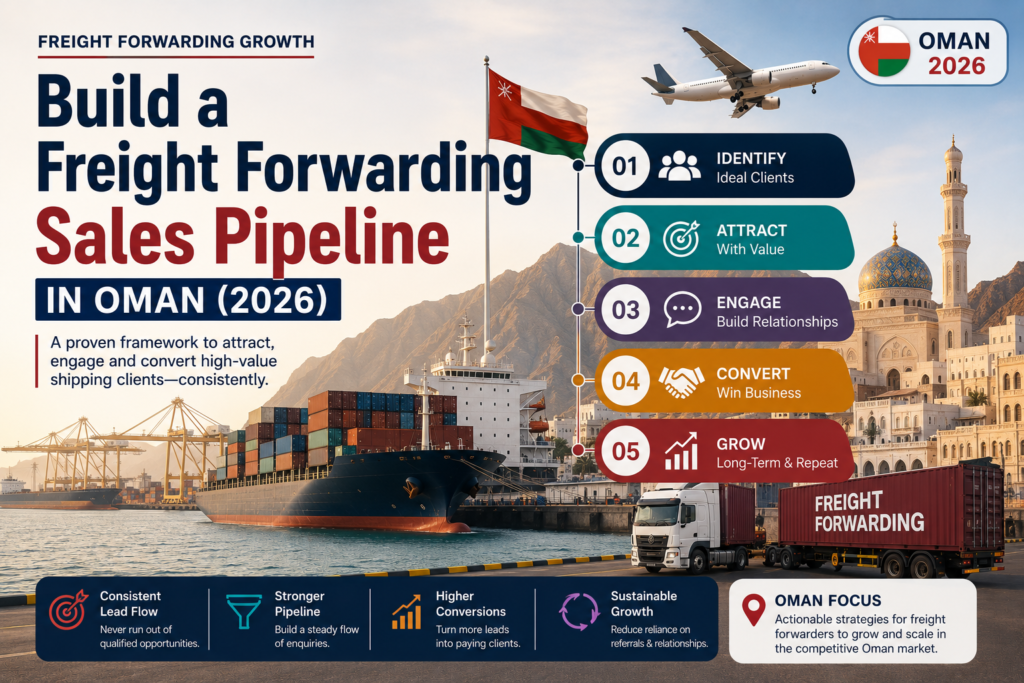
Build a Freight Forwarding Sales Pipeline in Oman (2026)
Freight Forwarding Marketing · Sales Strategy How to Build a Freight Forwarding Sales Pipeline That Doesn’t Rely on Relationships in Oman Anshul Kuntewar Freight Forwarding Marketing Agency 10 minute read Duqm — the largest Special Economic Zone in the Middle East — is drawing international operators with zero existing Oman relationships. A relationship-only sales model has no way to reach them at all. About this guide: Written by the RouteRush team, a digital marketing agency working exclusively with freight forwarders, CHAs, and logistics companies across Oman, the UAE, India, South Africa, Qatar, and Australia. Sales pipeline and conversion figures are sourced from HubSpot’s 2024 State of Sales, Martal Group’s 2026 B2B Sales Benchmarks, 6sense’s 2025 Buyer Experience Report, Ebsta x Pavilion’s 2025 GTM Benchmarks, and Focus Digital’s 2026 Sales Cycle Length Report. Market figures are sourced from Mordor Intelligence’s Oman Logistics & Warehousing and GCC Freight & Logistics market reports. What’s Covered In This Guide Why Relationship-Only Sales Is a Risk, Not a Strength 7 Ways to Build a Pipeline That Doesn’t Depend on Who You Know What’s Quietly Keeping You Relationship-Dependent Where Pipeline Risk Concentrates, Port by Port A Practical Roadmap Frequently Asked Questions Why Relationship-Only Sales Is a Risk, Not a Strength Most Omani freight forwarders still win new business almost entirely through referrals and long-standing personal relationships — and logistics is one of the strongest verticals for a different approach precisely because so few competitors have built one. Decision-makers are identifiable, the buying cycle is predictable, and most competitors are still relying on brokers and referrals rather than any structured, repeatable system. Oman’s economic diversification under Vision 2040 makes relationship-only selling a genuine growth constraint rather than just an operational risk. The Special Economic Zone at Duqm — the largest in the Middle East — is actively attracting international operators, green hydrogen investment, and new industrial entrants who have no existing Oman-specific forwarder relationships at all. Oman’s logistics and warehousing market is growing at roughly 9.3% annually, with freight forwarding alone accounting for around 35% of that market — the largest single segment. A forwarder relying purely on an existing personal network has no mechanism for capturing this new-entrant growth; a systemized pipeline does. Meanwhile, the broader B2B data reinforces why: inbound channels like SEO and referrals produce sales cycles 2-3 times shorter than pure outbound at comparable complexity, but referrals alone still only convert around 26% of the time — meaning even your best channel needs a system behind it, not just goodwill. Oman logistics & warehousing market size, 2024$1.00B (~9.3% CAGR to 2030) Freight forwarding share of Oman’s logistics market~35% (largest segment) GCC freight & logistics market, 2024$50.72B → $66.61B by 2029 Median B2B lead-to-customer conversion rate2.9% (2-5% typical) Referral lead conversion rate~26% Pipeline coverage needed to reliably hit quota3-5x revenue target Source: Mordor Intelligence 2026 (Oman Logistics & Warehousing, GCC Freight & Logistics); HubSpot State of Sales 2024; Martal Group 2026 B2B Sales Benchmarks; Landbase 2026 B2B Sales Statistics; Focus Digital 2026 Sales Cycle Length Report. 7 Ways to Build a Pipeline That Doesn’t Depend on Who You Know 01 Build inbound content around the specific ports and cargo types you handle. SEO-driven content (port pages, cargo-type guides, SEZ-specific breakdowns for Duqm) generates leads that arrive already searching for what you offer — no relationship required, and inbound-sourced deals close 2-3x faster than cold outbound at similar complexity. 02 Run structured outbound alongside referrals, not instead of them. Logistics is one of the strongest verticals for outbound specifically because decision-makers (procurement heads, supply chain directors) are identifiable and the buying cycle is predictable — most competitors simply haven’t built the system yet, which is exactly the opportunity as Oman’s economy diversifies. 03 Put every enquiry and relationship into a CRM, not a salesperson’s memory or phone contacts. When client relationships live in a CRM rather than in one person’s head, the business survives that person’s departure without losing the account or the pipeline history behind it. 04 Qualify leads systematically instead of chasing whoever calls first. With a median B2B win rate now around 19-21% and lead-to-customer conversion around 2.9%, a defined qualification process (cargo type, volume, port, urgency) prevents your team from spending months on deals that were never going to close. 05 Formalize account-based targeting toward Duqm SEZ entrants and diversification-driven operators. Vision 2040 and the Duqm Special Economic Zone are actively bringing international operators and green hydrogen investment into Oman with no existing local forwarder relationships — a deliberate, multi-touch sequence targeting these entrants works the same way whether or not you personally know anyone there. 06 Track pipeline velocity, not just win rate. Pipeline velocity (opportunities × average deal value × win rate ÷ sales cycle length) shows whether you’re actually generating revenue efficiently, not just closing occasional deals — a metric relationship-only selling rarely tracks at all. 07 Build a retention and renewal process for existing clients. A systemized check-in cadence, account review schedule, and expansion conversation turns existing relationships into a predictable, repeatable revenue stream rather than something that only gets attention when a client happens to call. What’s Quietly Keeping You Relationship-Dependent No CRM, or one nobody actually updates. If client history and pipeline status live in someone’s head or a personal notebook, the business has no visibility into its own sales process — and no way to onboard a new salesperson without starting from zero. All new business tied to 2-3 people. If the majority of your revenue traces back to a small handful of personal relationships, the business is one departure away from a serious revenue gap — a real risk in Oman’s relatively small, tightly networked logistics sector. No defined qualification criteria. Without a system for scoring leads by cargo type, volume, and fit, sales time gets spent equally on every enquiry regardless of how likely it is to close. Ignoring diversification-driven new entrants. As Vision 2040 pushes Oman’s economy beyond oil and gas, a relationship-only sales model structurally misses every new operator,
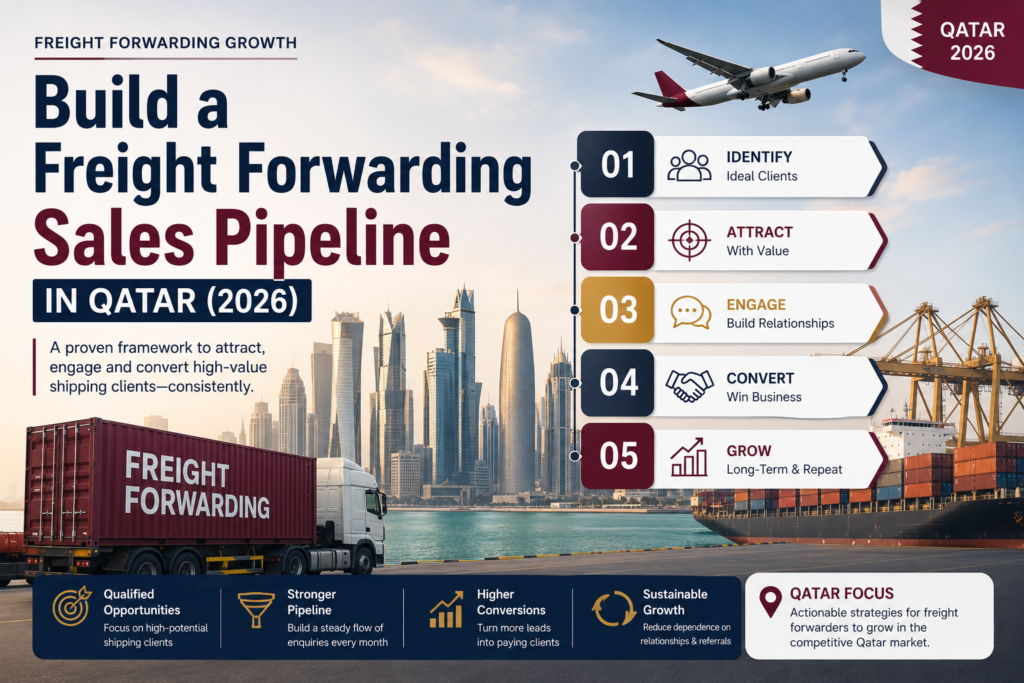
Build a Freight Forwarding Sales Pipeline in Qatar (2026)
Freight Forwarding Marketing · Sales Strategy How to Build a Freight Forwarding Sales Pipeline That Doesn’t Rely on Relationships in Qatar Anshul Kuntewar Freight Forwarding Marketing Agency 10 minute read In a market as concentrated as Qatar’s, relationship-only selling doesn’t just carry risk — it hits a hard ceiling. Once your existing network is exhausted, there’s nowhere left to grow without a system. About this guide: Written by the RouteRush team, a digital marketing agency working exclusively with freight forwarders, CHAs, and logistics companies across Qatar, the UAE, India, Oman, South Africa, and Australia. Sales pipeline and conversion figures are sourced from HubSpot’s 2024 State of Sales, Martal Group’s 2026 B2B Sales Benchmarks, 6sense’s 2025 Buyer Experience Report, Ebsta x Pavilion’s 2025 GTM Benchmarks, and Focus Digital’s 2026 Sales Cycle Length Report. Market figures are sourced from Mordor Intelligence’s Qatar Freight & Logistics Market report. What’s Covered In This Guide Why Relationship-Only Sales Is a Risk, Not a Strength 7 Ways to Build a Pipeline That Doesn’t Depend on Who You Know What’s Quietly Keeping You Relationship-Dependent Where Pipeline Risk Concentrates, Port by Port A Practical Roadmap Frequently Asked Questions Why Relationship-Only Sales Is a Risk, Not a Strength Most Qatari freight forwarders still win new business almost entirely through referrals and long-standing personal relationships — and logistics is one of the strongest verticals for a different approach precisely because so few competitors have built one. Decision-makers are identifiable, the buying cycle is predictable, and most competitors are still relying on brokers and referrals rather than any structured, repeatable system. Qatar’s market presents a specific version of this risk: it’s small and concentrated enough that relationship-only selling hits a hard ceiling. Once a forwarder has exhausted their existing personal network, there’s no natural mechanism to keep growing — and with free-zone incentives at Ras Bufontas and Umm Alhoul, continued National Vision 2030 investment, and the North Field LNG expansion pushing production toward 142 million tonnes annually by 2030, a meaningful share of new demand is coming from international entrants and expanding operations with no existing Qatar-specific relationships at all. Meanwhile, the broader B2B data shows why a systemized pipeline outperforms relationship-only selling at scale: inbound channels like SEO and referrals produce sales cycles 2-3 times shorter than pure outbound at comparable complexity, but referrals alone still only convert around 26% of the time — meaning even your best channel needs a system behind it, not just goodwill. Qatar freight & logistics market size, 2026$10.7B Projected market size by 2031$13.98B (5.5% CAGR) Hamad Port container throughput, 20247.5 million TEU North Field LNG production target by 2030142 million tonnes/year Median B2B lead-to-customer conversion rate2.9% (2-5% typical) Referral lead conversion rate~26% Source: Mordor Intelligence 2026 (Qatar Freight & Logistics Market); HubSpot State of Sales 2024; Martal Group 2026 B2B Sales Benchmarks; Landbase 2026 B2B Sales Statistics; Focus Digital 2026 Sales Cycle Length Report. 7 Ways to Build a Pipeline That Doesn’t Depend on Who You Know 01 Build inbound content around the specific ports and cargo types you handle. SEO-driven content (port pages, cargo-type guides, free-zone-specific breakdowns) generates leads that arrive already searching for what you offer — no relationship required, and inbound-sourced deals close 2-3x faster than cold outbound at similar complexity. 02 Run structured outbound alongside referrals, not instead of them. Logistics is one of the strongest verticals for outbound specifically because decision-makers (procurement heads, supply chain directors) are identifiable and the buying cycle is predictable — most competitors simply haven’t built the system yet, which is exactly the opportunity in a market this size. 03 Put every enquiry and relationship into a CRM, not a salesperson’s memory or phone contacts. When client relationships live in a CRM rather than in one person’s head, the business survives that person’s departure without losing the account or the pipeline history behind it — critical in a market small enough that losing one key relationship can mean losing a meaningful share of total revenue. 04 Qualify leads systematically instead of chasing whoever calls first. With a median B2B win rate now around 19-21% and lead-to-customer conversion around 2.9%, a defined qualification process (cargo type, volume, free zone, urgency) prevents your team from spending months on deals that were never going to close. 05 Formalize account-based targeting toward new entrants and expanding operations. With continued National Vision 2030 investment and LNG-driven expansion, a meaningful share of new demand comes from companies with no existing Qatar-specific forwarder relationship at all — a deliberate, multi-touch sequence targeting these entrants works the same way whether or not you personally know anyone there. 06 Track pipeline velocity, not just win rate. Pipeline velocity (opportunities × average deal value × win rate ÷ sales cycle length) shows whether you’re actually generating revenue efficiently, not just closing occasional deals — a metric relationship-only selling rarely tracks at all. 07 Build a retention and renewal process for existing clients. In a market as concentrated as Qatar’s, retaining every existing client matters more than in larger markets — a systemized check-in cadence and account review schedule protects revenue that a relationship-only approach can quietly lose to a single missed touchpoint. What’s Quietly Keeping You Relationship-Dependent No CRM, or one nobody actually updates. If client history and pipeline status live in someone’s head or a personal notebook, the business has no visibility into its own sales process — and no way to onboard a new salesperson without starting from zero. Revenue concentrated in a handful of personal relationships. In a market as small as Qatar’s, this risk is amplified — losing one or two key relationships can represent a disproportionate share of total revenue compared to a larger, more diversified market. No defined qualification criteria. Without a system for scoring leads by cargo type, volume, and fit, sales time gets spent equally on every enquiry regardless of how likely it is to close. Assuming the existing network is the entire addressable market. With new entrants arriving via free-zone incentives and LNG-driven expansion, treating
Build a Freight Forwarding Sales Pipeline in SA (2026)
Freight Forwarding Marketing · Sales Strategy How to Build a Freight Forwarding Sales Pipeline That Doesn’t Rely on Relationships in South Africa Anshul Kuntewar Freight Forwarding Marketing Agency 10 minute read DSV’s $15.3B acquisition of DB Schenker and DP World’s $3B African expansion are reshuffling who your buyers’ contacts even are. A pipeline built purely on relationships has no way to capture that disruption. About this guide: Written by the RouteRush team, a digital marketing agency working exclusively with freight forwarders, CHAs, and logistics companies across South Africa, the UAE, India, Oman, Qatar, and Australia. Sales pipeline and conversion figures are sourced from HubSpot’s 2024 State of Sales, Martal Group’s 2026 B2B Sales Benchmarks, 6sense’s 2025 Buyer Experience Report, Ebsta x Pavilion’s 2025 GTM Benchmarks, and Focus Digital’s 2026 Sales Cycle Length Report. Market figures are sourced from Mordor Intelligence’s South Africa Freight & Logistics Market report. What’s Covered In This Guide Why Relationship-Only Sales Is a Risk, Not a Strength 7 Ways to Build a Pipeline That Doesn’t Depend on Who You Know What’s Quietly Keeping You Relationship-Dependent Where Pipeline Risk Concentrates, Port by Port A Practical Roadmap Frequently Asked Questions Why Relationship-Only Sales Is a Risk, Not a Strength Most South African freight forwarders still win new business almost entirely through referrals and long-standing personal relationships — and logistics is one of the strongest verticals for a different approach precisely because so few competitors have built one. Decision-makers are identifiable, the buying cycle is predictable, and most competitors are still relying on brokers and referrals rather than any structured, repeatable system. That relationship-only model has a structural weakness that’s playing out in real time right now: DSV’s $15.3 billion acquisition of DB Schenker and DP World’s $3 billion African ports and logistics commitment through 2029 are actively reshaping who your buyers’ contacts even are. Mergers move people into new roles, out of the industry, or to competitors — and a sales pipeline built entirely on personal relationships with specific individuals is exceptionally exposed to exactly this kind of consolidation. Meanwhile, the broader B2B data shows why a systemized pipeline outperforms relationship-only selling at scale: inbound channels like SEO and referrals produce sales cycles 2-3 times shorter than pure outbound at comparable complexity, but referrals alone still only convert around 26% of the time — meaning even your best channel needs a system behind it, not just goodwill. South Africa freight & logistics market size, 2026$15.55B Projected market size by 2031$20.59B (5.78% CAGR) DSV’s acquisition of DB Schenker$15.3B DP World’s African ports & logistics commitment (through 2029)$3B Median B2B lead-to-customer conversion rate2.9% (2-5% typical) Referral lead conversion rate~26% Source: Mordor Intelligence 2026 (South Africa Freight & Logistics Market); HubSpot State of Sales 2024; Martal Group 2026 B2B Sales Benchmarks; Landbase 2026 B2B Sales Statistics; Focus Digital 2026 Sales Cycle Length Report. 7 Ways to Build a Pipeline That Doesn’t Depend on Who You Know 01 Build inbound content around the specific corridors and cargo types you handle. SEO-driven content (port pages, cargo-type guides, corridor breakdowns) generates leads that arrive already searching for what you offer — no relationship required, and inbound-sourced deals close 2-3x faster than cold outbound at similar complexity. 02 Run structured outbound alongside referrals, not instead of them. Logistics is one of the strongest verticals for outbound specifically because decision-makers (procurement heads, supply chain directors) are identifiable and the buying cycle is predictable — most competitors simply haven’t built the system yet, which is exactly the opportunity. 03 Put every enquiry and relationship into a CRM, not a salesperson’s memory or phone contacts. When client relationships live in a CRM rather than in one person’s head, the business survives that person’s departure — and survives your buyer’s contact moving on after a merger or restructure, since the relationship is documented rather than personal. 04 Qualify leads systematically instead of chasing whoever calls first. With a median B2B win rate now around 19-21% and lead-to-customer conversion around 2.9%, a defined qualification process (cargo type, volume, corridor, urgency) prevents your team from spending months on deals that were never going to close. 05 Formalize account-based targeting toward accounts in flux from consolidation. As DSV-DB Schenker and DP World’s expansion reshape the competitive landscape, buyers whose usual contact has left or changed roles are actively re-evaluating providers — a deliberate, timely outreach sequence toward these accounts converts far better than waiting for them to call. 06 Track pipeline velocity, not just win rate. Pipeline velocity (opportunities × average deal value × win rate ÷ sales cycle length) shows whether you’re actually generating revenue efficiently, not just closing occasional deals — a metric relationship-only selling rarely tracks at all. 07 Build a retention and renewal process for existing clients. A systemized check-in cadence, account review schedule, and expansion conversation turns existing relationships into a predictable, repeatable revenue stream rather than something that only gets attention when a client happens to call — and gives you a documented reason to stay in touch even if your usual contact moves on. What’s Quietly Keeping You Relationship-Dependent No CRM, or one nobody actually updates. If client history and pipeline status live in someone’s head or a personal notebook, the business has no visibility into its own sales process — and no way to onboard a new salesperson without starting from zero. All new business tied to 2-3 people. If the majority of your revenue traces back to a small handful of personal relationships, the business is one departure, restructure, or merger-driven role change away from a serious revenue gap. No defined qualification criteria. Without a system for scoring leads by cargo type, volume, and fit, sales time gets spent equally on every enquiry regardless of how likely it is to close. Treating industry consolidation as someone else’s problem. With major acquisitions reshaping the competitive landscape, buyers’ internal contacts are shifting constantly right now — a relationship-only sales model has no mechanism for capturing the accounts actively back in the market because of
Build a Freight Forwarding Sales Pipeline in UAE (2026)
Freight Forwarding Marketing · Sales Strategy How to Build a Freight Forwarding Sales Pipeline That Doesn’t Rely on Relationships in UAE Anshul Kuntewar Freight Forwarding Marketing Agency 10 minute read UAE non-oil trade is up nearly 49% since 2021. A large share of that growth is companies with zero existing forwarder relationships — meaning relationship-only sales structurally misses an increasingly large part of the opportunity. About this guide: Written by the RouteRush team, a digital marketing agency working exclusively with freight forwarders, CHAs, and logistics companies across the UAE, India, Oman, South Africa, Qatar, and Australia. Sales pipeline and conversion figures are sourced from HubSpot’s 2024 State of Sales, Martal Group’s 2026 B2B Sales Benchmarks, 6sense’s 2025 Buyer Experience Report, Ebsta x Pavilion’s 2025 GTM Benchmarks, and Focus Digital’s 2026 Sales Cycle Length Report. Market figures are sourced from Mordor Intelligence’s UAE Freight & Logistics Market report. What’s Covered In This Guide Why Relationship-Only Sales Is a Risk, Not a Strength 7 Ways to Build a Pipeline That Doesn’t Depend on Who You Know What’s Quietly Keeping You Relationship-Dependent Where Pipeline Risk Concentrates, Port by Port A Practical Roadmap Frequently Asked Questions Why Relationship-Only Sales Is a Risk, Not a Strength Most UAE freight forwarders still win new business almost entirely through referrals and long-standing personal relationships — and logistics is one of the strongest verticals for a different approach precisely because so few competitors have built one. Decision-makers are identifiable, the buying cycle is predictable, and most competitors are still relying on brokers and referrals rather than any structured, repeatable system. That relationship-only model has a structural weakness: it doesn’t survive a key salesperson leaving, a long-standing contact moving on, or simply having exhausted your existing network’s reach. This matters more in the UAE than most markets — non-oil foreign trade has climbed to $1.42 trillion, nearly 49% above 2021 levels, meaning a large share of the buyers entering the market now are new entrants with no legacy relationships to lean on at all. Meanwhile, the broader B2B data shows why a systemized pipeline outperforms relationship-only selling at scale: inbound channels like SEO and referrals produce sales cycles 2-3 times shorter than pure outbound at comparable complexity, but referrals alone still only convert around 26% of the time — meaning even your best channel needs a system behind it, not just goodwill. Most B2B teams also need 3-5x pipeline coverage relative to their revenue target just to hit quota reliably, which is nearly impossible to sustain from relationships alone once you’re trying to grow past a certain size. UAE freight & logistics market size, 2026$23.05B Projected market size by 2031$31.63B (6.55% CAGR) UAE non-oil foreign trade$1.42T (up ~49% vs. 2021) Median B2B lead-to-customer conversion rate2.9% (2-5% typical) Referral lead conversion rate~26% Pipeline coverage needed to reliably hit quota3-5x revenue target Source: Mordor Intelligence 2026 (UAE Freight & Logistics Market); HubSpot State of Sales 2024; Martal Group 2026 B2B Sales Benchmarks; Landbase 2026 B2B Sales Statistics; Focus Digital 2026 Sales Cycle Length Report. 7 Ways to Build a Pipeline That Doesn’t Depend on Who You Know 01 Build inbound content around the specific lanes and cargo types you handle. SEO-driven content (route pages, cargo-type guides, port-specific pages) generates leads that arrive already searching for what you offer — no relationship required, and inbound-sourced deals close 2-3x faster than cold outbound at similar complexity. 02 Run structured outbound alongside referrals, not instead of them. Logistics is one of the strongest verticals for outbound specifically because decision-makers (procurement heads, supply chain directors) are identifiable and the buying cycle is predictable — most competitors simply haven’t built the system yet, which is exactly the opportunity. 03 Put every enquiry and relationship into a CRM, not a salesperson’s memory or phone contacts. When client relationships live in a CRM rather than in one person’s head, the business survives that person’s departure, visa change, or relocation without losing the account or the pipeline history behind it — a genuine risk in a market with as much cross-border talent mobility as the UAE. 04 Qualify leads systematically instead of chasing whoever calls first. With a median B2B win rate now around 19-21% and lead-to-customer conversion around 2.9%, a defined qualification process (cargo type, volume, lane, urgency) prevents your team from spending months on deals that were never going to close. 05 Formalize your account-based targeting toward new market entrants. With non-oil trade nearly 49% above 2021 levels, a large share of your addressable market consists of companies with no existing UAE forwarder relationship at all — a deliberate, multi-touch sequence targeting these new entrants works the same way whether or not you personally know anyone there. 06 Track pipeline velocity, not just win rate. Pipeline velocity (opportunities × average deal value × win rate ÷ sales cycle length) shows whether you’re actually generating revenue efficiently, not just closing occasional deals — a metric relationship-only selling rarely tracks at all. 07 Build a retention and renewal process for existing clients. A systemized check-in cadence, account review schedule, and expansion conversation turns existing relationships into a predictable, repeatable revenue stream rather than something that only gets attention when a client happens to call. What’s Quietly Keeping You Relationship-Dependent No CRM, or one nobody actually updates. If client history and pipeline status live in someone’s head or a personal notebook, the business has no visibility into its own sales process — and no way to onboard a new salesperson without starting from zero. All new business tied to 2-3 people. If the majority of your revenue traces back to a small handful of personal relationships, the business is one departure, visa change, or relocation away from a serious revenue gap — a real risk given how mobile the UAE’s logistics workforce is. No defined qualification criteria. Without a system for scoring leads by cargo type, volume, and fit, sales time gets spent equally on every enquiry regardless of how likely it is to close. Ignoring the flood of
Build a Freight Forwarding Sales Pipeline Without Relationships
Freight Forwarding Marketing · Sales Strategy How to Build a Freight Forwarding Sales Pipeline That Doesn’t Rely on Relationships in India Anshul Kuntewar Freight Forwarding Marketing Agency 10 minute read Most Indian freight forwarders win business almost entirely through referrals and personal relationships. That’s a strength, right up until a key salesperson leaves — then it’s a revenue gap with no system behind it. About this guide: Written by the RouteRush team, a digital marketing agency working exclusively with freight forwarders, CHAs, and logistics companies across India, the UAE, Oman, South Africa, Qatar, and Australia. Sales pipeline and conversion figures are sourced from HubSpot’s 2024 State of Sales, Martal Group’s 2026 B2B Sales Benchmarks, 6sense’s 2025 Buyer Experience Report, Ebsta x Pavilion’s 2025 GTM Benchmarks, and Focus Digital’s 2026 Sales Cycle Length Report. Market figures are sourced from Mordor Intelligence’s India Freight & Logistics Market report. What’s Covered In This Guide Why Relationship-Only Sales Is a Risk, Not a Strength 7 Ways to Build a Pipeline That Doesn’t Depend on Who You Know What’s Quietly Keeping You Relationship-Dependent Where Pipeline Risk Concentrates, Port by Port A Practical Roadmap Frequently Asked Questions Why Relationship-Only Sales Is a Risk, Not a Strength Most Indian freight forwarders still win new business almost entirely through referrals and long-standing personal relationships — and logistics is one of the strongest verticals for a different approach precisely because so few competitors have built one. Decision-makers are identifiable, the buying cycle is predictable, and most competitors are still relying on brokers and referrals rather than any structured, repeatable system. That relationship-only model has a structural weakness: it doesn’t survive a key salesperson leaving, a long-standing contact retiring, or simply having exhausted your existing network’s reach. Meanwhile, the broader B2B data shows why a systemized pipeline outperforms relationship-only selling at scale: inbound channels like SEO and referrals produce sales cycles 2-3 times shorter than pure outbound at comparable complexity, but referrals alone still only convert around 26% of the time — meaning even your best channel needs a system behind it, not just goodwill. Most B2B teams also need 3-5x pipeline coverage relative to their revenue target just to hit quota reliably, which is nearly impossible to sustain from relationships alone once you’re trying to grow past a certain size. India freight & logistics market size, 2026$315.89B Projected market size by 2031$476.51B (8.57% CAGR) Median B2B lead-to-customer conversion rate2.9% (2-5% typical) Referral lead conversion rate~26% Inbound sales cycles vs. outbound2-3x shorter Pipeline coverage needed to reliably hit quota3-5x revenue target Source: Mordor Intelligence 2026; HubSpot State of Sales 2024; Martal Group 2026 B2B Sales Benchmarks; Landbase 2026 B2B Sales Statistics; Focus Digital 2026 Sales Cycle Length Report. 7 Ways to Build a Pipeline That Doesn’t Depend on Who You Know 01 Build inbound content around the specific lanes and cargo types you handle. SEO-driven content (route pages, cargo-type guides, port-specific pages) generates leads that arrive already searching for what you offer — no relationship required, and inbound-sourced deals close 2-3x faster than cold outbound at similar complexity. 02 Run structured outbound alongside referrals, not instead of them. Logistics is one of the strongest verticals for outbound specifically because decision-makers (procurement heads, supply chain directors) are identifiable and the buying cycle is predictable — most competitors simply haven’t built the system yet, which is exactly the opportunity. 03 Put every enquiry and relationship into a CRM, not a salesperson’s memory or phone contacts. When client relationships live in a CRM rather than in one person’s head, the business survives that person’s departure, illness, or retirement without losing the account or the pipeline history behind it. 04 Qualify leads systematically instead of chasing whoever calls first. With a median B2B win rate now around 19-21% and lead-to-customer conversion around 2.9%, a defined qualification process (cargo type, volume, lane, urgency) prevents your team from spending months on deals that were never going to close. 05 Formalize your account-based targeting. Rather than waiting for the next referral, identify specific target accounts by industry, shipment volume, and trade lane, and run a deliberate, multi-touch sequence against that list — a repeatable process that works the same way whether or not you personally know anyone there. 06 Track pipeline velocity, not just win rate. Pipeline velocity (opportunities × average deal value × win rate ÷ sales cycle length) shows whether you’re actually generating revenue efficiently, not just closing occasional deals — a metric relationship-only selling rarely tracks at all. 07 Build a retention and renewal process for existing clients. A systemized check-in cadence, account review schedule, and expansion conversation turns existing relationships into a predictable, repeatable revenue stream rather than something that only gets attention when a client happens to call. What’s Quietly Keeping You Relationship-Dependent No CRM, or one nobody actually updates. If client history and pipeline status live in someone’s head or a personal notebook, the business has no visibility into its own sales process — and no way to onboard a new salesperson without starting from zero. All new business tied to 2-3 people. If the majority of your revenue traces back to a small handful of personal relationships, the business is one departure or retirement away from a serious revenue gap. No defined qualification criteria. Without a system for scoring leads by cargo type, volume, and fit, sales time gets spent equally on every enquiry regardless of how likely it is to close. Buying committees are growing, and relationship-only selling doesn’t scale to them. B2B deals now average close to 7 decision-makers, and complex deals need multiple engaged contacts to close efficiently — a single personal relationship with one buyer increasingly isn’t enough on its own. Where Pipeline Risk Concentrates, Port by Port India has 13 government-administered major ports under the Ministry of Ports, Shipping and Waterways, plus Mundra — the country’s largest port by cargo volume. Relationship dependency and pipeline-building opportunity vary meaningfully by hub. Mumbai & JNPT (Nhava Sheva), Maharashtra The most mature and relationship-dense forwarder market in
How NDIS Providers Can Get More Referrals Without Cold Calling
NDIS Marketing · Referral Strategy How NDIS Providers Can Get More Referrals Without Cold Calling Anshul Kuntewar NDIS Digital Marketing 8 minute read 83% of satisfied families are willing to refer you. Only 29% actually do without being asked. That gap is where most of your untapped growth is already sitting — no cold calling required. About this guide: Written by the RouteRush team, a digital marketing agency working with NDIS providers across Australia on website, SEO, and referral-growth strategy. Referral and healthcare acquisition figures are sourced from McKinsey Health, Accenture Health, Rock Health, Deloitte Health, and Extole’s 2026 referral marketing benchmarks. NDIS registration figures reflect the Quality and Safeguards Commission’s registration groups as of mid-2026. What’s Covered In This Guide Why Referrals Still Beat Every Other NDIS Growth Channel 7 Ways to Build a Referral Pipeline Without Ever Cold Calling What’s Quietly Costing You Referrals Right Now Building Local Referral Relationships, City by City A Practical Roadmap Frequently Asked Questions Why Referrals Still Beat Every Other NDIS Growth Channel Cold calling support coordinators and allied health practices is slow, low-yield, and increasingly unwelcome in a sector that runs almost entirely on trust and existing relationships. Meanwhile, the data on referrals keeps pointing the same direction: telehealth and healthcare platforms attribute roughly 30-45% of new patient acquisition to word-of-mouth and referrals, and healthcare referral programs see participation rates of around 34% among existing patients and families. Referral-driven leads convert at 3-5 times the rate of other channels precisely because they arrive pre-loaded with trust — something a cold call has to build from zero, every single time. Here’s the gap worth paying attention to: roughly 83% of satisfied customers say they’re willing to refer a business they’ve had a good experience with, but only around 29% actually do it without being asked or given an easy way to. That 54-point gap is where most of the referral growth sitting untapped in your existing participant base, support coordinator relationships, and allied health network actually lives. Structured referral outreach — simply asking, and making it easy — can lift referral rates roughly threefold compared to relying on word-of-mouth happening on its own. Word-of-mouth share of new healthcare patient acquisition30-45% Healthcare referral program participation rate~34% Referral-driven lead conversion vs. other channels3-5x higher Consumers who trust referrals from people they know92% Satisfied customers willing to refer vs. who actually do83% vs. 29% Referral rate lift from a structured approach~3x Source: McKinsey Health 2026; Accenture Health 2026; Rock Health 2026; Deloitte Health 2026; Extole 2026 Referral Marketing Statistics. 7 Ways to Build a Referral Pipeline Without Ever Cold Calling 01 Make support coordinators your primary referral partners, not an afterthought. Support coordinators sit at the exact decision point where a participant is choosing a provider. Building genuine relationships with the coordinators active in your service area — through introductions, case conferences, or simply being consistently easy to work with — replaces the need to cold call entirely, because they start bringing participants to you. 02 Respond to enquiries fast, and make that speed visible. Coordinator-facing referral platforms now publish response-time benchmarks as a trust signal — median response times under 15 minutes, with the large majority answered within an hour. Whether or not you’re listed on such a platform, matching that standard (and mentioning it) makes coordinators more likely to send you their next participant instead of a competitor. 03 Build relationships with allied health practices treating the same participants. Occupational therapists, physiotherapists, speech pathologists, and psychologists are constantly asked by participants and families “who else should we be working with?” A provider with a genuine, two-way referral relationship with 5-10 allied health practices in their area has a pipeline that runs almost entirely on its own. 04 Ask satisfied families directly — don’t wait for them to think of it. Given that most satisfied customers never refer unless asked, a simple, low-pressure prompt at the right moment (after a positive outcome, at a plan review, in a follow-up message) is often the single highest-leverage thing a provider can do. It doesn’t need to be transactional or incentivized to work — it just needs to happen. 05 Show up consistently at local disability and allied health networking events. NDIS referral relationships are built the same way any professional trust relationship is — through repeated, low-stakes contact over time, not a single pitch. Regular presence at local provider meetups, allied health network events, or disability expo stalls compounds far more effectively than sporadic outreach. 06 Keep your online presence referral-ready. When a coordinator or allied health practitioner considers referring a participant to you, they’ll almost always check your website and Google reviews first to confirm the referral is a safe one to make. A site missing registration status, reviews, or clear service areas can quietly kill a referral that was otherwise ready to happen. 07 Formalize a simple referral pathway, even an informal one. A one-page PDF or web form making it easy for a coordinator or allied health practice to refer a participant — with your registration groups, service area, and typical response time clearly stated — removes friction at exactly the moment someone is deciding whether to bother. What’s Quietly Costing You Referrals Right Now Slow or inconsistent response times. A coordinator who doesn’t hear back quickly moves on to the next provider on their list — and often doesn’t come back the next time either. No visible registration status or reviews. Referral partners are putting their own reputation on the line when they refer a participant; anything that makes verifying your credibility harder makes referring you riskier for them. Treating referral partners as one-way pipelines. Coordinators and allied health practices notice when referrals only flow in one direction. Reciprocal referrals, where appropriate, build materially stronger long-term relationships than one-sided asks. Never actually asking satisfied families. The single most common reason referral potential goes untapped isn’t a bad experience — it’s simply that nobody asked, and the family didn’t think to volunteer it
LinkedIn Outreach for Freight Forwarders in Qatar (2026)
Freight Forwarding Marketing · LinkedIn Outreach LinkedIn Outreach for Freight Forwarders in Qatar: What Actually Works in 2026 Anshul Kuntewar Freight Forwarding Marketing Agency 9 minute read 89% of prospects on LinkedIn now get 15+ connection requests a week. Generic outreach is drowning in noise — but the freight forwarders sending fewer, sharper messages are still booking meetings. About this guide: Written by the RouteRush team, a digital marketing agency working exclusively with freight forwarders, CHAs, and logistics companies across Qatar, the UAE, Oman, South Africa, India, Australia, and the UK. LinkedIn outreach figures are sourced from Expandi’s 2026 benchmark study (13.2 million outreach attempts), Cleverly’s 2026 LinkedIn benchmarks, Belkins’ 2026 outreach study, and LeadSpark AI’s 2026 response-rate benchmarks. Market figures are sourced from Mordor Intelligence’s Qatar Freight & Logistics Market report. What’s Covered In This Guide Why LinkedIn Outreach Matters for Qatar Freight Forwarders Right Now 7 Things That Actually Work on LinkedIn in 2026 What’s Quietly Killing Your Response Rate Where to Focus Outreach, Port by Port A Practical Weekly Roadmap Frequently Asked Questions Why LinkedIn Outreach Matters for Qatar Freight Forwarders Right Now Qatar’s freight and logistics market is worth an estimated $10.7 billion in 2026 and is projected to reach $13.98 billion by 2031, growing at roughly 5.5% annually. Growth is being driven by capacity upgrades at Hamad Port and Hamad International Airport, free-zone incentives at Ras Bufontas and Umm Alhoul, and sustained government investment under National Vision 2030 — with the North Field LNG expansion alone pushing production toward 142 million tonnes annually by 2030. Hamad Port handled 7.5 million TEU in 2024 and continues expanding, positioning Doha as an increasingly high-efficiency hub within the wider Gulf supply chain. That’s a compact but fast-growing market — and LinkedIn is where most Qatari logistics decision-makers, from procurement leads to supply chain directors, actually spend their professional attention. But LinkedIn outreach in 2026 looks nothing like it did even two years ago. Nearly 90% of prospects now receive more than 15 connection requests a week, and connection-request reply rates have dropped 37% year-over-year as inboxes get noisier. The freight forwarders still generating real pipeline from LinkedIn aren’t sending more messages — they’re sending fewer, better-targeted ones. Qatar freight & logistics market size, 2026$10.7B Projected market size by 2031$13.98B (5.5% CAGR) Hamad Port container throughput, 20247.5 million TEU Average LinkedIn connection acceptance rate, 202628-31% Personalized note acceptance rate45-48% (vs. 15-26% blank) Average message reply rate10-11% (strong: 25-35%) Source: Mordor Intelligence 2026 (Qatar Freight & Logistics Market); Expandi 2026 LinkedIn Outreach Benchmarks (13.2M data points); Cleverly 2026 LinkedIn Benchmarks; LeadSpark AI 2026 Response Rate Benchmarks. 7 Things That Actually Work on LinkedIn in 2026 01 A personalized note on every connection request. This is the single highest-leverage habit in outreach right now. Personalized connection requests convert at roughly 45-48%, compared to 15-26% for blank requests — nearly double, sometimes triple. For a freight forwarder, “personalized” doesn’t need to be elaborate: referencing the prospect’s specific trade lane, industry, or a recent company announcement is enough. 02 Warm-first sequencing, not cold blasts. Visiting a prospect’s profile or engaging with a recent post before sending a request measurably improves acceptance. Sequences that combine a profile visit with a direct message have pushed reply rates as high as 11.87% in recent benchmarking, well above cold outreach alone. 03 Short messages over long pitches. Well-structured campaigns with tight targeting and short first messages regularly hit 14-17% reply rates — nearly double the platform average. A three-line message asking one clear question consistently outperforms a paragraph explaining your entire service offering. 04 Trigger-based outreach. Reaching out around a relevant event — a job change, a company expansion announcement, a post about a shipping delay or new trade lane — boosts response rates by roughly 32% compared to outreach with no clear reason for the timing. 05 Connection requests before InMail, not instead of it. InMail open rates are strong (52-57%), but cost-per-reply runs around $47 versus close to nothing for an organic connection sequence. InMail earns its cost specifically when you’re targeting a prospect with zero shared connections and a historically low acceptance rate — for most Qatar freight prospecting, a well-built connection sequence will outperform InMail on both cost and conversation quality. 06 Follow-ups spaced 2-5 business days apart. A single message rarely does the work. Sequenced, spaced follow-ups consistently outperform one-and-done outreach, without crossing into the kind of daily-ping behavior that gets flagged as spam. 07 Messaging built around the specific port, lane, or cargo type the prospect actually cares about. A generic “we help freight forwarders grow” message reads as one of dozens a decision-maker received that week. A message referencing their specific corridor — Hamad Port container imports, Ras Laffan LNG logistics, Mesaieed petrochemical exports — reads as researched, not templated. What’s Quietly Killing Your Response Rate Generic templates. Roughly 72% of all LinkedIn outreach messages are still generic beyond the recipient’s first name — and LinkedIn’s spam-detection has gotten materially better at identifying and suppressing them. Over-volume. Sending too many requests too fast is the single fastest way to trigger LinkedIn’s adaptive restriction algorithm — sustained acceptance rates below 25-30% can trigger automatic throttling on your account. Pitching in the first message. Asking for a call or pushing your services before any real exchange has happened is the most common reason a warm connection goes cold immediately after accepting. Ignoring day-of-week patterns. Response activity is measurably higher earlier in the week (Sunday through Wednesday in the Gulf working calendar) and drops sharply toward the weekend — sending your best messages on a Friday wastes your strongest content on your quietest audience. Where to Focus Outreach, Port by Port Qatar’s freight and maritime activity concentrates around a small number of ports, each tied to distinct cargo profiles and buyer behavior. Outreach that references the right one lands very differently than generic Qatar-wide messaging. Hamad Port, Umm Al Houl Qatar’s primary seaport and one of the world’s largest greenfield port developments,