
Build a Freight Forwarding Sales Pipeline in Qatar (2026)
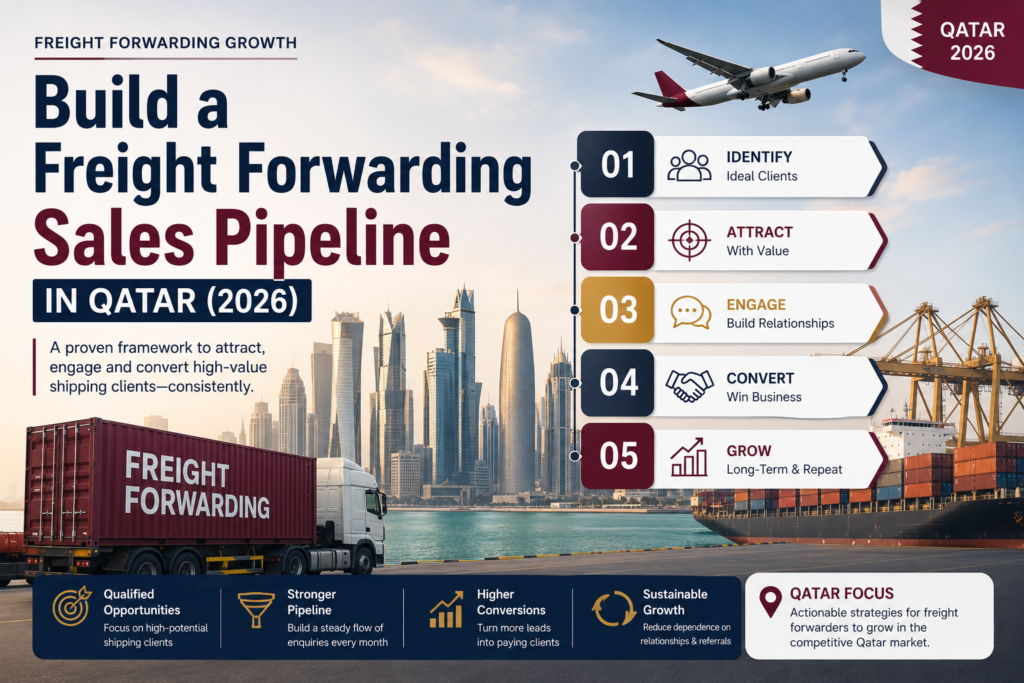
Freight Forwarding Marketing · Sales Strategy
How to Build a Freight Forwarding Sales Pipeline That Doesn't Rely on Relationships in Qatar
In a market as concentrated as Qatar's, relationship-only selling doesn't just carry risk — it hits a hard ceiling. Once your existing network is exhausted, there's nowhere left to grow without a system.
What's Covered In This Guide
- Why Relationship-Only Sales Is a Risk, Not a Strength
- 7 Ways to Build a Pipeline That Doesn't Depend on Who You Know
- What's Quietly Keeping You Relationship-Dependent
- Where Pipeline Risk Concentrates, Port by Port
- A Practical Roadmap
- Frequently Asked Questions
Why Relationship-Only Sales Is a Risk, Not a Strength
Most Qatari freight forwarders still win new business almost entirely through referrals and long-standing personal relationships — and logistics is one of the strongest verticals for a different approach precisely because so few competitors have built one. Decision-makers are identifiable, the buying cycle is predictable, and most competitors are still relying on brokers and referrals rather than any structured, repeatable system.
Qatar's market presents a specific version of this risk: it's small and concentrated enough that relationship-only selling hits a hard ceiling. Once a forwarder has exhausted their existing personal network, there's no natural mechanism to keep growing — and with free-zone incentives at Ras Bufontas and Umm Alhoul, continued National Vision 2030 investment, and the North Field LNG expansion pushing production toward 142 million tonnes annually by 2030, a meaningful share of new demand is coming from international entrants and expanding operations with no existing Qatar-specific relationships at all. Meanwhile, the broader B2B data shows why a systemized pipeline outperforms relationship-only selling at scale: inbound channels like SEO and referrals produce sales cycles 2-3 times shorter than pure outbound at comparable complexity, but referrals alone still only convert around 26% of the time — meaning even your best channel needs a system behind it, not just goodwill.
7 Ways to Build a Pipeline That Doesn't Depend on Who You Know
Build inbound content around the specific ports and cargo types you handle. SEO-driven content (port pages, cargo-type guides, free-zone-specific breakdowns) generates leads that arrive already searching for what you offer — no relationship required, and inbound-sourced deals close 2-3x faster than cold outbound at similar complexity.
Run structured outbound alongside referrals, not instead of them. Logistics is one of the strongest verticals for outbound specifically because decision-makers (procurement heads, supply chain directors) are identifiable and the buying cycle is predictable — most competitors simply haven't built the system yet, which is exactly the opportunity in a market this size.
Put every enquiry and relationship into a CRM, not a salesperson's memory or phone contacts. When client relationships live in a CRM rather than in one person's head, the business survives that person's departure without losing the account or the pipeline history behind it — critical in a market small enough that losing one key relationship can mean losing a meaningful share of total revenue.
Qualify leads systematically instead of chasing whoever calls first. With a median B2B win rate now around 19-21% and lead-to-customer conversion around 2.9%, a defined qualification process (cargo type, volume, free zone, urgency) prevents your team from spending months on deals that were never going to close.
Formalize account-based targeting toward new entrants and expanding operations. With continued National Vision 2030 investment and LNG-driven expansion, a meaningful share of new demand comes from companies with no existing Qatar-specific forwarder relationship at all — a deliberate, multi-touch sequence targeting these entrants works the same way whether or not you personally know anyone there.
Track pipeline velocity, not just win rate. Pipeline velocity (opportunities × average deal value × win rate ÷ sales cycle length) shows whether you're actually generating revenue efficiently, not just closing occasional deals — a metric relationship-only selling rarely tracks at all.
Build a retention and renewal process for existing clients. In a market as concentrated as Qatar's, retaining every existing client matters more than in larger markets — a systemized check-in cadence and account review schedule protects revenue that a relationship-only approach can quietly lose to a single missed touchpoint.
What's Quietly Keeping You Relationship-Dependent
- No CRM, or one nobody actually updates. If client history and pipeline status live in someone's head or a personal notebook, the business has no visibility into its own sales process — and no way to onboard a new salesperson without starting from zero.
- Revenue concentrated in a handful of personal relationships. In a market as small as Qatar's, this risk is amplified — losing one or two key relationships can represent a disproportionate share of total revenue compared to a larger, more diversified market.
- No defined qualification criteria. Without a system for scoring leads by cargo type, volume, and fit, sales time gets spent equally on every enquiry regardless of how likely it is to close.
- Assuming the existing network is the entire addressable market. With new entrants arriving via free-zone incentives and LNG-driven expansion, treating your current relationship network as the ceiling of your opportunity means missing genuine growth that a systemized pipeline would capture.
Where Pipeline Risk Concentrates, Port by Port
Qatar's freight and maritime activity concentrates around a small number of ports, each tied to distinct cargo profiles and buyer behavior. Relationship dependency and pipeline-building opportunity vary meaningfully by hub.
Hamad Port, Umm Al Houl
The most relationship-dense logistics hub in the country, handling 7.5 million TEU annually with continued capacity expansion under National Vision 2030. The highest concentration of forwarders and decision-makers operates here — but continued growth means a steady stream of new entrants with no existing relationships, giving a systemized pipeline real room to capture share even in the country's most competitive hub.
Doha Port
A smaller, longer-established cargo and maritime tourism operation. Forwarders connected here often have deep institutional relationships — a systemized approach built around this specific legacy, rather than trying to out-relationship incumbents, tends to work better.
Mesaieed Port (Umm Said)
An industrial and petrochemical hub with a technical, specialized buyer base. Existing relationships here run deep within the sector — content and outbound built around genuine industrial logistics expertise can break in where generic relationship networking cannot.
Ras Laffan Port
The cornerstone of Qatar's LNG expansion, an extremely narrow and technical buyer segment tied directly to energy logistics. A forwarder building genuine expertise-led content and outreach here can capture buyers that pure relationship networking, concentrated among a handful of incumbent contacts, never reaches.
Al Ruwais Port
A smaller, regionally focused port handling refrigerated food imports. The total pool of existing relationships is naturally limited here — a well-targeted systemized outreach effort can realistically reach a meaningful share of relevant decision-makers.
Al Rayyan Marine Oil Terminal
A highly specialized offshore oil segment with an extremely narrow buyer base. Relationship-only selling has essentially no room to expand here without deliberate, expertise-led outreach targeting the specific handful of relevant decision-makers.
Halul Island
An extremely niche offshore terminal. Similar to Al Rayyan, a small, precisely targeted systemized outreach list will substantially outperform any attempt to rely on existing personal relationships alone, simply because so few exist to rely on.
A Practical Roadmap
| Timeframe | Action |
|---|---|
| Week 1 | Move all client and prospect relationships out of individual memory/contacts and into a shared CRM |
| Week 1 | Define lead qualification criteria (cargo type, volume, free zone, urgency) |
| Weeks 2-4 | Build inbound content for your top 3-5 ports and cargo specializations |
| Weeks 2-4 | Identify target accounts among new entrants and expanding operations |
| Month 2 | Launch a multi-touch outbound sequence against your target account list |
| Month 2 | Set up a renewal/retention cadence for existing clients |
| Month 3 | Track pipeline velocity and win rate by source (referral vs. inbound vs. outbound) to see what's actually working |
Frequently Asked Questions
Isn't relationship-based selling still the most important channel in Qatar's freight forwarding market?
Relationships remain valuable — referral leads convert well and shouldn't be abandoned. The risk isn't relationships themselves; it's that in a market this concentrated, relationships alone eventually hit a ceiling, and a system is what lets you keep growing past it.
Is Qatar too small a market to bother building a systemized pipeline?
The opposite — precisely because the market is small, every relationship lost or every new entrant missed represents a larger share of total opportunity than in a bigger market. A systemized pipeline matters more in a concentrated market like Qatar's, not less.
How long does it take to build a pipeline that isn't relationship-dependent?
Most forwarders start seeing early inbound or outbound pipeline signal within 4-8 weeks, but building this into a reliable, diversified revenue source alongside existing relationships typically takes 3-6 months of consistent execution.
Do we need a full CRM system, or can we start simpler?
Start with whatever system your team will actually use consistently — even a well-maintained spreadsheet is a major improvement over relationships living in one person's head. The goal is visibility and continuity, not a specific tool.
Will building a systemized pipeline actually reduce our dependence on our best salespeople?
Yes, over time — a documented process, shared CRM data, and defined qualification criteria mean a new team member can be productive faster and a departure doesn't take the account history and relationship context with them.
Get Started
Ready to Build a Pipeline That Doesn't Depend on Who You Know?
We'll audit your current sales process, help you build inbound content around your actual ports and cargo types, set up structured outbound targeting toward new entrants and expanding operations, and put a real system behind the relationships you already have.
Request Your Free Pipeline AuditRelated reading
- How to Build a Freight Forwarding Sales Pipeline That Doesn't Rely on Relationships in India
- How to Build a Freight Forwarding Sales Pipeline That Doesn't Rely on Relationships in UAE
- LinkedIn Outreach for Freight Forwarders in Qatar: What Actually Works in 2026
Anshul Kuntewar
Founder, RouteRush Digital Marketing Agency — a freight forwarding marketing agency specialising in sales pipeline strategy, SEO, and lead generation for freight and logistics companies across Qatar, the UAE, India, Oman, South Africa, and Australia. Connect on LinkedIn →
This guide reflects B2B sales and Qatar freight market benchmark data current as of mid-2026. Individual results vary by port, cargo type, and existing relationship base.
[…] sales proposal. Consistency between those encounters supports recognition. RouteRush’s guide to building a freight forwarding sales pipeline in Qatar explores how to organise the broader commercial […]