
RouteRush / Freight forwarder growth
How Importers Search for a Freight Forwarder, and What Most Companies Miss
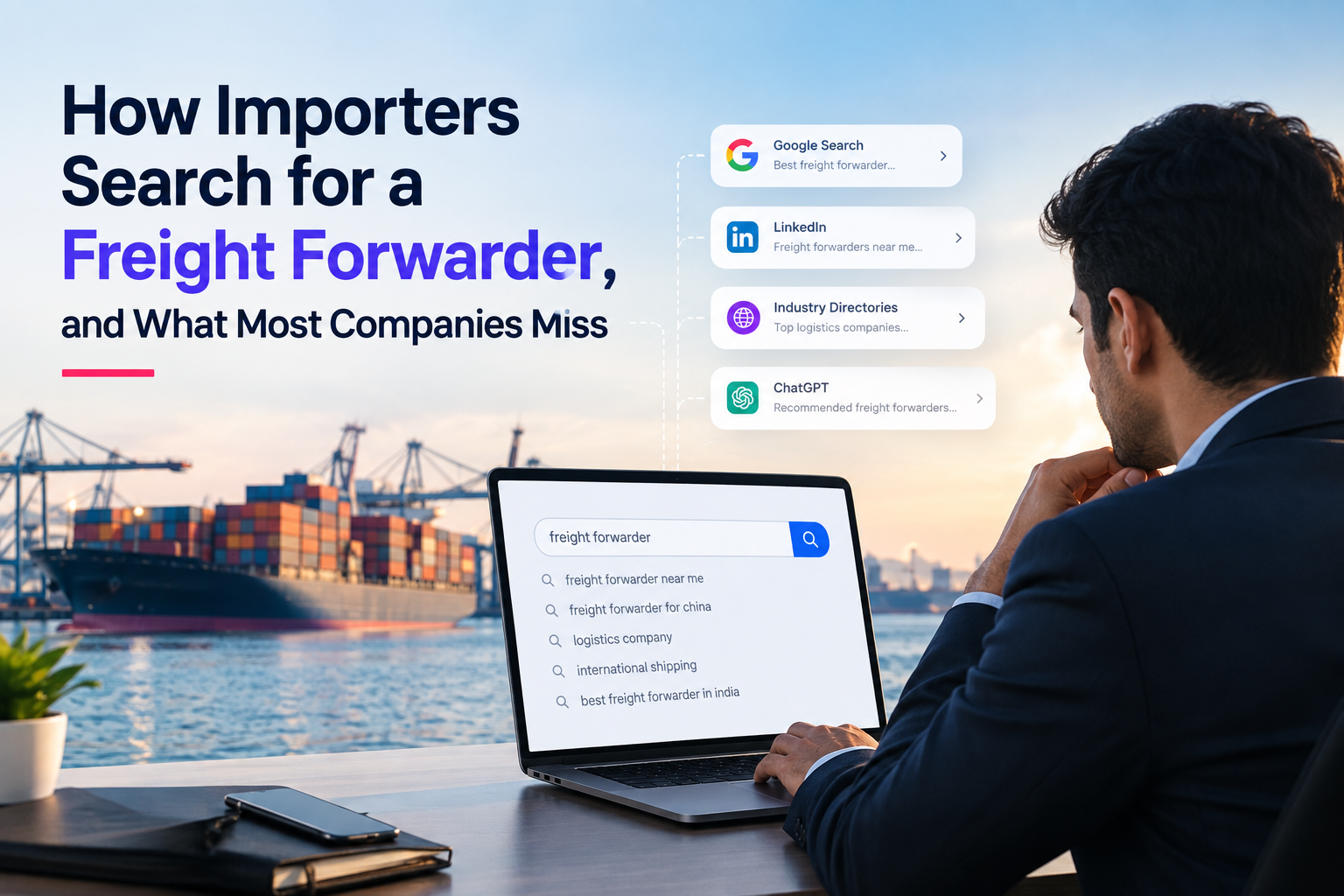
An importer in the middle of placing a first order with a new supplier in Shenzhen opens Google and types "freight forwarder for small import China." They don't click the first result. They open four or five tabs, skim each site for about fifteen seconds, and close most of them without reading past the hero section. Two make the shortlist. One gets an email. The other three forwarders that bid for that same search term never find out they lost — the importer simply never got in touch.
That fifteen-second skim is the moment almost every freight forwarder's marketing is actually competing in, and it's a moment most websites are built to fail. Not because the service is bad, but because the page the importer landed on was written for everyone, which means it actually spoke to no one in particular.
This is a look at what that search and evaluation process genuinely looks like from the importer's side, and the specific, fixable things most freight forwarders are missing at each stage of it.
Editorial context: This guide looks at buyer search behaviour to help freight forwarders position and structure their own marketing more effectively. It isn't written for importers themselves, and examples are illustrative rather than client-specific data.
The direct answer
How do importers actually search for a freight forwarder, and what do most companies miss?
Importers search in two distinct patterns depending on experience — broad, educational searches for first-timers, and specific, lane-and-cargo searches for anyone who's shipped before — then shortlist three to five forwarders based on a fast skim of each website, before contacting only the ones that look like they clearly understand their exact shipment. Most freight forwarders lose this stage not because they lack capability, but because their website is built around generic "full-service logistics" language instead of the specific lanes, cargo types and shipper problems an importer is actually searching for and trying to recognise themselves in.
Two search patterns
First-time importers search broadly and educationally; experienced ones search for specific lanes and services.
The 15-second skim
A shortlist of three to five sites gets scanned fast, not read — generic copy loses here instantly.
Proof before contact
Reviews, LinkedIn activity and visible expertise are checked before a message is ever sent.
Specificity wins
A page built around one lane and one kind of shipper beats a page trying to serve everyone.
Speed decides the rest
Among the shortlist that does reach out, response time often outweighs the quote itself.
What does an importer's search for a freight forwarder actually look like, step by step?
It rarely starts with "freight forwarder" at all. It usually starts with a shipment problem — a new supplier confirmed, a shipment that needs to move, a deadline attached to it — and the search terms reflect that specific, immediate need rather than a category label. From there, it typically moves through a short, fast sequence: an initial broad search, a narrowing based on location or lane once the importer understands their own requirement better, a quick scan of three to five candidate websites, and a shortlist of one or two that actually get contacted.
The entire visible part of this journey — from first search to first message sent — often happens in under ten minutes. That compresses an enormous amount of judgment into a handful of fast impressions, which is exactly why small, fixable details on a website end up deciding so much of the outcome.
Why do first-time importers search completely differently from experienced ones?
A first-time importer is often still working out whether they even need a freight forwarder, which means their searches lean educational — "do I need a freight forwarder to import from China," "how does sea freight shipping work," "freight forwarder vs customs broker." They're not ready to commit to anyone yet; they're trying to understand the category itself, and a page that assumes they already know the terminology loses them immediately.
An experienced importer, often one who's unhappy with their current forwarder or scaling into a new lane, searches with far more precision — a specific port pair, a specific cargo type, sometimes even a specific Incoterm. This importer already knows what they need and is scanning for evidence that a given company has actually done this exact thing before, not a general reassurance that the company "handles all your logistics needs."
Treating both groups with the same page is one of the most common reasons a forwarder's content underperforms — the broad, reassuring tone that works for a nervous first-timer reads as vague and unconvincing to an experienced buyer who already knows exactly what they're looking for.
What are importers actually typing into Google?
Real search behaviour tends to cluster around a few recognisable patterns: a lane plus a mode ("sea freight China to UK small business"), a problem plus a location ("customs delay help Felixstowe"), a comparison ("freight forwarder vs customs broker," "cheapest way to import from Vietnam"), or a direct, specific request from someone who already knows the category ("FCL freight forwarder Shenzhen to Rotterdam"). Very few people type "freight forwarder" on its own and nothing else — the term is almost always attached to a specific situation.
This matters because most freight forwarder websites are built around the generic version of the term, with service pages organised by mode — sea freight, air freight, road freight — rather than by the actual combinations a real importer is searching for. A page built specifically around "importing from China to the UK" captures search intent that a generic "sea freight services" page simply never surfaces for, because it never uses the language the importer actually typed.
Why does generic "full-service logistics" messaging lose searches it should be winning?
Because it answers a question nobody asked. "We offer complete global logistics solutions across sea, air and road" tells an importer almost nothing about whether this particular company has handled their particular shipment before — it's the digital equivalent of a shop sign that just says "shop," technically accurate and completely unhelpful for deciding whether to walk in.
The forwarders who win this moment consistently are the ones positioned around specific lanes and specific kinds of shippers — the lanes they actually want to grow, not a list of every mode they're technically capable of offering. A page built around moving furniture shipments from Ho Chi Minh City to Southampton, written for an importer in exactly that situation, will outperform a generic sea freight page every time that specific search happens, because it mirrors the importer's own words back to them. RouteRush's digital marketing guide for freight forwarders goes deeper into building this kind of lane-specific visibility rather than competing purely on broad, generic service terms.
Why do importers check several forwarders before ever making contact?
Because freight is a high-stakes, infrequent purchase for most importers, and the cost of picking badly — a missed deadline, a botched customs process, a damaged shipment — is high enough to justify a bit of comparison shopping before committing to a conversation. Reaching out to a forwarder, for most importers, feels like a real step, not a casual click, so they tend to narrow the field first rather than contact everyone that shows up in search.
This is why the website itself has to do a disproportionate amount of the persuading before any human conversation even happens. By the time an importer actually sends a message, they've often already mentally ruled out two or three other companies based on nothing more than how clearly — or vaguely — each one's website spoke to their specific situation.
What do importers check before they ever send that first message?
Increasingly, more than just the website itself. A quick look at Google reviews, a glance at whether the company's LinkedIn presence looks active and real, sometimes even a search for the company name plus "reviews" or "complaints" — all before a single enquiry goes out. This pre-contact research has become a normal part of B2B buying, freight included, and a company with no visible activity anywhere outside its own website reads as a risk, even if the service behind it is excellent.
This is exactly where a quiet or dormant online presence costs a freight forwarder business it never even knew it was in the running for — the importer simply moved down the shortlist without a word. RouteRush's guide on how smaller freight forwarders build trust online covers this gap in more depth, and the same logic in why freight forwarders should post on LinkedIn personally is directly relevant here — a real, active LinkedIn presence is often exactly the kind of "proof of life" an importer is quietly checking for during this stage, well before they ever reach your website's contact form.
Why does response speed decide more deals than the quote itself?
Because the importer who messaged you almost certainly messaged at least one competitor too, and whoever responds first with a clear, relevant answer effectively resets the comparison in their own favour — the conversation that moves fastest often becomes the only one that matters, regardless of which quote eventually turns out cheaper.
A fast response also reinforces exactly the impression the importer was hoping to find during their research stage: that this company is active, organised, and genuinely paying attention. A slow or generic reply undoes all of the positioning work a strong website just did to earn that message in the first place. RouteRush's guide to building a real freight forwarding sales pipeline covers how to make sure that speed and clarity are structural, not dependent on whoever happens to check the inbox that day.
What do most freight forwarder websites completely fail to show an importer during this search?
Three things, consistently. First, specificity — which lanes, which cargo types, which kind of shipper this company genuinely wants and is genuinely good for, stated plainly rather than implied through a long service list. Second, visible proof of real activity — recent content, a maintained LinkedIn presence, genuine reviews — the signals an importer checks before ever making contact. Third, a clear sense of what happens next — what information to provide, how quickly to expect a reply, what the process from enquiry to quote actually looks like.
None of these require a bigger marketing budget to fix. They require being willing to say plainly who you're best suited for, rather than trying to sound equally relevant to everyone who might ever search for a freight forwarder.
How should a freight forwarder actually structure their site around how importers search?
Start by mapping your strongest, most profitable lanes — the ones you actually want more of, not every lane you're technically capable of handling — and build a dedicated page for each, written around the specific importer who'd be searching for exactly that combination. Use the language that importer would actually type, not the internal industry terminology your own team defaults to.
Layer in the proof points that get checked before contact — an active, genuine LinkedIn presence, honest reviews, visible evidence that you understand the specific problems that trade lane's importers run into. Then make the path to contact completely unambiguous: what to provide, how fast you'll respond, what happens after that. RouteRush's piece on how freight forwarders turn industry updates into leads covers the content side of staying visible to importers even before they're ready to search directly for a forwarder, which compounds everything covered here over time. And once an enquiry actually arrives, RouteRush's guide on freight forwarding lead conversion picks up exactly where this piece leaves off — getting found is only the first half of the problem.
Frequently asked questions
What search terms do importers actually use to find a freight forwarder?
Usually a specific lane and mode combination, a problem tied to a location, or a comparison question — rarely just the generic term "freight forwarder" on its own.
Why do first-time and experienced importers search so differently?
First-time importers search educationally, still deciding whether they need a forwarder at all. Experienced importers search with specific lane and cargo detail, already knowing exactly what they need.
Why does generic "full-service logistics" website copy underperform?
It fails to match the specific language and situation an importer actually searched for, making it harder for them to recognise themselves in the page or trust that the company understands their exact shipment.
Do importers check reviews or LinkedIn before contacting a freight forwarder?
Increasingly, yes. Many importers research a company's online presence and reviews before ever sending an enquiry, and a dormant or inactive presence can quietly remove a forwarder from consideration.
Why does response speed matter so much once an importer does reach out?
Most importers contact more than one forwarder at once, and a fast, clear reply often decides the comparison before the quote itself is even evaluated.
How should a freight forwarder's website be structured to match how importers search?
Around specific lanes and cargo types the business actually wants to grow, using the importer's own search language, with visible proof of activity and a clear, fast path to contact.