
How to Get More Freight Forwarding Clients (2026)
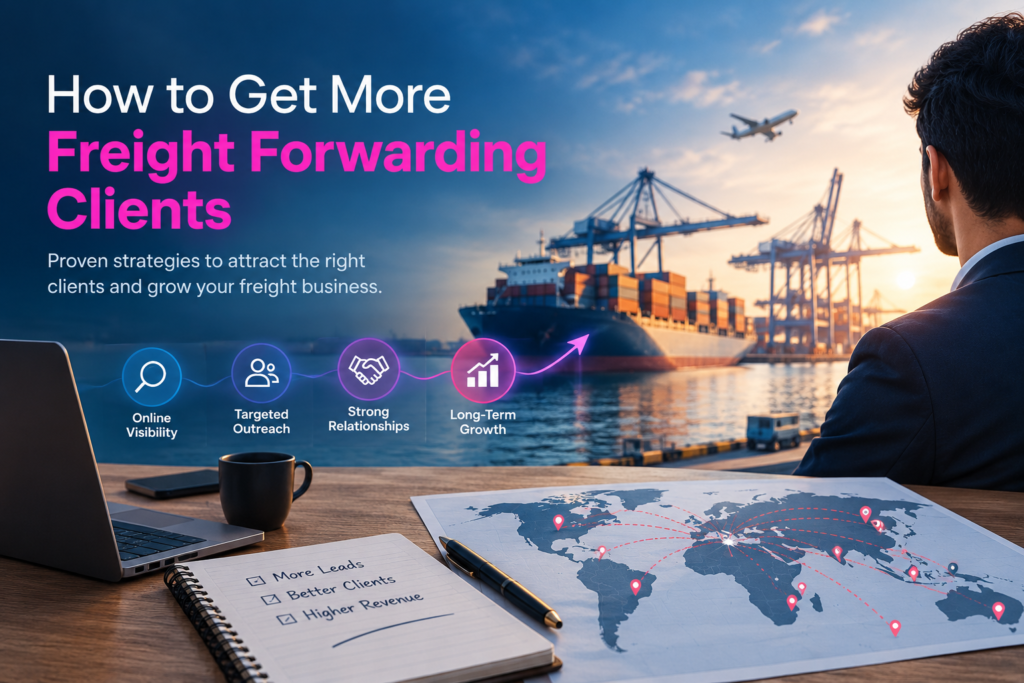
RouteRush / Freight forwarder growth
How to Get More Freight Forwarding Clients
Two freight forwarders operate three streets apart in the same city. One is turning away work, booked out weeks in advance. The other is chasing every lead that comes through the door and still has spare capacity most weeks. Their services are comparable. Their rates aren't wildly different. What separates them almost never comes down to who's better at moving cargo.
It comes down to whether new business is arriving through a deliberate, repeatable system — or whether it's arriving by accident, whenever a referral happens to land or a cold call happens to catch someone at the right moment.
Getting more freight forwarding clients isn't one tactic. It's a small set of channels working together, each solving a different part of the same problem. This guide covers what actually works, in plain terms, and what to prioritise first.
By RouteRush · Freight and logistics marketing
Updated
Editorial context: This guide covers marketing and business development strategies for freight forwarding companies. Examples are illustrative rather than client case studies, and results will vary by market, service mix and consistency of execution.
The direct answer
How do freight forwarders get more clients?
Freight forwarders get more clients through a combination of five things working together: being genuinely findable when a prospect searches online, building visibility through personal (not just company) social presence, actively asking existing clients for referrals rather than waiting for them, using paid advertising selectively for specific, time-sensitive opportunities, and converting the enquiries that already arrive by qualifying them properly and following up with a clear next step. Most freight forwarders are missing at least two or three of these, which is usually the real reason growth feels inconsistent.
1. Get found
SEO and a website that answers what a prospect actually needs to know before they call.
2. Be visible
Real people inside the business posting on LinkedIn, not just a quiet company page.
3. Ask for referrals
A deliberate process for turning satisfied clients into active introductions.
4. Use paid ads selectively
Targeted spend for specific, time-sensitive opportunities, not a blanket strategy.
5. Convert what arrives
Qualify enquiries properly and follow up with a clear next step, every time.
Is "get more leads" actually the right goal?
Not on its own. A freight forwarder can double their website traffic and LinkedIn followers and still not book a single additional shipment, because volume and quality are different problems with different fixes. More visitors who aren't a good fit for your services, or more enquiries that never get followed up properly, don't move revenue.
The more useful question is where in the process business is actually being lost — nobody finding you, people finding you but not trusting you enough to enquire, or enquiries arriving and then going nowhere. Each of the five channels below solves a different one of these, which is why picking just one rarely fixes the whole problem.
How do you get found when a prospect searches for a freight forwarder?
Most B2B buyers now research online before making a first call, even when the eventual decision comes down to a relationship or a referral. If your website doesn't clearly answer what services you offer, which trade lanes you cover, and what a prospect needs to provide for a quote, you're invisible at exactly the moment someone is deciding who to shortlist.
This means building service pages around specific, searchable needs — "sea freight from China," "customs clearance for a specific port," a named trade lane — rather than one vague "complete logistics solutions" page trying to cover everything at once. It also means making sure basic technical SEO is in order: fast load times, mobile-friendly pages, and clear, accurate business information that matches what appears in Google search results. RouteRush's broader digital marketing guide for freight forwarders covers this groundwork in more detail.
Does LinkedIn actually help freight forwarders win clients?
Yes, but mainly through personal profiles, not the company page alone. LinkedIn's algorithm distributes content from real people far more widely than content from brand pages, because the platform is built around personal networks rather than followings. A company page that posts consistently can still reach almost nobody beyond its existing followers, while a real person — the owner, someone in sales, someone in operations — posting about genuine shipment work reaches connections, and often their connections too.
What performs best isn't polished branding. It's specific, honest content: a shipment problem that was solved, an observation about rates or capacity on a particular lane, a lesson learned from a mistake. Two to three posts a week from one or two people is a realistic, sustainable starting point, and it typically takes a couple of months of consistency before the reach and enquiries become noticeable.
How do you get more referrals from existing freight clients?
Ask, directly and specifically — most satisfied clients simply never think to refer you on their own, not because they wouldn't, but because it doesn't occur to them and nobody has ever asked. A specific question tied to a challenge you've already solved for them — "is there anyone else you know dealing with a similar shipping issue to the one we sorted out for you?" — works far better than a generic "do you know anyone who needs a freight forwarder."
Referred prospects typically trust you faster and negotiate less than cold leads, and reaching them costs a fraction of what paid advertising or cold outreach does — which makes this one of the highest-return, most underused channels in the industry. It deserves the same deliberate process as any other lead source: a clear ask, an easy way to introduce someone, and tracking to see what's actually converting.
Where does paid advertising actually fit in?
Paid search and LinkedIn ads earn their cost in specific situations — reaching decision-makers at a defined list of target companies, promoting a time-sensitive service, or filling a capacity gap quickly — rather than as the default, ongoing way to generate all new business. Freight and logistics keywords tend to be expensive relative to other industries because the audience is professional and competition for visibility is real.
Treat paid spend as a targeted tool layered on top of organic search visibility and personal LinkedIn presence, not a replacement for either. A forwarder relying entirely on ads for new business is paying full price for every single enquiry, with none of the compounding value that organic content and referrals build over time.
Why do enquiries arrive but not turn into booked shipments?
This is where a lot of the value from the first four channels quietly leaks away. An enquiry that's answered slowly, quoted without a clear scope, or never followed up with a defined next step fails regardless of how well it was generated in the first place — the channel isn't the problem at that point, the process after the first message is.
RouteRush's article on how freight forwarders turn industry updates into leads covers converting content-driven interest into a genuine, quoted opportunity rather than letting it stay as a comment or a like. Every enquiry, regardless of source, needs the same basic discipline: understand what the prospect actually needs before quoting, make the quote's scope clear, and follow up with a specific next step rather than a vague "let us know if you have any questions."
How much should a freight forwarder spend on marketing?
There's no single figure that applies to every business, but a useful way to think about it is by channel rather than a flat percentage of revenue. Organic search and content require ongoing time more than large cash outlay. Personal LinkedIn posting costs almost nothing beyond an hour or two of team time each week. Referral programs cost little beyond the discipline of asking consistently. Paid advertising is the one channel with a direct, scalable cash cost, and it's the one worth budgeting most deliberately, tied to specific campaigns rather than an open-ended monthly spend.
A sensible starting posture for a smaller freight forwarder is investing time first — search visibility, LinkedIn, referrals — before committing meaningful ad budget, since the free and low-cost channels often produce a better return per hour invested than paid channels do per dollar spent, at least until the business has enough baseline visibility for paid ads to convert well.
How long does it take to see results?
Longer than most freight forwarders expect, and that mismatch is why many efforts get abandoned right before they'd have paid off. SEO improvements typically take a few months to show up in rankings. A new personal LinkedIn habit usually needs six to eight weeks of consistent posting before reach and enquiries become noticeable. Referral processes can produce results faster, sometimes within weeks, since the trust already exists — but only once you actually start asking.
Paid advertising is the exception, producing visible results almost immediately, which is part of why it's tempting to lean on it exclusively. The trade-off is that paid results stop the moment spending does, while the other channels compound and keep producing value well after the initial effort.
What should a freight forwarder actually do first?
Start with the channel that costs the least and has the clearest existing foundation. For most freight forwarders, that's referrals — pick your five best current clients and ask each one the specific-challenge question at your next natural point of contact. It costs nothing, and the trust required is already in place.
Run that in parallel with fixing how incoming enquiries are handled, since improving conversion on existing lead volume is usually faster than generating more leads from scratch. Once those two are running, layer in consistent LinkedIn posting from one or two people, then invest in search visibility as an ongoing foundation, and reserve paid advertising for specific, well-defined opportunities rather than as a default spend.
Frequently asked questions
What is the fastest way for a freight forwarder to get more clients?
Asking existing clients for referrals is usually the fastest, since the trust needed already exists. A specific, well-timed ask can produce results within weeks, while channels like SEO and LinkedIn typically take longer to compound.
Is LinkedIn or a website more important for getting freight forwarding clients?
Both matter, but they solve different problems. LinkedIn, especially personal posting, builds visibility and initial trust; the website is where a prospect verifies the business and finds enough detail to actually enquire. Neither replaces the other.
How much should a small freight forwarder spend on paid advertising?
There's no fixed figure, but a common approach is to prioritise low-cost channels like referrals, LinkedIn and search visibility first, and reserve paid spend for specific, time-sensitive opportunities rather than an open-ended monthly budget.
Why do freight forwarders get enquiries but not book more shipments?
Usually because of what happens after the enquiry arrives — slow responses, unclear quote scope, or no defined follow-up — rather than a problem with the channel that generated the enquiry in the first place.
How long does freight forwarder marketing take to show results?
SEO typically takes a few months, personal LinkedIn posting six to eight weeks of consistency, and referral programs sometimes just weeks. Paid advertising works fastest but stops producing results the moment spending stops.
Do referrals really work better than cold leads for freight forwarders?
Generally, yes. Referred prospects tend to trust the business faster and negotiate less than cold leads, and they cost far less time and marketing spend to reach than outreach to strangers.