
LinkedIn Outreach for Freight Forwarders in SA (2026)
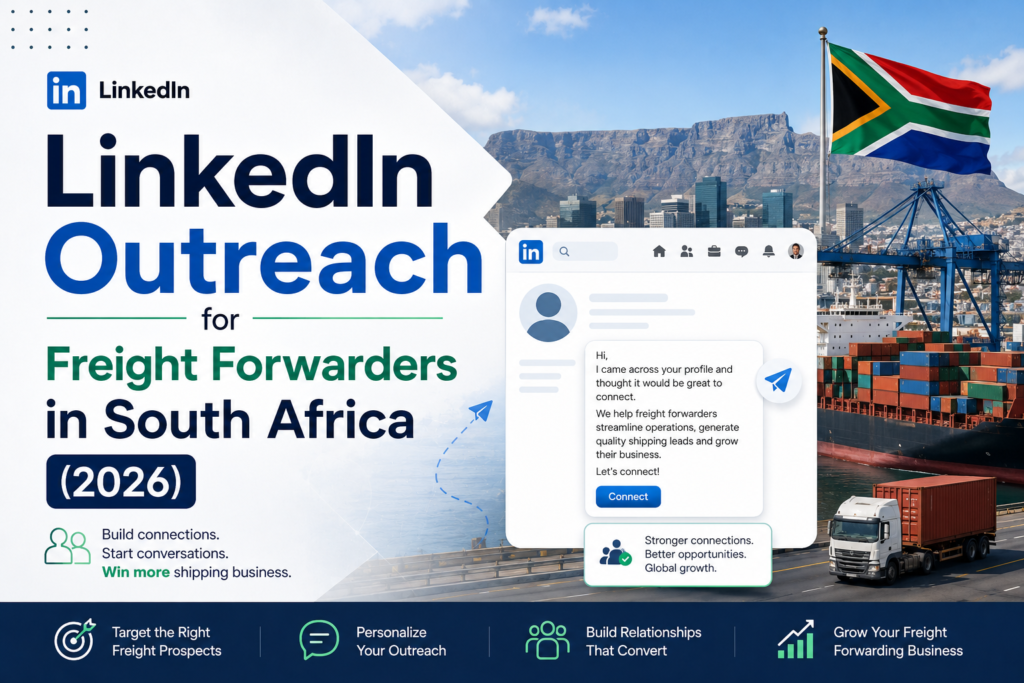
Freight Forwarding Marketing · LinkedIn Outreach
LinkedIn Outreach for Freight Forwarders in South Africa: What Actually Works in 2026
89% of prospects on LinkedIn now get 15+ connection requests a week. Generic outreach is drowning in noise — but the freight forwarders sending fewer, sharper messages are still booking meetings.
What's Covered In This Guide
- Why LinkedIn Outreach Matters for South African Freight Forwarders Right Now
- 7 Things That Actually Work on LinkedIn in 2026
- What's Quietly Killing Your Response Rate
- Where to Focus Outreach, Port by Port
- A Practical Weekly Roadmap
- Frequently Asked Questions
Why LinkedIn Outreach Matters for South African Freight Forwarders Right Now
South Africa's freight and logistics market is worth an estimated $15.55 billion in 2026 and is projected to reach $20.59 billion by 2031, growing at roughly 5.78% annually. Sea and inland waterways freight forwarding alone handled 71.56% of industry revenue in 2025, and the market is consolidating fast — DSV's $15.3 billion acquisition of DB Schenker and DP World's $3 billion African ports and logistics commitment through 2029 are reshaping who buyers are already talking to. That's a large, increasingly competitive market — and LinkedIn is where most South African logistics decision-makers, from procurement managers to supply chain directors, actually spend their professional attention.
But LinkedIn outreach in 2026 looks nothing like it did even two years ago. Nearly 90% of prospects now receive more than 15 connection requests a week, and connection-request reply rates have dropped 37% year-over-year as inboxes get noisier. The freight forwarders still generating real pipeline from LinkedIn aren't sending more messages — they're sending fewer, better-targeted ones.
7 Things That Actually Work on LinkedIn in 2026
A personalized note on every connection request. This is the single highest-leverage habit in outreach right now. Personalized connection requests convert at roughly 45-48%, compared to 15-26% for blank requests — nearly double, sometimes triple. For a freight forwarder, "personalized" doesn't need to be elaborate: referencing the prospect's specific trade lane, industry, or a recent company announcement is enough.
Warm-first sequencing, not cold blasts. Visiting a prospect's profile or engaging with a recent post before sending a request measurably improves acceptance. Sequences that combine a profile visit with a direct message have pushed reply rates as high as 11.87% in recent benchmarking, well above cold outreach alone.
Short messages over long pitches. Well-structured campaigns with tight targeting and short first messages regularly hit 14-17% reply rates — nearly double the platform average. A three-line message asking one clear question consistently outperforms a paragraph explaining your entire service offering.
Trigger-based outreach. Reaching out around a relevant event — a job change, a company expansion announcement, a post about port congestion or a new trade lane — boosts response rates by roughly 32% compared to outreach with no clear reason for the timing.
Connection requests before InMail, not instead of it. InMail open rates are strong (52-57%), but cost-per-reply runs around $47 versus close to nothing for an organic connection sequence. InMail earns its cost specifically when you're targeting a prospect with zero shared connections and a historically low acceptance rate — for most South African freight prospecting, a well-built connection sequence will outperform InMail on both cost and conversation quality.
Follow-ups spaced 2-5 business days apart. A single message rarely does the work. Sequenced, spaced follow-ups consistently outperform one-and-done outreach, without crossing into the kind of daily-ping behavior that gets flagged as spam.
Messaging built around the specific port, corridor, or cargo type the prospect actually cares about. A generic "we help freight forwarders grow" message reads as one of dozens a decision-maker received that week. A message referencing their specific corridor — Durban congestion workarounds, Richards Bay coal exports, Ngqura transshipment — reads as researched, not templated.
What's Quietly Killing Your Response Rate
- Generic templates. Roughly 72% of all LinkedIn outreach messages are still generic beyond the recipient's first name — and LinkedIn's spam-detection has gotten materially better at identifying and suppressing them.
- Over-volume. Sending too many requests too fast is the single fastest way to trigger LinkedIn's adaptive restriction algorithm — sustained acceptance rates below 25-30% can trigger automatic throttling on your account.
- Pitching in the first message. Asking for a call or pushing your services before any real exchange has happened is the most common reason a warm connection goes cold immediately after accepting.
- Ignoring day-of-week patterns. Response activity is measurably higher earlier in the week (Monday through Wednesday) and drops sharply on weekends — sending your best messages on a Saturday wastes your strongest content on your quietest audience.
Where to Focus Outreach, Port by Port
South Africa has 8 major commercial ports operated under Transnet National Ports Authority, each tied to distinct cargo profiles and buyer behavior. Outreach that references the right one lands very differently than generic South Africa-wide messaging.
Port of Durban, KwaZulu-Natal
Africa's busiest and largest container port, and the primary gateway for South Africa's import and export container trade. The highest concentration of freight forwarders in the country operates here, and ongoing congestion challenges make outreach referencing real operational pain points (dwell times, alternative routing) land far better than generic pitches.
Port of Cape Town, Western Cape
South Africa's second-busiest container port and a critical hub for the fruit export season, alongside general cargo and cruise traffic. Decision-makers here are often seasonally driven — outreach timed around harvest and export peaks tends to outperform outreach sent at random points in the year.
Port of Ngqura (Coega), Eastern Cape
South Africa's newest and deepest terminal, purpose-built as a transshipment hub and linked to the Coega Industrial Development Zone. A growing, less saturated forwarder base compared to Durban — an opportunity for well-personalized outreach to capture disproportionate share before competition catches up.
Port Elizabeth (Gqeberha), Eastern Cape
A long-established multi-cargo and container port serving the automotive manufacturing cluster in the Eastern Cape. Buyers here respond well to messaging that speaks directly to automotive and component logistics rather than generic container-shipping language.
Richards Bay, KwaZulu-Natal
The largest bulk export port in Africa by volume, handling the majority share of South Africa's cargo tonnage, dominated by coal exports. A highly specialized, bulk-commodity buyer base — generic container-freight messaging will miss almost entirely here.
Saldanha Bay, Western Cape
South Africa's largest and deepest natural harbour, central to iron ore exports and offshore oil and gas activity. A smaller, more technical buyer segment where precise, specialized outreach outperforms broad campaigns.
East London, Eastern Cape
South Africa's only river port, specializing heavily in automotive exports at the mouth of the Buffalo River. A distinct niche audience — outreach referencing automotive supply chains and export timelines resonates far more than generic freight messaging.
Mossel Bay, Western Cape
A smaller port supporting offshore oil operations, with an LNG import terminal. A narrow, highly technical buyer base where outreach volume should stay low and precisely targeted rather than broad.
A Practical Weekly Roadmap
| Timeframe | Action |
|---|---|
| Week 1 | Build a tight ICP list segmented by port and cargo specialization, not just job title |
| Week 1 | Write 3-4 short message variants (under 4 lines) referencing specific ports or corridors |
| Week 2 | Start warm-first sequencing: profile visit or post engagement before connecting |
| Week 2 | Send personalized connection notes only — no blank requests |
| Weeks 3-4 | Layer in trigger-based outreach (job changes, expansions, relevant posts) |
| Weeks 3-4 | Add spaced follow-ups (2-5 business days) for non-responders |
| Month 2 | Review acceptance and reply rates by port segment; double down on what's converting |
Frequently Asked Questions
Is LinkedIn outreach still worth it for freight forwarders in South Africa, given declining reply rates?
Yes, directionally — platform-wide averages have compressed, but well-targeted, personalized campaigns are still hitting reply rates of 25-35%, multiple times the platform average. With consolidation reshaping the competitive landscape (DSV-DB Schenker, DP World's expansion), personalized outreach that shows real market awareness stands out more, not less.
Should we use InMail or regular connection requests?
For most South African freight prospecting, connection requests first. InMail's higher open rate comes at a real cost (roughly $47 per reply versus near-zero for organic sequences) and is best reserved for high-value, technical-buyer segments like bulk commodities or offshore energy where the total addressable list is small.
How many connection requests can we safely send per week?
Most accounts can safely send 80-100 requests per week. Accounts with strong acceptance rates and Social Selling Index scores can push higher, but sustained acceptance rates below 25-30% risk automatic throttling — quality of targeting matters more than raw volume.
What should the first message actually say?
Keep it short — three or four lines, referencing something specific to the prospect (their port, cargo type, recent company news) and ending with a low-friction question, not a pitch or a meeting request. Save the service pitch for after a real exchange has started.
How long before LinkedIn outreach starts producing real pipeline?
Most well-structured campaigns show measurable pipeline signal within 4-6 weeks, though the strongest results typically come from segment-by-segment refinement over 2-3 months as you learn which ports and cargo types respond best to which messaging.
Get Started
Ready to Build LinkedIn Outreach That Actually Converts?
We'll build your ICP list by port and cargo specialization, write outreach sequences that reference real trade corridors instead of generic pitches, and track acceptance and reply rates so you know exactly what's working.
Request Your Free LinkedIn Outreach AuditRelated reading
- LinkedIn Outreach for Freight Forwarders in UAE: What Actually Works in 2026
- LinkedIn Outreach for Freight Forwarders in Oman: What Actually Works in 2026
- Why Your Freight Forwarding Website Isn't Converting (Even With Traffic)
Anshul Kuntewar
Founder, RouteRush Digital Marketing Agency — a freight forwarding marketing agency specialising in LinkedIn outreach, SEO, and lead generation for freight and logistics companies across South Africa, the UAE, Oman, India, Qatar, Australia, and the UK. Connect on LinkedIn →
This guide reflects LinkedIn outreach benchmark and South African freight market data current as of mid-2026. Platform algorithms and response patterns change frequently — treat these figures as directional benchmarks, not guarantees.