
NDIS Provider Marketing: The Complete Resource
NDIS Marketing · Resource Hub
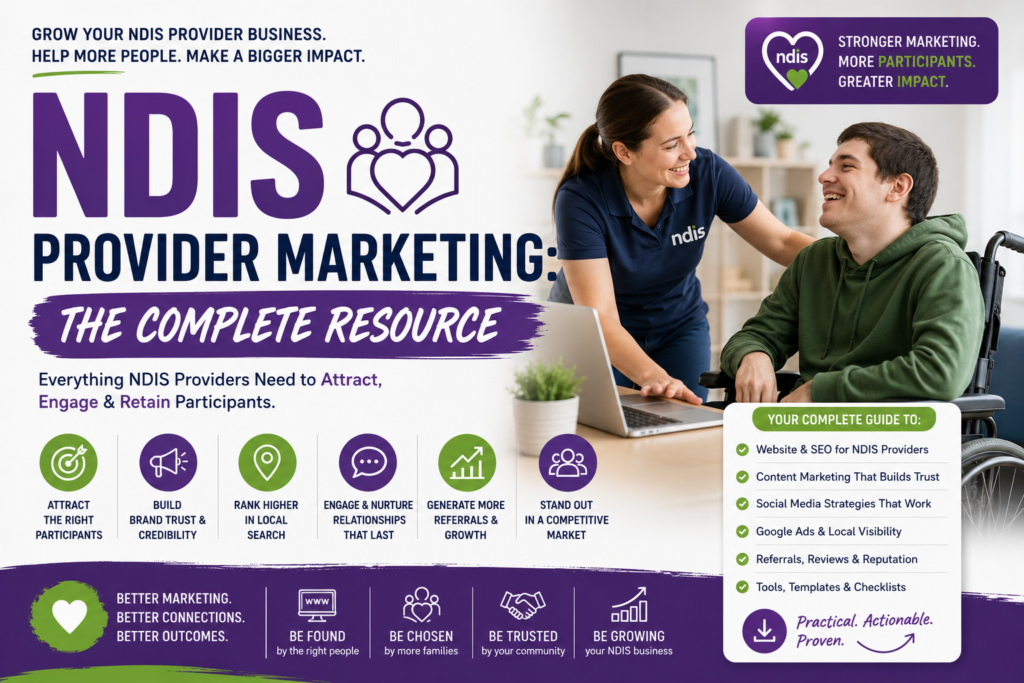
NDIS Provider Marketing: The Complete Resource
More than 774,000 Australians are currently benefiting from the NDIS, supported by a provider market that has grown past 21,000 registered organisations. As of July 2026, mandatory registration has taken effect for SIL and platform providers specifically — one part of a broader shift toward tighter scrutiny and higher expectations across the sector.
Families increasingly compare several providers in a single sitting rather than choosing the first one they find, and support coordinators — who are involved in choosing providers for roughly 45% of active participants — are operating under intensifying conflict-of-interest requirements that shape how, and how often, they can recommend anyone. None of this is solved by a single tactic. Effective NDIS provider marketing sits at the intersection of four distinct problems: being findable online, converting that visibility into enquiries, building referral relationships that don't depend on cold outreach, and earning the specific, compliant trust of support coordinators. Each has its own dedicated guide below.
01 · Getting Found Online
Before a family or coordinator can choose you, they have to find you — and most NDIS provider websites are quietly invisible to the exact searches that would bring in qualified enquiries. Fix the basics most providers skip: named registration groups, local pages for the areas you genuinely serve, and a complete, current Google Business Profile.
NDIS Provider Website Checklist02 · Turning Visitors Into Enquiries
Getting found is only half the problem — plenty of provider websites get traffic and still don't convert, because the copy doesn't answer a visitor's real, practical questions. Warm language ("compassionate, person-centred care") reads as identical to every competitor's site. What converts is specific: registration groups, a real capacity statement, and a trust bar built from checkable facts.
What an NDIS Homepage Should Actually Say03 · Building Referral Pipelines Without Cold Calling
Referrals convert at several times the rate of cold outreach, but most providers leave this to chance. Roughly 83% of satisfied families are willing to refer a provider they've had a good experience with — but only around 29% actually do it without being asked.
Get More Referrals Without Cold Calling04 · Winning Support Coordinator Trust, Compliantly
Support coordinators operate under a genuinely different set of rules — legally required to present unbiased options, not steer participants toward any single provider. With conflict-of-interest enforcement tightening and the sector shifting toward a new "Navigator" role, this relationship is changing faster than most providers realize.
Get Support Coordinators to Recommend YouA Practical Starting Order
If you're not sure where to begin, this is the order that tends to compound best:
Every other channel eventually sends traffic back to this page, so it needs to hold up. See the website checklist.
Once the structure is right, make sure the words answer a visitor's real questions. See the homepage copy guide.
Start asking satisfied families directly and building genuine allied health relationships. See the referrals guide.
The slowest-building but most durable channel — worth starting even while the others are in progress. See the support coordinator guide.
None of these are strictly sequential — but if resources are limited, this is the order that generally produces the fastest compounding return.
Frequently Asked Questions
How much should an NDIS provider actually spend on marketing?
There's no universal figure, but most providers get further starting with the free or low-cost fixes — website copy, Google Business Profile completeness, and direct outreach to coordinators — before investing in paid advertising. Get the fundamentals right first; they make every dollar spent afterward more effective.
Is SEO or referrals more important for an NDIS provider?
They serve different purposes and both matter. SEO and website work capture the demand that's already searching for a provider like you; referrals and coordinator relationships generate demand you'd otherwise never see through search at all. A provider relying on only one is leaving a substantial part of the market unaddressed.
Do we need to hire a marketing agency, or can we do this ourselves?
Much of what's covered across these guides — website copy, Google Business Profile updates, direct coordinator outreach — can be done internally with time and consistency rather than a large budget. An agency becomes more valuable when you want this done faster, more thoroughly, or alongside other operational priorities you don't have spare capacity for.
How is NDIS provider marketing different from marketing any other local service business?
The core difference is trust and verification. A family or coordinator choosing a disability support provider is making a decision with real consequences for someone vulnerable, and they actively look for checkable facts — registration status, reviews, specific service areas — rather than responding to persuasive copy the way a more casual consumer purchase might invite.
What's the single biggest mistake NDIS providers make with their marketing?
Treating warmth and good intentions as a substitute for specificity. "We're passionate about person-centred care" is true of nearly every provider and differentiates none of them — the providers that convert well replace that language with checkable, specific facts about what they do, where, and how fast they respond.
Ready to Build Your Full NDIS Marketing Strategy?
We'll audit where your website, referral relationships, and coordinator strategy currently stand, and build a prioritized plan across all four areas.
Request Your Free NDIS Marketing AuditAnshul Kuntewar
Founder, RouteRush Digital Marketing Agency — working with NDIS providers across Australia on website strategy, SEO, and referral-growth systems that turn existing relationships and online visibility into a reliable, compliant source of new participants.
This guide reflects NDIS market and provider data current as of mid-2026. Links throughout point to RouteRush's dedicated guides on each specific topic, updated as sector requirements change.